Category Archives: Research

Research – Dynamic model to describe kinetic behavior of Listeria monocytogenes in smoked salmon

Wiley Online

In this study, the dynamic model was developed to describe cell counts of Listeria monocytogenes in smoked salmon under distribution conditions. A 9-strain mixture of L. monocytogenes was inoculated in smoked salmon at 3–4 Log CFU/g. The inoculated samples were stored at 4°C, 10°C, and 20°C for up to 16 days, and the bacterial cell counts were enumerated on PALCAM agar. The Baranyi model was fitted to the L. monocytogenes cell counts to calculate the lag phase duration (LPD; hr) and maximum growth rate (μmax; Log CFU/g/hr). LPD was 74.22 hr at 4°C, and the value was rapidly decreased to 4.84 hr at 20°C as temperature increased. μmax ranged from 0.01 to 0.13 Log CFU/g/hr, depending on the storage temperature. The kinetic parameters were fitted with secondary models as a function of temperature. Cell counts predicted by the developed model were compared with the predicted cell counts obtained at 8°C and 15°C, and the differences between predicted and observed cell counts were indicated by root mean square error (RMSE). The dynamic model was then developed with the kinetic parameters derived from the secondary model and simulated the L. monocytogenes growth. RMSE (0.368) indicates that the model performance was appropriate. These results suggest that the developed kinetic models can be useful in predicting the fates of L. monocytogenes in smoked salmon under the dynamic conditions of storage temperature and time.

Research – Is Fresh Produce in Tigray, Ethiopia a Potential Transmission Vehicle for Cryptosporidium and Giardia?

MDPI

CDC Giardia2

In rural Ethiopia, where people often share their homes with their livestock, infections of humans and animals with Cryptosporidium and Giardia are relatively common. One possible transmission route is consumption of contaminated fresh produce; this study investigated the occurrence of Cryptosporidium and Giardia in fresh produce in four districts of rural Tigray in Ethiopia. Fresh produce samples (n = 55) were analysed using standard laboratory procedures. Overall, 15% (8/55) of samples were found to be contaminated. Although contamination levels were mostly low, a few samples had high numbers of Giardia cysts (up to around 70 cysts per 30 g sample). Molecular analyses were largely unsuccessful, but Giardia Assemblage A was identified in one sample. Contamination with these parasites was identified in two of the four districts, but, although a similar pattern has already been described for water contamination, this may be at least partially explained by sampling bias. Nevertheless, we speculate that access to clean water sources may be an important factor for reducing the occurrence of these pathogens. Given the public health and veterinary burden associated with both parasites, the factors which are of importance for their circulation in the communities and environments deserve further investigation. View Full-Text

Research – Antimicrobial activity and mechanism of limonene against Staphylococcus aureus

Wiley Online

Staph

In this study, inhibitory effect of limonene on Staphylococcus aureus (S. aureus) and its antibacterial mechanism was explored, respectively. The results showed that limonene effectively inhibited bacterial growth at a minimum inhibitory concentration (MIC) of 20 ml/L. Scanning electron microscopy (SEM), the reduction of AKP activity and fluorescence microscope observation confirmed that limonene caused the destruction of the cell morphology and cell wall integrity of S. aureus. The reduction of MFI in fluorescein diacetate staining experiment and leakage of biological macromolecules (nucleic acids and proteins) indicated that limonene damaged the cell membrane and increased membrane permeability. Besides, the reduction of membrane potential (MP) further confirmed that the damage to membrane and the reduction of respiratory metabolic activity. Furthermore, the respiratory depression test confirmed that the pathway of limonene affecting the respiratory metabolism of S. aureus is TCA pathway, followed by EMP. In addition, the disorder of succinate dehydrogenase (SDH), malate dehydrogenase (MDH), pyruvate kinase (PK), ATPase (T-ATPase, Na+-K+-ATPase, Ca2+-Mg2+-ATPase), and ATP concentration demonstrated that limonene could result in a slowdown of metabolism and metabolic dysfunction, thus inhibiting ATP synthesis.

Research- Michigan Restaurant at Center of 11-Year Salmonella Outbreak

Med Page Today

Salmonellaa

While most outbreaks of foodborne illness peak and recede, one southern Michigan restaurant struggled with an intermittent Salmonella outbreak for more than a decade.

From September 2008 to July 2019, there were 35 primary cases and one secondary case of Salmonella Mbandaka ultimately traced to the restaurant by the local public health department, William Nettleton, MD, medical director of the Kalamazoo County Health and Community Services Department, and colleagues reported in the August 20 issue of Morbidity and Mortality Weekly Report.

The unusual persistence of the outbreak was due to a complex interplay between the restaurant environment and asymptomatic food workers, Nettleton told MedPage Today.

“It was very challenging to identify the source of the outbreak,” he said in an interview. “Typically with Salmonella or other types of enteropathogens, there’s a foodborne vehicle. People get sick over a period of days to weeks, and once the source is eliminated, people stop getting sick. You get the traditional bell curve.”

“This was different,” he said. “The sporadic incidence made it very challenging.”

The restaurant initially made it on the county health department’s radar in 2012, when the Michigan Department of Health and Human Services sounded an alarm about Salmonella Mbandaka cases occurring intermittently in the county since 2008.

Kalamazoo health officials at the time launched a hypothesis-generating questionnaire, and by 2014 they’d homed their sights on the restaurant in question, after five known cases reported a meal there.

Research – Nanoemulsified carvacrol as a novel washing treatment reduces Escherichia coli O157:H7 on spinach and lettuce

Journal of Food Protection

Fresh produce continues to be the main source of foodborne illness outbreaks in the United States implicating bacterial pathogens such as Escherichia coli O157:H7 (EHEC). The efficacy of nanoemulsified carvacrol (NCR) as a washing treatment in reducing EHEC on fresh produce was investigated. Fresh baby spinach, Romaine lettuce, and Iceberg lettuce leaves (2.5 cm diameter cores) were spot-inoculated with a five-strain cocktail of nalidixic acid resistant EHEC at ~ 6 log CFU/cm 2 . After air-drying for 1 h, 20 pieces of each inoculated produce leaves were immersed in water-based treatment solutions (200 ml/group), including water alone, 25 or 50 ppm free chlorine, and 0.25% or 0.75% NCR for 2 minutes. Inoculated produce leaves without any treatment served as baseline. Produce leaves were stored at 10°C and surviving EHEC populations were enumerated on days 0, 2, 7 and 14. The viability of EHEC following NCR treatments on the fresh produce was visualized under fluorescence microscope. NCR treatment at 0.75% immediately reduced EHEC populations on Iceberg lettuce by 1.3 log CFU/cm 2 as compared to the produce treated with water alone (P<0.05). Antimicrobial activity of NCR against EHEC was comparable to chlorine treatments on day 0 for all produce (P>0.05). After 14-days of storage at 10°C, populations of EHEC on 0.75% NCR treated Romaine lettuce were reduced by 2.3 log CFU/cm 2 as compared to the recovery from 50 ppm chlorine treated samples (P<0.05). Microscopic images revealed that EHEC cells were observed to be clustered on the baseline samples, indicating the development of cell aggregation, as compared to the scattered cells seen on NCR-treated leaf surfaces. Treatments with NCR did not significantly affect the color on the fresh produce leaves during the 14 days of storage at 10°C. Results of this study support the potential use of NCR as a water soluble natural antimicrobial wash treatment for controlling EHEC on fresh produce.

Research – Efficacy and Quality Attributes of Antimicrobial Agents Application via a Commercial Electrostatic Spray Cabinet to Inactivate Salmonella on Chicken Thigh Meat

Journal of Food Protection

Salmonella is a foodborne pathogen associated with poultry meat. This study aimed to determine the efficiency and quality attributes of two antimicrobial agents to reduce Salmonella on raw chicken meat when applied individually and in combination using an electrostatic spray cabinet. Five logs CFU/g of non-pathogenic, rifampicin-resistant Salmonella Typhimurium were inoculated on skin less, bone less, raw chicken thigh meat and passed through an electrostatic spray cabinet while being sprayed with 5% lauric arginate (LAE), and 100, 1000, 1500, 1750 ppm of peracetic acid (PAA). Spraying of 5% LAE for 45 s, significantly reduced Salmonella by 5 logs (p<0.05). The 1500 ppm of PAA reduced Salmonella significantly within 45 s (1.157 logs). Spraying of 1500 ppm PAA followed by LAE within 15 s reduced Salmonella significantly more than vice versa (p<0.05). The color, water holding capacity, and texture did not differ significantly, but resulted in a significantly strong aroma and flavor. Both LAE and PAA efficiently reduced Salmonella when applied in an electrostatic spray cabinet on raw chicken thigh meat. The results suggest that the sequential order of application of antimicrobial agents is important to improve the safety and quality of raw chicken thigh meat.

Research – Thermosonication Combined with Natural Antimicrobial Nisin: A Potential Technique Ensuring Microbiological Safety and Improving the Quality Parameters of Orange Juice

MDPI

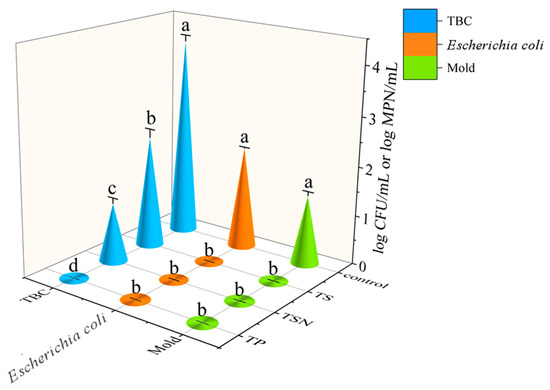
Currently, thermal pasteurisation (TP) remains the most widely applied technique for commercial orange juice preservation; however, a high temperature causes adverse effects on the quality attributes of orange juice. In order to explore a novel non-thermal sterilization method for orange juice, the impacts of thermosonication combined with nisin (TSN) and TP treatments on the quality attributes including microbial and enzyme inactivation and the physicochemical, nutritional, functional, and sensory qualities of orange juice were studied. Both TP and TSN treatments achieved desirable bactericidal and enzyme inactivation effects, and nisin had a significant synergistic lethal effect on aerobic bacteria in orange juice (p < 0.05). Additionally, TSN treatment significantly improved the color attributes of orange juice and well maintained its physicochemical properties and sensory quality. More importantly, TSN treatment significantly increased the total polyphenols content (TPC) and total carotenoids (TC) by 10.03% and 20.10%, increased the ORAC and DPPH by 51.10% and 10.58%, and the contents of total flavonoids and ascorbic acid were largely retained. Correlation analysis of antioxidant activity showed that the ORAC and scavenging ability of DPPH radicals of orange juice are mainly attributed to TC and TPC. These findings indicate that TSN shows great potential application value, which could guarantee the microbiological safety and improve the quality attributes of orange juice. View Full-Text

▼ Show Figures

Research – Mycotoxins in aquaculture: A mitigation approach in turbot

All About Feed

Aquaculture is the fastest-growing food production industry in the world. Due to concerns about sustainability, the need to replace fish meal with plant-based protein alternatives becomes more urgent. However, plant-based ingredients are often contaminated with mycotoxins, increasing the health risks to fish.

Plant-based ingredients in commercial fish diets include maize, soybean meal and various cereal grains, each representing a potential source of mycotoxins.

Mycotoxins in fish feed a widespread problem

Mycotoxin-contaminated fish feed is a widespread problem, especially in tropical regions and developing countries where the farmers themselves often make fish feeds under inappropriate conditions with improper milling and/or storage. In addition to their impact on fish health, some mycotoxins can also accumulate in fish tissue, thereby posing a possible food safety risk.

About mycotoxins in aquaculture

According to a recent risk assessment study on mycotoxin contamination in fish feeds in Europe, deoxynivalenol (DON) is one of the primary mycotoxins present. DON is produced by over 50 species of Fusarium fungi, which mainly infect crops such as wheat and maize before harvest. Fusarium fungi produce a range of mycotoxins, such as fumonisins, the trichothecenes — most strongly associated with chronic and fatal toxic effects in animals and humans — and zearalenone, which is known to affect the fertility of many animal species, including aquatic species such as fish and shrimp.

The impact of mycotoxins depends on several factors including:

  • The type and quantity of mycotoxins in the feed,
  • Feeding level,
  • Duration of exposure
  • The species of fish

Most common issues include:

  • Reduced growth performance,
  • Immune suppression
  • Increased mortality

These are often associated with other on-farm concerns, so the mycotoxin risk is currently underestimated.


Ireland – Legionnaires’ disease

HSE

CDC legionella

Legionnaires’ disease is a lung infection you can catch by inhaling droplets of water from things like air conditioning or hot tubs. It’s uncommon but can be very serious.

How you get Legionnaires’ disease

You can catch Legionnaires’ disease if you breathe in tiny droplets of water containing bacteria that cause the infection.

It’s usually caught in places like hotels, hospitals or offices where the bacteria have got into the water supply. It’s very rare to catch it at home.

You can catch it from things like:

  • air conditioning systems
  • spa pools and hot tubs
  • showers, taps and toilets

You cannot usually get it from:

  • drinking water containing the bacteria
  • other people with the infection
  • places like ponds, lakes and rivers

When to get medical help

Urgent advice:Get advice from your GP now if

you have a bad cough and:

  • it does not go away
  • you cannot breathe properly
  • you have severe chest pain
  • you have a high temperature or feel hot and shivery
  • you feel like you have severe flu

These could be symptoms of Legionnaires’ disease.

You should contact your GP and tell them where you have been in the past 10 days, such as if you stayed in a hotel, spa or hospital. Your GP will assess and advise you.

If you are unable to contact a GP and you are very unwell, you may need to go to your emergency department (ED).

Research – Fate of Salmonella Typhimurium and Listeria monocytogenes on Whole Papaya during Storage and Antimicrobial Efficiency of Aqueous Chlorine Dioxide Generated with HCl, Malic Acid or Lactic Acid on Whole Papaya

MDPI

Papaya-associated foodborne illness outbreaks have been frequently reported worldwide. The goal of this study was to evaluate the behavior of Salmonella Typhimurium and Listeria monocytogenes on whole papaya during storage and sanitizing process. Fresh green papayas were inoculated with approximately 7 log CFU of S. Typhimurium and L. monocytogenes and stored at 21 or 7 °C for 14 days. Bacteria counts were determined on day 0, 1, 7, 10 and 14. Fresh green papayas inoculated with approximately 8 log CFU of the bacteria were treated for 5 min with 2.5, 5 and 10 ppm aqueous chlorine dioxide (ClO2). The ClO2 solutions were generated by mixing sodium chlorite with an acid, which was HCl, lactic acid or malic acid. The detection limit of the enumeration method was 2.40 log CFU per papaya. At the end of storage period, S. Typhimurium and L. monocytogenes grew by 1.88 and 1.24 log CFU on papayas at 21 °C, respectively. Both bacteria maintained their initial population at inoculation on papayas stored at 7 °C. Higher concentrations of ClO2 reduced more bacteria on papaya. 10 ppm ClO2, regardless the acid used to generate the solutions, inactivated S. Typhimurium to undetectable level on papaya. 10 ppm ClO2 generated with HCl, lactic acid and malic acid reduced L. monocytogenes by 4.40, 6.54 and 8.04 log CFU on papaya, respectively. Overall, ClO2 generated with malic acid showed significantly higher bacterial reduction than ClO2 generated with HCl or lactic acid. These results indicate there is a risk of survival and growth for S. Typhimurium and L. monocytogenes on papaya at commercial storage conditions. Aqueous ClO2 generated with malic acid shows effectiveness in inactivating the pathogenic bacteria on papaya. View Full-Text