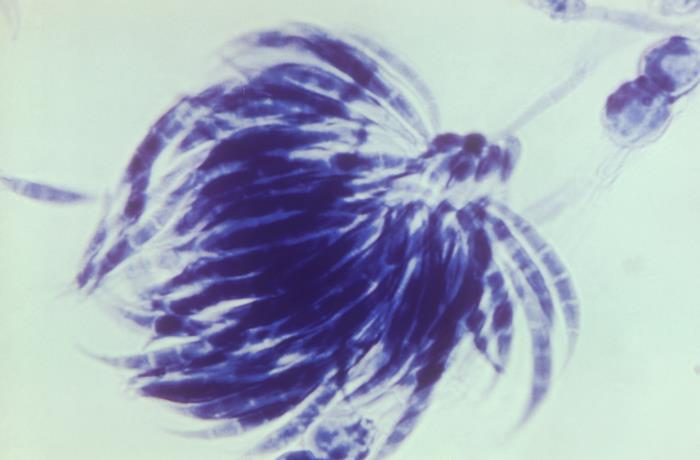
Category Archives: Mold Toxin

Denmark – Risk of mold in wheat buns with vanilla cream

DVFA

Pågen A / S is recalling Pågen Vanillas, as mold has been found in the product following a number of consumer inquiries.

Recalled Foods , Published: June 15, 2021

What foods:
Pågen Vanilla (see picture  here )
Net Contents: 220g
Expiry date: 29.06.2021-07.07.2021
EAN number: 7311070006230

Sold at:
The product is sold in grocery stores throughout the country.

Company recalling:
Pågen A / S

Reason:
After receiving a number of consumer inquiries, the company has established that there is a risk of mold in the products with the mentioned expiry dates.

Risk:
Mold formation makes the product unfit for human consumption.

Advice for consumers: The Danish
Veterinary and Food Administration advises consumers to deliver the product back to the store where it was purchased or to discard it.

Research – MYCOBIOTA ISOLATION AND AFLATOXIN B1 CONTAMINATION IN FRESH AND STORED SESAME SEEDS FROM RAINFED AND IRRIGATED ZONES OF PUNJAB, PAKISTAN

Study was carried out to evaluate the incidence of mycobiota and contamination of AFB 1  in sesame seeds from rainfed and irrigated zones of the Punjab, Pakistan. For this purpose, 100 sesame seed samples were collected directly from the fields of major sesame-producing areas of the rainfed and irrigated zone. Samples were subjected to the Agar Plate Method for the isolation of mycobiota and thin-layer chromatography for AFB 1 contaminations. Then, seed samples were stored for 12 months. After 12 months, the seeds were again analyzed for mycobiota and AFB 1 contaminations for comparison. The result of the present study revealed that all samples were reported positive for fungal growth in fresh and stored conditions. Twenty-one fungal species belonging to ten different fungal genera were isolated. Aspergillus flavus was the leading contaminant found in fresh and stored sesame seeds from rainfed and irrigated zone followed by A. niger, Alternaria alternata and Fusarium oxysporum . Least reported fungi were Aspergillus ochraceus and Cladosporium oxysporum.  AFB 1 analysis revealed that 92% fresh and 99% stored samples were contaminated with AFB 1 . In the rainfed zone, 88% fresh and 100% stored samples were contaminated with AFB 1 with a mean concentration of 15.74ppb and 33.8ppb, respectively. Similarly, in the irrigated zone, 96% fresh and 98% stored samples were contaminated with AFB 1 with a mean concentration of 20.5ppb and 27.56ppb, respectively. 20% fresh and 100% stored samples from rainfed zone and 28% fresh and 60% stored samples from irrigated zone were tainted with AFB 1 levels above 20 ppb, not fit for human consumption as per maximum limit (20ppb) assigned by FDA and FAO. This is the first-ever report of mycobiota and AFB 1 contamination in sesame seeds from rainfed and irrigated zones of the Punjab, Pakistan. This baseline data will be considered as an initial step to tackle this significant problem.

RASFF Alerts – Aflatoxin – Shelled Groundnuts – Pistachios Kernels

RASFF

Aflatoxin in groundnuts shelled from Brazil in Bulgaria

RASFF

Aflatoxins in Bolivian groundnuts in the Netherlands

RASFF

AFLATOXINS IN PISTACHIOS KERNELS FROM IRAN in Italy


Research -Center for Foodborne Illness Research and Prevention – Impact reReport

Click to access 2019-2020%20CFI%20Impact%20Report.pdf

Research – Mycotoxins Affecting Animals, Foods, Humans, and Plants: Types, Occurrence, Toxicities, Action Mechanisms, Prevention, and Detoxification Strategies—A Revisit

MDPI

CDC Fusarium1

Mycotoxins are produced by fungi and are known to be toxic to humans and animals. Common mycotoxins include aflatoxins, ochratoxins, zearalenone, patulin, sterigmatocystin, citrinin, ergot alkaloids, deoxynivalenol, fumonisins, trichothecenes, Alternaria toxins, tremorgenic mycotoxins, fusarins, 3-nitropropionic acid, cyclochlorotine, sporidesmin, etc. These mycotoxins can pose several health risks to both animals and humans, including death. As several mycotoxins simultaneously occur in nature, especially in foods and feeds, the detoxification and/or total removal of mycotoxins remains challenging. Moreover, given that the volume of scientific literature regarding mycotoxins is steadily on the rise, there is need for continuous synthesis of the body of knowledge. To supplement existing information, knowledge of mycotoxins affecting animals, foods, humans, and plants, with more focus on types, toxicity, and prevention measures, including strategies employed in detoxification and removal, were revisited in this work. Our synthesis revealed that mycotoxin decontamination, control, and detoxification strategies cut across pre-and post-harvest preventive measures. In particular, pre-harvest measures can include good agricultural practices, fertilization/irrigation, crop rotation, using resistant varieties of crops, avoiding insect damage, early harvesting, maintaining adequate humidity, and removing debris from the preceding harvests. On the other hand, post-harvest measures can include processing, chemical, biological, and physical measures. Additionally, chemical-based methods and other emerging strategies for mycotoxin detoxification can involve the usage of chitosan, ozone, nanoparticles, and plant extracts. View Full-Text

RASFF Alert – Ochratoxin A – Organic Rye Flakes

RASFF

OCHRATOXIN A IN ORGANIC RYE FLAKES FROM SPAIN in Spain and Portugal

RASFF Alerts – Aflatoxin – Piatchios – Organic Groundnuts – Organic Sesame Seeds – Watermelon Seeds with Saffron

RASFF

Pistachios total aflatoxins and B1 above legal limit from Iran in Spain

RASFF

Aflatoxins (B1 = 4.0; Tot. = 4.3 µg/kg – ppb) in organic groundnuts from China in the Netherlands

RASFF

Too much Aflatoxin B1 (11,7 µg/kg) in Organic Sesame seeds from Pakistan in Finland

RASFF

Aflatoxins in watermelon seeds with saffron from Iran in Germany

RASFF Alert – Animal Feed – Mould – Sunflower Meal

RASFF

Mould in sunflower meal from Ukraine in Poland

France- Product recall: CARREFOUR brand basmati rice – Aflatoxin B1

Oulah

Product recall: CARREFOUR brand basmati rice

ENCOUNTERED PROBLEM

Presence of aflatoxins B1

PROPOSED SOLUTION

Do not consume and return to the point of sale for reimbursement.

FURTHER INFORMATION

▸ Names of models or references
RIZ BASMATI CARREFOUR – 1kg bag


▸ Barcode
3560070837984


▸ Lot
L HH: MM


▸ DLC – DDM
02/05/2023


▸ Packaging
1kg bag


▸ Start date / End of marketing
From 02/09/2021 to 04/19/2021


Carrefour distributors


▸ Consumer service contact
For any further information, you can contact the Carrefour consumer service by dialing N ° Cristal 09 69 39 7000 – non-surcharged call from Monday to Saturday from 9 am to 7 pm.


▸ Source
CARREFOUR FRANCE

RASFF Alert – Ergot Alkaloids – Wholemeal Spelt Pasta

RASFF

Ergot (Claviceps purpurea) alkaloids in wholemeal spelt pasta from unknown origin, via Germany