Category Archives: Microbiology

France – Blown Cans – Terrine de Canard BIO – Microbiological Risk

Gov france


Identifying information for the recalled product

  • Product category Food
  • Product sub-category Meats
  • Product brand name PAPILLON house
  • Names of models or references 8201
  • Product identification
    GTIN Lot Dated
    3306111017522 300321A Date of minimum durability 03/30/2025
  • Packaging Preserves
  • Start date / End of marketing From 04/30/2021 to 07/02/2021
  • Storage temperature Product to be stored at room temperature
  • Health markFR12.063.026CE
  • Geographical sales area Whole France
  • Distributors GREEN RELAY

Practical information regarding the recall

  • Reason for recall UNSTABLE CANNED WITH BOMBED LID – ODOR ON OPENING
  • Risks incurred by the consumer Other biological contaminants
  • Consumer behavior Stop consuming
    Return the product to the point of sale
  • Contact number0614564269
  • Compensation modalities Exchange
  • End date of the recall procedure Sunday 30 March 2025

https://rappel.conso.gouv.fr/affichettePDF/1199/Interne

USA – FDA Releases Cyclospora Prevention, Response and Research Action Plan

FDA

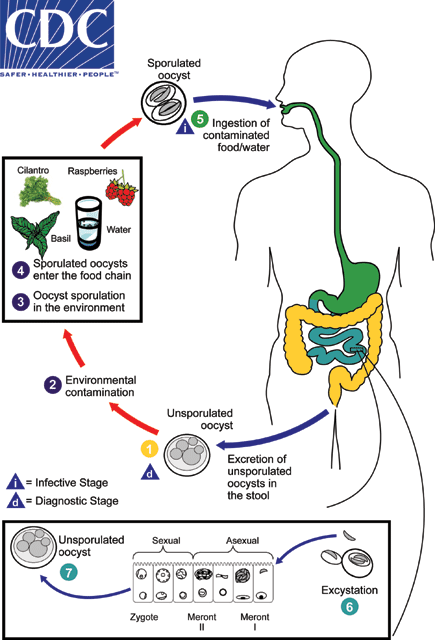
Cyclospora_LifeCycle201

As part of our ongoing efforts to combat foodborne illness and aligned with our New Era of Smarter Food Safety initiative, today, the U.S. Food and Drug Administration released the Cyclospora Prevention, Response and Research Action Plan. Modeled after our Leafy Greens Shiga toxin-producing E. coli (STEC) Action Plan, the plan focuses on improving prevention, enhancing response activities and filling knowledge gaps in order to help prevent Cyclospora contamination of foods and to help prepare for responding to future outbreaks.

Cyclosporiasis is a foodborne intestinal illness caused by Cyclospora cayetanensis. The most common symptoms of cyclosporiasis are diarrhea, weight loss, nausea and fatigue. Cyclospora is historically associated with imported produce or travel outside the U.S.; however, we have also detected Cyclospora in domestically produced foods in recent years.

The FDA first documented Cyclospora in domestically grown produce (cilantro) in 2018 as part of an ongoing sampling assignment of fresh herbs. The testing was done as part of a surveillance sampling, and the cilantro sample was not linked to any illnesses or outbreaks. Not long after, domestically grown produce was again associated with an outbreak linked to a salad mix. During the FDA’s investigations into this outbreak, Cyclospora was also detected in an unused package of the salad containing domestically grown produce.

The availability of new testing methods for Cyclospora developed at the FDA’s Center for Food Safety and Applied Nutrition played an important role in helping the FDA identify these positive samples of Cyclospora in the cilantro and in the salad mix. The number of reported cases of this foodborne illness has been rising in recent years, in part because of better diagnostic and detection methods. According to the Centers for Disease Control and Prevention, there have been roughly 6,000 domestically acquired cases of Cyclospora over the last three years. The number of reported cases typically rises during the spring and summer, usually in May, June and July. Rising case numbers and the emergence of Cyclospora contamination in domestically grown produce prompted the FDA to create the Cyclospora Task Force in 2019. The task force is comprised of multidisciplinary experts across the FDA and CDC, with the goal of reducing the public health burden of foodborne illness caused by Cyclospora in produce.

The task force formulated the action plan announced today, which will serve as a strategic guide to improve prevention, enhance response activities and fill knowledge gaps about the presence of Cyclospora in or on foods. In the area of prevention, the new action plan highlights how we’re addressing this food safety issue through the development and delivery of prevention-focused education materials and outreach to stakeholders. We’re also working with industry to encourage the development of rapid test kits to specifically detect Cyclospora to better facilitate industry testing and root cause analysis activities. In addition, we plan to collaborate with industry to look for ways to more effectively control Cyclospora in the environment and on farms.

In the area of response, the plan is focused on expanding laboratory capacity across the FDA, state, foreign partners and academia to sample and test for Cyclospora, providing greater capacity to investigate during outbreak events. The FDA is also developing a new investigational tool to help guide assessments of farms potentially implicated in a Cyclospora outbreak to determine potential sources and routes of contamination.

Given the emerging nature of Cyclospora contamination in domestic produce, a large number of action items in this plan are aimed at addressing knowledge gaps. In this area, the FDA intends to work with CDC to better understand the case distribution of cyclosporiasis across the U.S. and to advance genotyping methods in clinical, food and environmental samples that will allow us to genetically link clinical cases to food products and environments identified by traceback during an outbreak. As part of this plan, the FDA also intends to work with industry and academia to better understand the prevalence of Cyclospora in agricultural water and to encourage data sharing to help stakeholders identify trends associated with Cyclospora contamination. Our action plan underscores the importance of collaboration across industry, academia, state, federal and foreign government partners, and other stakeholders to reduce the risks and public health burden caused by foodborne Cyclospora. We’ll continue updating this plan as actions are completed and new actions are identified.

While the U.S. has one of the safest food supplies in the world, we are focused on making it better. The FDA is focused on working with all stakeholders to achieve the goals identified in this Cyclospora Prevention, Response and Research action plan.

Research – Cyclospora Infection: What to Know

WebMD

220px-Cyclospora_cayetanensis_stained

parasite that’s too tiny to see without a microscope can make you ill if you eat or drink the food or water it fouls. The illness is called a cyclospora infection (or cyclosporiasis), and it can bring on problems like watery diarrhea and stomach pain.

About 15,000 people in the U.S. catch it each year, and outbreaks of the infection have been linked to different kinds of imported fresh produce.

Here’s what you need to know to stay safe and lower your chances of catching this bug.  See at the link above.

Hawaii – DEPARTMENT OF HEALTH WARNS PUBLIC NOT TO DRINK RAW MILK

HHG

DOH embargoes unpasteurized goat milk
from various pet store supply and food retailers

HONOLULU – Hawai‘i Department of Health Food Safety Branch inspectors are visiting pet supply stores and food retailers throughout the state and issuing cease and desist notices to those engaged in the illegal sale of unpasteurized goat milk.

An embargo on raw milk products, which are not safe for human consumption, is now in effect. Pet stores or any other retailer that has raw milk in their possession must remove the product from sale immediately and destroy or return the product to their supplier. Failure to do so may result in seizure and fines of up to $10,000 per day.

As of July 1, there were nearly 20 O‘ahu pet stores that were selling the unpasteurized goat milk product. The health department is continuing its inspections today.

Under Hawai‘i law, only Grade A pasteurized milk and milk products may be sold to the final consumer or to restaurants.

“The goat milk is being advertised as ‘pet food,’ but the sale of any form of raw fluid milk is a risk to public health because it is easily diverted for human consumption,” said Peter Oshiro, chief of the Food Safety Branch. “There are many in our community that mistakenly believe that drinking raw milk is healthy, but this is simply untrue.”

Drinking unpasteurized milk is unsafe because it may result in serious illnesses, hospitalizations and even death. Raw milk has the potential to carry and transmit dangerous pathogens including E. Coli, Salmonella, and a host of other bacteria that can cause disease. It is especially dangerous for our keiki, kupuna, or those with weakened immune systems to drink raw milk because they may not be able to fend off these pathogens as a normal healthy individual would.

Drinking raw milk is particularly dangerous because children infected through consumption of raw milk can spread disease through fecal-oral means and cause a serious disease outbreak among other children with whom they come into contact. Raw milk consumption by a few individuals has the potential to negatively impact our community at large by causing an outbreak of disease.

The Food Safety Branch protects and promotes the health of Hawai‘i residents and visitors through education of food industry workers and regulation of food establishments statewide. The branch conducts routine health inspections of food establishments where food products are prepared, manufactured, distributed, or sold. The branch also investigates the sources of foodborne illnesses and potential adulteration; and is charged with the prevention or mitigation of foodborne outbreaks. Health inspectors work with business owners, food service workers, and the food industry to ensure safe food preparation practices and sanitary conditions.

# # #

PDF: Department of Health warns public not to drink raw milk – unpasteurized goat milk product embargoed

Research – Genetic diversity and pathogenic potential of Shiga toxin-producing Escherichia coli (STEC) derived from German flour

Science Direct

Abstract

Shiga toxin-producing Escherichia coli (STEC) can cause severe human illness, which are frequently linked to the consumption of contaminated beef or dairy products. However, recent outbreaks associated with contaminated flour and undercooked dough in the United States and Canada, highlight the potential of plant based food as transmission routes for STEC. In Germany STEC has been isolated from flour, but no cases of illness have been linked to flour.

In this study, we characterized 123 STEC strains isolated from flour and flour products collected between 2015 and 2019 across Germany. In addition to determination of serotype and Shiga toxin subtype, whole genome sequencing (WGS) was used for isolates collected in 2018 to determine phylogenetic relationships, sequence type (ST), and virulence-associated genes (VAGs).

We found a high diversity of serotypes including those frequently associated with human illness and outbreaks, such as O157:H7 (stx2c/d, eae), O145:H28 (stx2a, eae), O146:H28 (stx2b), and O103:H2 (stx1a, eae). Serotypes O187:H28 (ST200, stx2g) and O154:H31 (ST1892, stx1d) were most prevalent, but are rarely linked to human cases. However, WGS analysis revealed that these strains, as well as, O156:H25 (ST300, stx1a) harbour high numbers of VAGs, including eae, nleB and est1a/sta1.

Although STEC-contaminated flour products have yet not been epidemiologically linked to human clinical cases in Germany, this study revealed that flour can serve as a vector for STEC strains with a high pathogenic potential. Further investigation is needed to determine the sources of STEC contamination in flour and flour products particularly in regards to these rare serotypes.

Research – Behavior of Listeria monocytogenes and Other Microorganisms in Sliced Riojano Chorizo (Spanish Dry-Cured Sausage) during Storage under Modified Atmospheres

MDPI

Sliced ready-to-eat meat products packaged under modified atmospheres are often marketed since they cover consumer demands. The slicing process could be a potential risk for consumers since contamination with Listeria monocytogenes could occur during this stage. The current study evaluated the behavior of L. monocytogenes and other microorganisms in commercial sliced Riojano chorizo. This meat product was sliced and inoculated with L. monocytogenes (3.5 log CFU/g) before packaging under different atmospheres (air, vacuum, 100% N2, 20% CO2/80% N2 and 40% CO2/60% N2) and stored at 4 °C for up to 60 days. Samples were taken on days 0, 7, 21, 28 and 60 of storage. L. monocytogenes, mesophiles, Enterobacteriaceae, lactic acid bacteria, Micrococcaceae, molds and yeast counts were evaluated. Additionally, water activity, humidity and pH were determined. L. monocytogenes counts decreased in inoculated sliced chorizo during storage. Packaging conditions and day of storage influenced microbial counts. After 60 days, a significant reduction (p ≤ 0.05) in the initial Listeria contamination levels (3.5. log CFU/g) between 1.1 and 1.46 logarithmic units was achieved in the sausages packaged in modified atmosphere. The highest reductions were observed in slices packaged in 40% CO2/60% N2 after 60 days of storage at 4 °C. View Full-Text

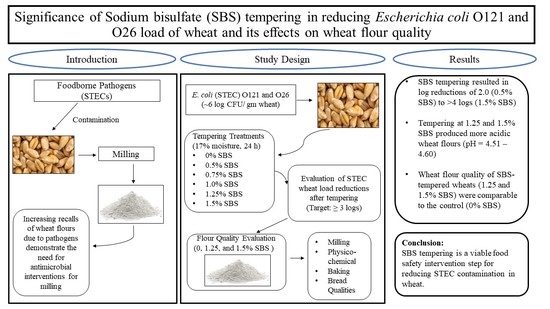
Research – Significance of Sodium Bisulfate (SBS) Tempering in Reducing the Escherichia coli O121 and O26 Load of Wheat and Its Effects on Wheat Flour Quality

MDPI

The occurrence of recalls involving pathogenic Escherichia coli-contaminated wheat flours show the need for incorporating antimicrobial interventions in wheat milling. The objectives of this study were to assess the efficacy of sodium bisulfate (SBS) tempering in reducing E. coli O121 (ATCC 2219) and O26 (ATCC 2196) wheat load and to evaluate the impact of effective (≥3.0 log reductions) SBS treatments on wheat flour quality. Wheat grains were inoculated with E. coli (~6 log CFU/g) and tempered (17% moisture, 24 h) using the following SBS concentrations (%wheat basis): 0, 0.5, 0.75, 1.0, 1.25, and 1.5% SBS. Reductions in E. coli O121 and O26 wheat load at different time intervals (0.5, 2, 6, 12, 18, and 24 h) during tempering were evaluated. The addition of SBS during tempering resulted in E. coli (O121 and O26) log reductions of 2.0 (0.5% SBS) to >4.0 logs (1.5% SBS) (p ≤ 0.05). SBS tempering (1.25 and 1.5% SBS) produced acidic wheat flours (pH = 4.51–4.60) but had comparable wheat flour properties in terms of composition, dough, and bread-making properties relative to the control (0% SBS). SBS tempering reduced the E. coli O121 and O26 load of wheat after tempering with minimal effects on wheat flour quality. View Full-Text

Vietnam Research – Microbiological safety of ready-to-eat foods in hospital and university canteens in Hanoi, Vietnam

Journal of Food Protection

The aim of this study is to analyze and document the microbiological safety and quality of ready-to-eat foods in hospital and university canteens in Hanoi, Vietnam. A total of 420 ready-to-eat food products from 21 canteens were sampled in July 2018 and May 2019. The ratio of samples exceeding the unsatisfactory level for Total Plate Count (TPC) was 31%. Escherichia coli, Listeria and Staphylococcus aureus were detected in 35 (8.3%), 99 (24%), 46 (11%) samples, with 3%, 10% and 0% exceeding the unsatisfactory level, respectively. The Total Plate Count (TPC), Listeria, Bacillus cereus, E. coli, S. aureus ranged from below detection limit to 5×10 9 , 4.6×10 5 , 6.2×10 3 , 3.4×10 3 , 7.6×10 3 CFU/g, respectively. Listeria monocytogenes was isolated from 3/420 samples (0.7%). In addition, there were 21 out of 410 samples (5%) contaminated with Salmonella. Overall, our data indicate frequent problems with the microbiological quality and safety of these canteen foods in Hanoi, and provide a baseline measurement that will allow environmental health officers and food microbiologists to develop targeted intervention strategies to reduce the economical and public health risk associated with these foods.

RASFF Alert – Animal Feed – Salmonella – Soybean Feed

RASFF

Salmonella (S. Havana) in soybean feed from Italy in Switzerland

Iceland – Salmonella in pork ears for pets

MAST

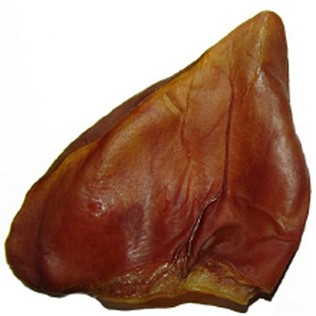
The company Petmark ehf has, in consultation with the Food Administration, recalled pig semen for pets after salmonella was detected in a sample. These are unpacked pork ears that were sold by choice in the stores Gæludýr.is and Bendir for the past four weeks (1.5.2021-6.6.2021). 

Product information:

  • Product name: Pork ear
  • Importer: Petmark ehf, Völuteig 6, 270 Mosfellsbær.
  • Country of manufacture: Germany
  • Manufacturer: Be-So GmbH
  • Lot number / best for dates: 13.5.2022. NOTE no packaging. The recall applies to pig semen purchased at Gæludýr.is and Bendi last year. 4 weeks
  • Storage conditions: Ambient
  • Distribution: Points and stores Gæludýr.is

Ears

Those who have purchased the product are asked to return it to the point of sale or discard it.

Related material