This report presents the 2021 results of regulatory control related to food safety, official controls and monitoring programmes on food and feed, as well as research and risk assessments.
The report also assesses, based on the results, the status of food safety and future needs for regulatory activities in Finland.
The report extends the annual report referred to in the EU Control Regulation (EU) No. 2017/625 on official control with respect to food safety; the annual report describes the results of the control in the various sectors of the food supply chain as a whole.
The results of official controls and investigations from 2021 indicate that the control works well and the level of food safety is good. The investigation of epidemics has developed, and the number of epidemics caused by unknown reasons was the smallest in years.
The export controls required by export countries were continued in accordance with the programmes. The number of food recalls has continued to increase dramatically. In 2021, more than 19,000 Oiva reports were published, which is an increase of 19 per cent from the previous year. Control was carried out through prioritised work. The new Food Act and the decrees issued under it entered into force in April 2021.
The number of foodborne outbreaks almost tripled in Switzerland in 2021 compared to the year before.
This past year, 37 outbreaks were reported with 540 people sick and 40 hospitalized versus 13 outbreaks in 2020.
Officials at the Federal Food Safety and Veterinary Office said the increase could be random, it could be due to better reporting and data collection or it could show the food safety situation has gotten worse, possibly because of the COVID-19 pandemic and other challenges facing businesses.
The agent was unknown in 17 outbreaks but Salmonella caused seven, norovirus four, Campylobacter three, two were due to Bacillus cereus and one each because of Shiga toxin-producing E. coli, Clostridium perfringens and hepatitis E.
The World Health Organization (WHO) is looking for people with experience on risk assessment of microbiological hazards.
The call comes as the Joint FAO/WHO Expert Meeting on Microbiological Risk Assessment (JEMRA) is renewing its expert roster for January 2023 to December 2027.
JEMRA is an international scientific expert group run by the Food and Agriculture Organization of the United Nations (FAO) and WHO. Meetings are convened on an ad-hoc basis, depending on requests from Codex.
One of the main aims is to provide a review of scientific advice on the state of microbiological risk assessment, and to develop the means of achieving risk assessments for specific pathogen -commodity combinations. Work often includes an evaluation of the impacts of different risk management options in the reduction or control of microbiological risks in food based on an analysis of the available knowledge.
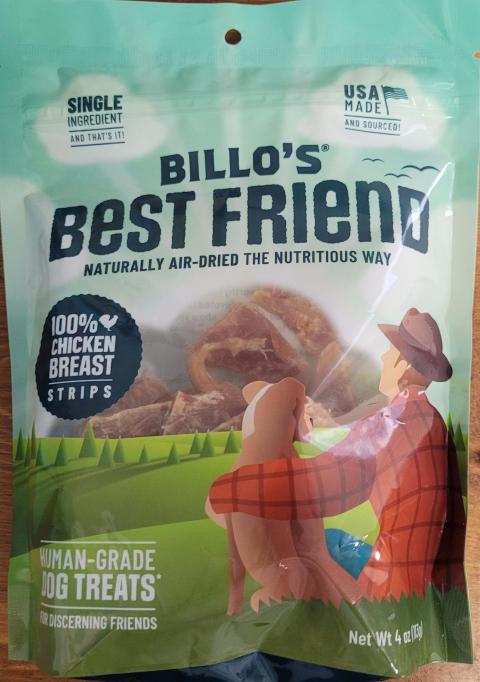
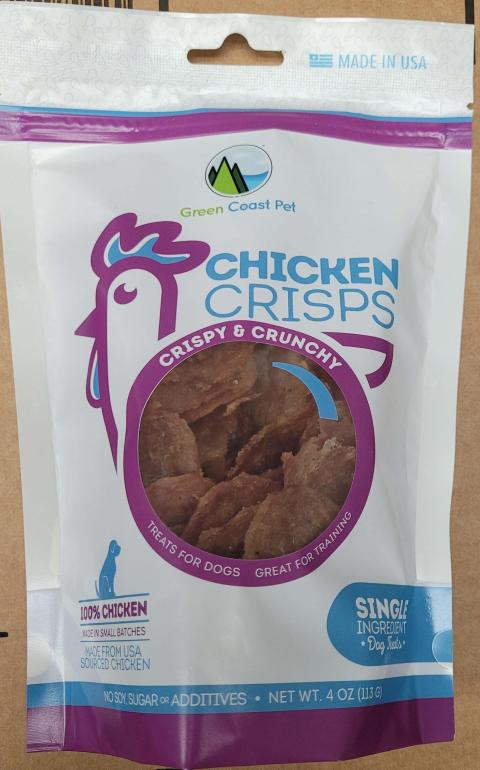
Beg & Barker, Billo’s Best Friend, and Green Coast Pets
Product Description:
Chicken dog treats
Company Announcement
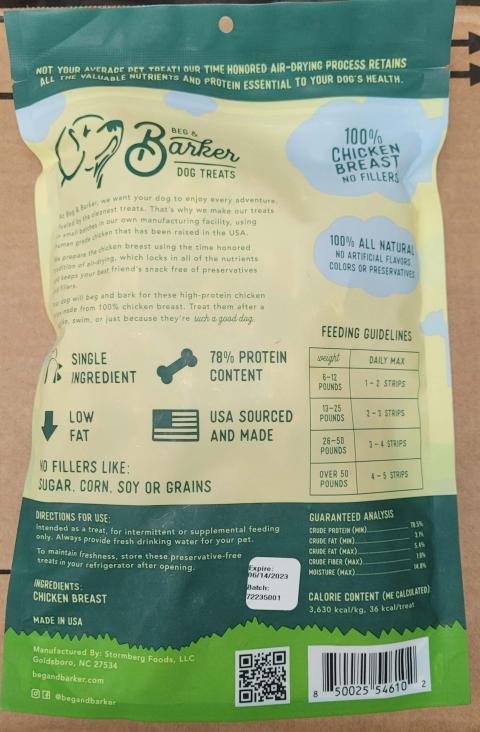
Stormberg Foods is recalling various sizes and batches of our Beg & Barker Chicken Breast Strips Dog Treat, Billo’s Best Friend Chicken Breast Strips Dog Treat, and Green Coast Pets Chicken Crisps Dog Treat products due to a potential contamination of Salmonella. On July 6, 2022, the firm was notified by the North Carolina Department of Agriculture & Consumer Services (NCDA & CS) that a sample they collected tested positive for Salmonella spp.
Salmonella can affect pets eating the products and there is risk to humans from handling contaminated pet products, especially if they have not thoroughly washed their hands after having contact with the products or any surfaces exposed to these products.
Healthy people infected with Salmonella should monitor themselves for some or all of the following symptoms: nausea, vomiting, diarrhea or bloody diarrhea, abdominal cramping and fever. Rarely, Salmonella can result in more serious ailments, including arterial infections, endocarditis, arthritis, muscle pain, eye irritation, and urinary tract symptoms. Consumers exhibiting these signs after having contact with these products should contact their healthcare providers.
Pets with Salmonella infections may be lethargic and have diarrhea or bloody diarrhea, fever, and vomiting. Some pets will have only decreased appetite, fever and abdominal pain. Infected but otherwise healthy pets can be carriers and infect other animals or humans. If your pet has consumed the recalled products and has these symptoms, please contact your veterinarian.
Stormberg Foods and NCDA & CS are continuing their investigation into the cause of the problem.
No illnesses have been reported to date.
Products affected are:
Product
Size
UPC
Batch No.
Exp Dates
Beg & Barker Chicken Breast Strips
1 oz
8 50025 54628 7
All batch numbers
06/06/23 to 06/23/23
Beg & Barker Chicken Breast Strips
4 oz
8 50025 54611 9
All batch numbers
06/06/23 to 06/23/23
Beg & Barker Chicken Breast Strips
10 oz
8 50025 54610 2
All batch numbers
06/06/23 to 06/23/23
Billo’s Best Friend Chicken Breast Strips
4 oz
8 50025 54682 9
All batch numbers
06/06/23 to 06/23/23
Green Coast Pets Chicken Crisps
4 oz
8 60001 92832 7
All batch numbers
06/06/23 to 06/23/23
Green Coast Pets Chicken Crisps
8 oz
8 60001 92833 4
All batch numbers
06/06/23 to 06/23/23
See product images for verification of products being recalled. Coding information may be found on the back of each package to the left or right of the UPC code.
The products were distributed between June 8, 2022 and June 22, 2022. These products were packaged in branded plastic bags in carboard master cases and shipped primarily to warehouses located in CA, MN, NC and RI. Products are then shipped nationwide to retail facilities and consumers via the internet.
Consumers who have purchased these products and/or have pets who have become ill are urged to notify stormbergship@gmail.com immediately with all product information for return or proper disposal information. Consumers with questions may contact the customer services department via (919) 947-6011, Monday – Saturday 3:00am – 9:00 pm EST or email 24h/day.
This recall is being made with the knowledge of the Food and Drug Administration.
The FDA Core Outbreak Investigation Table was updated, with ten active investigations. The FDA states that the Listeria monocytogenes outbreak that has sickened at least 23 people is linked to big Olaf ice cream. The quote is, “For the Listeria monocytogenes outbreak, a product linked to illnesses is ice cream from Big Olaf Creamery, located in Florida.”
On September 9, 2021, the Regional Health Agency (ARS) of Hauts-de-France was informed of a suspicion of collective food poisoning (TIAC) affecting half-board students, educated in several schools in a municipality. of the Lille metropolis.
On September 13, 2021, two cases of haemolytic and uremic syndrome (HUS) were diagnosed in two hospitalized children attending school in this town. Public Health France Hauts-de-France was asked by the Hauts-de-France ARS to provide support for the investigations and management of this TIAC. A total of 35 cases of gastroenteritis, with bloody diarrhea and fever (>38°C) in half of the cases, were identified. Ten cases were hospitalized and two children developed HUS.
The cases identified were half-board students in four school groups (29 cases), a parent of a student and elderly people benefiting from the municipality’s home meal delivery service (5 cases). The case canteens were all supplied by the central municipal kitchen.
The shape of the epidemic curve was in favour of a common and point source of contamination during meals on September 2 or 3, 2021. The case-control survey, carried out in schools, concluded that only the consumption of cucumbers in salad, served with the meal on September 2, was statistically and significantly associated with the occurrence of the disease.
A strain of E. highly pathogenic Shiga toxin-producing (STEC) O157 coli was isolated from the stool cultures of eight cases, including the two children who developed HUS and in the offending cucumber salad. Genomic analysis of the strains confirmed the genetic clustering of clinical and food strains that belonged to the same genomic cluster. The veterinary investigation revealed that a failure in the decontamination process, associated with incomplete peeling of the contaminated cucumbers, contributed to the occurrence of this TIAC.
The cucumbers in question came from Belgium and the Belgian health authorities were informed via the dedicated European alert circuits. No other episodes of clusters of STEC infection related to this TIAC have been reported to the ARS over the period while cucumbers from the same batch had been widely distributed in communities and commercial catering services in the Hauts-de-France region. The food vehicle, incriminated in this TIAC, is part of the plants at risk because of its raw mode of consumption. It is important to remind vulnerable populations and collective catering services that preventing the risk of STEC infection, linked to the consumption of raw vegetables, requires washing, disinfection and peeling.
At least six commandos fell ill due to suspected food poisoning at the Commando Complex in Newal village of Karnal district.
Soon after they developed vomiting, the commandos were taken to Kalpana Chawla Government Medical College. Later, one commando, Anshu, was referred to Medanta Medicity at Gurugram where his condition was said to be stable.
As per information, the commandos were in training when their health deteriorated.
Ramesh Chander, DSP, Commando Complex said that they had consumed regular meal and that an investigation to find out the reasons behind the food poisoning was going on.