Category Archives: Microbiology

Greece – Two Clostridium botulinum Cases

Hellas Posten

The EODY rang the bell for two serious cases of botulism in Greece.

As he states in his announcement, on November 15, 2022, a confluence of 2 suspected botulism cases linked to each other by a family relationship (couple) was declared through the EODY’s Mandatory Disease Notification System.

The botulism antitoxin distribution mechanism was immediately mobilized through the EODY, in collaboration with the treating doctors, to administer the antitoxin to the two patients.

With the assistance of the World Health Organization, it was possible to administer the special antitoxin within the first twenty-four hours from the declaration of the 2 cases to EODY. The two patients, one of whom is intubated, are hospitalized in a stable clinical condition in health units in Attica.

According to the EODY, from the reported food consumption history, it emerged that the couple, of foreign nationality, who were in Greece on vacation, consumed, a few days before the onset of symptoms, asparagus prepared by them through the canning process.

It is noted that in the period 2004-2021, three laboratory-confirmed cases of botulism in infants and one suspected case in an adult were reported to EODY.

Sweden – At least 100 ill in Swedish Cryptosporidium salad outbreak

Food Safety News

water contamination

A rise in Cryptosporidium infections in Sweden has been attributed to contaminated salad by public health officials.

The Public Health Agency of Sweden (Folkhälsomyndigheten) said 101 cases of a certain type of Cryptosporidium parvum had been confirmed in 13 regions of the country.

Patients fell ill from Sept. 25 to Oct. 15 this year and women were more affected than men. Cases range from 4 to 86 years old with an average age of 42.

Link to salad
The agency added there are another 99 potential cases being investigated. The type of Cryptosporidium parvum involved is common so there could be several possible sources.

Local infection control units, the Swedish Food Agency (Livsmedelsverket) and Folkhälsomyndigheten investigated the increase in infections to find a source.

Analysis of information from patients on what they had eaten before becoming ill shows they ate mixed or bagged salad more often than a control group.

Salad has a short shelf life so health officials don’t think it is still available for sale but no products have been sampled.

Livsmedelsverket has looked into possible producers and growers but has been unable to find the likely source of infection.

As reported cases of Cryptosporidium have decreased and are at similar levels to previous years, officials believe the outbreak is over.

Hong Kong – Draft ‘Oysters Intended for Raw Consumption – the Food Safety Guidelines for Food Businesses’

CFS

The Centre for Food Safety has drafted a set of trade guidelines on oysters intended for raw consumption. This set of guidelines aims to assist the food businesses in understanding the risks associated with raw oysters and implementing appropriate and practical food safety measures in their operations to reduce the occurrence of foodborne illnesses while also allowing susceptible groups of consumers to make informed choices. We are inviting members of the trade to provide comments on the draft guidelines. Your valuable comments will help us improve this set of guides. Please return your comments by 30 November 2022. Thank you.

Draft Oysters Intended for Raw Consumption – Food Safety Guidelines for Food Businesses

Questionnaire (Comments are welcome until 30 November 2022)

USA – FDA – Core Outbreak Table Update


FDA

What’s New

  • A new outbreak of Salmonella Typhimurium (reference #1113) in a not yet identified food has been added to the table and traceback has been initiated. There are currently 264 cases. The FDA is working closely with federal, state, and local partners to investigate multiple food items of interest to determine the source of this outbreak and will update the public when more information becomes available.
  • For the E. coli O157:H7 outbreak in a not yet identified food (reference #1121), the outbreak status has changed to “Ended”.

Norovirus: What to do if you catch it and helping to stop the spread

UKHSA

Norovirus, commonly known as the winter vomiting bug, is a stomach bug that causes sickness and diarrhoea. Following lower levels than normal throughout the COVID-19 pandemic, we have started to see an increase in norovirus activity as we head into the winter period.

Norovirus is able to spread easily through communities and so outbreaks are common in settings where individuals have close contact such as hospitals, care homes, schools and nurseries.

For most people this is an unpleasant, short-lived illness and they make a full recovery within 2-3 days without needing any medicine. However, some groups, including young children, the elderly or those with weakened immunity, are at risk of suffering more serious and prolonged illness which may require medical treatment.

Stopping the spread

Norovirus is easily transmitted through contact with people with the infection and any surfaces or objects which have been contaminated with the virus. Symptoms include sudden onset of nausea, projectile vomiting and diarrhoea but can also include a high temperature, abdominal pain and aching limbs.

The incubation period of norovirus is 12-48 hours, which is the time between catching the virus and developing symptoms. Individuals are most infectious when symptomatic, but it is possible to pass on norovirus or shed the virus, thereby contaminating surfaces, objects or even food, both before developing symptoms and after symptoms have stopped.

Good hand hygiene is important to stop norovirus spreading. To avoid catching norovirus or passing it on to others wash your hands frequently and thoroughly with soap and warm water. This is most important following an episode of illness, after using the toilet, before eating or preparing food as well as cleaning up vomit or diarrhoea. Alcohol-based hand sanitisers are not effective against norovirus.

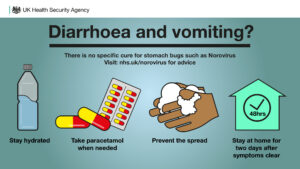
Diarrhoea and vomiting? There is no specific cure for stomach bugs such as Norovirus. Visit: nhs.uk/norovirus for advice. Icon of a water bottle. Stay hydrated. Icon of pills. Take paracetamol when needed. Icon of hands washing. Prvent the spread. Icon of a house with a clock saying 48 hours. Stay at home for two days after symptoms clear.

RASFF Alerts – Animal Feed – Salmonella – Rapeseed Extract – Meat Product

RASFF

Salmonella in post-extraction rapeseed meal from Ukraine in Poland and Lithuania

RASFF

Salmonella in meat product from Belgium in France

Research – Prevalence and Implications of Shiga Toxin-Producing E. coli in Farm and Wild Ruminants

MDPI

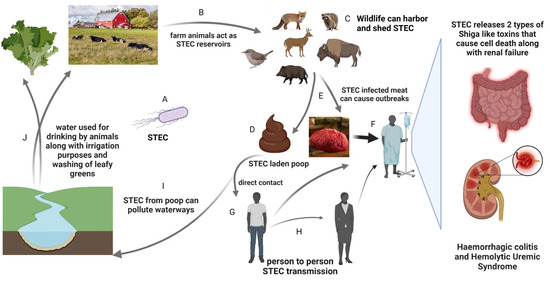
Shiga-toxin-producing Escherichia coli (STEC) is a food-borne pathogen that causes human gastrointestinal infections across the globe, leading to kidney failure or even death in severe cases. E. coli are commensal members of humans and animals’ (cattle, bison, and pigs) guts, however, may acquire Shiga-toxin-encoded phages. This acquisition or colonization by STEC may lead to dysbiosis in the intestinal microbial community of the host. Wildlife and livestock animals can be asymptomatically colonized by STEC, leading to pathogen shedding and transmission. Furthermore, there has been a steady uptick in new STEC variants representing various serotypes. These, along with hybrids of other pathogenic E. coli (UPEC and ExPEC), are of serious concern, especially when they possess enhanced antimicrobial resistance, biofilm formation, etc. Recent studies have reported these in the livestock and food industry with minimal focus on wildlife. Disturbed natural habitats and changing climates are increasingly creating wildlife reservoirs of these pathogens, leading to a rise in zoonotic infections. Therefore, this review comprehensively surveyed studies on STEC prevalence in livestock and wildlife hosts. We further present important microbial and environmental factors contributing to STEC spread as well as infections. Finally, we delve into potential strategies for limiting STEC shedding and transmission. View Full-Text

Research – Low levels of E. coli found in Norwegian produce testing

Food Safety News

Testing of fresh produce in Norway has found a low level of E. coli contamination.

The Norwegian Food Safety Authority (Mattilsynet) commissioned the Veterinary Institute to examine ready-to-eat lettuce and sugar snap peas in 2021.

A total of 118 samples, of which 37 were sugar snap peas and 81 ready-to-eat leafy greens, were analyzed. Salmonella was not detected, while E. coli was found in 11 samples, one of sugar snap peas and 10 of lettuce. E. coli, as a hygiene indicator, at levels above the guideline values was only detected in one sample of lettuce.

Results were considered unsatisfactory if three or more samples contained more than 100 colony forming units per gram or one sample contained above 1,000 CFU/g.

Officials said finding high levels of E. coli in lettuce may indicate the production process is not working optimally. Good raw material control and management of the washing and rinsing process are important, so microorganisms do not build-up and cross-contamination via water is minimized.

Research – The underestimated risk of mycotoxins in dairy cows

All About Feed

It is a myth that rumen microbial activity allows dairy cows to handle mycotoxin toxicity completely. A closer look at rumen degradation capability shows that this is not the case. Therefore, a mitigation strategy should be holistic, practical and beyond binding.

Risk, impact, and diagnostics

A complex and diverse Total Mixed Ration (TMR) poses multiple mycotoxin toxicity challenges. Although rumen microbes can reduce the toxicity of some mycotoxins, not all mycotoxins are equally degraded in the rumen. In high-yielding dairy cows high-starch diets can compromise the detoxification capacity of rumen microbes. For some mycotoxins, such as zearalenone (ZEN), rumen degradation may increase the toxicity. Furthermore, extended periods of exposure to low levels of multiple mycotoxins may lead to chronic toxicity, an increasing issue that is notoriously difficult to diagnose at an early stage.

Mycotoxins can threaten dairy cows’ health, rumen function, feed intake, milk yield, milk quality, lameness, and reproductive abilities. Many “mouldy silage syndrome” cases in the field have shown incidences of increased somatic cell counts, undigested faecal feed particles, laminitis, mastitis and ruminitis cases. Cases of reproductive challenges and vaccination failures have been reported with multiple mycotoxins in TMR.

Read more at the link above

Research – Bacterial Pathogens in the Food Industry: Antibiotic Resistance and Virulence Factors of Salmonella enterica Strains Isolated from Food Chain Links

MDPI

kswfoodworld salmonella

Salmonella is one of the most important foodborne pathogens. Fifty-three strains of Salmonella deposited in the Culture Collection of Industrial Microorganisms—Microbiological Resources Center (IAFB) were identified using molecular and proteomic analyses. Moreover, the genetic similarity of the tested strains was determined using the PFGE method. Main virulence genes were identified, and phenotypical antibiotic susceptibility profiles and prevalence of resistance genes were analyzed. Subsequently, the occurrence of the main mechanisms of β-lactam resistance was determined. Virulence genes, invA, fimA, and stn were identified in all tested strains. Phenotypic tests, including 28 antibiotics, showed that 50.9% of the strains were MDR. The tet genes associated with tetracyclines resistance were the most frequently identified genes. Concerning the genes associated with ESBL-producing Salmonella, no resistance to the TEM and CTX-M type was identified, and only two strains (KKP 1597 and KKP 1610) showed resistance to SHV. No strains exhibited AmpC-type resistance but for six Salmonella strains, the efflux-related resistance of PSE-1 was presented. The high number of resistant strains in combination with multiple ARGs in Salmonella indicates the possible overuse of antibiotics. Our results showed that it is necessary to monitor antimicrobial resistance profiles in all food chain links constantly and to implement a policy of proper antibiotic stewardship to contain or at least significantly limit the further acquisition of antibiotic resistance among Salmonella strains.