Category Archives: foodborne outbreak

USA – Outbreak Investigation of Cyclospora: Bagged Salads (June 2020) CDC announces the end of the outbreak; FDA continues its investigation.

CDC

Investigation Update

September 25, 2020

As of September 25, 2020, CDC has announced this outbreak is over. FDA’s traceback investigation is complete, however the cause or source of the outbreak has not been determined. FDA’s investigation is continuing, in consultation with the state agriculture and regional water board.

FDA investigated multiple farms identified in the traceback, one of which led to sampling and investigation around a farm in south Florida. FDA continues to work with the state of Florida and the local water district to try to determine the source and impact of Cyclospora that was found in the regional water management canal (C-23), located west of Port St. Lucie, Florida. Given the emerging nature of genetic typing methodologies for this parasite in foods and in environmental samples, the FDA has been unable to determine if the Cyclospora detected in the canal is a genetic match to the clinical cases, therefore, there is currently not enough evidence to conclusively determine the source of this outbreak. However, the presence of Cyclospora in a canal that had previously supplied irrigation water in the region, and specifically to a farm identified in the traceback, suggests the need for a collaborative effort by state, federal and industry partners to better define the scope of the contamination and identify appropriate risk mitigation measures.

Previous Updates

USA – Outbreak Investigation of Salmonella Stanley: Wood Ear Mushrooms – Dried Fungus (September 2020)

FDA

Background Information

The FDA, along with CDC and state and local partners, is investigating an ongoing multistate outbreak of Salmonella Stanley infections likely linked to wood ear mushrooms imported by Wismettac Asian Foods, Inc. of Santa Fe Springs, CA. Wood ear mushrooms are a dried mushroom, also commonly labelled or referred to as Kikurage, Dried Black Fungus, Dried Fungus, or Mu’er/Mu Er/Mu-Err.

In interviews, ill people answered questions about the foods they ate and other exposures in the week before they became ill. According to the CDC, of 18 people with information, 16 (89%) reported eating ramen at a restaurant in the week before their illness started. Four illness clusters were identified at restaurants serving ramen in three states. Eight (89%) of the nine ill people linked to restaurant clusters reported eating wood ear mushrooms or ramen containing wood ear mushrooms in the week before their illness started.

As part of this investigation, the California Department of Public Health collected a sample of wood ear mushrooms, imported by Wismettac Asian Foods, Inc., from one of the restaurants where ill patients reported eating. This sample was reported positive for the presence of Salmonella. This sample is undergoing genetic testing, or whole genome sequencing, to determine if the Salmonella present in the sample has the same genetic fingerprint as the outbreak strain. More information will be provided as it becomes available.

Wismettac Asian Foods, Inc. acted quickly upon being notified of the positive test result and recalled all wood ear mushrooms within shelf life on September 23, 2020. This product was labeled as Shirakiku brand Black Fungus (Kikurage) with UPC Code 00074410604305, imported from China. Product was distributed in six packs of five-pound bags to restaurants in AR, CA, CO, CT, DE, DC, FL, GA, HI, IA, IL, IN, LA, MA, MD, MI, MN, MO, MS, NC, NV, NJ, NY, OH, OR, PA, SC, TN, TX, VA, WA, WI, and Canada.

Recommendation

Wood ear mushrooms imported by Wismettac Asian Foods, Inc. were only sold to restaurants and were not available directly to consumers. Although these items have been recalled, concerned or high-risk individuals should check with their restaurant to confirm that any wood ear mushrooms that have been used or are being used are not part of this recall.

Restaurants should not sell or serve recalled wood ear mushrooms distributed by Wismettac Asian Foods, Inc. Additionally, restaurants that received recalled products should use extra vigilance in cleaning and sanitizing any surfaces that may have come in contact with recalled product, to reduce the risk of cross contamination.

Restaurants should discard and not sell or serve wood ear mushrooms if they cannot tell where they came from.

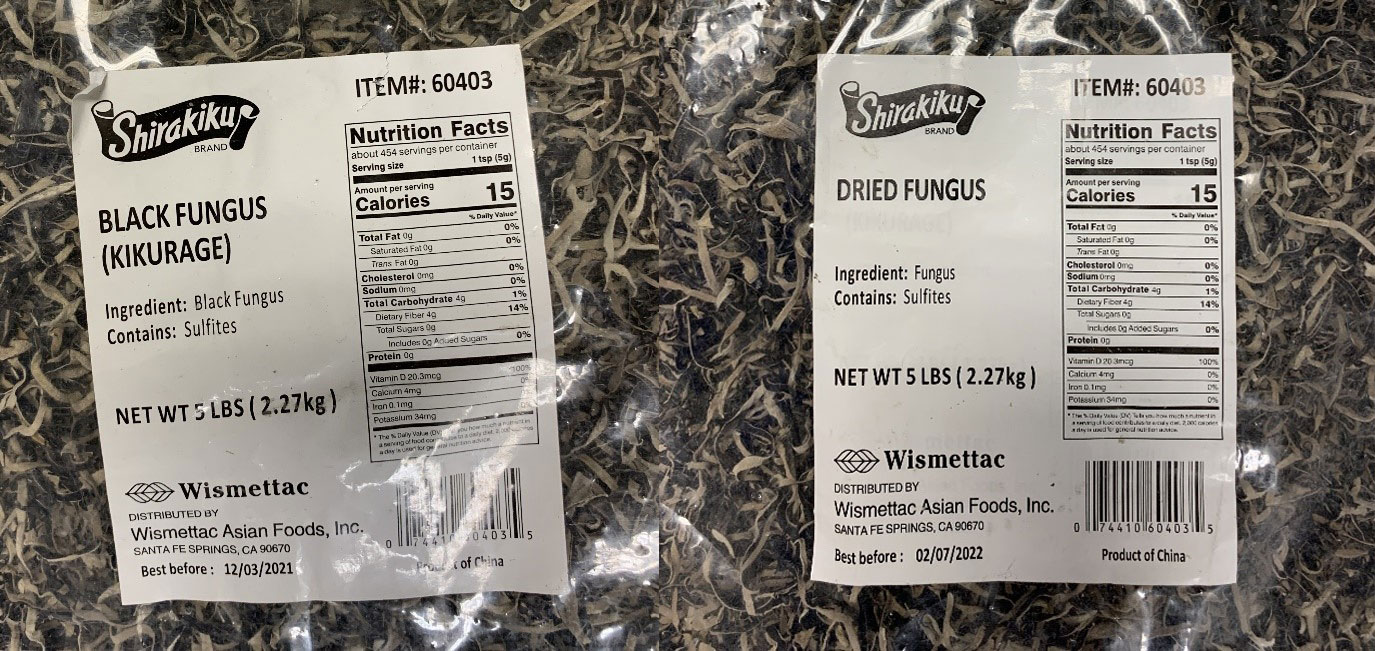
Product Images

Outbreak Investigation of Salmonella Stanley in Wood Ear Mushrooms (September 2020) - Photos of Recalled Shirakiku Dried Fungus

Canada – N.B. declares outbreak of shellfish bacteria causing gastrointestinal illness – Vibrio parahaemolyticus

Global News CA

Food Illness - Vibrio

Image CDC

New Brunswick health officials have declared an outbreak of vibrio parahaemolyticus, a bacteria found in shellfish that causes gastrointestinal illness in humans.

The province says nine cases of vibrio have been confirmed. The average for New Brunswick is typically only two to three cases a year.

“I am advising all New Brunswickers to ensure that they obtain shellfish and other seafood from a licensed establishment or harvest shellfish from fishing zones which are currently open by Fisheries and Oceans Canada,” said N.B. chief of health Dr. Jennifer Russell in a news release.

USA – Health departments probe Salmonella outbreak in NE counties

Journal Advocate

Salmonella kswfoodworld

Investigators with the Colorado Department of Public Health and Environment and the Northeast Colorado Health Department are looking into a cluster of Salmonella infections in residents of northeastern Colorado counties.

According to Deanna Herbert, a communications manager with CDPHE, 17 cases of Salmonella illness have been reported in northeast Colorado between Aug. 1 and Sept. 17. Eleven of those cases were in Logan County. Herbert said that typically, fewer than 12 cases are reported in the six northeastern counties during the months of August and September.

“Public health investigates reported Salmonella cases to determine if the cases have common exposures that might indicate that an outbreak is occurring,” Herbert said. “A single common exposure for all of the reported cases in August and September has not been identified and the investigation is ongoing.”

Research – Surveillance of foodborne disease outbreaks in China, 2003–2017

Science Direct

Foodborne disease remains a major public health problem worldwide. To understand the epidemiology and changes of foodborne disease in China, data reported to the National Foodborne Disease Outbreak Surveillance System during 2003–2017 were collected. A total of 19,517 outbreaks, which resulted in 235,754 illnesses, 107,470 hospitalizations, and 1,457 deaths, were reported in this period. Of the 13,307 outbreaks with known etiology, 31.8% of outbreaks were caused by poisonous mushrooms, followed by Vibrio parahaemolyticus (11.3%), saponin (8.0%), Salmonella (6.8%), nitrite (6.4%), pesticide (4.8%), Staphylococcus aureus (4.2%) and Bacillus cereus (3.0%). Among 18,955 outbreaks with reported setting, 46.6% were associated with food prepared in a household, followed by 22.5% with food prepared in a restaurant, and 18.4% prepared in a canteen. Of the 13,305 outbreaks associated with a single food category, fungi (mainly poisonous mushroom) were the most commonly implicated food category, followed by meats, vegetables, aquatic animals, condiments, poisonous plants (such as saponin, tung oil or seed, aconite) and grains (such as rice, noodle, rice noodle). Analysis of foodborne disease outbreaks can provide insight into the most important causative agents and sources of foodborne disease, and assist public health agencies determine the high-risk etiology and food pairs, specific points of contamination and settings to reduce foodborne disease illnesses.

USA – Austin federal court makes it official: Blue Bell owes record $17.25 million in criminal penalties – Listeria monocytogenes

Food Safety News

A federal court in Texas sentenced ice cream manufacturer Blue Bell Creameries L.P. to pay $17.25 million in criminal penalties for shipments of contaminated products linked to a 2015 listeriosis outbreak.

The Brenham, Texas-based Blue Bell is an iconic 113-year old ice cream maker whose product was once only available in the Lone Star State.   It now distributes in about half the country with manufacturing in Texas, Alabama, and Oklahoma.   The 2005 listeria outbreak proved both costly and deadly for the ice cream maker.

RASFF Alert – Foodborne Outbreak -Norovirus – Frozen Tellins (Donax trunculus)

European Food Alerts

RASFF

foodborne outbreak suspected to be caused by and norovirus (GI, GII) in frozen tellins (Donax trunculus) from Turkey in Spain

Europe – Shigellosis Annual Epidemiological Report for 2017

Click to access AER_for_2017_shigellosis.pdf

USA – As 1500 Become Ill, with over 200 Hospitalized, the CDC and Canadian Health Agencies Investigation of Salmonella Red Onion Outbreak Continues

As 1500 Become Ill, with over 200 Hospitalized, the CDC and Canadian Health Agencies Investigation of Salmonella Red Onion Outbreak Continues

The Victim Count Nears 1500, with over 200 Hospitalizations in the Red Onion Salmonella Outbreak – Heath Investigators in Two Countries Scramble to Get it Under Control

The CDC has released new information on the Salmonella red onion outbreak, which has caused 1012 illnesses in the United States, with illnesses in 47 states and 136  infections requiring hospitalizations. In Canada, there have been 457 confirmed cases and 66 individuals requiring hospitalizations with illnesses.

CDC

Research – Record number of outbreak alerts on EU platform

Record number of outbreak alerts on EU platform

A European system used by countries to report outbreaks saw a record number of alerts in 2019.

The European Centre for Disease Prevention and Control (ECDC) hosts the Epidemic Intelligence Information System for food- and waterborne diseases (EPIS-FWD) platform. The network is a restricted web-based platform for experts to help with early detection and coordination of response to multi-country outbreaks through sharing information.

It consists of Urgent Inquiries and associated forums, which are the outbreak alert and investigation tools. The forums allow information to be shared about the outbreak investigation among a restricted number of experts. Nominated people outside the EPIS-FWD network, such as food safety and environmental experts or veterinarians from network countries or any expert or organization outside the network can also be invited to join.