Category Archives: Food Safety

RASFF Alert -STEC E.coli – Lamb Meat

RASFF

Shigatoxin-producing Escherichia coli in lamb meat from New Zealand in Germany

RASFF Alert – Bacillus cereus – Curry Powder

RASFF

Bacillus cereus in curry powder from India, packed in UK in Finland

RASFF Alert – Mould – Groundnuts

RASFF

Visible mould in Chinese groundnuts in the Netherlands

RASFF Alert – Ochratoxin A – Basmati Rice

RASFF

Ochratoxin A in basmati rice from Pakistan, via the Netherlands in Germany


RASFF Alerts – Aflatoxin – Groundnuts – Pistachios – Peanuts – Organic Cocoa Powder – Hazelnuts

RASFF

Aflatoxin in Bolivian groundnuts in the Netherlands

RASFF

Aflatoxin in Egypt groundnuts in the Netherlands

RASFF

Aflatoxin in Egypt groundnuts in the Netherlands

RASFF

Aflatoxins in pistachios from Turkey in Belgium, Germany, France, USA and Switzerland

RASFF

Increased aflatoxin content in organic cocoa powder from Ghana, via the Netherlands in Belgium, France, Germany, Italy, Netherlands and Portugal

RASFF

Aflatoxins in peanuts from China in Slovakia

RASFF

Aflatoxins in hazelnuts from Turkey in Bulgaria

RASFF Alert- Listeria monocytogenes – Raw Milk Goats Cheese

RASFF

Listeria monocytogenes in raw milk goat cheese from France in Belgium


list

RASFF Alerts – Foodborne outbreak -Salmonella Dublin in chilled raw milk cheese

RASFF

Foodborne outbreak suspected to be caused by Salmonella Dublin in chilled raw milk cheese from France

RASFF Alerts – Salmonella – Polish Chicken and Turkey – Sesame Seeds – BBQ Pork Ribs – Shatavari Powder – Frozen Blanched Shrimps

RASFF

Salmonella spp. in chilled chicken meat from Poland in Germany and the UK

RASFF

Salmonella enterica ser. Enteritidis in frozen chicken elements from Poland in Belgium, France, Hungary, Latvia, Lithuania, UK, Netherlands, Slovakia and Poland

RASFF

Salmonella spp. in sesame from Nigeria in Germany

RASFF

Salmonella spp. in chilled chicken meat from Poland in Poland, Germany , Netherlands and UK

RASFF

Salmonella Enteritidis in chicken in Germany and Poland

RASFF

Salmonella spp. in fresh chicken broiler meat thighs meat, boneless, skinless from Poland in Lithuania

RASFF

Salmonella spp. in fresh chicken broiler drumsticks from Poland in Lithuania

RASFF

Salmonella spp. in chilled marinated in BBQ sauce pork ribs from Poland in Lithuania

RASFF

Salmonella in frozen chicken meat preparations from Belgium in the Netherlands

RASFF

Salmonella O:4 (B) in turkey meat from Poland in the UK

RASFF

Salmonella Enteritidis detected in chicken neck skins, chickens originating from Hungary, slaughtered in Poland” in Poland

RASFF

Carcasses and poultry cuts salmonella enteritidis from Poland in the UK, Ireland and Netherlands

RASFF

Salmonella spp. in organic shatavari powder from India in Austria, Finland, Germany, Italy , Netherlands, Poland, Portugal. Slovenia, Spain, Switzerland and the UK

RASFF

Salmonella Enteritidis in chicken neck skins from Poland in Lithuania

RASFF

Salmonella in gambero indopacifico/salmonella in frozen blanched shrimps (Parapenaeopsis stylifera) from India in Italy

RASFF

Salmonella Enteritidis in chilled chicken elements from Poland in Romania, Ukraine and the UK

RASFF

Presence of Salmonella in hulled sesame seeds from Nigeria in Greece

RASFF

Presence of Salmonella in sesame seeds from Nigeria in Greece


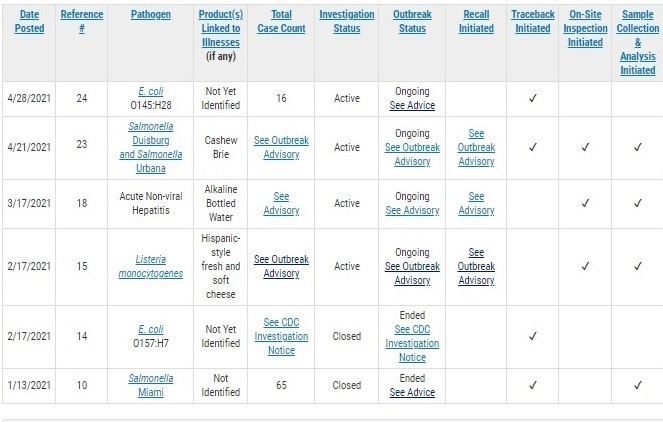
USA – FDA Core Investigation Table Update

FDA

0a

Research – Hepatitis A outbreak associated with consumption of dates, England and Wales, January 2021 to April 2021

Eurosurveillance

An outbreak of genetically related hepatitis A virus (HAV) infections among people with no travel history was identified by the Public Health England (PHE) Virus Reference Department (VRD) in conjunction with local teams noting that the cases had eaten dates.

We describe investigations including case characteristics, phylogenetics, analytical studies, and control measures. We aim to flag the possible risk of hepatitis A to populations in other countries through the consumption of contaminated dates, particularly as Ramadan, which is associated with an increase in consumption of dates, began on 12 April 2021, and hepatitis A has a long incubation period of 15 to 50 days.

A confirmed case was defined as a laboratory-confirmed HAV infection with one of three clustered sequences (sequences VRD21_HAV005, VRD21_HAV009 and VRD21_HAV020) and onset date from 1 January 2021 in England or Wales, no travel history or contact with a suspected or confirmed HAV case in the 60 days before onset. A probable case was a laboratory-confirmed HAV infection, with no or pending sequencing result, and with an epidemiological link to a confirmed HAV case with one of the three clustered sequences.

Samples from all locally diagnosed HAV infections in England and Wales are routinely sent to the VRD for characterisation. The outbreak cases had HAV from three closely related Middle Eastern genotype IB sequences (≤ 2 bp different in a 505 bp segment) which clustered most closely with those found in travellers returning from Syria and Lebanon. The sequences have been submitted to the European Nucleotide Archive (ENA), accession numbers OD998295–OD998297.