Category Archives: Food Poisoning

RASFF Alert – Staph Enterotoxin – Chilled Cured Sheep Cheese

European Food Alerts

RASFF

Staphylococcal enterotoxin (presence /25g) in chilled cured sheep cheese from Portugal in Portugal

RASFF Alerts – Histamine – Tuna – Chilled Tuna Loins

European Food Alerts

RASFF

histamine (500 and 900 mg/kg – ppm) in tuna from India in Spain

RASFF

histamine (425 mg/kg – ppm) in chilled tuna loins (Thunnus albacares) from the Maldives in France

RASFF Alerts – Clostridium – Chilled Sheep Casings

RASFF

Clostridium (between 1500 and 8100 CFU/g) in chilled sheep casings from Iran in Greece

RASFF Alert – STEC E.coli – Chilled Meat Preparation

European Food Alerts

RASFF

Escherichia coli (eae+, stx1+, stx2-) in chilled meat preparation from Belgium in Belgium

Hong Kong – Bacillus cereus in Soybean Milk

CFS

Recently, the Centre for Food Safety (CFS) collected a soybean milk sample from a local food shop when following up on a food complaint. The sample was later found containing a bacterium known as Bacillus cereus (B. cereus) in an amount that exceeded the limit in the CFS’ Microbiological Guidelines for Food and was consided unsatisfactory. Soybean milk produced by local retail shops, such as soybean product shops and congee shops, usually has a short shelf life and requires stringent temperature control to maintain its safety. In this article, we will look into how the bacterium finds its way to survive in soybean milk production and how to prevent it.
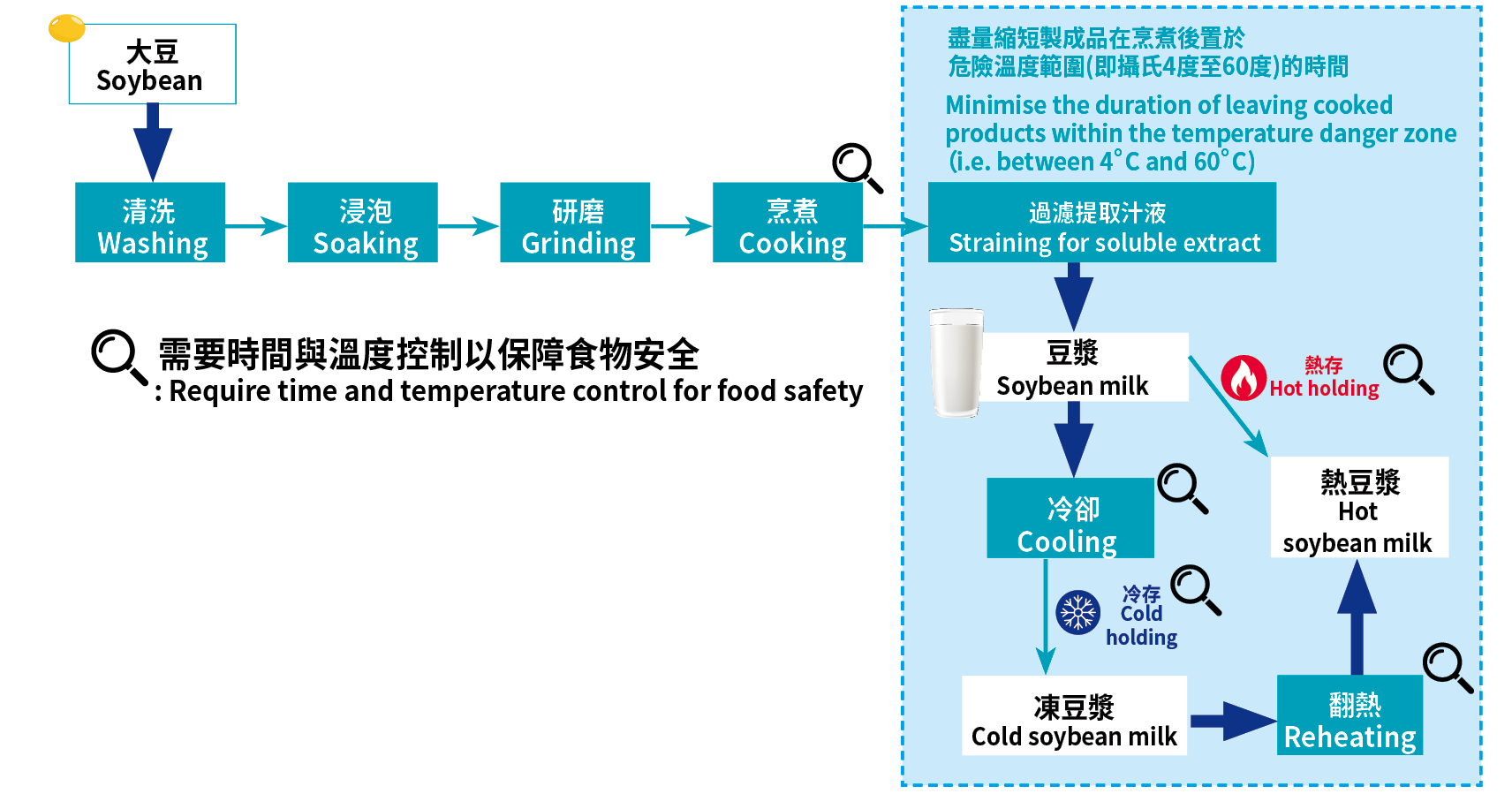
Figure 1 Highlights of processes requiring time and temperature control during production of soybean milk

Bacillus cereus Surviving Heat Treatment

B. cereus is a spore-forming bacterium and is ubiquitous in the environment. It is naturally present in soils, plants, agricultural products, etc. Hence, soybeans used in the production of soybean milk (see Figure 1) may contain B. cereus.

While cooking is effective to kill vegetative cells of B. cereus, its spores are heat-resistant and can only be eliminated by high temperature treatment, e.g. 121°C for 3 minutes. In this regard, the cooking temperature of soybean milk production at retail shops is not sufficient to kill the spores. Instead, the heat of cooking can not only induce the spores to germinate and become vegetative cells, but also create a favourable environment for the cells to grow by eliminating other microorganisms competing for growth. As a result, if the soybean milk is left under ambient condition for a prolonged period of time after cooking, vegetative cells can proliferate into a large number.

The vegetative cells can then produce a heat-resistant emetic (i.e. causes vomiting) toxin.  Even if contaminated soybean milk is reheated subsequently, it can still cause food poisoning that is characterised by causing the victim to vomit shortly after consumption.

Prevention by Time and Temperature Control

Despite the tenacious nature of B. cereus, soybean milk can still be safely produced. To prevent the microbiological hazard, certain production processes require time and temperature control (see Figure 1). First, the soybean slurry from grinding process has to be cooked thoroughly to kill B. cereus vegetative cells and other bacteria.  The heat treatment can also denature soybean enzymes that affect digestion of consumers.

After cooking, it is important to minimise the duration of leaving cooked products within the temperature danger zone, i.e. between 4°C and 60°C, in order to prevent the growth of vegetative cells of B. cereus formed from surviving spores. Cooked soybean slurry is strained through cheese cloth for soluble extract, i.e. soybean milk.  After straining, freshly made soybean milk can be held at above 60°C for hot serving.  As for cold soybean milk, it has to be cooled as quickly as possible, i.e. cooling to 20°C within two hours, and then to 4°C within the next four hours or less. Cooled soybean milk can then be stored at or below 4°C for cold serving. At certain food service businesses, soybean milk in cold holding may be reheated for serving. In that case, it has to be reheated with temperature reaching at least 75°C.

Last but not least, the production environment and equipment have to be kept hygienic to reduce microbiological contamination.  In particular, the equipment used after cooking processes, such as cheese cloth, container and dispenser, has to be cleaned after each use to minimise the building up of B. cereus which may contaminate cooked soybean milk of the next batch.

Key Points to Note

  1. Soybeans can be naturally contaminated with B. cereus. Normal cooking can kill vegetative cells of B. cereus, but not the spores and toxin of it.
  2. If cooked soybean milk is left at ambient temperature for too long, vegetative cells of B. cereus formed from surviving spores can produce toxin.
  3. It is important to minimise the duration of leaving soybean milk at a temperature range between 4°C and 60°C after cooking which favours the growth of B. cereus vegetative cells and toxin production.

Advice to the Trade

  • Avoid over-production as soybean milk has a short shelf life.
  • Speed up the cooling process by, for example, dividing soybean milk into small portions or using water bath or ice bath to cool bottled soybean milk.
  • Minimise the storage time of soybean milk, preferably clearing the stock within one day after production.

Advice to the Public

  • Consume soybean milk produced at retail shops as soon as possible.
  • Refrigerate the soybean milk at 4°C or below if it is not to be consumed immediately.

USA – Outbreak Investigation of E. coli – Leafy Greens (December 2020)

FDA

Total Illnesses: 40
Hospitalizations: 20 (4 Cases HUS)
Deaths: 0

The FDA, along with CDC and state and local partners, investigated a multistate outbreak of E. coli O157:H7 infections in the fall of 2020. The epidemiology and traceback investigation have determined that the outbreak was linked to leafy greens. The epidemiological and traceback investigations were not able to determine a specific type of leafy green linked to illnesses. On 12/22/2020, the CDC announced that this outbreak appears to be over. This outbreak, announced by FDA and CDC on October 28, 2020, was caused by a strain of E. coli that is genetically related to a strain linked to the fall 2019 romaine outbreak.

The FDA completed a traceback investigation of multiple types of leafy greens identified in patient interviews. Although no single ranch was identified as a common source of the leafy greens, FDA and state partners also conducted on-site investigations on farms of interest.

Teams were deployed to dozens of ranches in the region to conduct large scale environmental sampling. Additionally, no Shiga toxin-producing E. coli were found on leafy greens. As part of the field investigation, teams conducted environmental sampling on and around ranches of interest to identify any factors that could have led to contamination. Samples of soil, scat or animal droppings, compost, water, and other environmental sources were collected and analyzed.

Laboratory analysis of samples is now complete. The analysis has confirmed a positive match to the outbreak strain in a sample of cattle feces, which was collected during follow-up investigations on a roadside, uphill from where leafy greens or other food identified in the traceback investigation were grown. While the finding does not provide definitive information on how E. coli may have contaminated product during the growing and harvesting season, it does confirm the presence of a strain of E. coli O157:H7 that causes recurring outbreaks in a more narrowly defined growing region and a potential, continued source of contamination.

At this time, FDA’s investigational activities have concluded. The FDA continues to review the findings from this outbreak and a detailed report will be released in the near future. This report will include recommendations shaped by the investigation findings.

In the meantime, as recommended in our Leafy Greens Action Plan, the FDA continues to recommend growers assess and mitigate risk associated with adjacent and nearby land use practices, particularly as it relates to the presence of livestock, which are a persistent reservoir of E. coli O157:H7 and other STEC.

Recommendation

CDC has declared this outbreak to be over. There is no recommendation for consumers, retailers, or suppliers.

France – PREMIUM prepared from the Traiteur Pierrot brand -STEC E.coli

AFSCA

Recall of Euro-Délices Distribution
Product: PREMIUM prepared from the Traiteur Pierrot brand.
Problem: Possible presence of E. coli STEC.


In agreement with the AFSCA, Euro-Délices Distribution is withdrawing from sale the “Prepared PREMIUM” products of the Traiteur Pierrot brand and is recalling them to consumers because of the possible presence of STEC.

Euro-Délices Distribution asks its customers not to consume these products and to bring them back to the point of sale where they were purchased, where they will be reimbursed.

Product description Product

name: Prepared PREMIUM TP
Brand: Traiteur Pierrot Use by
date (DLC): 29/01/2021
Batch number: 105201
Sales period: from 07/01/2021 to 21/01/2021
Type of packaging: plastic jar with lid
Weight: 180g – 0.5kg – 1.25kg


The product was sold through various supermarkets, retailers and food stores.

For any further information , contact:

Fabienne Cluts
Tel: 04 / 278.78.12
fabiennecluts@eurodelices.be

Korea – 3 officials from McDonald’s supplier get suspended sentences for selling tainted patties – E.coli

Korea Herald

Ecoli Istock

Three officials from a burger patty supplier for McDonald’s Korea were given suspended prison sentences by a local court Tuesday for providing patties potentially contaminated with E. coli to the local unit of the global fast-food giant.

A managing director of the supplier, whose name was withheld, and two mid-ranking officials in charge of production and quality management, respectively, were indicted without detention in 2018 for allegedly distributing 63 tons of beef patties that tested positive for intestinal hemorrhagic E. coli contamination.

In addition, they were charged with selling 2,160 tons of beef patties with Shiga toxin genes detected in a PCR (polymerase chain reaction) test, a test method that amplifies DNA. Shiga toxin is a toxin component released from intestinal hemorrhagic E. coli.

The Seoul Central District Court convicted all three for violating the Livestock Products Sanitary Control Act but handed out suspended jail terms ranging from two to three years.

Food Safety Website – Stop Foodborne Illness

Stop Foodborne Illness

Incorporated as a not-for-profit in California in 1994, STOP began as a grassroots effort. The U.S. government and non-governmental organizations were not addressing this public safety issue and STOP stepped in to fill the void. The founders knew that increasing awareness about foodborne pathogens had to be a guiding principle.

Initially, STOP learned that there is not a singular government agency – there are many – that oversee food safety in the U.S. We also identified the lack of effective communication at all levels of governmental hierarchy – federal, state and local. It was clear that we weren’t the only organization seeking answers. As STOP became more knowledgeable of how food becomes contaminated, the weaknesses of the system and the complexity of the challenge of preventing foodborne illness became very apparent.

Learning that the United States government — our government — had known about emerging foodborne pathogens but lacked a comprehensive plan to combat them was disheartening. It was identified that as early as 1982, scientists and pathologists had been quietly warning the United States Department of Agriculture (USDA), Congress, and the media that a failure to inspect meat and poultry for bacteria would lead to a food safety disaster.

Time was of the essence and although there was significant resistance at every turn, STOP knew it held the truth.

STOP added its strong voice to the Safe Food Coalition, a group of consumer, public health and labor organizations which has advocated for improvements to the food safety system, particularly with respect to meat and poultry, since 1986. Industry held power, influence, and money. Victims’ families and survivors held onto lives that had been irreparably altered by foodborne illness. Families continued to tell their stories through the advocacy of STOP and its coalition partners.

STOP’s voices became a clarion call for change and eventually STOP was invited to participate in policy making. After countless hours spent educating the USDA and the meat industry about the devastation caused by E. coli, STOP became a key element in facilitating the first meat and poultry reforms since 1906. In 1996, STOP founders Roni and Nancy, were invited to witness this historic overhaul being signed into law by President Clinton.

Research – Monitoring online posts by consumers could help improve food safety

Phys Org

An estimated 48 million cases of foodborne illness are contracted in the United States every year, causing about 128,000 hospitalizations and 3,000 deaths, according to the Centers for Disease Control (CDC). In some instances, the source is well known, such as a batch of tainted ground beef that infected 209 people with E. Coli in 2019. But 80 percent of food poisoning cases are of unknown origin, making it impossible to inform consumers of hazardous food items.

David Goldberg, assistant professor of management information systems at San Diego State University, wants to improve the traceability and communication of risky  products. In a new study published by the journal Risk Analysis, his research team proposes a new Food Safety Monitoring System (FSMS) that utilizes consumer comments posted on websites to identify products associated with food-related illnesses.

The researchers utilized an AI technology called text mining to analyze comments and reviews from two websites: Amazon.com, the world’s largest e-commerce retailer, and IWasPoisoned.com, a site where consumers alert others to cases of food poisoning. The database consisted of 11,190 randomly selected Amazon reviews of “grocery and canned food” items purchased between 2000 and 2018, along with 8,596 reviews of food products posted on IWasPoisoned.com. These two datasets allowed the researchers to test the text mining tools before analyzing 4.4 million more Amazon reviews.