Category Archives: Food Microbiology Research

Research – Differential Survival of Generic E. coli and Listeria spp. in Northeastern U.S. Soils Amended with Dairy Manure Compost, Poultry Litter Compost, and Heat-Treated Poultry Pellets and Fate in Raw Edible Radish Crops

Journal of Food Protection

Composted or heat-treated Biological Soil Amendments of Animal Origin (BSAAO) can be added to soils to provide nutrients for fresh produce. These products lower the risk of pathogen contamination of fresh produce when compared with use of untreated BSAAO; however, meteorological conditions, geographic location, and soil properties can influence the presence of pathogenic bacteria, or their indicators (e.g., generic E. coli) and allow potential for produce contamination. Replicated field plots of loamy or sandy soils were tilled and amended with dairy manure compost (DMC), poultry litter compost (PLC), or no compost (NoC) over two different field seasons, and non-composted heat-treated poultry pellets (HTPP) during the second field season. Plots were inoculated with a three-strain cocktail of rifampicin-resistant E. coli (rE.coli) at levels of 8.7 log CFU/m2. Direct plating and most probable number (MPN) methods measured the persistence of rE.coli and Listeria spp. in plots through 104 days post-inoculation. Greater survival of rE. coli was observed in PLC plots in comparison to DMC plots and NoC plots during year 1 (P < 0.05). Similar trends were observed for year 2, where rE. coli survival was also greater in HTPP amended plots (P < 0.05). Survival of rE. coli was dependent on soil type, where water potential and temperature were significant covariables. Listeria spp. were found in NoC plots, but not in plots amended with HTPP, PLC or DMC. Radish data demonstrate that PLC treatment promoted the greatest level of rE.coli translocation when compared to DMC and NoC treatments (P  < 0.05). These results are consistent with findings from studies conducted in other regions of the US and informs Northeast produce growers that composted and non-composted poultry-based BSAAO supports greater survival of rE. coli in field soils. This result has the potential to impact the food safety risk of edible produce grown in BSAAO amended soils as a result of pathogen contamination.
Research – Desiccation survival in Salmonella enterica, Escherichia coli and Enterococcus faecium related to initial cell concentration and cellular components

Journal of Food Protection

Salmonella enterica is well-known for its ability to survive and persist in low-moisture environments.  Previous studies have indicated a link between the initial cell concentration and the population of Salmonella that survive upon desiccation and subsequent storage; however, how the initial cell concentration affects survival is unknown.  This study examined the basis of this phenomena and whether it occurred in other microorganisms, specifically Shiga toxigenic Escherichia coli (STEC), and Enterococcus faecium . Salmonella, STEC, and E. faecium were grown as lawns on TSAYE and harvested using buffered peptone water (BPW). To determine recovery at different initial cell levels, cultures were diluted to 9, 7, and 5 log CFU/mL and applied to filters.  Filters were dried for 24 h, then stored for 28 d at 25°C/33% RH. During storage, cells were recovered from filters using BPW and cultivated on TSAYE.  Both Salmonella and E. coli , but not E. faecium , showed non-proportional recovery. Less viability remained with lower initial starting population after 24 h desiccation such that ≥10 log CFU/mL were recovered when 11 log CFU/mL was desiccated, but ❤ log CFU/mL were recovered when 5 log CFU/mL was desiccated. Once dried, persistence did not appear affected by initial cell concentration. When dead cells (heat-treated) were added to the diluent, recovery of Salmonella was proportional with respect to the initial cell concentration. To further examine the response on desiccation, Salmonella was diluted in BPW containing one of 11 different test cell components related to quorum sensing or known to affect desiccation resistance to assess recovery and persistence. Of the 11 additions only cell debris fractions, cell-free extract, and peptidoglycan improved recovery of Salmonella . Desiccation survival appears related to cell wall components, however, the exact mechanism affecting survival remains unknown.

Research – Prevalence of E. coliO157:H7 in water sources: an overview on associated diseases, outbreaks and detection methods

Elsevier

Escherichia coli O157:H7 is a zoonotic pathogen with its ability to cause human illness ranging from diarrheal dis-ease to fatal hemolytic uremic syndrome. E. coli O157:H7 had been associated with waterborne outbreaks resulting in high morbidity and mortality worldwide. Therefore, it is important to investigate the prevalence of E. coli O157:H7 in water sources especially used for drinking and to develop the diagnostic methods for its early detection. The review describes traditional cultural methods, immunological techniques, and polymerase chain reaction (PCR)–based methods for detection of this bacterium in water sources. The current PCR-based techniques such as real-time PCR are more specific and sensitive and require less detection time (b3 hours).These methods can be applied for regular water monitoring and proper management of water sources to prevent waterborne diseases due to E. coli O157:H7.

Research – Bioactivity of Essential Oils for Mitigation of Listeria monocytogenes Isolated from Fresh Retail Chicken Meat

MDPI

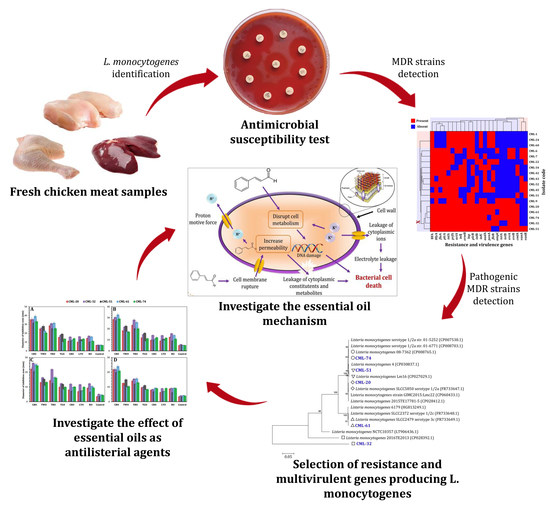
Listeria monocytogenes is one of the most severe foodborne pathogens found in several habitats. Therefore, this study aims to investigate the antilisterial activity of different essential oils (EOs) against multidrug-resistant (MDR) L. monocytogenes strains isolated from fresh chicken meat. Our results showed that the prevalence of L. monocytogenes in the examined samples was 48%. Seventy-eight isolates were identified as L. monocytogenes. Out of these, 64.1% were categorized as MDR and were categorized in 18 patterns with 50 MDR isolates. One isolate was selected randomly from each pattern to investigate their biofilm-forming ability, resistance, and virulence genes incidence. Out of 18 MDR isolates, 88.9% showed biofilm-forming ability. Moreover, the most prevalent resistance genes were ermB (72%), aadA (67%), penA (61%), and floR genes (61%). However, the most prevalent virulence genes were inlA (94.4%), prfA (88.9%), plcB (83.3%), and actaA (83.3%). The antilisterial activity of EOs showed that cinnamon bark oil (CBO) was the most effective antilisterial agent. CBO activity could be attributed to the bioactivity of cinnamaldehyde which effects cell viability by increasing the bacterial cell electrical conductivity, ion leakage, and salt tolerance capacity loss. Therefore, CBO could be an effective alternative natural agent for food safety applications. View Full-Text

USA – CDC – Food Safety for the Holidays

CDC

Prevent Food Poisoning During the Holidays

Feasting with family is part of many holiday celebrations. Follow these tips to help prevent food poisoning, or foodborne illness, during the holidays.

  • Keep foods separatedexternal icon. Keep meat, chicken, turkey, seafood, and eggs separate from all other foods at the grocery store and in the refrigerator. Prevent juices from meat, chicken, turkey, and seafood from dripping or leaking onto other foods by keeping them in containers or sealed plastic bags. Store eggs in their original carton in the main compartment of the refrigerator.
  • Cook food thoroughlyexternal icon. Meat, chicken, turkey, seafood, and eggs can carry germs that cause food poisoning. Use a food thermometer to ensure these foods have been cooked to a safe internal temperatureexternal icon. Roasts, chops, steaks, and fresh ham should rest for 3 minutes after you remove them from the oven or grill.
  • Keep food out of the “danger zone.”external icon Bacteria can grow rapidly in the danger zone between 40°F and 140°F. After food is prepared, keep hot food hot and cold food cold. Refrigerate or freeze any perishable food within 2 hours (1 hour if food is exposed to temperatures above 90°F, such as in a hot car). The temperature in your refrigerator should be set at or below 40°F and the freezer at or below 0°F.
  • Use pasteurized eggs for dishes containing raw eggsSalmonella and other harmful germs can live on both the outside and inside of normal-looking eggs. Many holiday favorites contain raw eggs, including eggnog, tiramisu, hollandaise sauce, and Caesar dressing. Always use pasteurized eggs when making these and other foods made with raw eggs.
  • Do not eat raw dough or batterexternal icon. Dough and batter made with flour or eggs can contain harmful germs, such as E. coli and Salmonella. Do not taste or eat raw dough or batter that is meant to be baked or cooked. This includes dough or batter for cookies, cakes, pies, biscuits, pancakes, tortillas, pizza, or crafts. Do not let children taste raw dough or batter or play with dough at home or in restaurants. Some companies and stores offer edible cookie dough that uses heat-treated flour and pasteurized eggs or no eggs. Read the label carefully to make sure the dough is meant to be eaten without baking or cooking.
  • Thaw your turkey safelyexternal icon. Thaw turkey in the refrigerator, in a sink of cold water (change the water every 30 minutes), or in the microwave. Avoid thawing foods on the counter. A turkey must thawexternal icon at a safe temperature to prevent harmful germs from growing rapidly.
  • Wash your hands. Wash your hands with soap and water during these key times when you are likely to get and spread germs:
    • Before, during, and after preparing food
    • Before eating food
    • After handling pet food or pet treats or touching pets
    • After using the toilet
    • After changing diapers or cleaning up a child who has used the toilet
    • After touching garbage
    • Before and after caring for someone who is sick
    • Before and after treating a cut or wound
    • After blowing your nose, coughing, or sneezing

USA – CDC – Say No to Raw Dough

CDC

hazegg.jpg

What You Need to Know

  • Don’t taste or eat raw (unbaked) dough or batter.
  • Don’t let children handle or play with raw dough, including play clay and dough for crafts.
  • Uncooked flour and raw eggs can contain germs that can make you sick if you taste raw dough.
  • Wash your hands, bowls, utensils, and countertops after handling raw flour, eggs, or dough.

Spending time with family while baking is a great way to celebrate special occasions. When making cookies, brownies, cakes, or bread, you might be tempted to taste a bite before it’s fully baked.

But you can get sick after eating or tasting raw (unbaked) dough or batter. Children can get sick from handling or eating raw dough used for crafts or play clay, too. Follow these safety tips to help you and your loved ones stay healthy when preparing and handling raw dough.

Raw Dough Can Contain Germs That Make You Sick

Flour doesn’t look like a raw food, but most flour is raw. That means it hasn’t been treated to kill germs that cause food poisoning, such as Escherichia coli (E. coli). These harmful germs can contaminate grain while it’s still in the field or flour while it’s being made. Steps like grinding grain and bleaching flour don’t kill harmful germs—and these germs can end up in flour or baking mixes you buy at the store. You can get sick if you eat unbaked dough or batter made with flour containing germs. Germs are killed only when food made with flour is baked or cooked.

CDC investigated outbreaks of E. coli infections linked to raw flour or cake mix in 20162019, and 2021. Some of these investigations led to recalls. Flour and baking mixes containing flour have long shelf lives, meaning they do not go bad quickly. It’s a good idea to check your pantry to see if you have any flour or baking mixes that have been recalled in recent years (search FDA’s recall listexternal icon). If you have any recalled flour or baking mixes, throw them away.

Raw eggs are another ingredient in dough and batter that can make you or your loved ones sick. Raw or lightly cooked eggs can contain Salmonella, a germ that causes food poisoning. Find out how to handle and cook eggs properly.

Some companies make edible cookie dough and brownie batter that you can find in stores. These products are made with heat-treated flour and pasteurized eggs or no eggs. Read the label carefully to make sure the dough is meant to be eaten without baking or cooking.

Stay Safe When Handling Flour and Other Raw Ingredients

Follow these practices to prevent food poisoning when you are baking and cooking with flour and other raw ingredients.

  • Do not taste or eat any raw dough or batter. This includes dough or batter for cookies, brownies, cakes, pie crusts, tortillas, pizza, biscuits, pancakes, or crafts made with raw flour, such as homemade play dough or holiday ornaments.
  • Do not let children play with or eat raw dough, including dough for crafts.
  • Bake raw dough, such as cookie dough, and batter, such as cake mix, before eating.
  • Follow the recipe or package directions for cooking or baking. Use the temperature and cooking time given in the recipe or directions.
  • Do not make milkshakes with products that contain raw flour, such as cake mix.
  • Do not use raw homemade cookie dough in ice cream.
    • Cookie dough ice cream sold in stores contains dough that has been treated to kill harmful germs.
  • Keep raw foods, such as flour and eggs, separate from ready-to-eat foods. Because flour is a powder, it can spread easily.
  • Follow label directions to refrigerate products containing raw dough or eggs until they are baked or cooked (for example, store-bought cookie dough).
  • Clean up thoroughly after handling flour, eggs, or raw dough.
    • Wash your hands with soap and water after handling flour, raw eggs, or any surfaces they have touched.
    • Wash bowls, utensils, countertops, and other surfaces with warm, soapy water.

Recognize Food Poisoning Symptoms

Food poisoning symptoms may range from mild to severe and can differ depending on the germ you swallowed.

Symptoms of E. coli infection include stomach cramps that can be severe, diarrhea (often bloody), and vomiting. People usually get sick 3 to 4 days after swallowing the germ and recover within a week. However, some people develop a serious illness called hemolytic uremic syndrome (HUS), which can result in kidney failure, stroke, and even death.

Symptoms of Salmonella infection include diarrhea, fever, and stomach cramps. Symptoms start 6 hours to 6 days after swallowing the germ and go away within 4 to 7 days.

Some groups of people have a greater chance of infection and severe illness. These groups include children younger than 5, adults age 65 and older, and people who have health problems or take medicines that lower the body’s ability to fight germs and sickness.

Canada – Public Health Notice: Outbreak of Salmonella infections – Update

PHAC

The Public Health Agency of Canada (PHAC) is collaborating with provincial public health partners, the Canadian Food Inspection Agency (CFIA) and Health Canada to investigate an outbreak of Salmonella infections involving five provinces: British Columbia, Alberta, Saskatchewan, Manitoba and Ontario. The illnesses reported in Ontario were related to travel to Alberta and British Columbia.

The source of the outbreak has not been confirmed and the investigation is ongoing. Many of the individuals who became sick reported eating fresh avocados purchased from grocery stores or served at restaurants before their illness. Investigation findings to date have identified that these avocados have been distributed in British Columbia, Alberta, Saskatchewan and Manitoba. More information is needed to confirm the source of the outbreak. The outbreak appears to be ongoing, as illnesses continue to be reported.

The Public Health Agency of Canada is issuing this public health notice to inform residents and businesses in British Columbia, Alberta, Saskatchewan and Manitoba of the investigation findings to date so that they can make informed decisions. At this time, there is no evidence to suggest that residents in other provinces and territories are affected by this outbreak. This notice also includes important safe food handling information for Canadians and businesses that may help prevent further Salmonella infections.

This public health notice will be updated as the investigation evolves.

Investigation summary

As of December 9, there have been 79 laboratory-confirmed cases of Salmonella Enteritidis illness investigated in: British Columbia (34), Alberta (28), Saskatchewan (4), Manitoba (11) and Ontario (2). The illnesses reported in Ontario are related to travel to Alberta and British Columbia. Individuals became sick between early September 2021 and mid-November 2021. Four individuals have been hospitalized. No deaths have been reported. Individuals who became ill are between 5 and 89 years of age. The majority of cases (63%) are female.

CFIA is conducting a food safety investigation. If specific contaminated food products are identified, they will take the necessary steps to protect the public, including requesting a recall of product as required. Currently there are no Food Recall Warnings associated with this outbreak.

Research -EU One Health report: drop in reported zoonotic diseases in humans and foodborne outbreaks in 2020

EFSA

Campylobacteriosis was the most reported zoonosis in the EU in 2020, with 120,946 cases compared to more than 220,000 the previous year. It was followed by salmonellosis, which affected 52,702 people compared to 88,000 in 2019. The number of reported foodborne outbreaks also fell by 47%. These findings are based on the annual EU One Health zoonosis report, by EFSA and ECDC.

Experts acknowledged the impact of the COVID-19 pandemic in Europe in the remarkable drop in reported zoonotic diseases in humans – ranging from 7% to 53% depending on the reported disease in question – and foodborne outbreaks.

Possible factors behind the large decrease in cases include changes in health seeking behaviour, restrictions on travel and on events, the closing of restaurants, quarantine, lockdown, and other mitigation measures such as the use of masks, physical distancing and hand sanitisation.  

The next most commonly reported diseases were yersiniosis (5,668) and infections caused by Shigatoxin-producing E.coli (4,446). Listeriosis was the fifth most reported zoonosis (1,876 cases), mainly affecting people over the age of 64.

Listeriosis and West Nile virus infections were the diseases with the highest case fatality and hospitalisation rates – with most locally acquired human infections of West Nile virus reported in Greece, Spain and Italy.

The report also monitors foodborne outbreaks in the EU, events during which at least two people contract the same illness from the same contaminated food. A total of 3,086 foodborne outbreaks were reported in 2020. Salmonella remained the most frequently detected agent and caused about 23% outbreaks. The most common sources of salmonellosis outbreaks were eggs, egg products and pig meat.

The report also includes data on Mycobacterium bovis/caprae, BrucellaTrichinellaEchinococcus, Toxoplasma gondii, rabies, Q fever and tularaemia.

EFSA is publishing two interactive communication tools on foodborne outbreaks – a story map and a dashboard. The story map provides general information on foodborne outbreaks, their causative agents and implicated food vehicles. The dashboard allows people to search and query the large amount of data on foodborne outbreaks collected by EFSA from EU Member States and other reporting countries since 2015.

USA – FDA – New Era of Smarter Food Safety: FDA’s Foodborne Outbreak Response Improvement Plan

FDA

New Era of Smarter Food Safety - FDA's Foodborne Outbreak Response Improvement Plan Cover

Tackling foodborne outbreaks faster and revealing the root cause are essential for the prevention of future outbreaks. We have a plan to do that.

Foodborne disease remains a significant public health problem in the United States. The FDA’s Foodborne Outbreak Response Improvement Plan (FORIP), described in this document, is an important step that the FDA is taking to enhance the speed, effectiveness, coordination, and communication of outbreak investigations. (Unless stated otherwise, this report focuses exclusively on the response to human food and not animal food.)

Our ultimate goal is to bend the curve of foodborne illness in this country.

RASFF Alert- Foodborne outbreak with Hepatitis A virus – Frozen Raspberries

RASFF

Foodborne outbreak with Hepatitis A virus suspected caused by frozen raspberries from Poland and Bulgaria in Norway and the Netherlands