RASFF – foodborne outbreak suspected to be caused by and Salmonella enterica ser. Enteritidis (presence /25g) in raw milk sheep’s cheese from France in France

RASFF – foodborne outbreak suspected to be caused by and Salmonella enterica ser. Enteritidis (presence /25g) in raw milk sheep’s cheese from France in France
Posted in food bourne outbreak, food contamination, Food Hygiene, Food Illness, Food Inspections, Food Micro Blog, Food Microbiology, Food Microbiology Blog, Food Pathogen, Food Poisoning, food recall, Food Safety, Food Safety Alert, Food Testing, foodborne outbreak, foodbourne outbreak, outbreak, RASFF, Raw Milk, raw milk cheese, Salmonella, Uncategorized
RASFF – Vibrio parahaemolyticus (presence /20g) in frozen cooked whole crayfish (Procambarus clarckii) in dill brine from China in Sweden
RASFF – food poisoning suspected to be caused by food supplements from Spain, via Germany in France
RASFF – high count of moulds (7 out of 12) in liquid candy in spray from Spain in Spain
RASFF – shigatoxin-producing Escherichia coli (stx1+ stx2- eae-) in soft cheese from Belgium in Germany
RASFF – aflatoxins (B1 = 2.6; Tot. = 3.3 µg/kg – ppb) in groundnuts with shell from Argentina in the UK
RASFF – aflatoxins (B1 = 149.1; Tot. = 168.55 µg/kg – ppb) in groundnuts from the United States in Slovakia
RASFF – aflatoxins in organic peanut butter from the Netherlands, with raw material from Germany in the Netherlands
RASFF – aflatoxins (B1 = 15; Tot. = 17.9 µg/kg – ppb) in groundnuts from Egypt in Italy
RASFF – aflatoxins (B1 = 3.1; Tot. = 3.7 µg/kg – ppb) in mixed nuts from Turkey in France
RASFF – aflatoxins (B1 = 11.1; Tot. = 16.6 µg/kg – ppb) in dried fig cubes from Turkey in France
RASFF – aflatoxins (B1 = 9.1; Tot. = 18.5 µg/kg – ppb) in dried figs cubes from Turkey in France
RASFF – aflatoxins (B1 = 7.8 µg/kg – ppb) in groundnuts with shell from India in the UK
RASFF – aflatoxins (B1 = 90; Tot. = 103 µg/kg – ppb) in ground nuts from China in Belgium
RASFF – aflatoxins (B1 = 11.1; Tot. = 11.6 µg/kg – ppb) in Cayenne pepper powder from India in the UK
RASFF – aflatoxins (B1 = 7.2 mg/kg – ppm) in hazelnut kernels from Georgia in Greece
RASFF – aflatoxins (B1 = 106.19; Tot. = 117.01 µg/kg – ppb) in pistachios with shell from the United States, dispatched from Turkey in Italy
RASFF – aflatoxins (B1 = 7.6 µg/kg – ppb) in chili powder from India in Belgium
RASFF – aflatoxins (B1 = 13.5; Tot. = 15.5 µg/kg – ppb) in groundnuts with shell from China in Spain
RASFF – aflatoxins (B1 = 21; Tot. = 29 µg/kg – ppb) in dried figs from Turkey in France
Consumers should not buy, eat, or serve any fresh basil exported by Siga Logistics de RL de CV from Morelos, Mexico to the United States.
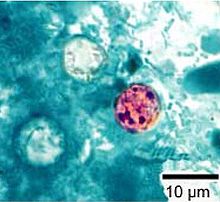
The fresh basil from Siga Logistics de RL de CV located in Morelos, Mexico is the subject of a multi-state outbreak investigation of Cyclospora illnesses potentially linked to fresh basil exported by Siga Logistics de RL de CV located in Morelos, Mexico.
As of July 9, health official found 132 illnesses in ten states that are attributed to the outbreak. Four patients required hospitalization. Restaurants in Florida, Minnesota, New York and Ohio exposed patrons to the parasite.
Cyclospora is a parasite typically transmitted by contaminated food. Some areas, such as Massachusetts, are this year experiencing higher Cyclosproa case counts than normal. States with Cyclospora cases associated with the current outbreak are found in CT, FL, IA, MA, MN, NY, OH, RI, SC, and WI.
Posted in Contaminated water, Cyclospora, food bourne outbreak, food contamination, food handler, Food Hygiene, Food Illness, Food Inspections, Food Micro Blog, Food Microbiology, Food Microbiology Blog, Food Pathogen, food recall, Food Safety, Food Safety Alert, Food Testing, foodborne outbreak, foodbourne outbreak, Uncategorized, Water, water microbiology, Water Safety
The Australian Government Department of Health in collaboration with jurisdictions is currently investigating three cases of Listeria infections (listeriosis) occurring in Victoria, Queensland and New South Wales. All cases occurred in people aged over 70 years and all had significant underlying health conditions. Unfortunately two people (from NSW and Victoria) have died.
Investigations have implicated smoked salmon as the likely source. This is a timely reminder for people to ensure that food is handled, prepared and stored safely, and that those most at-risk of listeriosis avoid certain foods.
Listeriosis is an illness usually caused by eating food contaminated by the bacterium Listeria monocytogenes. The bacteria are widely distributed in the environment and can grow in food at refrigeration temperatures. Most people who are exposed to Listeria will only develop mild symptoms, though illness can be severe in those most at-risk. Those at increased risk of illness include pregnant women and their unborn babies, newborn babies, the elderly, and people of all ages with immune systems weakened by illness or medication.
If you (or someone in your household) have a weakened immune system or are pregnant, the best way to avoid Listeria is to eat freshly cooked or freshly prepared food.
Try to avoid foods that have a higher risk of Listeria contamination such as:
You can further reduce your risk by:
Listeria infection starts with flu-like symptoms such as fever, chills, muscle aches, nausea, and sometimes diarrhoea.
People can start experiencing symptoms within a few days, but symptoms can take a number of weeks to appear after eating a contaminated product.
For information on listeria and food visit the Food Standards Australia New Zealand website.
For more information see the Listeria fact sheet.
For information on foods to eat or avoid when pregnant visit the NSW Food Authority website.
For further information on the investigation into the cases of listeriosis please contact the relevant state health departments.
Uzbekistan’s Foreign Ministry says 69 Uzbek labor migrants, including a child, have been hospitalized with symptoms of food poisoning in Russia’s Samara region.
The ministry said on July 21 that three of the hospitalized Uzbeks were in a very serious condition.
The ministry said investigations have been launched into the mass sickness. It said representatives from Uzbek diplomatic missions in Russia visited the hospitalized Uzbek citizens on July 19 and had discussed the situation with local authorities.
Russia’s Investigative Committee said earlier that dozens of Uzbek citizens were hospitalized with food-poisoning symptoms on July 16-17 in the Syzran district of the Samara region.
The Mississippi State Department of Health (MSDH) is investigating a case of hepatitis A in a food service worker that could have led to possible exposure for restaurant customers.
An employee of Los Encinos Mexican Grill (132 W. Main Street) in Calhoun City, MS has been diagnosed with hepatitis A virus, and patrons who ate at the restaurant from July 5 to July 23 might have been exposed.
“The risk of transmission is likely low, but anyone who dined at the restaurant during that time period should consider getting a hepatitis A vaccination from their healthcare provider, pharmacy or any county health department, if they have not been previously immunized” said MSDH State Epidemiologist Dr. Paul Byers.