Category Archives: Food Illness

Sweden – Salmonella Outbreak (Sweden, August 2021-)

Folkhalsomyndigheten

2021-09-24

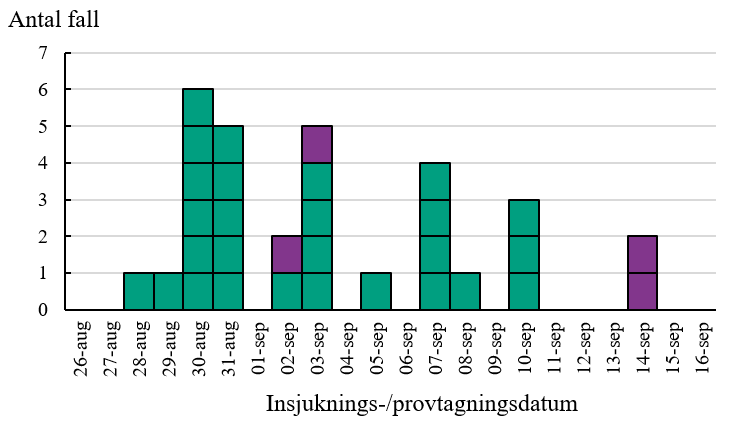
As of August 28, 31 people have been confirmed infected with Salmonella Coeln. Whole genome sequencing (analysis of the bacterium’s genome) has shown that the disease cases carry the same strain of Salmonella Coeln and are thus suspected of having been infected by a common source of infection. The cases, which are aged 0-85 years (median = 28 years), are resident in twelve different regions in Sweden and 18 (58 percent) of the patients are men. Affected infection control units, municipalities and County Administrative Boards, together with the National Food Administration and the Swedish Public Health Agency, are investigating the outbreak to identify the source of infection that is suspected to be a food with a wide distribution in Sweden.

Figure. Disease curve for outbreak cases with Salmonella Coeln (n = 31), 2021-09-24. For cases marked in purple, information on the date of illness is missing and instead the sampling date has been specified.

The bar graph shows that 0-6 people fell ill or were sampled per day between 28 August and 14 September

USA – Famous Anthony’s Hepatitis A Outbreak Sickens 10 in Roanoke, VA

Food Poisoning Bulletin

A potential Famous Anthony’s hepatitis A outbreak in Roanoke, Virginia has sickened at least 10 people, according to news reports and the Roanoke City and Alleghany Health Districts. An employee who tested positive for the virus worked while infectious at three Famous Anthony’s restaurants that are located on Grandin Road, Williamson Road, and Crystal Spring Avenue in that city. All ten patients were hospitalized. Officials think the case count will increase.

The employee worked there between August 10 and August 26, 2021. That means that it is too late for anyone who was exposed there during that time frame to get the hepatitis A or immune globulin vaccine. The vaccine is only effective if given within two weeks of exposure.

USA – Salmonella outbreak grows rapidly over past few weeks.

Outbreak News Today

The Centers for Disease Control and Prevention (CDC) reported an additional 152 Salmonella Oranienburg infections in the multistate outbreak that was first reported earlier this month.

The outbreak, which totals 279 cases to date, has expanded to 29 states. 26 people required hospitalization for their illness, an increase of 8 over the past week.

Texas has reported the most cases with 81, followed by 40 in Oklahoma, 23 in Illinois and 22 in Virginia.

A specific food item has not yet been identified as the source of this outbreak. CDC and public health and regulatory officials in several states are collecting different types of data.

Russia – Botulism increase reported in Tatarstan

Outbreak News Today

kswfoodworld

The head of the territorial department of the Rospotrebnadzor Administration for the Republic of Tatarstan, Irina Khairullina said twelve botulism cases have been reported this year in the districts of Almetyevsky, Zainsky, Leninogorsky and Sarmanovsky. This compares with two botulism cases reported in the previous two years.

Khairullina notes, 10 people got sick while eating homemade smoked fish, while 2 people associate their disease with the consumption of smoked goose meat, bought from unknown persons in places of unauthorized trade.

USA- Decreased Incidence of Infections Caused by Pathogens Transmitted Commonly Through Food During the COVID-19 Pandemic — Foodborne Diseases Active Surveillance Network, 10 U.S. Sites, 2017–2020

CDC

Summary

What is already known about this topic?

Before 2020, the incidence of infections transmitted commonly by food had not declined for many years.

What is added by this report?

During 2020, FoodNet identified 26% fewer infections compared with the average annual number during 2017–2019, including decreased infections associated with international travel.

What are the implications for public health practice?

The pandemic and resulting public health response present challenges to explaining changes in observed foodborne illness incidences. Continued surveillance might help elucidate the impact of the COVID-19 pandemic on foodborne illness and identify strategies to decrease illnesses. Concerted efforts are needed to reduce the incidence of these infections from farm to processing plant to restaurants and homes. Consumers can reduce their risk of foodborne illness by following safe food-handling and preparation recommendations.

Foodborne illnesses are a substantial and largely preventable public health problem; before 2020 the incidence of most infections transmitted commonly through food had not declined for many years. To evaluate progress toward prevention of foodborne illnesses in the United States, the Foodborne Diseases Active Surveillance Network (FoodNet) of CDC’s Emerging Infections Program monitors the incidence of laboratory-diagnosed infections caused by eight pathogens transmitted commonly through food reported by 10 U.S. sites.* FoodNet is a collaboration among CDC, 10 state health departments, the U.S. Department of Agriculture’s Food Safety and Inspection Service (USDA-FSIS), and the Food and Drug Administration. This report summarizes preliminary 2020 data and describes changes in incidence with those during 2017–2019. During 2020, observed incidences of infections caused by enteric pathogens decreased 26% compared with 2017–2019; infections associated with international travel decreased markedly. The extent to which these reductions reflect actual decreases in illness or decreases in case detection is unknown. On March 13, 2020, the United States declared a national emergency in response to the COVID-19 pandemic. After the declaration, state and local officials implemented stay-at-home orders, restaurant closures, school and child care center closures, and other public health interventions to slow the spread of SARS-CoV-2, the virus that causes COVID-19 (1). Federal travel restrictions were declared (1). These widespread interventions as well as other changes to daily life and hygiene behaviors, including increased handwashing, have likely changed exposures to foodborne pathogens. Other factors, such as changes in health care delivery, health care–seeking behaviors, and laboratory testing practices, might have decreased the detection of enteric infections. As the pandemic continues, surveillance of illness combined with data from other sources might help to elucidate the factors that led to the large changes in 2020; this understanding could lead to improved strategies to prevent illness. To reduce the incidence of these infections concerted efforts are needed, from farm to processing plant to restaurants and homes. Consumers can reduce their risk of foodborne illness by following safe food-handling and preparation recommendations.

FoodNet conducts active, population-based surveillance of laboratory-diagnosed infections caused by Campylobacter, Cyclospora, Listeria, Salmonella, Shiga toxin-producing Escherichia coli (STEC), Shigella, Vibrio, and Yersinia reported from 10 sites covering approximately 15% of the U.S. population (approximately 50 million persons per U.S. Census Bureau estimates in 2019). Bacterial infections are defined as isolation of bacteria from a clinical specimen by culture or detection of pathogen antigen, nucleic acid sequence, or, for STEC, Shiga toxin or Shiga toxin genes by a culture-independent diagnostic test (CIDT).§ Listeria infections are defined as isolation of L. monocytogenes or detection of its nucleic acid sequences from a normally sterile site, or from placental or fetal tissue in the instance of miscarriage or stillbirth. Cyclospora infections are defined as detection of the parasite using ultraviolet fluorescence microscopy, specific stains, or polymerase chain reaction.

In this analysis, patients with no history of international travel or unknown travel were considered to have domestically acquired infection. Death was attributed to infection when it occurred during hospitalization or within 7 days after specimen collection for non-hospitalized patients. Incidence (cases per 100,000 population) was calculated by dividing the number of infections in 2020 by the U.S. Census estimates of the surveillance area population for 2019. Incidence measures included all laboratory-diagnosed infections. A negative binomial model with 95% confidence intervals (CIs) was used to estimate change in incidence during 2020 compared with those during 2017–2019, adjusting for changes in the population over time.

Surveillance for physician-diagnosed post-diarrheal hemolytic uremic syndrome (HUS), a complication of STEC infection characterized by renal failure, thrombocytopenia, and microangiopathic anemia, was conducted through a network of nephrologists and infection preventionists and by hospital discharge data review. This report includes HUS data for children aged <18 years for 2019, the most recent year for which data are available. FoodNet surveillance activities were reviewed by CDC and were conducted consistent with applicable federal law and CDC policy.**

During 2020, FoodNet identified 18,462 cases of infection, 4,788 hospitalizations, and 118 deaths (Table). The overall incidence was highest for Campylobacter (14.4 per 100,000 population), followed by Salmonella (13.3), STEC (3.6), Shigella (3.1), Yersinia (0.9), Vibrio (0.7), Cyclospora (0.6), and Listeria (0.2). During 2020, 26% fewer infections were reported compared with the average annual number reported during 2017–2019; the incidence in 2020 was significantly lower for all pathogens except Yersinia and Cyclospora. The percentage of infections resulting in hospitalization increased 2% compared with 2017–2019 (Figure 1). During 2020, 5% (958) of infections were associated with international travel compared with 14% during 2017–2019. In 2020, most (798; 83%) of these infections occurred during January–March.

Overall, 59% of bacterial infections were diagnosed using a CIDT (range = 14% [Listeria] to 100% [STEC]); this was a 2% increase from 2017−2019. The percentage diagnosed using only a CIDT (i.e., including specimens with negative cultures and those not cultured) was 1% higher during 2020 than the percentage during 2017−2019. Among specimens with a positive CIDT result during 2020, a reflex culture†† was performed for 73%, which was 2% lower than during 2017–2019. Reflex cultures decreased for Vibrio (by 15%), Yersinia (7%), Campylobacter (5%), and STEC (2%); increased for Salmonella (2%), and Shigella (2%); and did not change for Listeria.

Among 5,336 (91%) fully serotyped Salmonella isolates in 2020, the seven most common serotypes were Enteritidis (1.6 per 100,000 population), Newport (1.5), Javiana (1.0), Typhimurium (0.9), I 4,[5],12:i:- (0.5), Hadar (0.4), and Infantis (0.3). Compared with 2017–2019, incidence during 2020 was significantly lower for I 4,[5],12:i:- (48% lower), Typhimurium (37% lower), Enteritidis (36% lower), and Javiana (31% lower). Incidence was significantly higher for Hadar (617% higher; 95% CI = 382–967) and did not change significantly for Newport or Infantis. Most (73%) of the 631 outbreak-associated Salmonella infections during 2020 were caused by three serotypes: Newport (220; 35%), Hadar (135; 21%), and Enteritidis (108; 17%). All outbreak-associated Hadar infections were from one multistate outbreak linked to contact with backyard poultry; 47 (35%) illnesses resulted in hospitalization. Four serogroups accounted for 63% of the 955 culture-positive STEC isolates. Serogroup O157 was most common (264; 28%), followed by O26 (148; 15%), O103 (115; 12%), and O111 (78; 8%).

FoodNet identified 63 cases of post-diarrheal HUS in children aged <18 years (0.6 cases per 100,000 population) during 2019; 55 (87%) had evidence of STEC infection and 41 (65%) were in children aged <5 years (1.4 per 100,000 population). These rates were similar to those during 2016–2018.

USA – Illinois La Mex and El Sombrero restaurants likely linked to nationwide Salmonella outbreak

Food Poison Journal

As of September 21, 2021 the CDC reported (revised later to 279)  infected with the outbreak strain of Salmonella Oranienburg reported from 29 states. Illnesses started on dates ranging from August 3, 2021 to September 13, 2021.

Of note, Illinois has 28 illnesses reported and the following two health departments produced interim reports on seemingly separate Salmonella outbreaks that now are likely linked to the multi-state Salmonella Oranienburg outbreak that appears linked to cilantro consumption.

On September 9th, the Grundy County Health Department identified at least eight Salmonella cases in Grundy County that appear to be linked to the La Mex restaurant located 115 E. Jackson Street in Morris Illinois. Illnesses appeared linked to food consumed at La Mex restaurant between 8/31/2021 and 9/7/2021.

On September 4th,  the McHenry County Department of Health reported a foodborne illness outbreak of a gastrointestinal illness caused by Salmonella.  The illnesses were linked to El Sombrero restaurant at 314 Lincoln Ave, Fox River Grove. Those who ate at the food establishment from August 23 to September 3, regardless of if they develop symptoms or remain well, were asked to assist MCDH in collecting data to conduct a comprehensive investigation of this illness outbreak to eliminate the public health risk.

USA – Salmonella Outbreak with Unknown Food Source

CDC

A specific food item has not yet been identified as the source of this fast-growing outbreak. If you have symptoms of a Salmonella infection, talk to your healthcare provider and report your illness to your health department to help investigators solve this outbreak.

Fast Facts
  • Illnesses: 279  (152 new)
  • Hospitalizations: 26  (8 new)
  • Deaths: 0
  • States: 29  (4 new)
  • Recall: No
  • Investigation status: Active

USA – Cilantro May Be the Source in Mystery Multistate Salmonella Outbreak

Food Poisoning Bulletin

Salmonellaa

Cilantro may be the source in the mystery multistate Salmonella Oranienburg outbreak, according to a dendrogram on the National Center for Biotechnology Information site, part of the National Institutes of Health. According to that information, cilantro has tested positive for Salmonella Oranienburg, the bacteria that has caused this outbreak.

USA – How to Report a Foodborne Illness – General Public

CDC

Please contact your local health department, also known as a county or city health department, if you believe you or someone you know became ill from eating a certain food. Ask to speak with the environmental health specialist, or sanitarian, about a possible food problem. Refer to your state health department website to find more information about how to contact your local health department.

Reporting illnesses to your local health department helps them identify potential foodborne disease outbreaks. Public health officials learn about possible problems in food preparation, production, and distribution that may cause illness during investigations of foodborne disease outbreaks.

Contact CDC about a Foodborne Illness:

Please call CDC INFO at 1-800-CDC-INFO (1-800-232-4636).

USA – Georgetown University reports outbreak among students; source unknown

Food Safety News

At least a dozen students at Georgetown University have reported being sick with symptoms that resemble foodborne illness and an official says they may be part of a nationwide outbreak of Salmonella infections.

Chief Public Health Officer Dr. Ranit Mishori says the school is working to determine the cause of the illnesses.

“At this time we do not know the cause of the symptoms, but it is prudent to assume they are related to an infectious process. Please be aware that the U.S. Centers for Disease Control and Prevention has reported a national outbreak of Salmonella from an unknown source,” according to a letter Mishori sent to students and staff. 

Students have reported symptoms including severe stomach pains, vomiting and diarrhea, which are consistent with foodborne illness.