Category Archives: Food Illness

Norway – searches for source of hepatitis A outbreak – food suspected

Food Safety News

Norwegian public health officials are investigating an outbreak of hepatitis A that has affected 10 people.

The Norwegian Institute of Public Health (FHI) reported an investigation has been started with local health services and the Norwegian Food Safety Authority (Mattilsynet) but the suspected source is unknown.

Infection has been detected in 10 people living in several counties. Another two people are suspected of being part of the outbreak.

Samples were taken from April to September and sequencing shows hepatitis A virus (HAV) with an identical sequence of genotype 1A in all of the patients. This suggests they were infected from the same source.

Sick people are between 25 and 80 years old with a median age of 53. Sixty percent are men.

Widely distributed food suspected
Six patients live in Viken, two in Trøndelag and one each in Oslo, Vestfold og Telemark, Innlandet and Troms og Finnmark.
USA – Outbreak Investigation of Salmonella Typhimurium: Bright Farms Packaged Salad Greens (July 2021) -Outbreak is over

FDA

The FDA, along with CDC and state and local partners, investigated a multistate outbreak of Salmonella Typhimurium infections linked to the consumption of BrightFarms packaged salad greens produced in the firm’s Rochelle, IL facility.

FDA visited the facility and collected samples. Some environmental samples taken inside the facility tested positive for Salmonella Liverpool, but were not a match to the outbreak strain. In addition, a sample collected from an outdoor storm water drainage pond adjacent to the facility was analyzed and reported to be Salmonella Typhimurium and a genetic match to the outbreak strain.

Although no clear route of contamination was readily identified, the FDA is preparing a report to discuss findings and provide information to assist in future prevention efforts.

Recommendation

CDC has declared this outbreak to be over.

Investigation Background

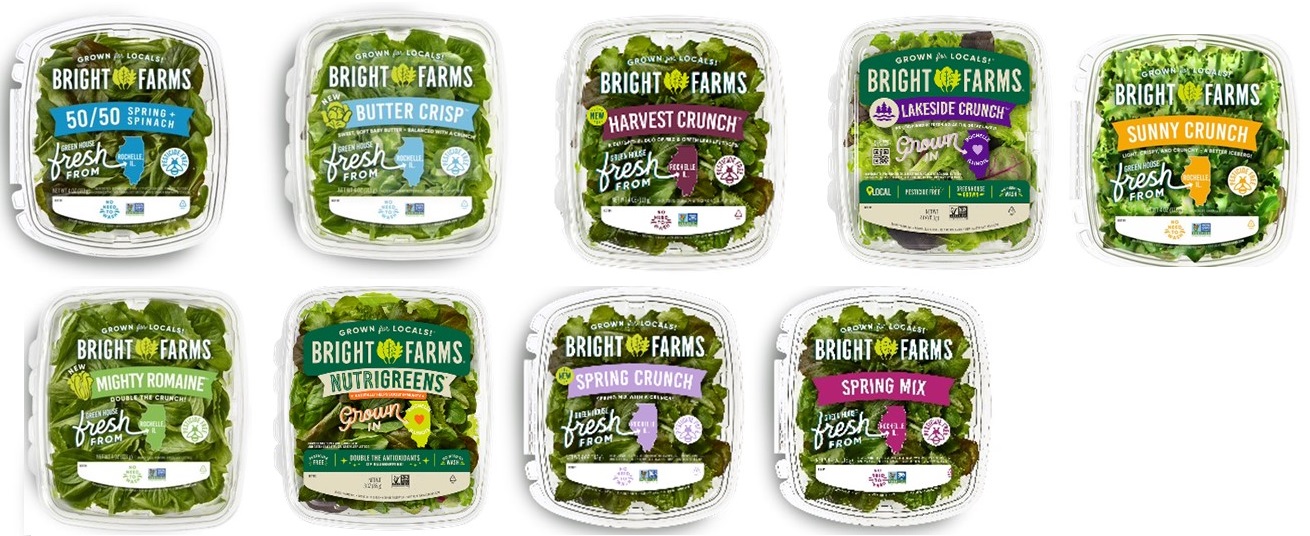
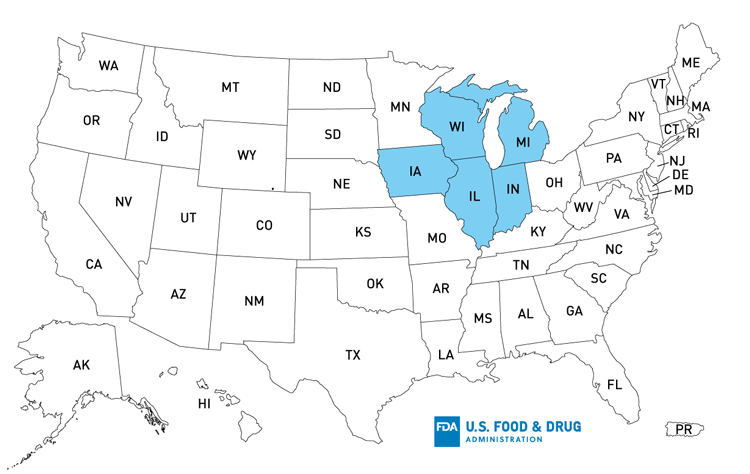
On July 15, 2021, BrightFarms recalled packaged salad greens produced in its Rochelle, Illinois (Ogle County) greenhouse farm sold in Illinois, Indiana, Iowa, and Wisconsin. On July 21, 2021, Michigan was added to the list of states that received recalled products. Interview data and shopper card records show that 15 people ate or bought multiple types of BrightFarms brand salad products before they got sick, including Sunny Crunch, 50/50 Spring & Spinach, Harvest Crunch, and Butter Crisp. FDA conducted a traceback investigation and identified the farm in Rochelle, IL, as the likely source of the BrightFarms brand salad bought by people who became ill. On July 28, 2021, following positive sample results, BrightFarms expanded their recall to include Baby Spinach packaged in clear, plastic clamshells with “Best By” dates through 7/26/2021.


Product Images

Outbreak Investigation of Salmonella Typhimurium in BrightFarms Packaged Salad Greens - Product Images

View Larger Images

Map of U.S. Distribution of Recalled BrightFarms Products

Outbreak Investigation of Salmonella Typhimurium in BrightFarms Packaged Salad Greens - Map of U.S. Distribution of Recalled Products (October 6, 2021)

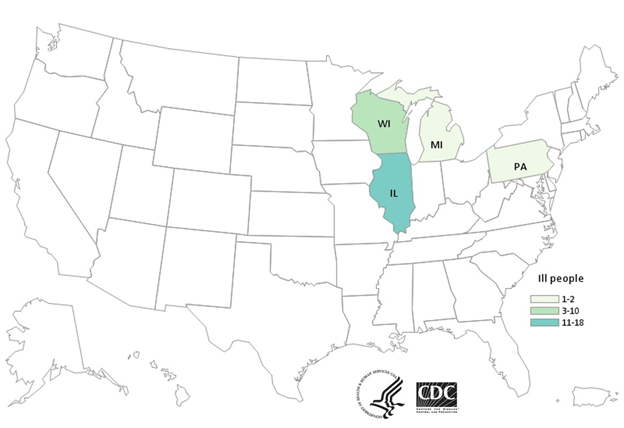
Case Count Map Provided by CDC

Outbreak Investigation of Salmonella Typhimurium in BrightFarms Packaged Salad Greens - CDC Case Count Map (October 6, 2021)

Case Counts

Total Illnesses: 31
Hospitalizations: 4
Deaths: 0
Last Illness Onset: August 18, 2021
States with Cases: IL (18), MI(1), PA (2), WI (10)
Product Distribution*: IA, IL, IN, MI, WI
*Distribution has been confirmed for states listed, but product could have been distributed further, reaching additional states

USA – Domestically Acquired Cases of Cyclosporiasis — United States, May–August 2021

CDC

cardcyclosporasme

LAST UPDATED SEPTEMBER 30, 2021 4:00 PM EDT

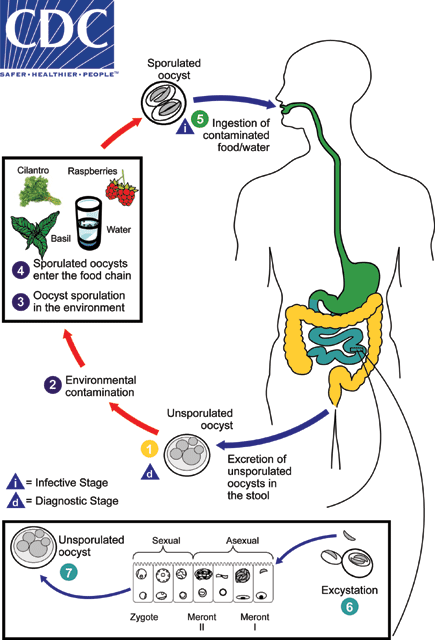
Cyclosporiasis illnesses are reported year-round in the United States. However, during the spring and summer months there is often an increase in cyclosporiasis acquired in the United States (i.e., “domestically acquired”). The exact timing and duration of these seasonal increases in domestically acquired cyclosporiasis can vary, but reports tend to increase starting in May. In previous years the reported number of cases peaked between June and July, although activity can last as late as September. The overall health impact (e.g., number of infections or hospitalizations) and the number of identified clusters of cases (i.e., cases that can be linked to a common exposure) also vary from season to season. Previous U.S. outbreaks of cyclosporiasis have been linked to various types of fresh produce, including basil, cilantro, mesclun lettuce, raspberries, and snow peas.

At a Glance
  • Illnesses: 1020
  • Hospitalizations: 70
  • Deaths: 0
  • States reporting cases: 36

CDC, along with state and federal health and regulatory officials, monitor cases of cyclosporiasis in the United States in the spring and summer months to detect outbreaks linked to a common food source. However, many cases of cyclosporiasis cannot be directly linked to an outbreak, in part because of the lack of validated laboratory “fingerprinting” methods needed to link cases of Cyclospora infection. Officials use questionnaires to interview sick people to determine what they ate in the 14-day period before illness onset. If a commonality is found, CDC and partners work quickly to determine if a contaminated food product is still available in stores or in peoples’ homes and issue advisories.

Final Update

  • In 2021, multiple outbreaks of cyclosporiasis cases associated with different restaurants or events were investigated by state public health authorities, CDC, and FDA.
    • CDC investigated two large multistate outbreaks of cyclosporiasisexternal icon, one including 40 illnesses and one with 130 illnesses, in which ill people reported eating various types of leafy greens. State officials and FDA conducted traceback investigations for these two outbreaks, but a specific type or grower of leafy greens was not identified as the source of either outbreak.
  • As of September 28, 2021, 1,020 laboratory-confirmed cases of cyclosporiasis in people who had no history of international travel during the 14-day period before illness onset have been reported to CDC by 37 jurisdictions, including 36 states and New York City, since May 1, 2021.
    • The median illness onset date is June 25, 2021 (range: May 1–August 31, 2021).
    • At least 70 people have been hospitalized; no deaths have been reported.

September 30, 2021

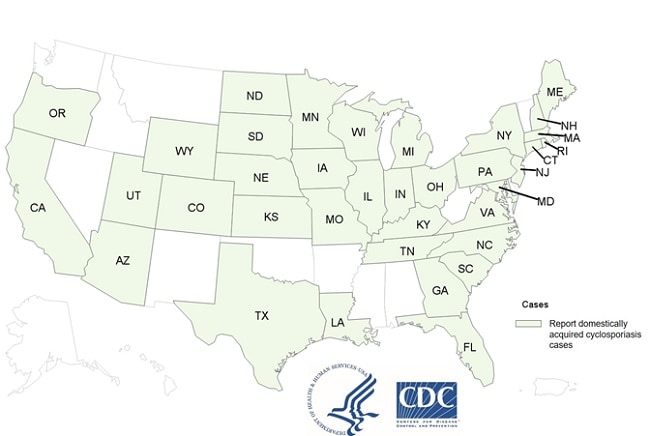
Geographic Distribution of Reported Cases of Domestically Acquired Cyclosporiasis—May 1 to August 31, 2021*

outbreak_map_season_9_30_21

* Data are current as of 09/28/2021 (9:00am EDT). States/jurisdictions highlighted on the map have each reported at least one case. New York State includes case reports from New York City. Data are preliminary and subject to change. For questions related to the number of cases reported in each state, contact that state’s health department.

Botulism Symptoms.

CDC

kswfoodworld

Signs and symptoms might include:

  • Difficulty swallowing
  • Muscle weakness
  • Double vision
  • Drooping eyelids
  • Blurry vision
  • Slurred speech
  • Difficulty breathing
  • Difficulty moving the eyes

Possible signs and symptoms in foodborne botulism might also include:

  • Vomiting
  • Nausea
  • Stomach pain
  • Diarrhea

Signs and symptoms in an infant might include:

  • Constipation
  • Poor feeding
  • Drooping eyelids
  • Pupils that are slow to react to light
  • Face showing less expression than usual
  • Weak cry that sounds different than usual
  • Difficulty breathing

People with botulism might not have all of these symptoms at the same time.

The symptoms all result from muscle paralysis caused by the toxin. If untreated, the disease may progress and symptoms may worsen to cause full paralysis of some muscles, including those used in breathing and those in the arms, legs, and trunk (part of the body from the neck to the pelvis area, also called the torso).

In foodborne botulism, symptoms generally begin 18 to 36 hours after eating a contaminated food.

If you or someone you know has symptoms of botulism, immediately see your doctor or go to the emergency room.

South Africa – South African oysters linked to illness in Hong Kong

Food Safety News

Oysters from South Africa have been linked to cases of food poisoning in Hong Kong.

The Centre for Food Safety (CFS) in Hong Kong ordered the suspension of imports of raw oysters produced by Zwembesi Farm Limited in South Africa this past week.

Six food poisoning clusters have been identified after consumption of raw oysters at one restaurant in Mong Kok and another in Tsim Sha Tsui. It is not clear what the infectious agent is or how many people are sick.

The Centre for Health Protection (CHP) previously reported it was investigating two clusters involving 11 illnesses in people that had dinner at a restaurant in Mong Kok.

USA – Cyclospora cases top 1000 in the US, 36 states reporting cases

Outbreak News Today

The Centers for Disease Control and Prevention (CDC) reported 156 additional Cyclospora cases in the past month, putting the total cases since May 2021.

The 1,020 laboratory-confirmed cases of cyclosporiasis were reported in people who had no history of international travel during the 14-day period before illness onset. Cases have been reported in 37 jurisdictions, including 36 states and New York City.

Seventy people required hospitalization for their illness.

USA – More patients identified in hepatitis A outbreak linked to restaurants

Food Safety News

At least three people have been admitted to hospitals in a growing outbreak of hepatitis A linked to restaurants in Virginia.

There are now 14 people confirmed infected, according to state health officials. Four of those patients are new since the outbreak was initially reported on Sept. 24. 

Additional patients are highly likely to be identified. It takes 15 to 50 days for hepatitis A symptoms to develop, according to the Centers for Disease Control and Prevention.

The infected people ate at three Famous Anthony’s restaurants, according to the Virginia Department of Health. Cynthia Morrow from the Roanoke City and Alleghany Health Districts provided an update on the outbreak earlier this week.

USA – 417 with Salmonella in 35 States

Food Poison Journal

Cilantro still looks suspicious, but NCIB dendrogram now says “mixed produce.”

Illinois, Maryland, Minnesota, Oklahoma, Texas and Virginia hardest hit.

The CDC reports today that since the last update on September 23, 2021, 140 more people were added to this outbreak. As of September 29, 2021, 419 people infected with the outbreak strain of Salmonella Oranienburg have been reported from 35 states. Illnesses started on dates ranging from June 19, 2021, to September 14, 2021.

Singapore – Recall and prohibition of sale and movement of Mdm Ling Bakery Mao Shan Wang – Gastrointestinal Issues Snowskin Mooncakes

Click to access joint-moh-sfa-media-release—recall-and-prohibition-of-sale-and-movement-of-mdm-ling-bakery-mao-shan-wang-snowskin-mooncakes.pdf

USA – Is Salmonella Oranienburg Outbreak Connected to Onions or Limes?

Food Poisoning Bulletin

The rapidly expanding Salmonella Oranienburg outbreak has not yet been definitively solved by the FDA or CDC, but there are clues in the latest investigation information. On Friday, September 24, 2021, the CDC said that they found the outbreak strain in a takeout condiment cup that contained cilantro, onion, and lime. Is the Salmonella Oranienburg outbreak connected to onions or lime?