Category Archives: Food Illness

Research – Collective food poisoning (TIAC) ​​with E. coli O157 producing Shiga toxins, associated with the consumption of raw cucumbers

Sante Publique

On September 9, 2021, the Regional Health Agency (ARS) of Hauts-de-France was informed of a suspicion of collective food poisoning (TIAC) ​​affecting half-board students, educated in several schools in a municipality. of the Lille metropolis. 

On September 13, 2021, two cases of haemolytic and uremic syndrome (HUS) were diagnosed in two hospitalized children attending school in this town. Public Health France Hauts-de-France was asked by the Hauts-de-France ARS to provide support for the investigations and management of this TIAC. A total of 35 cases of gastroenteritis, with bloody diarrhea and fever (>38°C) in half of the cases, were identified. Ten cases were hospitalized and two children developed HUS. 

The cases identified were half-board students in four school groups (29 cases), a parent of a student and elderly people benefiting from the municipality’s home meal delivery service (5 cases). The case canteens were all supplied by the central municipal kitchen. 

The shape of the epidemic curve was in favour of a common and point source of contamination during meals on September 2 or 3, 2021. The case-control survey, carried out in schools, concluded that only the consumption of cucumbers in salad, served with the meal on September 2, was statistically and significantly associated with the occurrence of the disease.

A strain of E. highly pathogenic Shiga toxin-producing (STEC) O157 coli was isolated from the stool cultures of eight cases, including the two children who developed HUS and in the offending cucumber salad. Genomic analysis of the strains confirmed the genetic clustering of clinical and food strains that belonged to the same genomic cluster. The veterinary investigation revealed that a failure in the decontamination process, associated with incomplete peeling of the contaminated cucumbers, contributed to the occurrence of this TIAC. 

The cucumbers in question came from Belgium and the Belgian health authorities were informed via the dedicated European alert circuits. No other episodes of clusters of STEC infection related to this TIAC have been reported to the ARS over the period while cucumbers from the same batch had been widely distributed in communities and commercial catering services in the Hauts-de-France region. The food vehicle, incriminated in this TIAC, is part of the plants at risk because of its raw mode of consumption. It is important to remind vulnerable populations and collective catering services that preventing the risk of STEC infection, linked to the consumption of raw vegetables, requires washing, disinfection and peeling.
Report

Canada – Mystery Cyclospora Outbreak spreads to Canada

Food Poison Journal

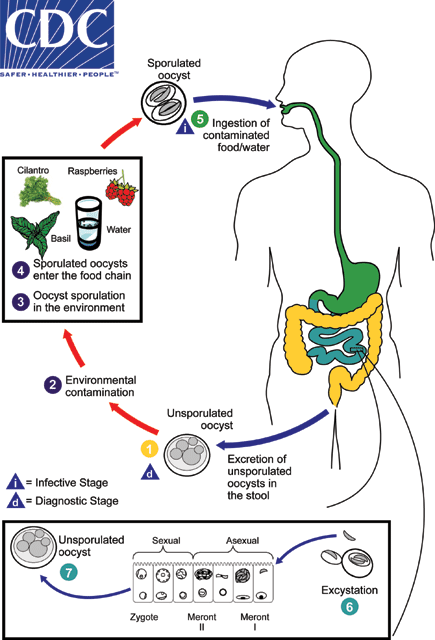
Public Heath Canada is working with its public health and food safety partners to identify possible ways non-travel related Cyclospora infections are occurring in Canada.

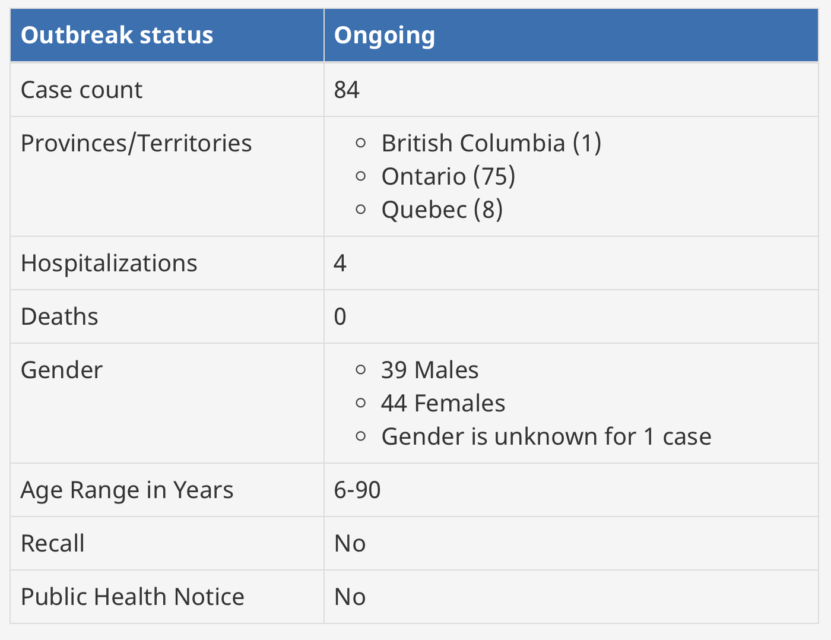
As of June 30, a total of 84 cases of Cyclospora infections were reported in the following provinces: British Columbia (1), Ontario (75), and Quebec (8). 4 individuals have been hospitalized and no deaths have been reported. To date, there is no recall or Public Health Notice, the investigation is ongoing.

In case you are experiencing Cyclosporiasis symptoms such as watery diarrhea (most common), cramping, bloating, increased gas, nausea, fatigue, and possibly vomiting and low-grade fever, it is important to report it. It can help to detect & resolve outbreaks early and prevent others from being harmed, and it enables better surveillance. If symptoms persist, seek medical care.

India – Six commandos fall ill due to food poisoning in Karnal

Hindustan Times

At least six commandos fell ill due to suspected food poisoning at the Commando Complex in Newal village of Karnal district.

Soon after they developed vomiting, the commandos were taken to Kalpana Chawla Government Medical College. Later, one commando, Anshu, was referred to Medanta Medicity at Gurugram where his condition was said to be stable.

As per information, the commandos were in training when their health deteriorated.

Ramesh Chander, DSP, Commando Complex said that they had consumed regular meal and that an investigation to find out the reasons behind the food poisoning was going on.

India – 24 wedding guests fall ill after drinking mango juice served with dinner

India Tv News

HIGHLIGHTS

  • 24 people fell ill in Uttar Pradesh’s Mathura after having food at a wedding
  • These people did not wake up in the morning and were found unconscious by their family members
  • Prima facie, it appears to be a case of food poisoning

In a suspected case of food poisoning, 24 people fell ill in Uttar Pradesh’s Mathura on Saturday after having food at a wedding, police said.

Chief Medical Officer Ajay Kumar Verma said the ‘baraat’ of one Nandu had gone to Nathu ki Garhi village in Agra on Friday from Parkham (Beri) village under the Farah police station area here. Some of the guests returned home at night.

USA – Listeria Outbreak Linked to Ice Cream

CDC

Listeria Outbreak Linked to Ice Cream

Illustration with a triangle and exclamation mark and text reading Food Safety Alert

Posted July 8, 2022

CDC is concerned that Big Olaf Creamery ice cream could still be in people’s homes or available for sale in stores. Big Olaf Creamery ice cream is sold in Florida in Big Olaf Creamery stores and stores with different company names.

Fast Facts
  • Illnesses: 23
  • Hospitalizations: 22
  • Deaths: 1
  • States: 10
  • Recall: No
  • Investigation status: Active
Representative image for this outbreak
What Everyone Should Do

Do not eat Big Olaf Creamery ice cream.

  • If you have any Big Olaf Creamery ice cream at home, throw it away.
  • If you are in Florida and don’t know if the ice cream being sold is Big Olaf Creamery brand, ask the store before you buy or eat it.

Clean any areas, containers, and serving utensils that may have touched the ice cream.

What Businesses Should Do

Do not serve or sell any Big Olaf Creamery ice cream products.

  • Clean and disinfect any areas and equipment that may have touched Big Olaf Creamery ice cream products, including ice cream scoops and other serving utensils.
What People at Higher Risk Should Do

Listeria is most likely to sicken pregnant people and their newborns, adults aged 65 or older, and people with weakened immune systems. Other people can be infected with Listeria, but they rarely become seriously ill.

Call your healthcare provider right away if you have any of these Listeria symptoms:

  • Pregnant people typically experience only fever, fatigue, and muscle aches. However, Listeria infections during pregnancy can lead to miscarriage, stillbirth, premature delivery, or life-threatening infection of the newborn.
  • People who are not pregnant may experience headache, stiff neck, confusion, loss of balance, and convulsions, in addition to fever and muscle aches.

USA – Domestically Acquired Cases of Cyclosporiasis — United States, May–June 2022

CDC

LAST UPDATED JUNE 30, 2022 4:00 PM EDT

Cyclosporiasis illnesses are reported year-round in the United States. However, during the spring and summer months there is often an increase in cyclosporiasis acquired in the United States (i.e., “domestically acquired”). The exact timing and duration of these seasonal increases in domestically acquired cyclosporiasis can vary, but reports tend to increase starting in May. In previous years the reported number of cases peaked between June and July, although activity can last as late as September. The overall health impact (e.g., number of infections or hospitalizations) and the number of identified clusters of cases (i.e., cases that can be linked to a common exposure) also vary from season to season. Previous U.S. outbreaks of cyclosporiasis have been linked to various types of fresh produce, including basil, cilantro, mesclun lettuce, raspberries, and snow peas.

At a Glance
  • Illnesses: 61
  • Hospitalizations: 6
  • Deaths: 0
  • States reporting cases: 13

CDC, along with state and federal health and regulatory officials, monitor cases of cyclosporiasis in the United States in the spring and summer months to detect outbreaks linked to a common food source. However, many cases of cyclosporiasis cannot be directly linked to an outbreak, in part because of the lack of validated laboratory “fingerprinting” methods needed to link cases of Cyclospora infection. Officials use questionnaires to interview sick people to determine what they ate in the 14-day period before illness onset. If a commonality is found, CDC and partners work quickly to determine if a contaminated food product is still available in stores or in peoples’ homes and issue advisories.

Latest Information

  • This is the first monthly report on the number of domestically acquired cyclosporiasis illnesses with onset on or after May 1, 2022. Cases continue to be reported.
  • As of June 28, 2022, 61 laboratory-confirmed cases of cyclosporiasis in people who had no history of international travel during the 14-day period before illness onset have been reported to CDC by 13 states since May 1, 2022.
    • The median illness onset date is May 31, 2022 (range: May 3–June 20, 2022).
    • At least 6 people have been hospitalized; no deaths have been reported.

USA – Starbucks withdraws new chicken sandwich over quality concerns

NBC

Starbucks has withdrawn a recently introduced breakfast chicken sandwich from its locations, saying Friday the seasonal item failed to meet its standards for quality.

The Seattle-based company said it issued a voluntary “stop sell” for its chicken, maple butter and egg sandwich on June 26. Any claims the item caused specific illness are simply false, Starbucks said.

Unverified reports on social media claim the sandwich made a few people sick. The crowdsourced website iwaspoisoned.com, which is dedicated to tracking foodborne illness outbreaks and credited with helping identify several outbreaks, logged five claims the sandwich made customers feel ill, at least temporarily.

“The quality issue that was identified by Starbucks would not lead to food borne illness and any reports linking the stop sale to illness are inaccurate,” Starbucks said in a statement.

Sweden – Foodborne illness figures rise in Sweden in 2021

Food Safety News

The number of foodborne infections climbed in Sweden in 2021 compared to the year before but most are still below pre-Coronavirus pandemic levels.

The report by the National Veterinary Institute (SVA), Folkhälsomyndigheten (the Public Health Agency of Sweden), Livsmedelsverket (the Swedish Food Agency) and Jordbruksverket (Swedish Board of Agriculture) showed a rise for Campylobacter, Salmonella, Listeria, E. coli and Yersinia infections.

Disease surveillance relies on patients seeking care and fewer people have done this during the pandemic. This is believed to be related to patients with symptoms choosing to not seek care and a true reduction in disease incidence because of changes in general hygiene such as increased handwashing, physical distancing and reduced travel because of COVID-19-related recommendations, according to the agencies.

USA – FDA Core Investigation Table

FDA

What’s New

  • For the Salmonella Braenderup outbreak in a not yet identified food (ref# 1075), the case count has increased from 42 to 59 cases.
  • For the Listeria monocytogenes outbreak (ref# 1057), a product linked to illnesses is ice cream from Big Olaf Creamery, located in Florida.
Date
Posted
Ref
#
Pathogen or
Cause of Illness

Product(s)
Linked to
Illnesses

(if any)
Total
Case Count

Status
6/29/

2022

1076 Not Yet Identified Frozen Food See Outbreak
Advisory
Active
6/22/

2022

1075 Salmonella
Braenderup
Not Yet Identified 59 Active
6/22/

2022

1072 Salmonella
Paratyphi B var. L(+) tartrate+
Not Yet Identified 14 Active
6/15/

2022

1070 Listeria
monocytogenes
Not Yet Identified 12 Active
6/8/

2022

1068 E. coli
O157:H7
Not Yet Identified 10 Active
6/1/

2022

1066 Hepatitis A Virus Strawberries See Outbreak
Advisory
Active
5/25/

2022

1067 Salmonella 
Senftenberg
Peanut Butter See Outbreak Advisory Active
4/20/

2022

1064 Not Yet
Identified
Dry Cereal 558 adverse
event reports
Active
4/13/

2022

1057 Listeria
monocytogenes
Ice Cream See CDC’s Investigation Notice Active
3/30/

2022

1060 None
Identified
Meal Replacement
Drink
6 adverse
event reports
Closed
3/16/

2022

1055 Salmonella
Saintpaul
Not Identified 60 Closed
2/17/

2022

1056 Cronobacter
sakazakii
Powdered
Infant
Formula
See
Advisory
Active (IMG)
2/9/

2022

1040 Listeria
monocytogenes
Not Identified 20 Closed
2/2/

2022

1054 Enteroinvasive
E. coli
O143:H26
Not
Identified
16 Closed
1/10/

2022

1050 E. coli
O121:H19
Romaine 4 Closed

CDC – Listeria Outbreak Linked to Ice Cream

CDC

A bit late but it only came through to my inbox today!!

Fast Facts
  • Illnesses: 23Hospitalizations: 22
  • Deaths: 1
  • States: 10
  • Recall: No
  • Investigation status: Active
Representative image for this outbreak
What Everyone Should Do

Consumers who have Big Olaf Creamery brand ice cream at home should throw away any remaining product. Big Olaf Creamery brand ice cream is only sold in Florida.

  • Clean any areas, containers, and serving utensils that may have touched Big Olaf ice cream products.
What Businesses Should Do

Do not serve or sell any Big Olaf ice cream products.

  • Big Olaf Creamery in Sarasota, FL, is voluntarily contacting retail locations to recommend against selling their ice cream products until further notice.
  • Clean and disinfect any areas and equipment that may have touched Big Olaf ice cream products, including ice cream scoops and other serving utensils.
What People at Higher Risk Should Do

Listeria is most likely to sicken pregnant people and their newborns, adults aged 65 or older, and people with weakened immune systems. Other people can be infected with Listeria, but they rarely become seriously ill.

Call your healthcare provider right away if you have any of these Listeria symptoms:

  • Pregnant people typically experience only fever, fatigue, and muscle aches. However, Listeria infections during pregnancy can lead to miscarriage, stillbirth, premature delivery, or life-threatening infection of the newborn.
  • People who are not pregnant may experience headache, stiff neck, confusion, loss of balance, and convulsions, in addition to fever and muscle aches.