Category Archives: Food Illness

USA – Cyclospora Illnesses Spike to 384 Sick with 30 Hospitalized

Food Poisoning Bulletin

Cyclospora Illnesses Spike to 384 Sick with 30 Hospitalized

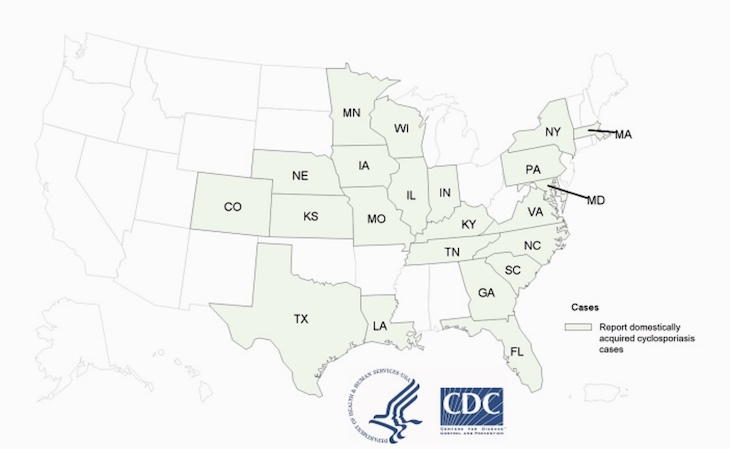
Cyclospora illnesses have spiked to 384 sick in 22 states and 30 hospitalized, according to the Centers for Disease Control and Prevention (CDC). There has been a cyclospora outbreak, in fact, usually several cyclospora outbreaks, in the United States during the spring and summer months every year since 2013. This is an increase of 323 cases since the last update was issued on June 30, 2022. Cases are still being reported.

French E. coli outbreak linked to cucumbers from Belgium

Food Safety News

More than 30 people were sick in France in late 2021 as part of an outbreak traced to contaminated cucumbers.

In September 2021, the Hauts-de-France Regional Health Agency was notified of a suspected foodborne outbreak among students in the Lille area. Two hospitalized children were diagnosed with hemolytic uremic syndrome (HUS). HUS is a severe complication associated with E. coli infection that causes kidney failure. The agency asked Santé publique France for support in investigating the incident.

In total, 35 cases of gastroenteritis, half of whom had bloody diarrhea and fever, were identified. Ten people were hospitalized.

Identified cases were 29 children in four schools and five elderly adults who received meals through a local delivery program. One case was the parent of a pupil. Five children and one adult had meals delivered to them at home.

The median age of patients was 8 with a range of 4 to 89 years old and almost two thirds were female.

School cafeterias and the meal delivery service were all supplied by the same municipal canteen.

450 sick in Ferrero chocolate Salmonella outbreak

Food Safety News

A Salmonella outbreak linked to Kinder chocolate has sickened more than 450 people, based on the latest figures.

Only 10 cases have been reported in the month since the previous European Centre for Disease Prevention and Control (ECDC) update, bringing the total to 455 as of mid-July.

The outbreak has hospitalized a high proportion of people, mostly children younger than 10 years of age, and some had severe clinical symptoms including bloody diarrhea.

The latest monophasic Salmonella Typhimurium case is from the United Kingdom with a sampling date of June 16. Concerns were previously raised by authorities that potentially contaminated chocolate could still be on sale despite a recall in April.

The UK has the most patients with 128 followed by France with 121. Belgium has recorded 66 sick people, 49 are ill in Switzerland, 34 in Germany, 18 in Ireland and 14 in Austria. There are still four cases in Canada and one in the United States.

Sweden, Spain, Norway, Netherlands, Luxembourg, Italy, Denmark and Czech Republic all have single-figure case numbers.

Research – English E. coli outbreak caused by milk pasteurisation problem in 2019

Cambridge Org

In November 2019, an outbreak of Shiga toxin-producing Escherichia coli O157:H7 was detected in South Yorkshire, England. Initial investigations established consumption of milk from a local dairy as a common exposure. A sample of pasteurised milk tested the next day failed the phosphatase test, indicating contamination of the pasteurised milk by unpasteurised (raw) milk. The dairy owner agreed to immediately cease production and initiate a recall. Inspection of the pasteuriser revealed a damaged seal on the flow divert valve.

Ultimately, there were 21 confirmed cases linked to the outbreak, of which 11 (52%) were female, and 12/21 (57%) were either <15 or >65 years of age. Twelve (57%) patients were treated in hospital, and three cases developed haemolytic uraemic syndrome. Although the outbreak strain was not detected in the milk samples, it was detected in faecal samples from the cattle on the farm. Outbreaks of gastrointestinal disease caused by milk pasteurisation failures are rare in the UK. However, such outbreaks are a major public health concern as, unlike unpasteurised milk, pasteurised milk is marketed as ‘safe to drink’ and sold to a larger, and more dispersed, population. The rapid, co-ordinated multi-agency investigation initiated in response to this outbreak undoubtedly prevented further cases.

Spain – 109 infections confirmed in Norovirus outbreak in Mojacar, Almeria, tourist complex

Euroweekly

A total of 109 people have been confirmed infected by the norovirus outbreak at a tourist complex in the Almeria municipality of Mojacar.

An outbreak of norovirus in the Best Pueblo Indalo apartments located in the Almeria municipality of Mojacar has infected 109 people according to a report today, Friday, July 29, from the Territorial Delegation of Health and Families.

The first case was confirmed last Wednesday, July 27, and epidemiologists have since been carrying out an exhaustive tracking of newly affected patients.

“It is an explosive virus, but the symptoms are mild and disappear within 24 to 48 hours”, health sources confirmed to Diario de Almeria. They assured the publication that a significant number of patients had already recovered.

Those affected by this stomach virus have suffered vomiting, gastrointestinal ailments, diarrhoea, and general malaise these past few days. It is a sickness that is not caused by food poisoning but is most likely transmitted through direct contact with surfaces such as a railing or a doorknob.

Argentina – Botulism case prompts warning in Argentina

Food Safety News

kswfoodworld

Argentinian officials have warned people not to consume a specific product line due to the risk of botulism.

The National Administration of Drugs, Foods and Medical Devices (ANMAT) said a suspected case of botulism has been associated with a product of the A Pleno brand, produced in Villa de las Rosas.

No official details were given about the sick person but local station Radio Verdad was told the patient was 47-years old and remained in the hospital in a serious condition after eating an expired A Pleno product.

The General Directorate of Control of the Food Industry in Córdoba and agencies in the areas of Villa de las Rosas and Villa Dolores are involved in the investigation.

ANMAT advised people not to eat any A Pleno branded products, which include peanut butter and cheese spread alternatives, and told traders to stop selling them.

Another outbreak in Argentina in Misiones earlier this year affected up to 18 people with two deaths. It was linked to homemade sausages made from wild animal meat that were shared in the community.

USA – Peas from Wisconsin Farmer’s Market Sicken Six with Salmonella

Food Poison Journal

kswfoodworld Salmonella

The Wisconsin Department of Health Services (DHS), in collaboration with the Department of Agriculture, Trade and Consumer Protection (DATCP) and local health departments, is working to investigate cases of Salmonella infection associated with shelled peas sold at Wisconsin farmers markets. The investigation shows that at least six people were infected with the same strain of Salmonella bacteria after purchasing shelled peas produced by Green Barn Farm Market of Ripon, Wisconsin.  The peas were sold at Green Barn Farm Market farm stands and farmers markets in Ripon, Green Bay, Madison, and Fond du Lac, as well as Green Valley Acres Farm and Company farm stand in Neenah. Shelled peas are loose, no longer in their pod.

India – Adilabad: 30 students of KGBV fell ill due to food poisoning

Telangana Today

As many as 30 girl students of Kasturba Gandhi Balika Vidyalaya were hospitalized when they suffered food-poisoning at their mess in Bhela mandal centre on Monday.

The victims alleged that the food had worms, resulting in illness to them. They accused the warden of adamant and said that the authorities were showing negligence in providing quality food to the pupils. They requested the district authorities to take steps to ensure food was cooked in hygienic conditions and to prevent recurrence of similar incidents in future.

France – Norwegian smoked salmon – Listeria monocytogenes

Gov france

Identification information of the recalled product

  • Product category Feed
  • Product subcategory Fishery and aquaculture products
  • Product brand name prod fish
  • Model names or references Pre-sliced ​​Norwegian smoked salmon
  • Identification of products
    Batch Date
    716158 Use-by date 08/09/2022
  • Packaging Under a vacuum
  • Marketing start/end date From 20/07/2022 to 26/07/2022
  • Storage temperature Product to be stored in the refrigerator
  • Health mark EN 77.122.005 EC
  • Geographic area of ​​sale Whole France
  • Distributors prod’fish blanc sebert foodimport cisseymaree

Practical information regarding the recall

  • Reason for recall Listeria monocytogenes <10ufc/g
  • Risks incurred by the consumer Listeria monocytogenes (causative agent of listeriosis)

Research – Dynamics of Salmonella enterica and antimicrobial resistance in the Brazilian poultry industry and global impacts on public health

PLOS One

Non-typhoidal Salmonella enterica is a common cause of diarrhoeal disease; in humans, consumption of contaminated poultry meat is believed to be a major source. Here we determine that Senterica serovars Heidelberg and Minnesota were the most prevalent serovars in Brazilian poultry and in poultry products imported from Brazil into the UK. However, long-term surveillance data collected by the UK Health Security Agency showed no increase in the incidence of Salmonella Heidelberg or Salmonella Minnesota in human cases of clinical disease in the UK following the increase of these two serovars in Brazilian poultry. Salmonella Heidelberg and Salmonella Minnesota clades shared resistance to sulphonamides, tetracyclines and beta-lactams conferred by sul2tetA and blaCMY-2 genes, not widely observed in other co-circulating serovars despite similar selection pressures. The sul2 and tetA genes were concomitantly carried on IncC plasmids, whereas blaCMY-2 was either co-located with the sul2 and tetA genes on IncC plasmids or independently on IncI1 plasmids. These findings suggest that introduction of the Salmonella Enteritidis vaccine, in addition to increasing antimicrobial use, could have resulted in replacement of salmonellae in Brazilian poultry flocks with serovars that are more drug resistant, but less associated with disease in humans in the UK.