Category Archives: E.coli O145

Research – Attachment of Shiga Toxin-Producing Escherichia coli (STEC) to Pre-Chill and Post-Chill Beef Brisket Tissue

MDPI

Shiga toxin-producing Escherichia coli (STEC) has caused numerous foodborne illness outbreaks where beef was implicated as the contaminated food source. Understanding how STEC attach to beef surfaces may inform effective intervention applications at the abattoir. This simulated meat processing conditions to measure STEC attachment to adipose and lean beef tissue. Beef brisket samples were warmed to a surface temperature of 30 °C (warm carcass), while the remaining samples were maintained at 4 °C (cold carcass), prior to surface inoculation with an STEC cocktail (O26, O45, O103, O111, O121, O145, and O157:H7). Cocktails were grown in either tryptic soy broth (TSB) or M9 minimal nutrient medium. Loosely and firmly attached cells were measured at 0, 3, 5, and 20 min and 1, 3, 8, 12, 24 and 48 h. TSB-grown STEC cells became more firmly attached throughout storage and a difference in loosely versus firmly attached populations on lean and adipose tissues was observed. M9-grown STEC demonstrated a 0.2 log10 CFU/cm2 difference in attachment to lean versus adipose tissue and variability in populations was recorded throughout sampling. Future research should investigate whether a decrease in intervention efficacy correlates to an increase in firmly attached STEC cells on chilled carcasses and/or subprimals, which has been reported. View Full-Text

Research – High Occurrence of Shiga Toxin-Producing Escherichia coli in Raw Meat-Based Diets for Companion Animals—A Public Health Issue

MDPI

Feeding pets raw meat-based diets (RMBDs) is becoming increasingly popular but comes with a risk of pathogenic bacteria, including Shiga toxin-producing Escherichia coli (STEC). In humans, STEC may cause gastrointestinal illnesses, including diarrhea, hemorrhagic colitis (HC), and the hemolytic uremic syndrome (HUS). The aim of this study was to evaluate commercially available RMBDs with regard to the occurrence of STEC. Of 59 RMBD samples, 59% tested positive by real-time PCR for the presence of Shiga toxin genes stx1 and/or stx2. STECs were recovered from 41% of the 59 samples, and strains were subjected to serotyping and virulence gene profiling, using whole genome sequencing (WGS)-based methods. Of 28 strains, 29% carried stx2a or stx2d, which are linked to STEC with high pathogenic potential. Twenty different serotypes were identified, including STEC O26:H11, O91:H10, O91:H14, O145:H28, O146:H21, and O146:H28, which are within the most common non-O157 serogroups associated with human STEC-related illnesses worldwide. Considering the low infectious dose and potential severity of disease manifestations, the high occurrence of STEC in RMBDs poses an important health risk for persons handling raw pet food and persons with close contact to pets fed on RMBDs, and is of concern in the field of public health.

Research – High Occurrence of Shiga Toxin-Producing Escherichia coli in Raw Meat-Based Diets for Companion Animals—A Public Health Issue

MDPI

Feeding pets raw meat-based diets (RMBDs) is becoming increasingly popular but comes with a risk of pathogenic bacteria, including Shiga toxin-producing Escherichia coli (STEC). In humans, STEC may cause gastrointestinal illnesses, including diarrhea, hemorrhagic colitis (HC), and the hemolytic uremic syndrome (HUS). The aim of this study was to evaluate commercially available RMBDs with regard to the occurrence of STEC. Of 59 RMBD samples, 59% tested positive by real-time PCR for the presence of Shiga toxin genes stx1 and/or stx2. STECs were recovered from 41% of the 59 samples, and strains were subjected to serotyping and virulence gene profiling, using whole genome sequencing (WGS)-based methods. Of 28 strains, 29% carried stx2a or stx2d, which are linked to STEC with high pathogenic potential. Twenty different serotypes were identified, including STEC O26:H11, O91:H10, O91:H14, O145:H28, O146:H21, and O146:H28, which are within the most common non-O157 serogroups associated with human STEC-related illnesses worldwide. Considering the low infectious dose and potential severity of disease manifestations, the high occurrence of STEC in RMBDs poses an important health risk for persons handling raw pet food and persons with close contact to pets fed on RMBDs, and is of concern in the field of public health. View Full-Text

Research – Genetic diversity and pathogenic potential of Shiga toxin-producing Escherichia coli (STEC) derived from German flour

Science Direct

Abstract

Shiga toxin-producing Escherichia coli (STEC) can cause severe human illness, which are frequently linked to the consumption of contaminated beef or dairy products. However, recent outbreaks associated with contaminated flour and undercooked dough in the United States and Canada, highlight the potential of plant based food as transmission routes for STEC. In Germany STEC has been isolated from flour, but no cases of illness have been linked to flour.

In this study, we characterized 123 STEC strains isolated from flour and flour products collected between 2015 and 2019 across Germany. In addition to determination of serotype and Shiga toxin subtype, whole genome sequencing (WGS) was used for isolates collected in 2018 to determine phylogenetic relationships, sequence type (ST), and virulence-associated genes (VAGs).

We found a high diversity of serotypes including those frequently associated with human illness and outbreaks, such as O157:H7 (stx2c/d, eae), O145:H28 (stx2a, eae), O146:H28 (stx2b), and O103:H2 (stx1a, eae). Serotypes O187:H28 (ST200, stx2g) and O154:H31 (ST1892, stx1d) were most prevalent, but are rarely linked to human cases. However, WGS analysis revealed that these strains, as well as, O156:H25 (ST300, stx1a) harbour high numbers of VAGs, including eae, nleB and est1a/sta1.

Although STEC-contaminated flour products have yet not been epidemiologically linked to human clinical cases in Germany, this study revealed that flour can serve as a vector for STEC strains with a high pathogenic potential. Further investigation is needed to determine the sources of STEC contamination in flour and flour products particularly in regards to these rare serotypes.

USA – Core Investigation Updated

FDA

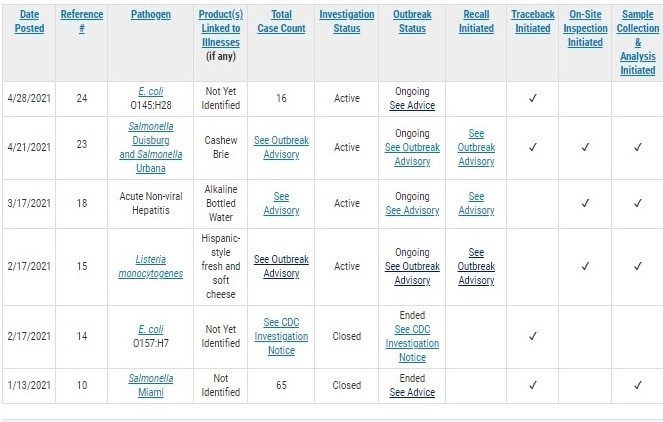
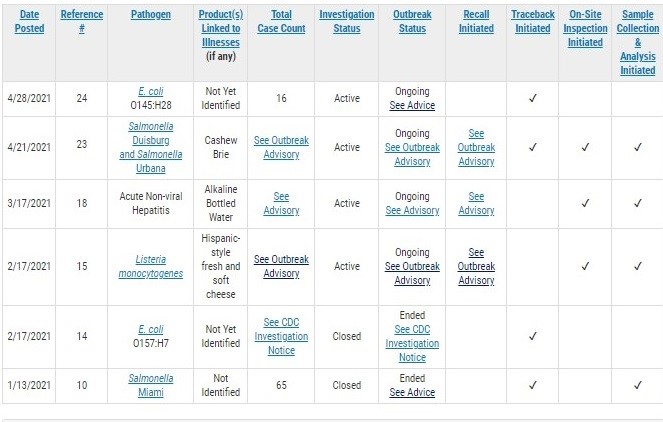
The table includes the conclusion of an  E. coli O145:H28 outbreak. The FDA reports that 16 people were sickened in the outbreak for which a cause has not been detected.

A new Salmonella outbreak has also been added with little other information.

USA – FDA Core Investigation Table Update

FDA

0a

USA – USDA – Outbreak Investigations

FSIS USDA

The table below lists outbreak investigations in which FSIS responded by posting a recall of FSIS-regulated product linked to illness, a public health alert, and/or an after-action review report. The table does not include outbreak investigations that did not result in one or more of these outcomes.

Outbreak Year Pathogen Product Outcomes & References Active
2021 Salmonella Hadar Turkey, ground FSIS Public Notification: FSIS Issues Public Health Alert for Raw Ground Turkey Products Linked to Salmonella Hadar Illness

CDC Notice: Salmonella Outbreak Linked to Ground Turkey

Yes
2021 Salmonella Enteritidis Chicken, raw, breaded, stuffed (suspect) Yes
2021 Escherichia coli O157:H7 (E. coli) Beef, ground (suspect) No
2021 Escherichia coli O145 (E. coli) Beef, ground (suspect) No
2021 Escherichia coli O157:H7 (E. coli) Unknown

CDC Notice: View CDC Investigation Notice

No
2021 Listeria monocytogenes Unknown No

USA – FDA Core Investigation Table

FDA

0a


Research – Prevalence and Epidemiology of Non-O157 Escherichia coli Serogroups O26, O103, O111, and O145 and Shiga Toxin Gene Carriage in Scottish Cattle, 2014–2015

ASM

ABSTRACT

Cattle are a reservoir for Shiga toxin-producing Escherichia coli (STEC), zoonotic pathogens that cause serious clinical disease. Scotland has a higher incidence of STEC infection in the human population than the European average. The aim of this study was to investigate the prevalence and epidemiology of non-O157 serogroups O26, O103, O111, and O145 and Shiga toxin gene carriage in Scottish cattle. Fecal samples (n = 2783) were collected from 110 herds in 2014 and 2015 and screened by real-time PCR. Herd-level prevalence (95% confidence interval [CI]) for O103, O26, and O145 was estimated as 0.71 (0.62, 0.79), 0.43 (0.34, 0.52), and 0.23 (0.16, 0.32), respectively. Only two herds were positive for O111. Shiga toxin prevalence was high in both herds and pats, particularly for stx2 (herd level: 0.99; 95% CI: 0.94, 1.0). O26 bacterial strains were isolated from 36 herds on culture. Fifteen herds yielded O26 stx-positive isolates that additionally harbored the intimin gene; six of these herds shed highly pathogenic stx2-positive strains. Multiple serogroups were detected in herds and pats, with only 25 herds negative for all serogroups. Despite overlap in detection, regional and seasonal effects were observed. Higher herd prevalence for O26, O103, and stx1 occurred in the South West, and this region was significant for stx2 at the pat level (P = 0.015). Significant seasonal variation was observed for O145 prevalence, with the highest prevalence in autumn (P = 0.032). Negative herds were associated with Central Scotland and winter. Herds positive for all serogroups were associated with autumn and larger herd size and were not housed at sampling.

IMPORTANCE Cattle are reservoirs for Shiga toxin-producing Escherichia coli (STEC), bacteria shed in animal feces. Humans are infected through consumption of contaminated food or water and by direct contact, resulting in serious disease and kidney failure in the most vulnerable. The contribution of non-O157 serogroups to STEC illness was underestimated for many years due to the lack of specific tests. Recently, non-O157 human cases have increased, with O26 STEC of particular note. It is therefore vital to investigate the level and composition of non-O157 in the cattle reservoir and to compare them historically and by the clinical situation. In this study, we found cattle prevalence high for toxin, as well as for O103 and O26 serogroups. Pathogenic O26 STEC were isolated from 14% of study herds, with toxin subtypes similar to those seen in Scottish clinical cases. This study highlights the current risk to public health from non-O157 STEC in Scottish cattle.

USA – New E. coli O145:H28 Outbreak Sickens 15; Little Information Provided

Food Poisoning Bulletin

new E. coli O145:H28 outbreak has been posted on the FDA’s CORE Investigation outbreak table. This new outbreak has sickened at least 15 people. There is no more information provided, which is typical for a posting on that table. The FDA only gives out more information about these outbreaks when they believe there are actionable steps that consumers can take to protect themselves, such as a recall.