Ochratoxin A above the Maximum Allowable Limit in dried grapes (sultanas) from Uzbekistan in Turkey and Spain
Presence of Ochratoxin A beyond the permitted limits in dried figs from Spain in Italy

Ochratoxin A above the Maximum Allowable Limit in dried grapes (sultanas) from Uzbekistan in Turkey and Spain
Presence of Ochratoxin A beyond the permitted limits in dried figs from Spain in Italy
Posted in food contamination, food handler, Food Hazard, Food Hygiene, Food Inspections, Food Micro Blog, Food Microbiology, Food Microbiology Blog, Food Microbiology Testing, Food Pathogen, Food Quality, food recall, Food Safety, Food Safety Alert, Food Safety Management, Food Safety Regulations, Food Testing, Mycotoxin, Ochratoxin, Ochratoxin A, RASFF
Staphylococcus aureus in fermented dried sausage from Belgium in the Netherlands
Posted in food contamination, food handler, Food Hazard, Food Hygiene, Food Inspections, Food Micro Blog, Food Microbiology, Food Microbiology Blog, Food Microbiology Testing, Food Pathogen, Food Poisoning, Food Quality, food recall, Food Safety, Food Safety Alert, Food Safety Management, Food Safety Regulations, Food Testing, Food Toxin, RASFF, Staphylococcus aureus
Aflatoxin B1 and total aflatoxins in dried figs from Turkey in France
Aflatoxin B1 and total aflatoxins in dried figs from Turkey in France
Aflatoxins (B1 and Total) beyond permitted limits in shelled pistachios from Turkey
Aflatoxin B1 in groundnut from Argentina in the Netherlands
Aflatoxins in groundnuts from the USA (via UK) in the Netherlands
Aflatoxin B1 in peanuts from the United States in the Netherlands
Aflatoxin in Groundnut kernels from the United States in the Netherlands
High content of aflatoxin in in-shell pistachios from Iran in Italy
Aflatoxins in dried figs from Türkiye in Slovenia
Aflatoxins beyond permitted limits in shelled Pistachios from Türkiye in Italy
Aflatoxin B1 and total aflatoxins in dried figs from Turkey in france
Aflatoxins above the limits in Pistachios in shell from Turkey in Italy
Aflatoxins in pistachio kernels from the Islamic Republic of Iran in Germany
Posted in Aflatoxin, Aflatoxin B1, Aspergillus Toxin, food contamination, food handler, Food Hazard, Food Hygiene, Food Inspections, Food Micro Blog, Food Microbiology, Food Microbiology Blog, Food Microbiology Testing, Food Poisoning, Food Quality, food recall, Food Safety, Food Safety Alert, Food Safety Management, Food Safety Regulations, Food Testing, Food Toxin, Mold Toxin, Mould Toxin, Mycotoxin, RASFF
Presence of Salmonella spp. in Indian hulled sesame seeds in Greece
Presence of Salmonella Enteritidis in official samples of chicken neck skins, country of origin Poland in the Netherlands and Hungary
Presence of Salmonella in spices (bixa orellana seeds) from Côte d’Ivoire in Spain
Salmonella enteritidis in raw chicken from the Netherlands in Belgium and Germany
Salmonella spp in frozen chicken prime wings (in 5 out of 5 units) from Poland in Italy
Salmonella spp in sesame seeds from Nigeria in Greece
S. Infantis in poultry meat from Poland in Bulgaria
Salmonella enteritidis in chicken products from the Netherlands in Germany
Salmonella in shoarma mix from the Netherlands in Belgium
Posted in food contamination, food handler, Food Hazard, Food Hygiene, Food Inspections, Food Micro Blog, Food Microbiology, Food Microbiology Blog, Food Microbiology Testing, Food Pathogen, Food Quality, food recall, Food Safety, Food Safety Alert, Food Safety Management, Food Safety Regulations, Food Testing, Polish Chicken Salmonella, RASFF, Salmonella, Salmonella Poland, Salmonella Sesame Seeds
Salmonella is notorious for surviving and replicating in macrophages, which are normally lethal to invading bacteria because of their inhospitable environment. In a new study, researchers have discovered how a system of proteins, called TamAB, helps Salmonella survive under the harsh conditions inside macrophages.
Salmonella is a foodborne pathogen that causes more than a million infections each year in the U.S. Concerningly, it can kill young, old, and immunocompromised individuals.
What makes these bacteria especially dangerous is their ability to evade our immune responses. Read More at the Link Above
Salmonella Montevideo in dog chews from France in Germany
Salmonella Senftenberg in rapeseed meal from Ukraine in Lithuania
Salmonella infantis in corn germs from Austria in Germany and Hungary
Salmonella Senftenberg in soybean meal from the Netherlands in Belgium
2024-01-18
Norrköping’s dairy is recalling cheeses because they may contain listeria.
The following cheeses are recalled:
Basimo Msanara 800g, best before date 240416, batch 26956
Basimo Vitost 1300 g, best before date 240322, batch 22937
Basimo Vitost, 900 g, best before date 240225, batch 01922
Basimo Akawi, 400 g, best before date 240307, batch 21936
Basimo Msanara 800 g, best before date 240314, batch 14931
Basimo Msanara 800g, best before date 240413, batch 27957
The Swedish Food Agency urges consumers to throw away the cheese. Listeria is a bacterium that can cause serious illness in people with compromised immune systems, the frail elderly and pregnant women.
Posted in food contamination, food handler, Food Hazard, Food Hygiene, Food Inspections, Food Micro Blog, Food Microbiology, Food Microbiology Blog, Food Microbiology Testing, Food Pathogen, Food Quality, food recall, Food Safety, Food Safety Alert, Food Safety Management, Food Safety Regulations, Food Testing, Listeria, Listeria in Cheese, Listeria monocytogenes, livsmedelsverket

The Los Angeles County Department of Public Health is reporting that there are more than 150 suspected local cases of gastrointestinal illness linked to the consumption of raw oysters, likely caused by norovirus. At this time, Public Health is warning consumers not to eat raw oysters from Laguna De Guerrero Negro, Baja California, Mexico; Laguna Manuela, Baja California, Mexico; and Bahia Salina, Sonora, Mexico because they may be linked to outbreaks of norovirus illnesses in California. Before eating raw oysters, consumers should ask the vendor/restaurant where the oysters were harvested.

Recall by Beyco bv
Product: Salami “Yayla Sucuk” (200g) from the Yayla brand.
Problem: possible presence of STEC bacteria (E. Coli).
In agreement with the FASFC, Beyco bv is withdrawing the Yayla brand “Yayla Sucuk” salami (200g) from sale and recalling it from consumers due to the possible presence of STEC bacteria (E. Coli). Beyco asks its customers not to consume this product and to return it to the point of sale where it was purchased, where they will be refunded.
Product description
– Product name: Yayla Sucuk
– Brand: Yayla
– Consumption dates (DLC = Consume until): 01/14/2024 – 01/26/2024 – 02/23/2024 – 03/01 /2024
– Batch number: 10865984
– Sales period: from 11/30/2023 to 01/15/2024
– Nature of packaging: plastic
– Weight: 200g
Posted in food contamination, food handler, Food Hazard, Food Hygiene, Food Inspections, Food Micro Blog, Food Microbiology, Food Microbiology Blog, Food Microbiology Testing, Food Pathogen, Food Quality, food recall, Food Safety, Food Safety Alert, Food Safety Management, Food Safety Regulations, Food Testing, STEC, STEC E.coli
The Centre for Food Safety (CFS) received in April 2023 a referral from the Centre for Health Protection of a suspected case of diarrhoetic shellfish poisoning in which the affected persons developed diarrhoea, nausea, vomiting and abdominal pain within an hour after consuming venus clams at a restaurant. This article gives a brief introduction on shellfish poisoning.
Shellfish poisoning is caused by shellfish toxins produced by certain species of algae. When shellfish eat toxin-producing algae, the toxins can accumulate in their tissue. Consumption of shellfish containing shellfish toxins by humans can cause a variety of gastrointestinal and neurological illnesses, known as shellfish poisoning. Examples of shellfish that have been involved in shellfish poisoning include mussels, clams, oysters, scallops and geoducks.
Numerous shellfish toxins have been discovered around the world; they could cause different types of shellfish poisoning. Five major types of shellfish poisoning are discussed below:
(i) Paralytic shellfish poisoning (PSP) — caused by paralytic shellfish toxins (PSTs), which are a group of water-soluble alkaloid neurotoxins, including saxitoxins (STXs).
(ii) Diarrhoetic shellfish poisoning (DSP) — caused by diarrhoetic shellfish toxins (DSTs), which are a group of lipid-soluble polyether toxins, including okadaic acid (OA).
(iii) Neurotoxic shellfish poisoning (NSP) — caused by neurotoxic shellfish toxins (NSTs), which are a group of lipid-soluble polyether toxins, including brevetoxins (BTXs).
(iv) Amnesic shellfish poisoning (ASP) — caused by amnesic shellfish toxins (ASTs), including the water-soluble amino acid domoic acid (DA).
(v) Azaspiracid shellfish poisoning (AZP) — caused by azaspiracid shellfish toxins (AZTs), including the lipid-soluble toxin azaspiracid (AZA).
Characteristics of Shellfish Toxins
Different groups of shellfish toxins display multifarious chemical structures, which can be broadly classified into amino acids (DA), alkaloids (STXs) and polyketides (OA, BTXs and AZA).
The reasons why some algae produce shellfish toxins remain unknown. These toxins are secondary metabolites with no explicit function for the algae. They are probably used by the algae to compete for space, defence against predators or prevent the overgrowth of other organisms.
In general, shellfish toxins are heat stable, odourless, tasteless and not destroyed by cooking, freezing or other food preparation procedures. It is hard to distinguish between toxic and non-toxic shellfish visually.
Bioaccumulation of Shellfish Toxins in Bivalve Molluscs
Algae are part of the natural diet of bivalve molluscs. After shellfish has ingested shellfish toxin-producing algae, shellfish toxins will accumulate and concentrate in their internal organs, such as hepatopancreas of bivalves (Figure 1). Generally speaking, the adductor muscle contains only a low level of shellfish toxins.
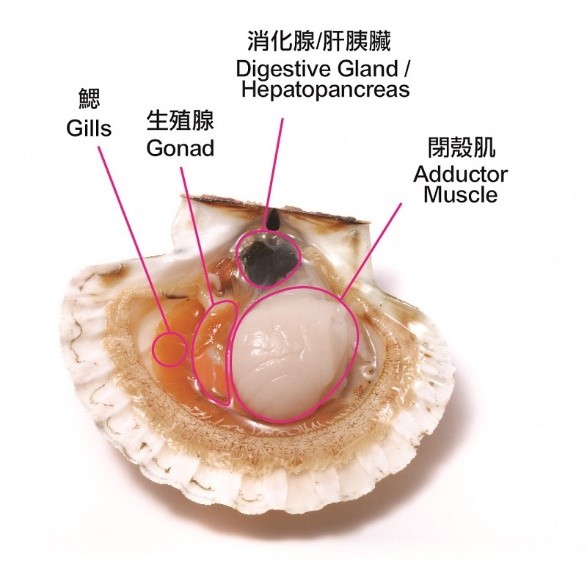
Figure 1: Internal parts of a scallop
Symptoms of Shellfish Poisoning
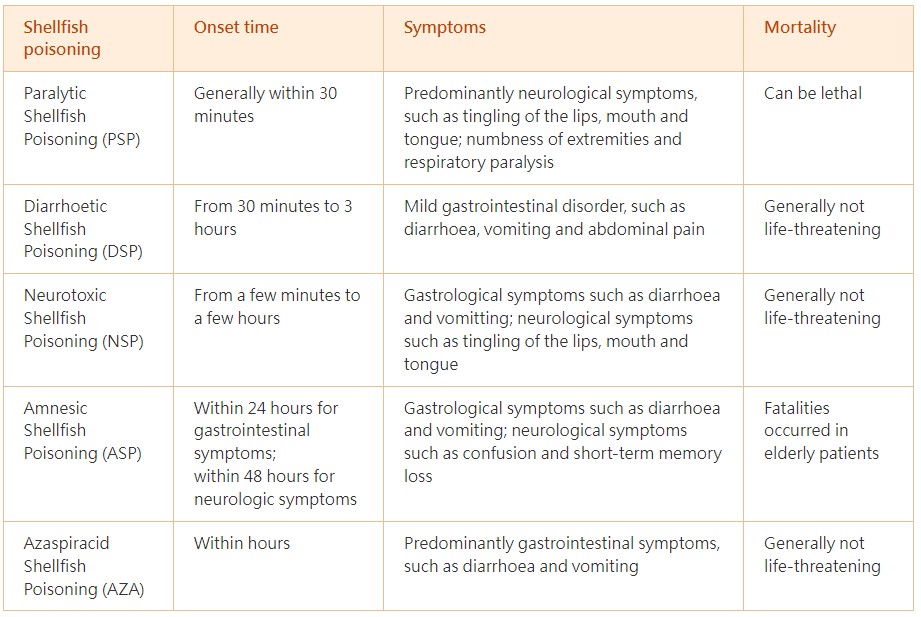
Shellfish toxins can cause a wide variety of symptoms in humans, depending on the type and amount of toxins ingested. Symptoms of different types of shellfish poisoning are summarised below:
Safety Levels of Shellfish Toxins
The toxicity of various shellfish toxins was evaluated by a joint expert working group of the Food and Agriculture Organization of the United Nations (FAO), the World Health Organization (WHO) and the Intergovernmental Oceanographic Commission of UNESCO in 2004. Acute reference doses (ARfDs) (i.e. the amount of toxins that can be ingested in a period of 24 hours or less without appreciable health risk) have been established for these shellfish toxins. In addition, the Codex Alimentarius Commission (Codex) has established the maximum levels (MLs) for shellfish toxins in edible parts (the whole or any part intended to be eaten separately) of live bivalve molluscs. While the ARfDs are critical in assessing the safety of food in terms of the level of shellfish toxins contained, Codex MLs are the levels recommended by Codex to be permitted in shellfish.
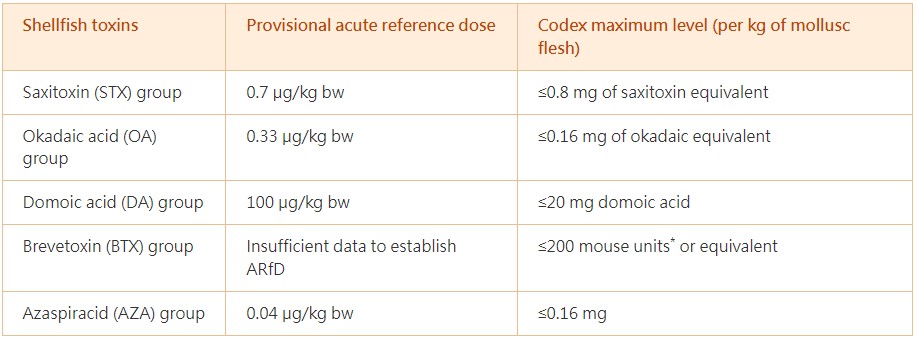
*An estimate of toxicity of the toxin made by mouse bioassay.
Key Points to Note
Advice to Consumers

 FoodWorld