Category Archives: STEC E.coli

RASFF Alert- STEC E.coli – Bovine Meat

RASFF

Escherichia coli STEC in bovine meat from Brazil. in Bulgaria and Spain

Research – In-House Validation of Multiplex PCR for Simultaneous Detection of Shiga Toxin-Producing Escherichia coli, Listeria monocytogenes and Salmonella spp. in Raw Meats

MDPI

The aim of the study was to perform in-house validation of the developed multiplex PCR (mPCR)-based alternative method to detect Shiga toxin-producing Escherichia coli (STEC), Listeria monocytogenes (L. monocytogenes) and Salmonella spp. in raw meats following the ISO 16140-2: 2016. A comparative study of the developed mPCR against the Bacteriological Analytical Manual (BAM) method was evaluated for inclusivity and exclusivity, sensitivity and the relative level of detection (RLOD). Inclusivity levels for each target bacterium were all 100%, while exclusivity for non-target bacteria was 100%. The sensitivity of the developed mPCR was calculated based on the analysis of 72 samples of raw meat. The sensitivity of the developed mPCR was 100%. The RLOD values of the developed mPCR for STEC, L. monocytogenes and Salmonella spp. were 0.756, 1.170 and 1.000, respectively. The developed mPCR showed potential as a tool for the fast, specific and sensitive detection of the three bacteria in the raw meat industry View Full-Text

Research – Foodborne Illness Outbreaks Reported to National Surveillance, United States, 2009–2018

CDC

Abstract

Foodborne outbreaks reported to national surveillance systems represent a subset of all outbreaks in the United States; not all outbreaks are detected, investigated, and reported. We described the structural factors and outbreak characteristics of outbreaks reported during 2009–2018. We categorized states (plus DC) as high (highest quintile), middle (middle 3 quintiles), or low (lowest quintile) reporters on the basis of the number of reported outbreaks per 10 million population. Analysis revealed considerable variation across states in the number and types of foodborne outbreaks reported. High-reporting states reported 4 times more outbreaks than low reporters. Low reporters were more likely than high reporters to report larger outbreaks and less likely to implicate a setting or food vehicle; however, we did not observe a significant difference in the types of food vehicles identified. Per capita funding was strongly associated with increased reporting. Investments in public health programming have a measurable effect on outbreak reporting.

Foodborne diseases remain a major public health challenge in the United States, where 31 known pathogens cause an estimated 9 million illnesses, 56,000 hospitalizations, and 1,300 deaths annually (1). Efforts to improve food safety and reduce the burden of foodborne disease rely on data from foodborne disease surveillance and outbreak investigations to help prioritize food safety interventions, policies, and practices. Data from foodborne illness outbreaks reported to the Centers for Disease Control and Prevention (CDC) provide vital information on the foods causing illness and common food–pathogen pairs. Those data are used by the Interagency Food Safety Analytics Collaboration (IFSAC) to inform outbreak-based attribution models that attribute illnesses to specific food categories (2,3).

Foodborne illness outbreaks are investigated by local, state, and territorial health departments, CDC, the US Food and Drug Administration (FDA), and the Food Safety and Inspection Service of the United States Department of Agriculture and are reported to CDC’s Foodborne Disease Outbreak Reporting Surveillance System (FDOSS) through the web-based National Outbreak Reporting System (NORS). Although reported outbreaks are a rich data source, they represent a subset of all outbreaks occurring in the United States; not all outbreaks will be detected, investigated, and reported. Factors influencing which outbreaks are detected, investigated, and reported to CDC include both structural factors associated with the jurisdiction in which the outbreak occurred (e.g., infrastructure and capacity) and characteristics of the outbreak (e.g., size, geographic location, pathogen).

We integrated data from a variety of sources to examine structural factors and describe outbreak characteristics of foodborne outbreaks involving Salmonella, Shiga toxin–producing Escherichia coli (STEC) O157, norovirus, and bacterial toxins that were reported to national surveillance. In addition, we assessed the effects of state variation in outbreak reporting on the types of food vehicles identified.

RASFF Alert – STEC E.coli – Chilled Beef

RASFF

Shigatoxin-producing Escherichia coli (STEC) in chilled beef from Argentina in Austria, Germany and Italy

France – Prosecutors open criminal inquiry into French STEC E. coli outbreak linked to Nestlé pizza

Food Safety News

French authorities have stepped up their investigations related to an E. coli outbreak in the country linked to pizzas made by Nestlé.

The latest figures from Santé publique France show 56 cases and two deaths from Buitoni brand Fraîch’Up pizzas.

The Paris prosecutor’s office opened a criminal inquiry into the incident this past week. Charges include the involuntary manslaughter of one person, the injuring of 14 others and marketing a product dangerous to health.

An investigation had already been launched on March 22 and searches of the Nestlé factory in Caudry took place, authorized by the public health department of the Paris prosecutor’s office, on April 13.

A judicial inquiry is led by an investigating judge and was opened at the request of the public prosecutor to carry out such a highly complex investigation.

More than 50 children sick
Of the 56 infections, 54 were caused by E. coli O26 and two by E. coli O103, according to Santé publique France, the country’s public health agency.

Belgium – Raw Salted Milk Butter from the Marlier brand –

AFSCA

Recall of Marlier
Product: raw salted milk butter from the Marlier brand
Problem: presence of E.Coli STEC.


In agreement with the FASFC, Marlier is withdrawing the salted raw milk butter (500g) of the Marlier brand, with the expiry date of 05/11/22, from sale and recalling it from the consumer because of the presence of ‘E.Coli STEC.

Marlier asks its customers not to consume this product and to bring it back to the point of sale where it was purchased (Carrefour de Bomerée), where it will be reimbursed.

Product description

– Product name: Salted raw milk butter
– Brand: Marlier
– Best before date (BBD) (“Use by”): 05/11/22
– Batch number: 05/11/22
– Sales period: from 04/27/22 to 05/11/22
– Type of packaging: paper
– Weight: 500 g

The product was distributed by:

Carrefour Rue de la Station 1 6110 Montigny-le-tilleul

For further information , contact: Marlier

Research – Investigation of grouped cases of haemolytic-uremic syndrome (HUS) and shiga-toxin-producing E. coli (STEC) infections linked to the consumption of Buitoni® brand Fraîch’Up pizzas. Update on May 4, 2022.

Sante Publique

Public Health France and the National Reference Center (CNR) E. coli and its associated laboratory (Institut Pasteur, Paris, and Microbiology Laboratory of the Robert Debré Hospital, Paris), in conjunction with the Directorate General for Food, the Directorate General for Competition, Consumer Affairs and Fraud Prevention, and in coordination with the Directorate General for Health, have been investigating since 02/10/2022 an increase in the number of cases of haemolytic uremic syndrome (HUS) pediatric infections and Shiga toxin-producing Escherichia coli (STEC) infections.

The epidemiological, microbiological and traceability investigations carried out since that date have confirmed a link between the occurrence of these grouped cases and the consumption of frozen pizzas from the Buitoni brand Fraîch’Up range contaminated with STEC bacteria. On 03/18/2022, the company proceeded with the withdrawal-recall of all the pizzas in the Fraîch’Up range, marketed since June 2021 and the authorities asked the people who hold these pizzas not to consume them and to destroy them.

The total number of HUS cases linked to the consumption of these pizzas has stabilized since the withdrawal-recall. Other reports of STEC infection are investigated as part of routine surveillance. To date, these reports are not linked to grouped cases or consumption of Fraîch’Up pizzas.

Case of SHU in France: update on 04/05/22

As of 04/05/2022, 56 confirmed cases have been identified, of which 54 are linked to STEC O26 strains, and 2 to STEC O103 strains.

These 56 cases occurred in 55 children and 1 adult, who presented symptoms between 18/01/2022 (week 3) and 05/04/2022 (week 14) (Figure 1). The epidemic peak is in week 7 (14/02 to 20/02) and week 9 (28/02 to 06/03), with 10 cases each of these weeks.

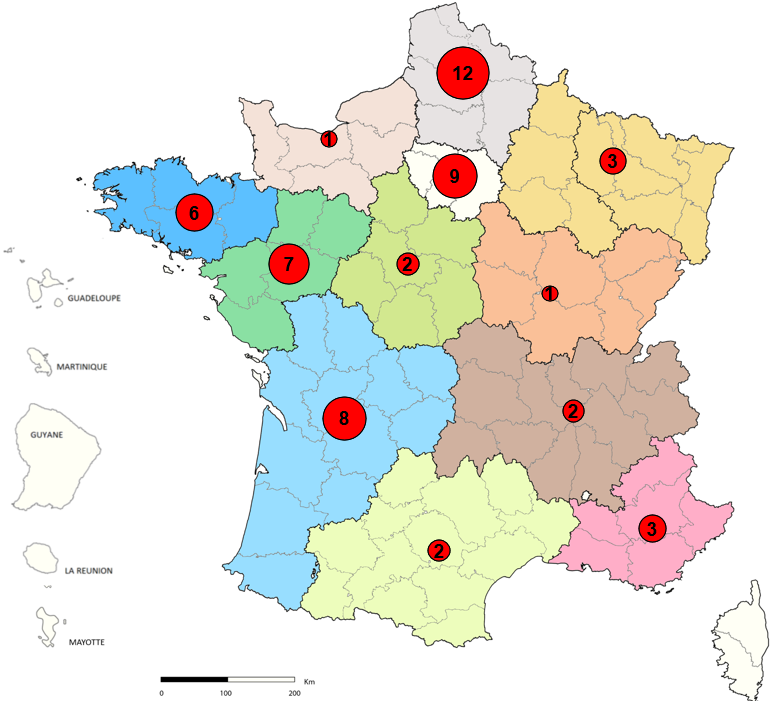
These 56 cases occurred in 12 regions of metropolitan France: Hauts-de-France (12 cases), Ile-de-France (9 cases), New Aquitaine (8 cases), Pays de la Loire (7 cases), Brittany ( 6 cases), Grand Est (3 cases), Provence-Alpes-Côte d’Azur (3 cases), Auvergne-Rhône-Alpes (2 cases), Occitanie (2 cases), Center Val-de-Loire (2 cases) , Bourgogne Franche-Comté (1 case) and Normandy (1 case) (Figure 2).

The 55 sick children are aged from 1 to 17 years old with a median age of 6 years; 25 (45%) are female; 48 (87%) presented with HUS, 7 (13%) with STEC gastroenteritis. Two children died. The adult did not present with HUS.

Figure 1: Epidemic curve: number of confirmed cases of HUS and STEC infections, by week of onset of symptoms – metropolitan France, weeks 3 to 14, 2022 (N=54: week of onset of symptoms not specified for 2 cases )
Figure 1: Epidemic curve: number of confirmed cases of HUS and STEC infections, by week of onset of symptoms - metropolitan France, weeks 3 to 14, 2022 (N=54: week of onset of symptoms not specified for 2 cases )
Figure 2: Geographical distribution of confirmed cases of HUS and STEC infections (N=56) linked to the consumption of Buitoni® brand Fraîch’Up pizzas, by region of residence in metropolitan France, weeks 3 to 14, 2022
Figure 2: Geographical distribution of confirmed cases of HUS and STEC infections (N=56) linked to the consumption of Buitoni® brand Fraîch'Up pizzas, by region of residence in metropolitan France, weeks 3 to 14, 2022

Research – Joint FAO/WHO Expert Meeting on Microbiological Risk Assessment (JEMRA) on Shiga toxin-producing Escherichia coli (STEC) associated with meat and dairy products

FAO

Shiga toxin-producing Escherichia coli (STEC) are an important cause of food-borne disease. Infections can result in a wide range of disease symptoms from mild intestinal discomfort and hemorrhagic diarrhea to severe conditions including haemolytic uremic syndrome (HUS), end-stage renal disease and death. In its report on the global burden of food-borne disease, WHO estimated that in 2010 food-borne STEC caused more than 1.2 million illnesses, 128 deaths, and nearly 13 000 Disability Adjusted Life Years (DALYs) (WHO, 2015). The Codex Committee on Food Hygiene (CCFH) has highlighted the importance of STEC in foods since its 32nd Session in 1999, when it prioritized their presence in beef and sprouts as significant public health problems in Member countries (FAO and WHO, 2000). Following a request from the 47th Session in November 2015 (FAO and WHO, 2016), the FAO and WHO published the report Shiga toxin-producing Escherichia coli (STEC) and food: attribution, characterization and monitoring in 2018 (FAO and WHO, 2018). As part of the 50th session of CCFH in November 2018, the FAO/WHO further updated the committee with additional information on STEC that was subsequently published in the report Attributing illness caused by Shiga toxin-producing Escherichia coli (STEC) to specific foods (FAO and WHO, 2019a). The Codex Alimentarius Commission (CAC) at the 42nd Session, July 2019, approved new work on the development of guidelines for the control of STEC in beef, raw milk and cheese produced from raw milk, leafy greens and sprouts (FAO and WHO, 2019b). To support this work, the Joint FAO/WHO Expert Meeting on Shiga toxin-producing Escherichia coli(STEC) associated with Meat and Dairy Products was convened virtually from 1 to 26 June 2020 to review relevant measures for pre- and post-harvest control of STEC in animals and foods of animal origins. The scientific literature describing physical, chemical and biological control measures (and their combinations) against STEC during primary production, processing and post-processing of raw meat, raw milk and raw milk cheeses was reviewed. The efficacy and utility of reported control measures were scored as high, medium or low, based on expert opinion informed by systematic reviews and/or meta-analyses, when available.

Research – The effectiveness and safety of high pressure food treatment

asca

Definition and applicable regulations

Type of food treated and processing conditions

Intrinsic and extrinsic factors of food that influence the effectiveness of high pressure treatment

Possible chemical and microbiological hazards associated with high pressure treatment

High pressure treatment as an alternative to pasteurization of milk

Efficacy of high pressure treatment for the control of Listeria monocytogenes in ready-to-eat foods

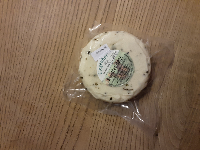
Germany – Herb goat natural and nettle – STEC E.coli

LMW

product image.jpg

Alert type: Food
Date of first publication: 05/05/2022
Product name: Herb goat natural and nettle
Manufacturer (distributor):

Ziegenhof Fam. Filgertshofer

Reason for warning:

Detection of Vero/Shiga toxin-forming VTEC/STEC, stx1- positive

Manufacturer’s website:

Click to access e-coli-Pressemitteilung.pdf