Category Archives: Salmonella

RASFF Alerts – Animal Feed – Salmonella – Rapeseed Meal – Raw Cat Food – Dog Chews – Potato Pulp

European Food Alerts

RASFF

Salmonella (presence /25g) in rapeseed meal from Germany in Germany

RASFF

Salmonella enterica ser. Infantis (in 1 out of 5 samples /25g) in raw cat food from the Netherlands in Belgium

RASFF

Salmonella (presence /25g) in dog chews from India in Sweden

RASFF

Salmonella (presence /25g) in potato pulp from Germany in Germany

Lithuania- More than 450 outbreaks in Lithuania in 2019

Food Safety News

More than 450 outbreaks were recorded in Lithuania this past year, according to the Center for Communicable Diseases and AIDS (ULAC).

ULAC data shows there were 459 outbreaks in 2019 with 1,204 people affected, of which more than half — 805 — were treated in hospitals.

Of these outbreaks, 410 were classed as familial and 49 as widespread. From the latter, 39 were related to children’s educational institutions and five were linked to food businesses.

The largest outbreak with 39 patients was recorded in a childcare facility that spread through contaminated food and because of a lack of proper hygiene.

The most common causes were rotavirus, norovirus, and Salmonella, but more than half could not be identified. Main factors in transmission were lack of hygiene and contaminated food such as chicken and egg products.

Research – Investigations of Possible Multistate Outbreaks of Salmonella, Shiga Toxin–Producing Escherichia coli, and Listeria monocytogenes Infections — United States, 2016

CDC

Problem/Condition: Salmonella, Shiga toxin–producing Escherichia coli (STEC), and Listeria monocytogenes are the leading causes of multistate foodborne disease outbreaks in the United States. Responding to multistate outbreaks quickly and effectively and applying lessons learned about outbreak sources, modes of transmission, and risk factors for infection can prevent additional outbreak-associated illnesses and save lives. This report summarizes the investigations of multistate outbreaks and possible outbreaks of Salmonella, STEC, and L. monocytogenes infections coordinated by CDC during the 2016 reporting period.

Period Covered: 2016. An investigation was considered to have occurred in 2016 if it began during 2016 and ended on or before March 31, 2017, or if it began before January 1, 2016, and ended during March 31, 2016–March 31, 2017.

Description of System: CDC maintains a database of investigations of possible multistate foodborne and animal-contact outbreaks caused by Salmonella, STEC, and L. monocytogenes. Data were collected by local, state, and federal investigators during the detection, investigation and response, and control phases of the outbreak investigations. Additional data sources used for this report included PulseNet, the national molecular subtyping network based on isolates uploaded by local, state, and federal laboratories, and the Foodborne Disease Outbreak Surveillance System (FDOSS), which collects information from state, local, and territorial health departments and federal agencies about single-state and multistate foodborne disease outbreaks in the United States. Multistate outbreaks reported to FDOSS were linked using a unique outbreak identifier to obtain food category information when a confirmed or suspected food source was identified. Food categories were determined and assigned in FDOSS according to a classification scheme developed by CDC, the Food and Drug Administration (FDA), and the U.S. Department of Agriculture Food Safety and Inspection Service (FSIS) in the Interagency Food Safety Analytics Collaboration.

A possible multistate outbreak was determined by expert judgment to be an outbreak if supporting data (e.g., temporal, geographic, demographic, dietary, travel, or food history) suggested a common source. A solved outbreak was an outbreak for which a specific kind of food or animal was implicated (i.e., confirmed or suspected) as the source. Outbreak-level variables included number of illnesses, hospitalizations, cases of hemolytic uremic syndrome (HUS), and deaths; the number of states with illnesses; date of isolation for the earliest and last cases; demographic data describing patients associated with a possible outbreak (e.g., age, sex, and state of residence); the types of data collected (i.e., epidemiologic, traceback, or laboratory); the outbreak source, mode of transmission, and exposure location; the name or brand of the source; whether the source was suspected or confirmed; whether a food was imported into the United States; the types of regulatory agencies involved; whether regulatory action was taken (and what type of action); whether an outbreak was publicly announced by CDC via website posting; beginning and end date of the investigation; and general comments about the investigation. The number of illnesses, hospitalizations, cases of HUS, and deaths were characterized by transmission mode, pathogen, outcome (i.e., unsolved, solved with suspected source, or solved with confirmed source), source, and food or animal category.

Results: During the 2016 reporting period, 230 possible multistate outbreaks were detected and 174 were investigated. A median of 24 possible outbreaks was under investigation per week, and investigations were open for a median of 37 days. Of these 174 possible outbreaks investigated, 56 were excluded from this analysis because they occurred in a single state, were linked to international travel, or were pseudo-outbreaks (e.g., a group of similar isolates resulting from laboratory media contamination rather than infection in patients). Of the remaining 118 possible multistate outbreaks, 50 were determined to be outbreaks and 39 were solved (18 with a confirmed food source, 10 with a suspected food source, 10 with a confirmed animal source, and one with a suspected animal source). Sprouts were the most commonly implicated food category in solved multistate foodborne outbreaks (five). Chicken was the source of the most foodborne outbreak-related illnesses (134). Three outbreaks involved novel food–pathogen pairs: flour and STEC, frozen vegetables and L. monocytogenes, and bagged salad and L. monocytogenes. Eleven outbreaks were attributed to contact with animals (10 attributed to contact with backyard poultry and one to small turtles). Thirteen of 18 multistate foodborne disease outbreaks with confirmed sources resulted in product action, including 10 outbreaks with recalls, two with market withdrawals, and one with an FSIS public health alert. Twenty outbreaks, including 11 foodborne and nine animal-contact outbreaks, were announced to the public by CDC via its website, Facebook, and Twitter. These announcements resulted in approximately 910,000 webpage views, 55,000 likes, 66,000 shares, and 5,800 retweets.

Interpretation: During the 2016 reporting period, investigations of possible multistate outbreaks occurred frequently, were resource intensive, and required a median of 37 days of investigation. Fewer than half (42%) of the 118 possible outbreaks investigated were determined to have sufficient data to meet the definition of a multistate outbreak. Moreover, of the 50 outbreaks with sufficient data, approximately three fourths were solved.

Public Health Action: Close collaboration among CDC, FDA, FSIS and state and local health and agriculture partners is central to successful outbreak investigations. Identification of novel outbreak sources and trends in sources provides insights into gaps in food safety and safe handling of animals, which helps focus prevention strategies. Summarizing investigations of possible multistate outbreaks can provide insights into the investigative process, improve future investigations, and help prevent illnesses. Although identifying and investigating possible multistate outbreaks require substantial resources and investment in public health infrastructure, they are important in determining outbreak sources and implementing prevention and control measures.

Research – Microbiological control of pasteurized and unpasteurized dairy products, 2018 – Norway

Mattilsynet

The microbiological quality was generally good for the 189 dairy products on the Norwegian market that the Norwegian Food Safety Authority examined in 2018. Nevertheless, we see that there are microbiological challenges in connection with unpasteurized dairy products.

What did we investigate? 189 samples of unpasteurized and pasteurized cheeses and other dairy products produced in Norway and in the EU.
Period: 2018
What were we looking for? The four categories have been analyzed for various disease-causing bacteria (pathogens). These choices are made in order to get the most information for each category.

The different categories are:

PN = pasteurized milk product produced in Norway.

P EU = pasteurized milk product produced outside Norway.

UN = unpasteurized milk product produced in Norway.

U EU = unpasteurized milk product produced outside Norway.
The various disease-causing infectious agents we analyzed for:

Listeria monocytogenes (pathogen): PN, P EU, UN, U EU, number 189 pcs.

Shigatoxin-producing Escherichia coli (STEC) (pathogen): UN, U EU, number 96 pcs.

E. coli (hygiene parameter): PN, UN, U EU, 169 st.

S. aureus (hygiene parameter): UN, number 71 st.

Toxins (enterotoxin) from S. aureus (pathogen): UN, U EU, number 96 pcs.

Salmonella (pathogen): U EU, number 25 st.

What did we find? Listeria monocytogenes : No detection in 189 samples of dairy product.

Shigatoxin-producing Escherichia coli (STEC):
One finding in French red cow cheese of cow’s milk ( E. coli O-, stx2 and eae ). A total of 25 unpasteurized milk products produced outside Norway were examined. No findings in 71 unpasteurized milk products from Norway.

Escherichia coli (hygiene parameter):
In 73 pasteurized milk products from Norway, there was a detection and this was above the lower limit value (100 kde / g) but below the upper limit value (1,000 kde / g). No E. coli was detected above the detection limit of 10 colony forming units / g sample (kde / g) in the other samples.

In 61 of the 71 unpasteurized milk products produced in Norway, E. coli was not detected above the detection limit of 10 colony-forming units / g sample (kde / g). 3 st. (4.2%) was above 100 kde / g.

In unpasteurized dairy products from the EU (25), 5 (20%) of the products had more than 100 kde / g E. coli. There is no microbiological criterion for E. coli in the regulations for unpasteurized cheeses.

Staphylococcus aureus:
Of 71 samples, none exceeded the regulatory limit of 10,000 kde / g.

Of the 96 unpasteurized dairy products examined, the enterotoxins AE Toxins (enterotoxins), which some S. aureus can produce , were not detected .

Salmonella was not detected in the 25 samples of unpasteurized milk products produced outside Norway.

Belgium – 125g Rosette Sandwich from the Leader Price brand – Salmonella

AFSCA

In agreement with the AFSCA, LEADER PRICE is withdrawing the 125g Sandwich Rosette from sale and is recalling it to consumers because of the possible presence of Salmonella.

LEADER PRICE asks its customers not to consume this product and to return it to the point of sale where it was purchased for reimbursement.

Product Description

Naam van het product Barcode Stempel Vervaldatum (TGT) Lotnummers
Sandwich Rosette 125g LP 326385949312 FR 01-159-002 CE 11/19/20
11/21/20
11/23/20

11/26/20

12/01/20

030701

030901

031101

031401

031901

The product was sold through Leader Price stores in Belgium

219 CHAUSSEE DE PHILIPPEVILLE 6010 COUILLET CHARLEROI
1 ANGLE RUE DU SEWAGE / CONCORDE 4100 SERAING
90 BD ERNEST SOLVAY 4040 HERSTAL
70 RUE PHILIPPE MONNOYER 6180 COURCELLES
LAGUESSE STREET 13 4460 GRACE HOLLOGNE
RTE DE CHARLEROI 160 7134 BINCHE
RUE DU MONS 280 7301 HORNU BELGIUM
31 AVENUE DE L’INDUSTRIE 4500 TIHANGE
787 CHAUSSEE DE CHARLEROI 6220 FLOWERS

For any further information , you can contact the consumer service by dialing the telephone number: 0033 800 35 00 00 from Monday to Friday from 8:30 a.m. to 6 p.m.

Belgium – Sequoia – Organic free-range chicken from Le Picoreur – Salmonella

AFSCA

In agreement with the AFSCA, Sequoia is withdrawing the Le Picoreur organic free-range chicken product from sale and is recalling it to consumers because of the presence of Salmonella.

Sequoia asks its customers not to consume this product and to return it to the point of sale where it was purchased, with proof of purchase for reimbursement.

Product description
– Product name: Organic black free-range chicken
– Brand: Le Picoreur
– Use -by date (DLC) (“To be consumed until”): 18/11/2020, 19/11/2020.
– Batch number: 30708105 // Sanitary stamp: FR 85.223.001 CE
– Weight: variable
– Sales period: from 6/11/20 to 10/11/20
– Type of packaging: cardboard and plastic

The product has was sold via:
– Sequoia Jourdan: 2, rue Gray 1040 Etterbeek
– Sequoia Lepoutre: 512, chaussée de Waterloo 1050 Ixelles
– Sequoia Uccle: 532, chaussée de Saint-Job 1180 Uccle

For any further information , contact:
Sequoia
info@sequoia.bio

France – Product recall: Franprix brand Pause Meal 125g rosette sandwich -Salmonella

Oulah

Product recall: Franprix brand Pause Meal 125g rosette sandwich

ENCOUNTERED PROBLEM

Presence of salmonella

PROPOSED SOLUTION

Those in possession of this product are asked not to consume it and to return it to the point of sale where it was purchased.

Foodborne illness caused by salmonella results in gastrointestinal disturbances, diarrhea, vomiting and abdominal pain, often accompanied by fever; these symptoms may be more severe in young children, immunocompromised individuals and the elderly. The incubation period can range from 6 to 72 hours.
People who have consumed the products mentioned below and who have these symptoms are invited to consult their doctor, notifying him of this consumption.

FURTHER INFORMATION

▸ Barcode
3263858760916

▸ Lot
• 030701
• 030901
• 031101
• 031401
• 031901

▸ DLC
• 11/19/20
• 11/21/20
• 11/23/20
• 11/26/20
• 12/01/20

▸ Health
stamp FR 01-159-002 CE

▸ Consumer service contact
For any further information, you can contact customer service by dialing the telephone number: 09 70 17 10 00 (non-surcharged call) from Monday to Saturday from 8:30 am to 10 pm or by e-mail at the contact address @ franprix.fr.

▸ Source
https://www.franprix.fr/

France – Product recall: Casino brand 125g rosette sandwich – Salmonella

Oulah

Product recall: Casino brand 125g rosette sandwich

ENCOUNTERED PROBLEM

Presence of salmonella

PROPOSED SOLUTION

Those in possession of this product are asked not to consume it and to return it to the point of sale where it was purchased for reimbursement.

Foodborne illness caused by salmonella results in gastrointestinal disturbances, diarrhea, vomiting and abdominal pain, often accompanied by fever; these symptoms may be more severe in young children, immunocompromised individuals and the elderly. The incubation period can range from 6 to 72 hours.
People who have consumed the products mentioned below and who have these symptoms are invited to consult their doctor, notifying him of this consumption.

FURTHER INFORMATION

▸ Barcode
3222475401657

▸ Lot and DLC
• 030401 – 11/16/20 • 030701 –
11/19/20
• 030901 – 11/21/20
• 031101 –
11/23/20 • 031401 – 11/26/20
• 031501 – 11/27 / 20
• 032101 – 12/03/20

▸ Health
stamp FR 01-159-002 CE

▸ Consumer service contact
For any further information, you can contact the consumer service by dialing the Freephone number: 0 800 13 30 16 (free service and call) from Monday to Friday, 9 am to 7 pm.

▸ Source
https://www.geantcasino.fr/

France – Product recall: Saint Alby brand Rosette de Lyon -Salmonella

Oulah

Product recall: Saint Alby brand Rosette de Lyon

ENCOUNTERED PROBLEM

Presence of salmonella

PROPOSED SOLUTION

Those in possession of this product are asked not to consume it and to return it to the point of sale where it was purchased for reimbursement.

Foodborne illness caused by salmonella results in gastrointestinal disturbances, diarrhea, vomiting and abdominal pain, often accompanied by fever; these symptoms may be more severe in young children, immunocompromised individuals and the elderly. The incubation period can range from 6 to 72 hours.
People who have consumed the products mentioned below and who have these symptoms are invited to consult their doctor, notifying him of this consumption.

FURTHER INFORMATION

▸ Barcode
20021139

▸ Lot
• 111001
• 111928

▸ DLC
• 01/22/2021
• 01/29/2021

▸ Health
stamp FR 69.238.010 CE

▸ Marketing date
From 10/15/2020 to 11/17/2020

▸ Consumer service contact
The LIDL consumer service is at your disposal at the following telephone number 0 800 900 343.

▸ Source
https://www.lidl.fr/fr

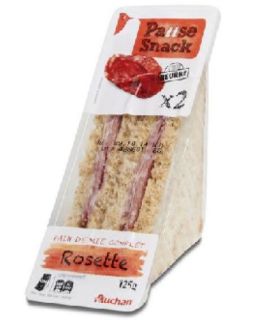
Luxembourg – RECALL: AUCHAN BRAND CLUB ROSETTE SANDWICH -Salmonella

SAP

Last name Club Rosette Sandwich
Mark Auchan
Unit 125 g
Bar code 3596710385041
Use by date (DLC) 11/15/20; 11/18/20; 20/11/20; 11/22/20; 11/25/20; 11/28/20
Lot 030401; 030701; 030901; 031101; 031401; 031701

Danger  : Potential presence of Salmonella

Salmonella can cause symptoms such as nausea, vomiting, abdominal cramps, diarrhea, fever and headache within 6 to 72 hours after consumption. These symptoms may be aggravated in young children, immunocompromised individuals and the elderly. People who have consumed these products and who present these symptoms are advised to consult a doctor, notifying him of this consumption.

Sale in Luxembourg by: Auchan

Source of information: Auchan recall notification

Communicated by: Government Commission for Quality, Fraud and Food Safety .