Category Archives: Salmonella

RASFF Alerts – Animal Feed -Salmonella – Organic Soy Expeller – Sunflower Seeds – Whey Powder

European Food Alerts

RASFF

Salmonella enterica ser. Mbandaka (presence /25g) in organic soy expeller from the Netherlands in Germany

RASFF

Salmonella enterica ser. Leeuwarden (in 3 out of 5 samples /25g) in sunflower seeds from Bulgaria in Sweden

RASFF

Salmonella (presence /25g) in whey powder from France in France

Norway – Microbiological control of pasteurised and unpasteurised dairy products, 2018

Mattilsynet

The microbiological quality was generally good for the 189 dairy products on the Norwegian market that the Norwegian Food Safety Authority examined in 2018. Nevertheless, we see that there are microbiological challenges in connection with unpasteurised dairy products.

What did we investigate? 189 samples of unpasteurised and pasteurised cheeses and other dairy products produced in Norway and in the EU.
Period: 2018
What were we looking for?

The four categories have been analysed for various disease-causing bacteria (pathogens). These choices are made in order to get the most information for each category.

The different categories are:

PN = pasteurised milk product produced in Norway.

P EU = pasteurised milk product produced outside Norway.

UN = unpasteurised milk product produced in Norway.

U EU = unpasteurised milk product produced outside Norway.
 

The various disease-causing infectious agents we analysed for:

Listeria monocytogenes (pathogen): PN, P EU, UN, U EU, number 189 pcs.

Shigatoxin-producing Escherichia coli (STEC) (pathogen): UN, U EU, number 96 pcs.

E. coli (hygiene parameter): PN, UN, U EU, 169 st.

S. aureus (hygiene parameter): UN, number 71 st.

Toxins (enterotoxin) from S. aureus (pathogen): UN, U EU, number 96 pcs.

Salmonella (pathogen): U EU, number 25 st.

What did we find?

Listeria monocytogenes : No detection in 189 samples of dairy product.

Shigatoxin-producing Escherichia coli (STEC):
One finding in French red cow cheese of cow’s milk ( E. coli O-, stx2 and eae ). A total of 25 unpasteurised milk products produced outside Norway were examined. No findings in 71 unpasteurised milk products from Norway.

Escherichia coli (hygiene parameter):
In 73 pasteurised milk products from Norway, there was a detection and this was above the lower limit value (100 cfu / g) but below the upper limit value (1,000 cfu / g). No E. coli was detected above the detection limit of 10 colony forming units / g sample (cfu / g) in the other samples.

In 61 of the 71 unpasteurised milk products produced in Norway, E. coli was not detected above the detection limit of 10 colony-forming units / g sample (cfu / g). 3 st. (4.2%) was above 100 cfu / g.

In unpasteurised dairy products from the EU (25), 5 (20%) of the products had more than 100 cfu/ g E. coli. There is no microbiological criterion for E. coli in the regulations for unpasteurised cheeses.

Staphylococcus aureus:
Of 71 samples, none exceeded the regulatory limit of 10,000 cfu/ g.

Of the 96 unpasteurised dairy products examined, the enterotoxins AE Toxins (enterotoxins), which some S. aureus can produce , were not detected .

Salmonella was not detected in the 25 samples of unpasteurised milk products produced outside Norway.

Report Link

Canada – Updated Food Recall Warning – Eggs from Les Œufs Richard Eggs Inc. recalled due to Salmonella

CFIA

Recall details

Ottawa, November 24, 2020 – The food recall warning issued on November 21, 2020 has been updated to include additional distribution information. This additional information was identified during the Canadian Food Inspection Agency’s (CFIA) food safety investigation.

Les Œufs Richard Eggs Inc. is recalling eggs from the marketplace due to possible Salmonella contamination. Consumers should not consume and distributors, retailers and food service establishments such as hotels, restaurants, cafeterias, hospitals, and nursing homes should not serve, sell, or use the recalled products described below.

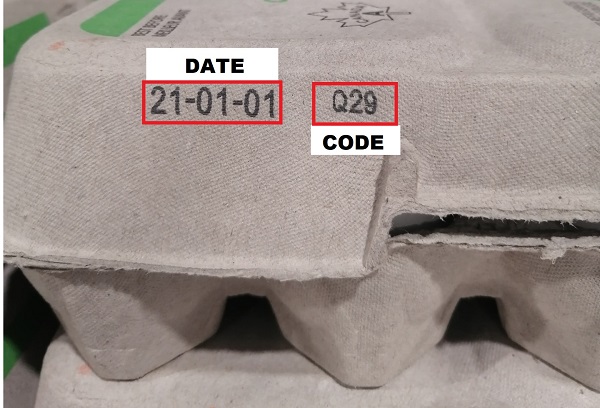
Only eggs from Les Œufs Richard Eggs Inc. with best before dates indicated in the table below where the lot code contains “Q29” or where there is no lot code on the package are implicated by the recall.

Recalled products

Brand Product Size UPC Codes
Les Œufs Richard Eggs Inc. Large Size Eggs 12 eggs 0 57711 01056 9 20-12-26 Q29
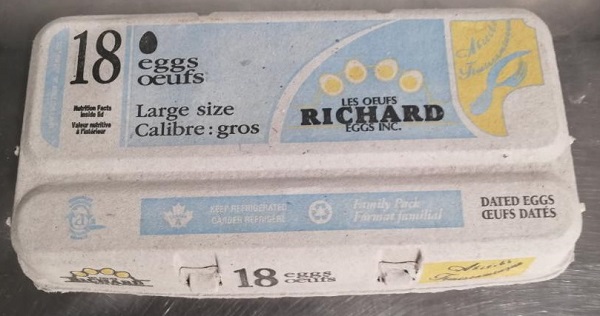
Les Œufs Richard Eggs Inc. Large Size Eggs, Family Pack 18 eggs 0 57711 01018 7 20-12-22 Q29
20-12-26 Q29
Les Œufs Richard Eggs Inc. Extra Large Size Eggs 12 eggs 0 57711 01064 4 20-12-26 Q29
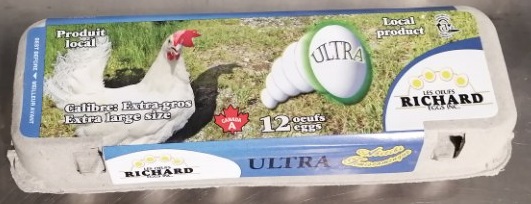
Les Œufs Richard Eggs Inc. Extra Large Size Ultra Eggs 12 eggs 0 57711 01070 5 20-12-18 Q29
20-12-22 Q29
20-12-24 Q29
Les Œufs Richard Eggs Inc. Large Size Brown Eggs 12 eggs 0 57711 08056 2 20-12-24 Q29
20-12-30 Q29
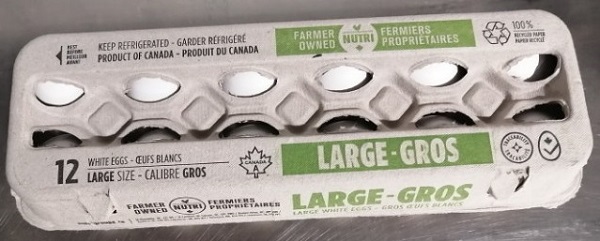
Nutri Large White Eggs 12 eggs 0 61719 01121 3 20-12-22 Q29
20-12-24 Q29
Nutri Large White Eggs 18 eggs 0 61719 01155 8 20-12-22 Q29
21-01-01 Q29
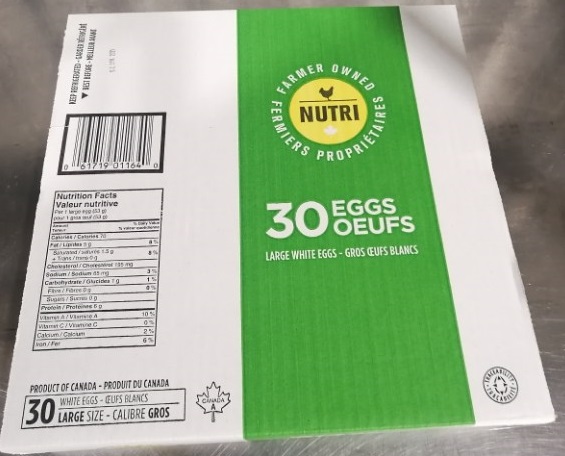
Nutri Large White Eggs 30 eggs 0 61719 01164 0 20-12-22 Q29
20-12-24 Q29
no name Medium size eggs 12 eggs 0 60383 66415 2 20-12-26 Q29

What you should do

If you think you became sick from consuming a recalled product, call your doctor.

Check to see if you have the recalled products in your home or establishment. Recalled products should be thrown out or returned to the location where they were purchased.

Food contaminated with Salmonella may not look or smell spoiled but can still make you sick. Young children, pregnant women, the elderly and people with weakened immune systems may contract serious and sometimes deadly infections. Healthy people may experience short-term symptoms such as fever, headache, vomiting, nausea, abdominal cramps and diarrhea. Long-term complications may include severe arthritis.

Background

This recall was triggered by test results. The CFIA is conducting a food safety investigation, which may lead to the recall of other products. If other high-risk products are recalled, the CFIA will notify the public through updated Food Recall Warnings.

The CFIA is verifying that industry is removing the recalled products from the marketplace.

Illnesses

There have been no reported illnesses associated with the consumption of these products.

Product photos

Printer ready version of photos

  • Example (best before date and lot code)
  • Les Oeufs Richard Eggs Inc. – Brown eggs, large size – 12 eggs
  • Les Oeufs Richard Eggs Inc. – Extra large size eggs – 12 eggs
  • Les Oeufs Richard Eggs Inc. – Extra large size Ultra Eggs – 12 eggs
  • Les Oeufs Richard Eggs Inc. – Large size eggs – 12 eggs
  • Les Oeufs Richard Eggs Inc. – Large size eggs – 12 eggs
  • No name – Medium size eggs – 12 eggs
  • Nutri – Large white eggs – 12 eggs
  • Nutri – Large white eggs – 18 eggs
  • Nutri – Large white eggs – 30 eggs

Public enquiries and media

Public enquiries
Toll-free: 1-800-442-2342 (Canada and U.S.)
Telephone: 1-613-773-2342 (local or international)
Email: cfia.enquiries-demandederenseignements.acia@canada.ca

Canada – Food Recall Warning – Eggs from Les Œufs Richard Eggs Inc. recalled due to Salmonella

CFIA

Recall details

Ottawa, November 21, 2020 – Les Œufs Richard Eggs Inc. is recalling eggs from the marketplace due to possible Salmonella contamination. Consumers should not consume and distributors, retailers and food service establishments such as hotels, restaurants, cafeterias, hospitals, and nursing homes should not serve, sell, or use the recalled products described below.

Only eggs from Les Œufs Richard Eggs Inc. with best before dates indicated in the table below where the lot code contains “Q29” or where there is no lot code on the package are implicated by the recall.

Recalled product

Brand Product Size UPC Codes
Les Œufs Richard Eggs Inc. Large Size Eggs 12 eggs 0 57711 01056 9 20-12-26 Q29
Les Œufs Richard Eggs Inc. Large Size Eggs, Family Pack 18 eggs 0 57711 01018 7 20-12-22 Q29
20-12-26 Q29
Les Œufs Richard Eggs Inc. Extra Large Size Eggs 12 eggs 0 57711 01064 4 20-12-26 Q29
Les Œufs Richard Eggs Inc. Extra Large Size Ultra Eggs 12 eggs 0 57711 01070 5 20-12-18 Q29
20-12-22 Q29
20-12-24 Q29
Les Œufs Richard Eggs Inc. Large Size Brown Eggs 12 eggs 0 57711 08056 2 20-12-24 Q29
20-12-30 Q29
Nutri Large White Eggs 12 eggs 0 61719 01121 3 20-12-22 Q29
20-12-24 Q29
Nutri Large White Eggs 18 eggs 0 61719 01155 8 20-12-22 Q29
21-01-01 Q29
Nutri Large White Eggs 30 eggs 0 61719 01164 0 20-12-22 Q29
20-12-24 Q29
no name Medium size eggs 12 eggs 0 60383 66415 2 20-12-26 Q29

What you should do

If you think you became sick from consuming a recalled product, call your doctor.

Check to see if you have the recalled products in your home or establishment. Recalled products should be thrown out or returned to the location where they were purchased.

Food contaminated with Salmonella may not look or smell spoiled but can still make you sick. Young children, pregnant women, the elderly and people with weakened immune systems may contract serious and sometimes deadly infections. Healthy people may experience short-term symptoms such as fever, headache, vomiting, nausea, abdominal cramps and diarrhea. Long-term complications may include severe arthritis.

Background

This recall was triggered by test results. The Canadian Food Inspection Agency (CFIA) is conducting a food safety investigation, which may lead to the recall of other products. If other high-risk products are recalled, the CFIA will notify the public through updated Food Recall Warnings.

The CFIA is verifying that industry is removing the recalled products from the marketplace.

Illnesses

There have been no reported illnesses associated with the consumption of these products.

Product photos

Printer ready version of photos

  • Example (best before date and lot code)
  • Les Oeufs Richard Eggs Inc. – Brown eggs, large size – 12 eggs
  • Les Oeufs Richard Eggs Inc. – Extra large size eggs – 12 eggs
  • Les Oeufs Richard Eggs Inc. – Extra large size Ultra Eggs – 12 eggs
  • Les Oeufs Richard Eggs Inc. – Large size eggs – 12 eggs
  • Les Oeufs Richard Eggs Inc. – Large size eggs – 12 eggs
  • No name – Medium size eggs – 12 eggs
  • Nutri – Large white eggs – 12 eggs
  • Nutri – Large white eggs – 18 eggs
  • Nutri – Large white eggs – 30 eggs

Public enquiries and media

Public enquiries
Toll-free: 1-800-442-2342 (Canada and U.S.)
Telephone: 1-613-773-2342 (local or international)
Email: cfia.enquiries-demandederenseignements.acia@canada.ca
Media relations
Telephone: 613-773-6600
Email: cfia.media.acia@canada.ca

Research – Iceland – Electronic publication of salmonella and campylobacter monitoring

MAST

Official results of monitoring Salmonella spp. and Campylobacter spp. in poultry and Salmonella spp. in pigs have been published in a live and interactive dashboard on the website of the Food Administration. The publication is part of the transfer of Matvælastofnun’s monitoring results from the agency’s databases to an accessible electronic form with transparency in mind.

The dashboard offers easy access to information where the user chooses the period he wants to view, whether on an annual or monthly basis, all the way back to 2013. He can also look up when the selected Salmonella serum type was detected and how often. With explanations on the help page (green field Help), the reader is quick to realize options.

Related material

Belgium – “Baguette Rosette” and “Bun Rosette” (salami) sandwiches – Salmonella

AFSCA

Recall of the Nonna company
Product: “Baguette Rosette” and “Bun Rosette” (salami) sandwiches.
Problem: presence of Salmonella.


In agreement with the AFSCA, Nonna withdraws two sandwiches filled with Rosette (salami):
“Baguette Rosette” and “Bun Rosette” because of the possible presence of Salmonella.
The sandwiches are individually wrapped.

ROSETTE BAGUETTE

EAN: 05425016577011
LOT and expiry date (DLC):
– lot 240311: 20/11/20
– lot 240670: 21/11/20

EAN: 05425016577080
LOT and expiry date (DLC):
– lot 240319: 11/21/20
– lot 240676: 11/22/20

Weight 240g

BUN ROSETTE

EAN: 05425016577578
LOT and expiry date (DLC):
– lot 240334: 20/11/20
– lot 240684: 21/11/20

EAN: 05425016577608
LOT and expiry date (DLC):
– lot 240686: 11/22/20

Weight 105g

The products are likely to have been sold between 11/16/2020 and 11/17/2020. Consumers who have not yet consumed the affected sandwiches can return it to the store where they were purchased.

The products were sold in Belgium through various points of sale.

Nonna has been informed by her supplier that there is a possible presence of Salmonella . Possible symptoms of salmonella poisoning are: fever, abdominal pain, diarrhea, nausea and sometimes vomiting.

People who have consumed these products and who present this type of symptoms are invited to consult their doctor without delay, notifying him of this consumption.

The Nonna company is located rue des Résistants N ° 22, 5030 Gembloux. Do not hesitate to call 081/600 803 for more information or an answer to your questions.

Belgium – Marinated boar steak 300g from the Belgian Quality brand – Salmonella

AFSCA

PRODUCT RECALL
 Printable version   |   Last updated on18.11.2020
11/18/2020
Recall of Aldi
Product: Marinated boar steak 300g from the Belgian Quality brand.
Problem: presence of Salmonella.


An analysis by our supplier has shown the presence of Salmonella in the product “Marinated boar steak 300g”.

ALDI has therefore decided, in consultation with the AFSCA, to withdraw this product from the market and to recall it to consumers.

Other ALDI products are not affected by this product recall.

PRODUCT DESCRIPTION

Name: Marinated boar steak 300g
EAN code: 20070 3000992 6
Brand: Belgian Quality
Type of packaging: Transparent skin pack type
Expiration dates (DLC): 27/11/2020 and 28/11/2020
Numbers number of lots: 20315 in 20317
Sales period: from 11/13/2020 to 11/18/2020
Points of sale: ALDI stores

DESCRIPTION OF THE RISK

Possible symptoms of salmonella poisoning are: fever, abdominal cramps and diarrhea, within 12 to 48 hours of consuming the contaminated food. The risk of infection is higher in the elderly, children, pregnant women and people with weakened immune systems.

People who have consumed these products and who present this type of symptoms are invited to consult their doctor without delay, notifying him of this consumption.

ADVICE FOR CONSUMERS

Please do not consume these products and bring them back to the store.
The returned products will be reimbursed (also without receipt).
For any further information, you can contact ALDI via customercareFR@aldi.be .

Belgium – Pure pork rosette from the Selecta brand – Salmonella

AFSCA

Recall of Roussel
Product: Pure pork rosette from the Selecta brand.
Problem: presence of Salmonella.


In agreement with the AFSCA, Roussel is withdrawing the “Rosette pur porc” salami from the Selecta brand from sale and is recalling it to consumers because of the presence of Salmonella.

Roussel asks his customers not to consume this product and to bring it back to the point of sale where it was purchased. It will be refunded to them.

Product description

– Product name: Pure pork rosette
– Brand: Selecta
– Best before dates (BBD): 01/12/2020 and 08/12/2020
– Lot number: 20487
– Sale period : from 23/10 / 2020 to 11/17/2020
– Type of packaging: transparent plastic package
– Weight: 500g

The product was distributed through Cora stores in Belgium .

For any further information, contact:

Mr. Philippe Roussel: 052 / 33.18.97 – philippe@rousselslicing.be

Research – Iceland – Salmonella in pigeons

MAST

Pigeon owners and breeders are well aware that individual pigeons can die under stress, for example when exposed to stress during nesting or group migration. Juveniles are more vulnerable. The cause of such deaths can be salmonella infection.

Pathogenicity and epidemiology

Over 2,400 different serotypes are known. The most common type of serum in pigeons was Salmonella Typhimurium. Copenhagen (STVC). This serotype has adapted specifically to pigeons and can cause diseases and deaths in them but generally not in other animals.

Symptoms

Symptoms of pigeons can be mild or severe, sometimes symptoms can be chronic but also pigeons can die suddenly. Juveniles are more likely to become seriously infected, while older birds show milder symptoms. If chicks are infected with hatching, it is common for deaths to peak when the chicks are one week old.

Symptoms can be of a general nature and it can be difficult to distinguish the symptoms of salmonella infections from other bacterial infections. Sick birds can show symptoms such as diarrhea, loss of appetite, weakness and poor hygiene. Arthritis is also common as the birds can have difficulty walking and flying, as well as infected birds can get eye infections.

Changes in autopsies seen during autopsy are not limited to salmonella infections. Inflammation and abscesses are seen in the organs that are infected but common are infections of the liver, spleen and intestines.

Diagnosis and treatment

It is necessary to diagnose salmonella , in particular STVC in case of illness and / or death in order to be able to take appropriate action. Diagnosis is made by bacterial culture of samples taken from sick birds, eg faecal samples and / or samples taken by a veterinarian from the swollen joint. However, it is best to grow the bacterium from samples taken from infected organs at autopsy when birds have died.

Diagnosis of salmonella in birds without symptoms is difficult because the bacteria are often not found in samples from them. Samples can be taken from the birds themselves, smear samples from sewage or faecal samples, but environmental samples can also be taken. There may be samples from bedding, dust samples and smear samples from inside the huts where faecal contamination is present. It also matters if you are being treated with antibiotics when taking samples. Salmonella is found irregularly in the faeces of asymptomatic carriers and therefore needs to have a faecal sample taken more than once if a bird infection is suspected.

Salmonella infections can be difficult to detect by antibody testing in blood samples because the tests are usually only for common serotypes in poultry but do not detect antibodies against all salmonella serotypes.

If infection is detected, sick birds can be treated with appropriate antibiotics. Studies abroad have shown that antibiotic resistance can be considerable in pigeon populations due to the extensive use of antibiotics. The status of antibiotic susceptibility in STVC strains in Iceland is not known, but it is always advisable to measure antibiotic susceptibility before starting treatment so that appropriate antibiotics are used. It should be borne in mind that infection in pigeonholes can not be eradicated by treating the whole group with antibiotics. Despite treatment, salmonella can survive in recovering birds. Those birds become asymptomatic carriers that, especially under stress, infect the environment and new birds that are brought into the huts. In addition, the use of antibiotics does not affect environmental infections. The use of antibiotics is therefore only justified for the treatment of sick birds and thus reduces losses.

Infection control, preventive measures

Vaccination of pigeons against salmonella infections can reduce the severity of the disease. It is unlikely, however, that infection in pigeon cabins can be eradicated simply by vaccinating the birds. Vaccination increases resistance to STVC, but in spite of this, the birds can be infected by the bacterium. Because the bacteria are found in the gut, these birds can infect the environment with feces, but to varying degrees depending on the vaccine used. To date, no vaccine has been used in pigeons in Iceland.

Infection control can be reduced by ensuring good hygiene in the huts and preventing congestion. Good ventilation should be considered. Good and regular cleaning together with disinfection with suitable materials in the hut and on the equipment reduces the contagion. Feed and water systems should be set up so that they are not contaminated by dirt. These measures, together with the targeted vaccination of uninfected birds, further reduce the impact of infections in huts where salmonella has developed.

It is difficult to reduce the contagion in huts where asymptomatic carriers are kept. As mentioned before, it is difficult to identify those birds, but if they are found, it is advisable to remove them from the huts.

When buying new pigeons, it is advisable to check the disease status at the place of origin. Pigeons should not be taken from huts unless they have been ill for the past 12 months. Furthermore, repeated samples were taken from pigeons and / or environments that had been detected negatively with respect to salmonella. It can be a good idea to keep new pigeons in isolation for a few weeks to check for illness before placing them in the pigeon loft.

The Food Administration’s response

Salmonella infections in animals are subject to notification to the Food Administration. The Agency assesses the response to a diagnosis to protect animal and human health. If the disease is rare, it may be appropriate to isolate the cases and temporarily limit the spread of infected animals during operations to reduce the risk of infection. If the disease is endemic, isolating infected animals is not justified. In such cases, it is the responsibility of the owner of the animals to minimize the risk of infection and to treat the animals in consultation with their veterinarian.

There is a lack of information on the frequency of STVC in pigeons in Iceland. Matvælastofnun only has information on four diagnoses of salmonella in pigeons in Iceland. Despite this, the disease can be much more widespread in pigeons in Iceland than it lacks diagnosis.

Matvælastofnun believes that there is no need for official restrictions if STVC infection occurs in pigeons due to the specific nature of the bacterium in its animal species. Instead, the agency encourages infection control as described above, but reiterates that it is the responsibility of pigeon owners to inform buyers about diseases in their pigeons. In the same way, the agency encourages pigeon buyers to check with sellers if there have been diseases in the huts and if samples have been taken to monitor salmonella.

The institute encourages pigeon owners as well as everyone who keeps animals to take care of good hygiene as the animals are kept to reduce the risk of infection due to the various diseases. It is desirable that all huts have at least facilities for hand washing and cleaning shoes. Organizers of pigeon competitions and exhibitions are also encouraged to assess the risk of infection at events where pigeons gather from many huts and take appropriate measures.

Related material

RASFF Alerts – Salmonella – Black Pepper – Poultry Meat – Chicken Fillets and Legs – Live Bouchot Mussels – Turkey Meat – Chicken Skin – Chicken Sleeves – Dumplings with Chicken and Cheese

European Food Alerts

RASFF

Salmonella ser. Michigan (presence /25g) and Salmonella enterica ser. Rubislaw (presence /25g) in black pepper from Brazil in Germany

RASFF

Salmonella enterica ser. Enteritidis (in 1 out of 5 samples /25g) in frozen poultry meat from Poland in Poland

RASFF

Salmonella enterica ser. Kiambu (presence /25g) in black pepper from Brazil in Germany

RASFF

Salmonella enterica ser. Enteritidis (presence /25g) in chilled chicken fillets and legs from Poland in Poland

RASFF

Salmonella (presence /25g) in live bouchot mussels (Mytilus edulis) from France in France

RASFF

Salmonella enterica ser. Enteritidis (presence /10g) in frozen chicken sleeves from Poland in France

RASFF

Salmonella (in 2 out of 5 samples /25g) in frozen dumplings with chicken and cheese from Latvia in Lithuania

RASFF

Salmonella enterica ser. Typhimurium monophasic (in 1 out of 5 samples /25g) in chilled turkey meat from France in France

RASFF

Salmonella enterica ser. Enteritidis (presence) in frozen chicken skins from the Netherlands in the Netherlands