Category Archives: Salmonella

Belgium – Black chicken fillet “the 91 days” (about 150 g) brand The PICOREUR – Salmonella

AFSCA

Delibio Recall
Product: black chicken fillet “the 91 days” (about 150 g) brand The PICOREUR.
Nature of the problem: presence of Salmonella ENTERITIDIS.


In agreement with the AFSCA, Delibio is withdrawing the Black Chicken Fillet “on 91 days” (approximately 150 g) from sale and is recalling it to consumers because of the presence of Salmonella ENTERITIDIS.

Delibio asks its customers not to consume this product and to bring it back to the point of sale where it was purchased. The product must be destroyed and it will be credited.

Product description Product
name: Black chicken fillet “le 91 jours” (about 150 gr)
– Brand: Picoreur / Bodin
– Use-by date (DLC) (“To be consumed until”): 20/11/2020
– Lot number (s): 30708105
– Sales period: from 11/09/2020 to 11/10/2020
– Type of packaging: cardboard and vacuum plastic packaging
– Weight: approximately 150 g

The product was distributed by:
– BIO C BON STOCKEL – RUE DE L’EGLISE 120-122, 1150 WOLUWE-SAINT-PIERRE
– BIO C BON STEPHANIE – CHAUSSEE DE CHARLEROI 18, 1060 SAINT-GILLES
– BIO C BON ALSEMBERG – CHAUSSEE D’ALSEMBERG 676-678, 1180 UCCLE
– BIO C BON BASCULE – CHAUSSEE DE WATERLOO 718-720, 1180 UCCLE
– FARM BASCULE – RUE VANDERKINDERE 546A, 1180 UCCLE

For any further information , contact:
Delibio – 067 /34.15.59 – info@delibio.be
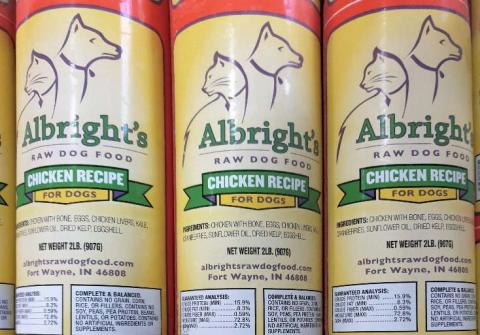
USA – Albright’s Raw Dog Food Recalls Chicken Recipe For Dogs Because of Possible Salmonella Health Risk

FDA

Albright’s Raw Dog Food of Fort Wayne, IN is voluntarily recalling 67 cases of Chicken Recipe for Dogs because it has the potential to be contaminated with SalmonellaSalmonella can affect animals eating the products and there is risk to humans from handling contaminated pet products, especially if they have not thoroughly washed their hands after having contact with the products or any surfaces exposed to these products.

Healthy people infected wit Salmonella should monitor themselves for some or all of the following symptoms: nausea, vomiting, diarrhea or bloody diarrhea, abdominal cramping and fever. Rarely, Salmonella can result in more serious ailments, including arterial infections, endocarditis, arthritis, muscle pain, eye irritation, and urinary tract symptoms. Consumers exhibiting these signs after having contact with this product should contact their healthcare providers.

Pets with Salmonella infections may be lethargic and have diarrhea or bloody diarrhea, fever, and vomiting. Some pets will have only decreased appetite, fever and abdominal pain. Infected but otherwise healthy pets can be carriers and infect other animals or humans. If your pet has consumed the recalled product and has these symptoms, please contact your veterinarian.

Albright’s Raw Dog Food Chicken Recipe for Dogs was distributed in CA, FL, IL, IN, NH, NJ, NV, NY, PA, and TN and product was distributed through retail stores, mail order, and direct delivery.

The product is labeled Albright’s Raw Dog Food Chicken Recipe for Dogs and is packaged in 2 lbs chubs/rolls. Each chub/roll is printed with “Lot number C000185, Best By 19 May 2021.” Product was sold frozen, and was distributed from the company to distributors from 7/8/20 to 8/27/20.

One animal illness has been reported. No human illnesses have been reported to date.

The problem bacteria was revealed after testing conducted by the FDA. The problem was confined to this batch and the company has ceased the distribution of the batch as FDA and the company continue their investigation as to what caused the problem.

Due to the frozen condition of the product, it is possible that retailers and end users may still have the product in their freezers. Consumers who have purchased Albright’s Raw Dog Food Chicken Recipe for Dogs are urged to return it to the place of purchase for a full refund.

Consumers with questions may contact the company at 1-260-422-9440 Monday – Friday, 8 am – 4 pm, EST.


Company Contact Information

Consumers:
 260-422-9440
 albrightsrawdogfood@aol.com

Product Photos

Canada – Sarnia – Bad hummus most likely source of Salmonella outbreak

The Sarnia Journal

The exact source of a food poisoning outbreak that sickened about 200 people may never be known, although contaminated hummus has been fingered as the most likely suspect, Lambton Public Health said.

Forty-five people were lab-confirmed to be infected with Salmonella and another 185 reported feeling sick after eating at the Barakat restaurant in Sarnia and Barakat food truck in Corunna in late October.

An investigation involving local, provincial and federal officials did not identify a specific food, but officials suspect cross-contamination of multiple dishes with hummus the most likely source of contamination, the health unit said.

“Many of these foodborne investigations are not conclusive in their cause, and this is one of those,” said Dr. Sudit Ranade Ranade, Lambton’s medical officer of health.

When the restaurant and food truck are ready to reopen they will be re-inspected.

France – Product recall: Saint Azay brand straight and curved dry sausages – Salmonella

Oulah

Product recall: Saint Azay brand straight and curved dry sausages

ENCOUNTERED PROBLEM

Presence of salmonella

PROPOSED SOLUTION

Those in possession of this product are asked not to consume it and to return it to the point of sale where it was purchased.

Foodborne illness caused by Salmonella results in gastrointestinal disturbances, diarrhea, vomiting and abdominal pain, often accompanied by fever; these symptoms may be more serious in young children, immunocompromised people and the elderly. The incubation period can range from 6 to 72 hours.
People who have consumed the products mentioned below and who have these symptoms are invited to consult their doctor, notifying him of this consumption.

FURTHER INFORMATION

▸ Barcode
• 3564700012246 (Dry sausage straight 250g)
• 3564700012253 (Dry sausage curved 300g)

▸ DDM
All DDM until 08/12/20 included

▸ Health
stamp FR 69.238.010 CE

▸ Consumer service contact
0 800 86 52 86 Free service and call

▸ Source
https://www.e-leclerc.com/

USA – Hundreds sick, 1 dead in nationwide Salmonella outbreak linked to chicks, ducklings

USA Today

Chicks and ducklings kept in backyards are the likely source of a nationwide Salmonella outbreak that has sickened nearly 1,000 people and killed one person, the U.S. Centers for Disease Control and Prevention said Wednesday.

The outbreak nearly doubled in size since the CDC’s last report on June 24.  Sick people range in age from 1 to 94-years-old, and more than 150 people have been hospitalized.

Research – Microbiological Survey of Wheat Flour Sold at Retail in Canada, 2018-2019

Journal of Food Protection

Following two O121 STEC outbreaks linked to wheat flour, this study was conducted to gain baseline information on the occurrence of bacterial pathogens and levels of indicator organisms in wheat flour in Canada. A total of 347 pre-packaged wheat flour samples were analyzed for Salmonella spp., Shiga Toxin-Producing Escherichia coli (STEC), Listeria monocytogenes ( L. monocytogenes ) , aerobic colony count (ACC), total coliforms, and generic Escherichia coli ( E. coli ) . Salmonella spp. and O157 STEC were not detected in any of the samples. L. monocytogenes was identified in two samples (0.6%) at levels below the limit of detection (<0.7 log CFU/g). Non-O157 STEC were isolated from six samples (1.7%) and were characterized for the presence of STEC virulence genes: stx 1, stx 2 and subtypes, eae , hlyA, and aggR . One O103:H25 STEC isolate carried virulence genes ( stx 1 a + eae ) that are known to be capable of causing diarrhea and/or bloody diarrhea in humans. Of the five remaining non-O157 STEC isolates, four carried single stx 2a or stx 2c genes and were considered to have the potential of causing diarrhea. The remaining non-O157 STEC isolate ( stx 2 ), while not a priority non-O157 STEC was not available for sequencing and thus its potential to cause illness is unknown. ACC, total coliforms, and generic E. coli were detected   in 98.8%, 72.6% and 0.6% of the flour samples. The mean counts of ACC were greater in whole-wheat flour as compared to the other flour types tested ( p <0.001). The results of this study suggest that the occurrence of O157 STEC and Salmonella  is low, but the occurrence of non-O157 STEC in wheat flour with the potential to cause human illness of diarrhea is relatively common. Therefore, the consumption of raw flour could increase the likelihood of STEC infections. Further research is merited for potential risk mitigation strategies within the food production system and with consumers.

Research – A Comparison of Three Methods for Determining Thermal Inactivation Kinetics: A Case Study on Salmonella enterica in Whole Milk Powder

Journal of Food Protection

Different methods for determining the thermal inactivation kinetics of microorganisms could result in discrepancies of the resulting thermal resistance values. This study determined the thermal resistance of Salmonella in whole milk powder using three methods (Thermal death time (TDT) disk in water bath, pouches in water bath, and TDT Sandwich). Samples from three separate production lots of whole milk powder were inoculated with a five strain Salmonella cocktail and equilibrated to 0.20 a w . The samples were then subjected to three isothermal treatment methods at 75, 80, or 85 °C. Samples were taken out at six timepoints and enumerated for survivors. The inactivation data were fitted to two consolidated models consisting of two primary models (log-linear and Weibull) and one secondary model (Bigelow). Normality testing indicated that all the model parameters were normally distributed. None of the model parameters for both consolidated models were significantly different (α=0.05). The amount of inactivation during the come-up time phase was also not significantly different among the methods (α=0.05). In terms of magnitude, however, the TDT Sandwich showed less inactivation during the come-up time phase and overall less variation in model parameters. The survivor data from all three methods were combined and fitted to both consolidated models, with the Weibull having lower root mean square error and a better fit according to corrected Akaike’s Information Criterion. These results suggest that the three thermal treatment methods are not significantly different from each other and are interchangeable, at least in the case of Salmonella in whole milk powder. Comparisons with more methods, other microorganisms, and larger varieties of food products using the same framework presented in this study could provide guidance for standardizing thermal inactivation kinetics studies for microorganisms in foods.

RASFF Alerts -Salmonella – Minced Turkey – Poultry Meat – Whole Chicken – Chicken Legs/Wings/Breast/Thighs/Fillets/Drumsticks- Chicken Escalopes – Salted Pork Intestines – Tahini – Whole Goose – Chicken Livers

European Food Alerts

RASFF

Salmonella enterica ser. Agona (presence /25g) in minced turkey from Germany in Austria

RASFF

Salmonella (presence /25g) in chilled poultry meat from Poland in Italy

RASFF

Salmonella enterica ser. Infantis (presence /25g) in frozen whole chicken from Ukraine, via the Netherlands in Denmark

RASFF

Salmonella (presence /25g) and Campylobacter (< 100 CFU/g) in chilled chicken escalopes from Austria in Germany

RASFF

Salmonella enterica ser. Enteritidis (presence /25g) in chilled whole chicken, thighs and fillets from France in France

RASFF

Salmonella enterica ser. Enteritidis (presence /25g) in frozen chicken wings from Poland in the Netherlands

RASFF

Salmonella enterica ser. Enteritidis in frozen chicken breasts from Poland in the UK

RASFF

Salmonella enterica ser. Enteritidis (in 3 out of 5 samples /25g) in frozen chicken thighs from Poland in Italy

RASFF

Salmonella group B (presence /25g) in frozen salted pork intestines from Poland in Germany

RASFF

Salmonella (presence /25g) in tahini from Egypt in Cyprus

RASFF

Salmonella enterica ser. Enteritidis (presence /25g) in frozen whole goose with giblets from Poland in Slovenia

RASFF

Salmonella enterica ser. Enteritidis (presence /25g) in frozen chicken livers from Poland in Italy

RASFF

Salmonella enterica ser. Typhimurium (in 2 out of 5 samples /25g) in chilled chicken meat from France in France

RASFF

possible presence of Salmonella enterica ser. Enteritidis in frozen hen legs and chicken wings from the United Kingdom in the UK

RASFF

Salmonella enterica ser. Typhimurium (presence /25g) in chicken breast fillets from Poland in Poland

RASFF

Salmonella enterica ser. Enteritidis (in 2 out of 5 samples /25g) in chilled chicken drumsticks from Poland in Slovakia

RASFF Alert – Animal Feed – Salmonella – Lamb Meal

European Food Alerts

RASFF

Salmonella (presence /25g) in lamb meal from New Zealand in Belgium

Canada – Updated Food Recall Warning – Alwatania brand Halva Extra recalled due to Salmonella

CFIA

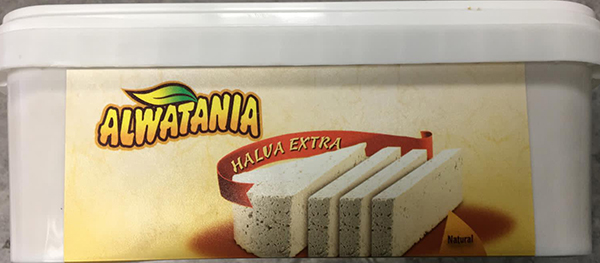
Alwatania - Halva Extra - 1 kg

Recall details

Ottawa, November 12, 2020 – The food recall warning issued on October 30, 2020 has been updated to include additional product information. This additional information was identified during the Canadian Food Inspection Agency’s (CFIA) food safety investigation.

Migahid & Elsawi Co. Ltd. is recalling Alwatania brand Halva Extra from the marketplace due to Salmonella. Consumers should not consume the recalled products described below.

Recalled product

Brand Product Size UPC Codes
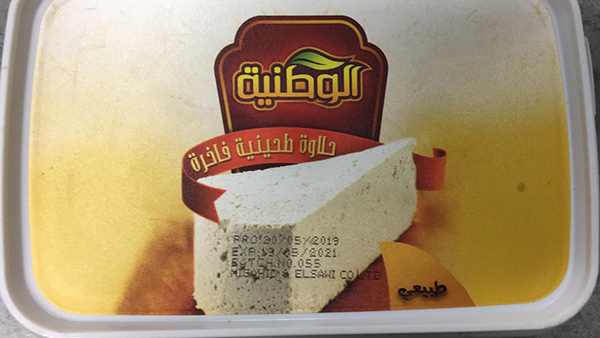
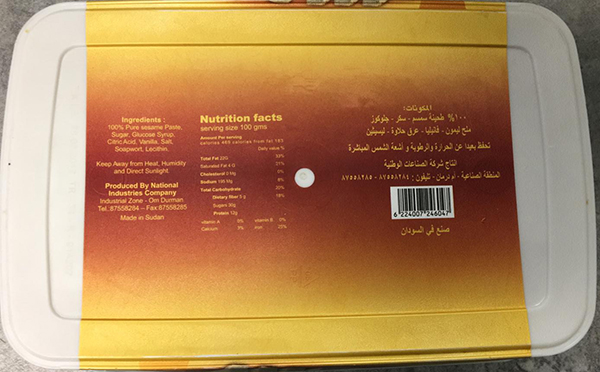
Alwatania Halva Extra 1 kg 6 224007 246047 PRO : 20/05/2019
EXP : 19/05/2021

What you should do

If you think you became sick from consuming a recalled product, call your doctor.

Check to see if you have the recalled product in your home. Recalled products should be thrown out or returned to the store where they were purchased.

Food contaminated with Salmonella may not look or smell spoiled but can still make you sick. Young children, pregnant women, the elderly and people with weakened immune systems may contract serious and sometimes deadly infections. Healthy people may experience short-term symptoms such as fever, headache, vomiting, nausea, abdominal cramps and diarrhea. Long-term complications may include severe arthritis.

Background

This recall was triggered by the CFIA’s inspection activities. The CFIA is conducting a food safety investigation, which may lead to the recall of other products. If other high-risk products are recalled, the CFIA will notify the public through updated Food Recall Warnings.

The CFIA is verifying that industry is removing the recalled product from the marketplace.

Illnesses

There have been no reported illnesses associated with the consumption of this product.

Product photos

Printer ready version of photos

  • Alwatania - Halva Extra - 1 kg
  • Alwatania - Halva Extra - 1 kg - top
  • Alwatania - Halva Extra - 1 kg - bottom

Public enquiries and media

Public enquiries
Toll-free: 1-800-442-2342 (Canada and U.S.)
Telephone: 1-613-773-2342 (local or international)
Email: cfia.enquiries-demandederenseignements.acia@canada.ca
Media relations
Telephone: 613-773-6600
Email: cfia.media.acia@canada.ca