Category Archives: Research

Research – Stress test finds cracks in the resistance of harmful hospital bugs

Science Daily

Research has identified critical factors that enable dangerous bacteria to spread disease by surviving on surfaces in hospitals and kitchens.

The study into the mechanisms which enable the opportunistic human pathogen Pseudomonas aeruginosa to survive on surfaces, could lead to new ways of targeting harmful bacteria.

To survive outside their host, pathogenic bacteria must withstand various environmental stresses. One mechanism is the sugar molecule, trehalose, which is associated with a range of external stresses, particularly osmotic shock — sudden changes to the salt concentration surrounding cells.

Researchers at the John Innes Centre analysed how trehalose is metabolised by P. aeruginosa to define its role in protection against external stresses.

Combining analytical biochemistry and reverse genetics — using mutated bacteria lacking key functions — they show that trehalose metabolism in P. aeruginosa is connected to biosynthesis of the carbon storage molecule glycogen.

Experiments showed that disruption of either trehalose or glycogen pathways significantly reduced the ability of P. aeruginosa to survive on human-made surfaces such as kitchen or hospital counters.

The study found that while both trehalose and glycogen are important for stress tolerance in P. aeruginosa they counter distinct stresses: trehalose helps the bacteria to survive in conditions of elevated salt; glycogen contributes to survival in dry (desiccated) environments.

The findings raise the possibility of targeting the trehalose and glycogen pathways to limit pathogen survival on human-made surfaces.

“We have shown how a dangerous human pathogen Pseudomonas aeruginosa responds to environmental challenges, such as salt stress or drying out. Disrupting the production of certain stress-tolerance sugars in this bug significantly reduces its ability to survive on kitchen and hospital worksurfaces,” said corresponding author of the study Dr Jacob Malone.

An unexpected finding was how the bacteria operates different pathways for different stresses, said Dr Malone: “Conventional wisdom says that trehalose was responsible for both phenotypes, but we have shown that trehalose only protects against osmo-stress and glycogen is needed to protect against desiccation. We were also surprised to see such a marked drop in surface survival when we disrupted the pathways in the bugs.”

The next step for the research is to understand how trehalose and glycogen metabolic pathways are regulated in P. aeruginosa and closely related species. The group also wants to understand how glycogen accumulation allows the bacteria to survive in dry environments and provide more explanation of how and when different parts of the pathways are turned on and off.

P. aeruginosa is a significant pathogen in animals as well as humans. In humans it primarily affects immunocompromised individuals, where it is a major cause of pneumonia and hospital-acquired infections. Chronic P. aeruginosa infections occur in 80% of adult cystic fibrosis patients, where it is the primary cause of morbidity and mortality.


Story Source:

Materials provided by John Innes CentreNote: Content may be edited for style and length.


Journal Reference:

  1. Stuart D. Woodcock, Karl Syson, Richard H. Little, Danny Ward, Despoina Sifouna, James K. M. Brown, Stephen Bornemann, Jacob G. Malone. Trehalose and α-glucan mediate distinct abiotic stress responses in Pseudomonas aeruginosaPLOS Genetics, 2021; 17 (4): e1009524 DOI: 10.1371/journal.pgen.1009524

Research – Lactic acid bacteria can extend the shelf life of foods

Science Daily

Researchers at the National Food Institute have come up with a solution that can help combat both food loss and food waste: They have generated a natural lactic acid bacterium, which secretes the antimicrobial peptide nisin, when grown on dairy waste.

Nisin is a food-grade preservative, which can extend the shelf life of foods, and thus can be used to reduce food waste. The discovery also makes it possible to better utilize the large quantities of whey generated when cheese is made.

Nisin is approved for use in a number of foods, where it can prevent the growth of certain spoilage microorganisms as well as microorganisms that make consumers sick. It can for instance inhibit spore germination in canned soups and prevent late blowing in cheeses — without affecting its flavour.

In theory, nisin could be added to fresh milk to extend its shelf life. However, different countries have different rules stating what types of products nisin may be added to and in which amounts.

Extra step towards better utilization of whey

Many dairies are already turning a profit by extracting protein and lactose from the many tons of whey they generate, which they use in e.g. infant formula and sports nutrition. What is left behind can still be used to produce nisin.

In addition to ensuring better resource utilization, there may be a financial gain from producing nisin: Most commercially available nisin products contain 2.5% nisin and cost approximately 40 euro per kilogram.

Research – Expiration Date of Ready-to-Eat Salads: Effects on Microbial Load and Biochemical Attributes

MDPI

When minimally processed vegetables reach their expiration date, expose an increased microbial load. This includes mainly spoilage microorganisms but also foodborne pathogens, thus affecting the quality and safety of highly consumed ready-to-eat salads. A total of 144 ready-to-eat salads from the Cypriot market were analyzed in an attempt to determine the effects of the expiration date on the microbial load and plant metabolic variables of the salads. Possible correlations between them were also investigated for the first time. Furthermore, the impacts of the season (winter, summer), salad producing companies and type of salad and/or their interactions with the tested parameters were investigated. Results revealed that the microbial load (mainly spoilage microorganisms, such as Pseudomonas spp., yeasts and molds) increased towards the end of the shelf life. The microbial load was differentiated among the five salad producers and/or the salad types, highlighting the importance of a common and safe sanitation-processing chain in the preparation of ready-to-eat salads. Summer was the season in which Escherichia coli counts were found to be higher for plain lettuce, while Staphylococcus spp. was increased numbers for the lettuce+endive/radicchio, lettuce+rocket and lettuce+chives type of salads. Additionally, an increased Staphylococcus spp. was observed for plain rocket salads in winter. All samples examined were found negative for Salmonella enterica and Listeria monocytogenes. Moreover, carbon dioxide production and damage indexes (hydrogen peroxide and lipid peroxidation) increased on expiration date on both winter and summer seasons, indicating plant tissue stress at the end of shelf life. These findings indicate that the expiration date and relevant shelf life of processed vegetables are important parameters to be considered when postharvest management is applied to these products, ensuring safety and quality. View Full-Text

Norovirus – Increased hand sanitizer use blamed for rise in gastro outbreaks

New Atlas

Food Borne Illness - Norovirus -CDC Photo

A number of countries are reporting increasing rates of viral gastroenteritis over recent months, and experts suggest greater use of hand sanitizers, known to have little effect on pathogens such as norovirus, may be partly responsible.

New data released by health authorities in the Australian state of Victoria is reporting a four-fold increase in gastroenteritis outbreaks across childcare facilities over the first few months of 2021, compared to the five-year average. Other countries such as New Zealand and Taiwan have also reported spikes in norovirus outbreaks over recent months.

http://www.china.org.cn/world/Off_the_Wire/2021-04/28/content_77448785.htm

SYDNEY, April 28 (Xinhua) — Health authorities in Australia urged people to use soap and water rather than relying solely on hand sanitizers to ward off the norovirus.

The Food Safety Information Council (FSIC) made the suggestion on Wednesday following hundreds of outbreaks of the gastro virus around the nation in the past five months. Nearly 390 cases have been recorded this year in the state of Victoria, four times higher than average.

“Norovirus is highly contagious. A single infected person can easily spread it to many others, especially if they don’t wash their hands properly or prepare food or drink for others while they’re sick,” said FSIC chairwoman Cathy Moir.

She said not all viruses are the same and although hand sanitizers are very effective against reducing the spread of COVID-19, it has little effect on the spread of norovirus.

The FSIC suggested people to frequently wash their hands with soap and warm water for 20 seconds and drying for another 20 seconds to effectively remove norovirus.

The most important times to wash hands are after going to the toilet, vomiting, changing nappies, cleaning up vomit or faeces (poo) or attending to a sick person who has vomited, and before eating and preparing food.

The FSIC also suggested not to prepare food or drink for others if having gastro, and not to share plates, utensils or drink bottles with others.

USA – Factors Potentially Contributing to the Contamination of Leafy Greens Implicated in the Fall 2020 Outbreak of E. coli O157:H7

FDA

Executive Summary

Between August and December 2020, the U.S. Food and Drug Administration (FDA) and multiple state and federal partners were involved in an outbreak investigation related to E. coli O157:H7 illnesses and the consumption of leafy greens. The outbreak, which caused 40 reported domestic illnesses, was linked via whole genome sequencing (WGS) and geography to outbreaks traced back to the California growing region associated with the consumption of leafy greens in 2019 and 2018. FDA, alongside state and federal partners, investigated the outbreak to identify potential contributing factors that may have led to leafy green contamination with E. coli O157:H7. The E. coli O157:H7 outbreak strain was identified in a cattle faeces composite sample taken alongside a road approximately 1.3 miles upslope from a produce farm with multiple fields tied to the outbreaks by the traceback investigations. In addition, several potential contributing factors to the 2020 leafy greens outbreak were identified.

Isolates within this cluster of illnesses are part of a reoccurring strain of concern and are associated with outbreaks that have occurred in leafy greens each fall since 2017. The two most recent outbreaks associated with this strain were an outbreak in 2018 (linked to romaine lettuce from the Santa Maria growing region of California) and an outbreak in 2019 (linked to romaine lettuce from the Salinas growing region of California). Clinical isolates from cases in this 2020 outbreak appear more closely related to those from the 2019 outbreak than the 2018 outbreak. In addition, several specific food and environmental isolates that appear to be highly related to this 2020 outbreak include a faecal-soil composite sample collected by FDA in February 2020 from the Salinas growing region and two leafy green samples collected in 2019 by state partners as a part of the 2019 investigation that traced back to the Salinas growing region.

As part of this investigation, tracebacks of leafy greens consumed by ten ill individuals from eleven points of service were conducted. Although that traceback investigation was based on a relatively small number of the total cases, it was based on those cases which presented the strongest evidence via purchase card information, invoices, bills of lading, and electronic data. The traceback investigation identified the Salinas growing region of California as a geographical region of interest.

In light of this most recent finding, combined with previous outbreak investigation findings in the region, FDA has identified key trends regarding the issues of a reoccurring strain, a reoccurring region, and reoccurring issues around adjacent and nearby land use of primary importance in understanding the contamination of leafy greens by E. coli O157:H7 that occurred in 2020 and previous years.

FDA also recognizes the interconnection between people, animals, plants, and their shared environment when it comes to public health outcomes. As such, we strongly encourage collaboration among various groups in the broader agricultural community (i.e. livestock owners; leafy greens growers, state and federal government agencies, and academia) to address this issue. With this collaboration, the agricultural community, alongside academic and government partners, can work to identify and implement measures to prevent contamination of leafy greens. FDA recommends that these parties participate in efforts to understand and address the challenge of successful coexistence of various types of agricultural industries to ensure food safety and protect consumers against foodborne illnesses.

Download the Full Report (PDF 563KB)

Research – Prevalence and Epidemiology of Non-O157 Escherichia coli Serogroups O26, O103, O111, and O145 and Shiga Toxin Gene Carriage in Scottish Cattle, 2014–2015

ASM

ABSTRACT

Cattle are a reservoir for Shiga toxin-producing Escherichia coli (STEC), zoonotic pathogens that cause serious clinical disease. Scotland has a higher incidence of STEC infection in the human population than the European average. The aim of this study was to investigate the prevalence and epidemiology of non-O157 serogroups O26, O103, O111, and O145 and Shiga toxin gene carriage in Scottish cattle. Fecal samples (n = 2783) were collected from 110 herds in 2014 and 2015 and screened by real-time PCR. Herd-level prevalence (95% confidence interval [CI]) for O103, O26, and O145 was estimated as 0.71 (0.62, 0.79), 0.43 (0.34, 0.52), and 0.23 (0.16, 0.32), respectively. Only two herds were positive for O111. Shiga toxin prevalence was high in both herds and pats, particularly for stx2 (herd level: 0.99; 95% CI: 0.94, 1.0). O26 bacterial strains were isolated from 36 herds on culture. Fifteen herds yielded O26 stx-positive isolates that additionally harbored the intimin gene; six of these herds shed highly pathogenic stx2-positive strains. Multiple serogroups were detected in herds and pats, with only 25 herds negative for all serogroups. Despite overlap in detection, regional and seasonal effects were observed. Higher herd prevalence for O26, O103, and stx1 occurred in the South West, and this region was significant for stx2 at the pat level (P = 0.015). Significant seasonal variation was observed for O145 prevalence, with the highest prevalence in autumn (P = 0.032). Negative herds were associated with Central Scotland and winter. Herds positive for all serogroups were associated with autumn and larger herd size and were not housed at sampling.

IMPORTANCE Cattle are reservoirs for Shiga toxin-producing Escherichia coli (STEC), bacteria shed in animal feces. Humans are infected through consumption of contaminated food or water and by direct contact, resulting in serious disease and kidney failure in the most vulnerable. The contribution of non-O157 serogroups to STEC illness was underestimated for many years due to the lack of specific tests. Recently, non-O157 human cases have increased, with O26 STEC of particular note. It is therefore vital to investigate the level and composition of non-O157 in the cattle reservoir and to compare them historically and by the clinical situation. In this study, we found cattle prevalence high for toxin, as well as for O103 and O26 serogroups. Pathogenic O26 STEC were isolated from 14% of study herds, with toxin subtypes similar to those seen in Scottish clinical cases. This study highlights the current risk to public health from non-O157 STEC in Scottish cattle.

Norway -Monitoring program 2020 – Monitoring and control of Salmonella in live animals, fresh meat and eggs

Mattilsynet

Since 1995, the Norwegian Food Safety Authority has carried out monitoring programs for Salmonella in live animals (cattle, pigs and poultry), fresh meat and eggs. The program documents that the incidence is very low compared to most other countries.

What did we investigate? The aim of the program is to ensure that food-producing animals, fresh meat and eggs from Norwegian domestic animals are virtually free of salmonella. The program also documents the very favorable salmonella situation Norway has, which in turn provides a basis for salmonella guarantees, ie when importing certain animals and certain animal products, the shipment must be examined for salmonella with a negative result in the country of dispatch before it can be sent to Norway. In the program, samples have been taken in herds, in the slaughterhouses and in downsizing companies.
Period: All year
What were we looking for? The samples were tested for Salmonella.
What did we find? In the program for 2020, one positive sample was found among a total of 8,285 from poultry, one positive sample from pigs among 3,245 examined, three positive samples from cattle out of a total of 2,975 samples and four positive samples from a total of 8,690 taken from fresh meat in slaughterhouses and cutting plants. .


The full report can be read here


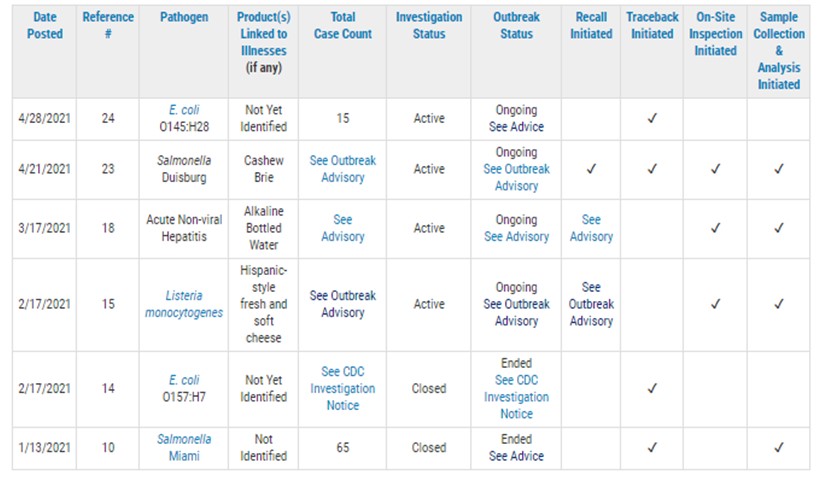
USA – FDA Core Investigation Table Update

FDA

USA – Notes from the Field: Multistate Outbreak of Escherichia coli O26 Infections Linked to Raw Flour — United States, 2019

CDC

On February 20, 2019, PulseNet, the molecular subtyping network for foodborne disease surveillance, identified six Shiga toxin–producing Escherichia coli (STEC) O26:H11 infections with the same pulsed-field gel electrophoresis (PFGE) pattern combination. This PFGE pattern combination matched that of infections from a July 2018 outbreak that was associated with ground beef. In response, CDC initiated an investigation with federal, state, and local partners to identify the outbreak source and implement prevention measures.

CDC defined a case as STEC O26 infection with an isolate matching the outbreak strain by PFGE or related by core genome multilocus sequence typing scheme (cgMLST), with dates of illness onset during December 11, 2018–May 21, 2019. Investigators initially hypothesized that ground beef was the outbreak cause because of the PFGE match to the July 2018 outbreak and because in early interviews, patients commonly reported eating ground beef and leafy greens. Investigators used cgMLST to compare the genetic sequences of isolates from both outbreaks and determined that they fell into separate genetic clades (differing by 6–11 alleles), suggesting that something other than ground beef caused the illness in 2019. CDC noted that one patient consumed raw cookie dough and that most patients were young adult females, similar to demographic distributions of past flour-associated STEC outbreaks (13). Investigators developed a supplemental questionnaire focusing on beef, leafy greens, and flour exposures.

Twenty-one cases were reported from nine states (Figure). The median age of patients was 24 years (range = 7–86 years); 71% were female. Three patients were hospitalized, and none died. Among 13 patients asked about flour exposures, six reported eating, licking, or tasting raw homemade dough or batter during the week before illness onset. Three patients reported eating raw dough or batter made with the same grocery store brand of all-purpose flour, including a patient who reported eating raw dough at a bakery in Rhode Island. Overall, of 18 patients with store information, 11 reported shopping at this same grocery store chain.

The Rhode Island Department of Health visited the bakery reported by the patient and collected flour for testing. On May 21, 2019, testing identified STEC O26 from an intact bag of all-purpose flour, which was the same grocery store brand reported by other patients. PulseNet confirmed that the STEC O26 isolated from the flour was highly related to clinical isolates using cgMLST (0–1 alleles). Product distribution records collected by the Food and Drug Administration indicated that the store brand flour purchased by six patients in three states was produced in a single milling facility in Buffalo, New York. Based on results of the investigation, the store chain recalled all lots of product from its retail locations in 11 states. The milling company also recalled all lots of this product and several other lots of flour produced in that facility, resulting in the recall of additional brands and products distributed to multiple states.

Flour is increasingly recognized as a cause of STEC outbreaks (15). Raw flour is not a ready-to-eat product, and this outbreak highlights the continuing risk for illness associated with consumption of flour and raw dough or batter. The investigation was aided by considering demographic information early in the investigation because these characteristics were similar to those in past flour-associated outbreaks (13). These similarities, coupled with the discriminatory power of cgMLST, helped to guide the consideration of alternative hypotheses regarding the outbreak source and the successful identification of flour as the cause of this outbreak.

Singapore – NTUSingapore, Singapore Food Agency, and A*STAR launch Future Ready Food Safety Hub(FRESH)to build Singapore’s capabilities in food safety science

Click to access ntu-singapore-singapore-food-agency-and-a-star-launch-future-ready-food-safety-hub-(fresh)-to-build-singapore-s-capabilities-in-food-safety-science.pdf