Category Archives: outbreak

Canada – Sarnia – Bad hummus most likely source of Salmonella outbreak

The Sarnia Journal

The exact source of a food poisoning outbreak that sickened about 200 people may never be known, although contaminated hummus has been fingered as the most likely suspect, Lambton Public Health said.

Forty-five people were lab-confirmed to be infected with Salmonella and another 185 reported feeling sick after eating at the Barakat restaurant in Sarnia and Barakat food truck in Corunna in late October.

An investigation involving local, provincial and federal officials did not identify a specific food, but officials suspect cross-contamination of multiple dishes with hummus the most likely source of contamination, the health unit said.

“Many of these foodborne investigations are not conclusive in their cause, and this is one of those,” said Dr. Sudit Ranade Ranade, Lambton’s medical officer of health.

When the restaurant and food truck are ready to reopen they will be re-inspected.

Research – Microbiological Survey of Wheat Flour Sold at Retail in Canada, 2018-2019

Journal of Food Protection

Following two O121 STEC outbreaks linked to wheat flour, this study was conducted to gain baseline information on the occurrence of bacterial pathogens and levels of indicator organisms in wheat flour in Canada. A total of 347 pre-packaged wheat flour samples were analyzed for Salmonella spp., Shiga Toxin-Producing Escherichia coli (STEC), Listeria monocytogenes ( L. monocytogenes ) , aerobic colony count (ACC), total coliforms, and generic Escherichia coli ( E. coli ) . Salmonella spp. and O157 STEC were not detected in any of the samples. L. monocytogenes was identified in two samples (0.6%) at levels below the limit of detection (<0.7 log CFU/g). Non-O157 STEC were isolated from six samples (1.7%) and were characterized for the presence of STEC virulence genes: stx 1, stx 2 and subtypes, eae , hlyA, and aggR . One O103:H25 STEC isolate carried virulence genes ( stx 1 a + eae ) that are known to be capable of causing diarrhea and/or bloody diarrhea in humans. Of the five remaining non-O157 STEC isolates, four carried single stx 2a or stx 2c genes and were considered to have the potential of causing diarrhea. The remaining non-O157 STEC isolate ( stx 2 ), while not a priority non-O157 STEC was not available for sequencing and thus its potential to cause illness is unknown. ACC, total coliforms, and generic E. coli were detected   in 98.8%, 72.6% and 0.6% of the flour samples. The mean counts of ACC were greater in whole-wheat flour as compared to the other flour types tested ( p <0.001). The results of this study suggest that the occurrence of O157 STEC and Salmonella  is low, but the occurrence of non-O157 STEC in wheat flour with the potential to cause human illness of diarrhea is relatively common. Therefore, the consumption of raw flour could increase the likelihood of STEC infections. Further research is merited for potential risk mitigation strategies within the food production system and with consumers.

USA – Walmart recall: Tanimura & Antle romaine lettuce recalled from more than 1,000 Walmart stores over E. coli risk

USA Today

Eurofins Food Testing UK

Walmart has released a list of the stores that carried the recalled Tanimura & Antle romaine lettuce.

Last week, Salinas, California-based Tanimura & Antle Inc. voluntarily recalled select single heads of romaine lettuce distributed across the country for possible E. coli contamination. The company posted an announcement on the Food and Drug Administration website Friday.

The affected lettuce is labeled with a “packed on date of 10/15/2020 or 10/16/2020,” the company said. The UPC number on the lettuce is 0-27918-20314-9.

According to Tanimura & Antle, no other products or pack dates are being recalled and there have been “no reported illnesses associated with the recalled product.”

Canada – More than 180 people have had Salmonella symptoms after eating at a Sarnia restaurant

CBC

Dozens of people have contracted salmonella after eating at a restaurant in Sarnia and food truck in Corunna last month, according to Lambton Public Health.

On Monday, the local health unit confirmed that 41 people have now been diagnosed with salmonella after eating at the Barakat restaurant in Sarnia and the Barakat Food Truck in Corunna between Oct. 19 and Oct. 29. In total, the health unit said that more than 180 people have had symptoms consistent with the illness and nine people have been hospitalized.

On Oct. 30, the health unit put out its first news release, stating that they were looking into the situation. Days later on Nov. 5, they said there were 33 cases related to the outbreak in people between nine months and 73 years old.

Now the health unit has added several more infected individuals to the list.

Majority of the exposures took place between Oct. 21 and Oct. 25.

For anyone else who may have symptoms of salmonella, including diarrhea, fever, stomach cramps or vomiting, public health said they are advised to report the illness to Lambton Public Health and contact their health care provider as needed if symptomatic.

USA – Fresh Express Inc – Div of Chiquita Brands – FDA Warning Letter

FDA

The U.S. Food and Drug Administration (FDA ) inspected your bagged salad operation located at 1109 East Lake Street, Streamwood, IL 60107, from June 25, 2020 through July 23, 2020. The inspection was initiated as part of an investigation of a multistate foodborne outbreak of cyclosporiasis (human infections with the parasite Cyclospora cayetanensis). As of September 23, 2020, the Centers for Disease Control and Prevention (CDC) reported that at least 701 people from 14 states have been infected with Cyclospora cayetanensis. Based on epidemiological and traceback evidence, CDC and FDA have determined that bagged salad mixes containing iceberg lettuce, carrots, and red cabbage manufactured at your Streamwood, IL facility were the source of this multistate cyclosporiasis outbreak. On June 19, 2020, you recalled bagged salad mix containing iceberg lettuce, red cabbage, and carrots, because they had the potential to be contaminated with Cyclospora. The Public Health Agency of Canada is also investigating an outbreak of cyclosporiasis infections occurring in three Canadian provinces in which Fresh Express brand salad products containing iceberg lettuce, carrots, and red cabbage have been identified as the likely source of the outbreak. This is the second outbreak of cyclosporiasis linked to Fresh Express product. In 2018, a multistate foodborne outbreak of cyclosporiasis involving 511 confirmed cases from 15 states was linked to salads sold at a fast food restaurant and manufactured at your Streamwood, IL facility.

USA – Outbreak Investigation of Salmonella Stanley: Wood Ear Mushrooms – Dried Fungus (September 2020)

FDA

The FDA, along with CDC and state and local partners, investigated a multistate outbreak of Salmonella Stanley infections linked to wood ear mushrooms imported by Wismettac Asian Foods, Inc. of Santa Fe Springs, CA. Wood ear mushrooms are a dried mushroom, also commonly labelled or referred to as Kikurage, Dried Black Fungus, Dried Fungus, or Mu’er/Mu Er/Mu-Err.

Wismettac Asian Foods, Inc. acted quickly upon being notified of the positive test result and recalled all wood ear mushrooms within shelf life on September 23, 2020.

Recommendation

Wood ear mushrooms imported by Wismettac Asian Foods, Inc. were only sold to restaurants and were not available directly to consumers. Although these items have been recalled, restaurants that received recalled products should use extra vigilance in cleaning and sanitizing any surfaces that may have come in contact with the recalled product, to reduce the risk of cross contamination. All recalled product should be thrown out.


Investigation Update

November 4, 2020

As of November 4, 2020, the CDC declared that this outbreak is over.

General Food Safety Tips for Dried Mushrooms

Dried mushrooms, that have not been recalled due to potential contamination, should always be reconstituted using boiling water to kill any pathogens. This advice does not apply to recalled products, which should be thrown out.

Product Images

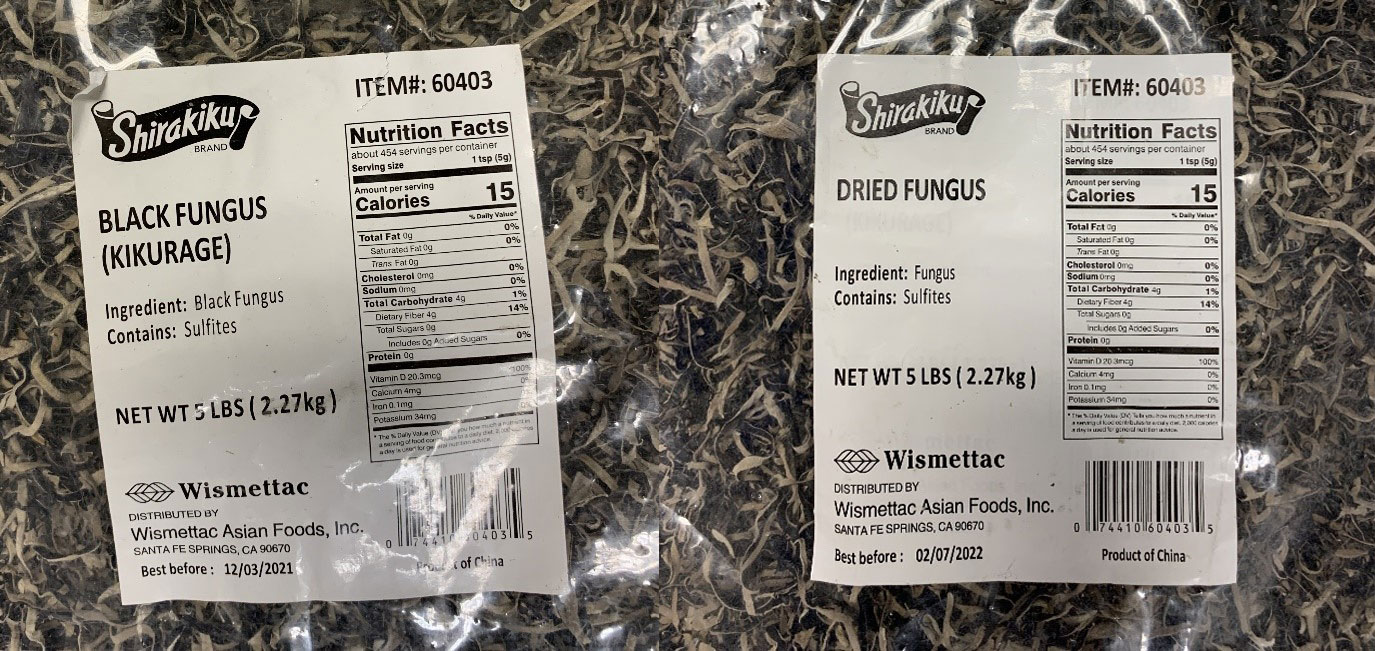
Outbreak Investigation of Salmonella Stanley in Wood Ear Mushrooms (September 2020) - Photos of Recalled Shirakiku Dried Fungus

Recall Information

On September 23, 2020, Wismettac Asian Foods, Inc. recalled Shirakiku brand imported dried fungus. This product was labeled as Shirakiku brand Black Fungus (Kikurage) with UPC Code 00074410604305, imported from China. Product was distributed in six packs of five-pound bags to restaurants in AR, CA, CO, CT, DE, DC, FL, GA, HI, IA, IL, IN, LA, MA, MD, MI, MN, MO, MS, NC, NV, NJ, NY, OH, OR, PA, SC, TN, TX, VA, WA, and WI.

Research – Characteristics of Norovirus Food Poisoning Outbreaks in Korea in the 2000s

Journal of Food Protection

Eurofins

Norovirus food poisoning outbreaks in Korea (South) appeared in 2000s and have been increasing since then. We aimed to investigate the epidemiological features of norovirus food poisoning outbreaks in Korea over the past years (2002 ~ 2017), based on official food poisoning statistics and available reports, and to find their association with climate factors. Norovirus was the most common cause of food poisoning among known causative substances in Korea during the study period. More than one-third of the incidents occurred in group meal-service facilities, including school lunch programs. A few of these facilities used groundwater contaminated with noroviruses to wash / cook food, which contributed to outbreaks. Norovirus occurrences showed strong seasonality; cold and relatively dry winter air may help norovirus to flourish. Both norovirus genotypes GI and GII infectious to humans were detected, with GII becoming more prevalent than GI. According to our correlation analysis in connection with climate factors, average temperatures, the highest and lowest temperatures, precipitation, the number of rain days, and humidity showed a significant negative correlation with a monthly norovirus occurrence (p < 0.05). The lowest temperature and average temperature had higher coefficients of correlation, -0.377 and -0.376, respectively. The norovirus outbreaks in Korea showed complex etiological characteristics, although it more prevailed in wintertime, and are now considered as a major public health problem. The use of groundwater in group meal-service settings has a public health impact as well as norovirus concern, therefore groundwater used in food service facilities / business should be treated for safety.

Australia – Shigella outbreak reported at Richmond State School in Townsville

Outbreak News Today

Shigella - kswfoodworld

Image CDC

Townsville Public Health Unit is responding to a shigella outbreak at Richmond State School where there have been 12 confirmed cases.

Shigella infection is a serious form of gastroenteritis caused by a bacterium that attacks the intestines leading to diarrhea, abdominal pain or cramps and fever.

The illness is spread if you accidentally swallow the bacteria that is found in faeces, usually through not washing your hands properly after going to the toilet or changing diapers.

Townsville Public Health Unit physician, Dr Julie Mudd said additional cleaning was being undertaken at Richmond School today as it is closed for a public holiday.

Of the 12 cases, one was brought to Townsville University Hospital as a precaution and has since been discharged. The remaining 11 cases are recovering in the community.

Canada – Ontario: Salmonella outbreak linked to the Barakat restaurant in Sarnia

Outbreak News Today

In the city of Sarnia in Southwestern Ontario, Canada, officials with Lambton Public Health (LPH) report investigating an outbreak of Salmonella infection in people who recently ate at the Barakat restaurant.

As of Friday, LPH has received laboratory confirmation of four cases related to this outbreak. The department is currently following up with several others who have reported becoming ill after eating at this restaurant.

The investigation into the source of this outbreak is ongoing. The owners of the restaurant are cooperating with Lambton Public Health and have voluntarily closed while LPH ensures there is no on-going risk of illness.

Members of the public who ate at the Barakat restaurant between October 21st and October 29th and became ill with symptoms of Salmonella infection (diarrhea, fever, stomach cramps, vomiting) are advised to:

  • Report the illness to Lambton Public Health at 519-383-8331 or toll free 1-800-667-1839
  • Contact their health care provider as needed if symptomatic

Research – UK hit hardest by outbreak linked to Brazil nuts; no cases in U.S. yet

Food Safety News

More than 120 people are part of a multi-country Salmonella outbreak linked to Brazil nuts.

Since August 2019, the outbreak, caused by Salmonella Typhimurium and Salmonella Anatum, has affected three European Union countries, the United Kingdom and Canada. The United States was one of more than 30 countries that received Brazil nuts from Bolivia contaminated with Salmonella.

In total, 123 cases of Salmonella Typhimurium have been reported, of which 105 were in the UK, 14 in France, three in Luxembourg and one each in the Netherlands and Canada. One Salmonella Anatum patient was recorded in the UK.

A case-control study in the UK and patient interviews in the UK, France and Luxembourg indicated Brazil nuts and nut bars as likely vehicles of infections. Two batches of Brazil nuts from Bolivia tested positive for Salmonella Typhimurium and Salmonella Anatum matching the outbreak strains.