Category Archives: Microbiology

Resaerch- Evaluation of Various Lactic Acid Bacteria and Generic E. coli as Potential Non-pathogenic Surrogates for In-Plant Validation of Biltong Dried Beef Processing

MDPI

Validation studies conducted within a food processing facility using surrogate organisms could better represent the manufacturing process than controlled laboratory studies with pathogenic bacteria on precision equipment in a BSL-2 lab. The objectives of this project were to examine potential surrogate bacteria during biltong processing, conduct biltong surrogate validation lethality studies, and measure critical factors and intrinsic parameters during processing. Beef pieces (1.9 cm × 5.1 cm × 7.6 cm) were inoculated with four-strain mixtures of Carnobacterium divergens/C. gallinarumPediococcus acidilactici/P. pentosaceous, and Biotype 1 E. coli ATCC BAA (-1427, -1428, -1429, and -1430), as well as a two-strain mixture of Latilactobacillus sakei and other commercially available individual bacterial cultures (P. acidilactici Saga200/Kerry Foods; Enterococcus faecium 201224-016/Vivolac Cultures). Inoculated beef was vacuum-tumbled in marinade and dried in a humidity-controlled oven for 8–10 days (24.9 °C; 55% relative humidity). Microbial enumeration of surviving surrogate bacteria and evaluation of intrinsic factors (water activity, pH, and salt concentration) were performed post inoculation, post marination, and after 2, 4, 6, 8, and 10 days of drying. Trials were performed in duplicate replication with triplicate samples per sampling time and analyzed by one-way RM-ANOVA. Trials conducted with E. faeciumPediococcus spp., and L. sakei never demonstrated more than 2 log reduction during the biltong process. However, Carnobacterium achieved a >5 log (5.85 log) reduction over a drying period of 8 days and aligned with the reductions observed in previous trials with pathogenic bacteria (Salmonella, E. coli O157:H7, L. monocytogenes, and S. aureus) in biltong validation studies. Studies comparing resuspended freeze-dried or frozen cells vs. freshly grown cells for beef inoculation showed no significant differences during biltong processing. Carnobacterium spp. would be an effective nonpathogenic in-plant surrogate to monitor microbial safety that mimics the response of pathogenic bacteria to validate biltong processing within a manufacturer’s own facility. View Full-Text

USA – 2 Florida deaths linked to bacterial infection from eating raw oysters – Vibrio vulnificans

Fox Weather

Food Illness

A warning to shellfish lovers: Health officials are investigating the deaths of two people in Florida linked to eating raw oysters.

The deaths are reportedly linked to oysters from Louisiana. The two separate occasions happened a week apart in Escambia and Broward counties, according to the Florida Department of Health.

Eating raw oysters and other undercooked seafood can put people at risk for infections, including vibriosis, which is caused by certain strains of Vibrio bacteria, according to the Centers for Disease Control and Prevention.

So far this year, there have been 26 Vibrio vulnificus infections reported in Florida. Six of those resulted in deaths, data from the Florida Department of Health shows. Nationally, an estimated 80,000 people have fallen ill and 100 deaths are reported every year from the bacterium that usually lives in warm, brackish seawater, the nation’s top public health agency reports.

Finland – The plant-based food preparation product spoils before the date

Epressi

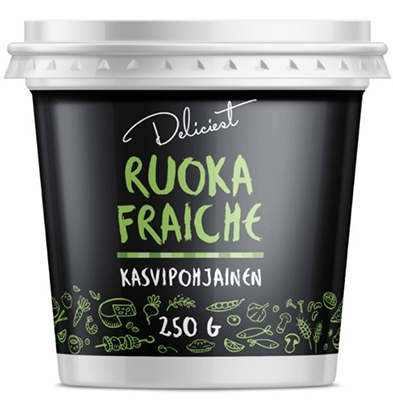
A 250 gram jar of Deliciest Food Fraiche.

Deliciest Oy has announced that it will issue a recall for the product  Deliciest Food Fraiche 250 g, best before date 30.9.2022.

The manufacturer says that a quality defect has been detected in the product batch of that date, which causes the product to spoil before the date expires.

Instructions for consumers who bought the product can be found on the website of Deliciest Oy  .

More information: Product manager Anna-Maria Sneck, Deliciest Oy, tel. 040 514 1042,  palaute@deliciest.fi .

The matter is handled at the Food Agency by Chief Inspector Paula Hietanen, tel. 050 596 9637  firstname.surname@ruokavirasto.fi .

RASFF Alert – Food Spoilage – High Total Microbial Count – Mozarella

RASFF

Altered organoleptic properties and high total microbial count in mozarella from Italy in Germany

RASFF Alert – Animal Feed – Ergot Alkaloids – Mycotoxin – Peas

RASFF

Ergot (Claviceps purpurea) in peas from Belgium in the Netherlands

RASFF Alerts – Animal Feed – Salmonella – Poultry Meal – Feed Materials

RASFF

Salmonella in poultry meal from the United Kingdom in Netherlands and Belgium

RASFF

Salmonella Isangi in feed materials from Germany in Norway

Denmark – Outbreak of Salmonella Enteritidis in Denmark

SSI

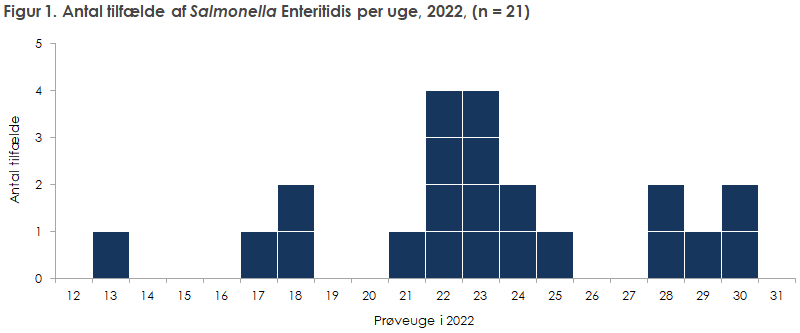
Since 31 March 2022, 21 cases of Salmonella Enteritidis have been registered at the Statens Serum Institut. In the current outbreak, the source of infection remains unknown, but an investigation is underway.

Last edited on August 16, 2022

About the disease outbreak

Between 31 March 2022 and 30 July 2022, 21 people have been registered at the Statens Serum Institut who have been infected with the same type of Salmonella Enteritidis (figure 1). Among the sick are 15 men and 6 women. The patients are between 8-59 years old (median age is 28 years). The patients primarily live in the Capital Region and Zealand Region (table 1).

The Statens Serum Institut is working together with the Danish Veterinary and Food Administration and the Norwegian Food Institute DTU on this outbreak to identify the source of infection.

Number of cases of Salmonella Enteritidis sequence type 11 per week, 2022, (n = 21)

Table 1. Patients with Salmonella Enteritidis in Denmark, March to July 2022, per region (n=21)

Region  Number of patients
 The capital   13
 Zealand   5
 Central Jutland   2
 Southern Denmark   1
 Northern Jutland   0
 Total  21

The outbreak strain

The bacteria is of the type Salmonella Enteritidis. When whole-genome sequencing of the bacteria isolated from the patients shows that they are very closely related and belong to sequence type 11.

General about salmonella infection

Salmonella is found in animals and can infect humans through food contaminated with the bacteria. Salmonella is a frequent and well-known cause of bacterial intestinal infections in Denmark. There are more than 2,500 different types of salmonella.

Incubation period

The time that passes from being infected to getting symptoms varies from 6-72 hours. Usually 12-36 hours before symptoms appear.

Symptoms

Infection with salmonella typically causes general malaise, diarrhoea, stomach ache, possibly nausea, vomiting and/or fever. The infection is often accompanied by joint pain, muscle pain and headache. Plenty of fluids are important to prevent and treat dehydration from diarrhea and vomiting. In the event of severe diarrheal disease, a doctor should be consulted.

USA – FDA Coe Investigation Table Update

FDA

What’s New

  • An outbreak of E. coli O157:H7 (ref# 1081) in an unidentified product was added to the table and FDA has initiated a traceback investigation. CDC has issued an Investigation Notice.
  • An outbreak of Salmonella Senftenberg (ref# 1087) in an unidentified product was added to the table.
  • An outbreak of Salmonella Typhimurium (ref# 1095) in an unidentified product was added to the table and traceback has been initiated.
  • For the outbreak of Salmonella Braenderup (ref# 1075) in an unidentified product, the outbreak has ended.
  • For the outbreak of Cyclospora in an unidentified product (ref# 1084), the case count has increased from 77 to 98.
  • For the outbreak of hepatitis A illnesses linked to fresh strawberries (ref# 1066), the FDA investigation has closed and the outbreak is over.
Date
Posted
Ref
Pathogen
Product(s)
Linked to
Illnesses

(if any)
Total
Case Count

Status
8/17/

2022

1081 E. coli
O157:H7
Not Yet Identified See CDC Investigation Notice Active
8/17/

2022

1087 Salmonella
Senftenberg
Not Yet Identified 19 Active
8/17/

2022

1095 Salmonella
Typhimurium
Not Yet Identified 44 Active
8/3/

2022

1080 Cyclospora Not Yet Identified 6 Active
7/27/

2022

1084 Cyclospora Not Yet Identified 98 Active
6/29/

2022

1076 Not Yet Identified Frozen Food See Outbreak
Advisory
Active
6/22/

2022

1075 Salmonella
Braenderup
Not Yet Identified 74 Active
6/22/

2022

1072 Salmonella
Paratyphi B var. L(+) tartrate+
Not Identified 14 Closed
6/15/

2022

1070 Listeria
monocytogenes
Not Identified 12 Closed
6/8/

2022

1068 E. coli
O157:H7
Not Identified 10 Closed
6/1/

2022

1066 Hepatitis A Virus Strawberries See Outbreak
Advisory
Closed
5/25/

2022

1067 Salmonella 
Senftenberg
Peanut Butter See Outbreak Advisory Closed
4/20/

2022

1064 Not Yet
Identified
Dry Cereal 558 adverse
event reports
Active
4/13/

2022

1057 Listeria
monocytogenes
Ice Cream See Outbreak Advisory Active
3/30/

2022

1060 None
Identified
Meal Replacement
Drink
6 adverse
event reports
Closed
3/16/

2022

1055 Salmonella
Saintpaul
Not Identified 60 Closed
2/17/

2022

1056 Cronobacter
sakazakii
Powdered
Infant
Formula
See
Advisory
Active (IMG)
2/9/

2022

1040 Listeria
monocytogenes
Not Identified 20 Closed
2/2/

2022

1054 Enteroinvasive
E. coli
O143:H26
Not
Identified
16 Closed
1/10/

2022

1050 E. coli
O121:H19
Romaine 4 Closed

Hong Kong – Pre-shucked Oysters for Raw Consumption – What Should One be Aware of?

cfs

french oysters

Raw Oysters are High-risk Foods
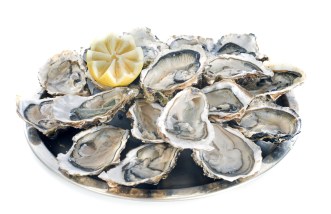
Oysters are filter feeders. They constantly draw in water and accumulate materials from water, including pathogens such as Vibrio bacteria, norovirus and hepatitis A virus. These pathogens can infect people who eat oysters raw or undercooked. In addition, bacteria like Vibrio can continue to grow in oysters after harvesting if oysters are not maintained at low enough temperatures from harvest through to consumption. Food poisoning outbreaks related to raw oysters have been reported locally from time to time. Although the illness is usually mild and self-limiting, causing symptoms such as diarrhoea, abdominal cramps and vomiting, they can also cause severe health consequences especially for susceptible individuals.

Additional Risks in Shucked Oysters
Both physical and microbiological contamination are possible during the shucking of oysters. Physical removal of shellfish meat from the shell at the shucking table often exposes the product to dirt, mud and detritus. Shucked oysters should be rinsed or washed well to eliminate these contaminants and to reduce microbiological level of the products. Good hygiene practices should also be observed to minimise contamination from the workers and the working environment.

Before deshelling, oysters can stay alive even after long-haul shipping if kept under correct temperature and conditions. Once killed after shucking, raw oysters can deteriorate quickly if the temperature is not low enough to limit bacterial growth. Shucked oysters should be packed and chilled or frozen as soon as possible. Furthermore, an uninterrupted cold chain during transportation is critical to ensure safety and quality of the shellfish products.

USA – With E. coli Outbreaks in Ohio and Michigan, what do you need to know?

Food Poison Journal

With at least 18 ill in Ohio and nearly 100 ill in Michigan – not yet clear if the outbreaks from the two states are linked – the public is looking for information about this potentially deadly pathogen.

Read all about it at the link above