Category Archives: Microbiology Investigations

USA – FDA – Core Outbreak Investigation Table Update

FDA

What’s New

  • For the Listeria monocytogenes outbreak (ref# 1106) in a not yet identified product, traceback has been initiated.
  • For the Salmonella Mississippi outbreak (ref# 1097) in a not yet identified product, the case count changed from 102 to 103.
  • For the Salmonella Senftenberg outbreak (ref# 1087) in a not yet identified product, the case count changed from 27 to 30.
  • For the Salmonella Typhimurium outbreak (ref# 1095) in a not yet identified product, the case count changed from 78 to 84.
  • For the Cyclospora outbreak (ref# 1080) in a not yet identified product, the case count changed from 79 to 81

Nestlé eyes November re-opening of E. coli-hit Buitoni plant

Just Food

Nestlé is lining up the return of production at a Buitoni factory in France at the centre of a fatal E. coli outbreak earlier this year.

The world’s largest food maker said the site, located in Caudry in northern France, could see output resume in November, subject to the approval of local officials.

France’s national public health agency, Santé Publique France, made its first statement on rising cases of haemolytic uremic syndrome (HUS) or Shiga toxin-producing E. coli (STEC) on 25 February.

What Are Common Food Poisoning Pathogen Incubation Periods?

Food Safety Gov

Check out the fact sheets at the link above.

Bacteria and Viruses

Bacteria and viruses are the most common cause of food poisoning. The symptoms and severity of food poisoning vary, depending on which bacteria or virus has contaminated the food.

To prevent illness, always follow the food safety steps: cleanseparatecook, and chill. Other prevention tips for specific bacteria and viruses are included below.

The bacteria and viruses that cause the most illnesses, hospitalizations, or deaths in the United States are described below and include:

Other important bacteria and viruses that cause foodborne illness include:

New Zealand strengthens tahini controls after outbreak

Food Safety News

Authorities in New Zealand have tightened the import rules around tahini and halva from Syria following a recall and outbreak.

An outbreak of Salmonella Kintambo earlier this year involved three patients who had consumed sesame-based products from Syria. Two people were hospitalized. Sequencing of clinical isolates showed cases were closely genetically related and had the same sequence type as in an ongoing European outbreak linked to the same type of products.

In July, Middle East recalled specific batches of Algota brand Sesame Tahini because of the possible presence of Salmonella.

New Zealand Food Safety testing of tahini and halva products found Salmonella Kintambo, Salmonella Amsterdam and Salmonella Orion.

The agency has amended the sampling plan for such high risk products. Changes mean all consignments of crushed sesame seed products, such as tahini and halva, must be sampled and tested for Salmonella, when exported from Syria or if they originate from the country.

Research – Risk Assessment of Norovirus Transmission in Food Establishments

FDA

The Risk Assessment of Norovirus Transmission in Food Establishments: Evaluating the Impact of Intervention Strategies and Food Employee Behavior (Duret et al. 2017) evaluates the dynamics of norovirus transmission from ill or infected food employees in food establishments (restaurant setting) to ready-to-eat food and consumers during food preparation and also evaluates the impact of prevention strategies. A discrete event model was developed to study norovirus transmission from the soiled hands of ill or infected food employees and the impact of prevention strategies and their compliance on the prevalence of contaminated servings and the number of resulting infected customers.

The Evaluation of the Impact of Compliance with Mitigation Strategies and Frequency of Restaurant Surface Cleaning and Sanitizing on Control of Norovirus Transmission from Ill Food Employees Using an Existing Quantitative Risk Assessment Model (Fanaselle et al. 2022) uses the previously published FDA quantitative risk assessment model in Duret et al. 2017, to evaluate more than 60 scenarios examining the impact of implementation and compliance with recommendations in the FDA Food Code for: restaurant surface cleaning and sanitizing, hand hygiene and employee health.

Information – CDC Food Safety Social Media Graphics

CDC

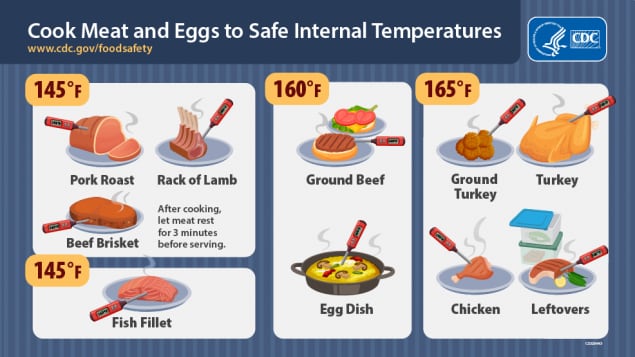
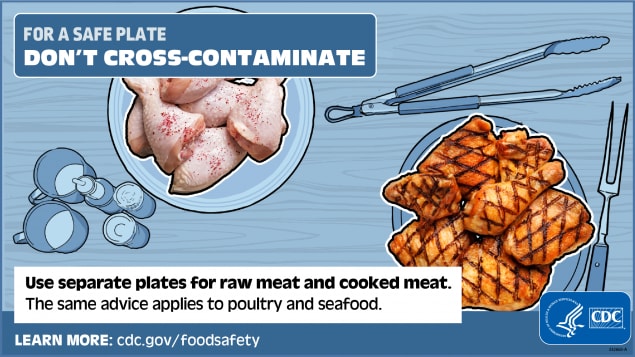
A whole range of free food safety graphics are available at the link above 🙂

Cook Meat and Eggs to a Safe Internal Temperature

Food Safety Education Month Facebook image 7

Man Utd players hit by food poisoning after FC Sheriff win

The Sun

MANCHESTER UNITED players and staff were hit by a bout of suspected food poisoning following their Europa League victory in Moldova.

Telangana: 27 children take ill, hospitalised due to suspected food poisoning.

Live Mint

A total of 27 children were reportedly hospitalised due to food poisoning in Adilabad, said the officials on Tuesday. These children were taken to the hospital after they complained of nausea and vomiting. District Magistrate, Adilabad Prabhakar Reddy said, “yesterday night, 27 children from Kaga Nagar Minority Boys hostel Gurukul were admitted to a local hospital complaining of vomiting and nausea. A detailed inquiry has been ordered and we are investigating the matter,” according to ANI report.

The tragic incident took place after the cooks avoided washing grains and rice before cooking due to a shortage of staff,

Research – Drought-stressed maize is more likely to present mycotoxin risk.

The Cattle Site

The extremely hot weather this summer has meant many maize forage crops have grown under drought stressed conditions, which has increased the likelihood of in-field mycotoxins developing, according to UK agricultural supply company Wynnstay.

Wynnstay dairy specialist Beth Parry urges dairy farmers to be aware of this heightened mycotoxin risk when feeding maize forage this autumn and winter.

“With potentially limited forage stocks following a difficult growing season, farmers are going to need to maximise feed utilisation and digestion to ensure performance isn’t impacted too greatly this winter,” she said.

“In-field mycotoxins are more likely to be present in silages if the crop experienced any kind of stress, such as growing in drought conditions, because moulds and fungi will have had more opportunity to take hold and produce mycotoxins,” she added.

Research – Zearalenone and Its Masked Forms in Cereals and Cereal-Derived Products: A Review of the Characteristics, Incidence, and Fate in Food Processing

MDPI

Zearalenone (ZEA) is known as a Fusarium-produced mycotoxin, representing a risk to cereal food safety with repercussions for economies and worldwide trade. Recent studies have reported the co-occurrence of ZEA and masked ZEA in a variety of cereals and cereal-based products, which may exert adverse effects on public health due to additive/synergistic interactions. However, the co-contamination of ZEA and masked ZEA has received little attention. In order to minimize the threats of co-contamination by ZEA and masked ZEA, it is necessary to recognize the occurrence and formation of ZEA and masked ZEA. This review focuses on the characteristics, incidence, and detection of ZEA and its masked forms. Additionally, the fate of ZEA and masked ZEA during the processing of bread, cake, biscuits, pasta, and beer, as well as the ZEA limit, are discussed. The incidence of masked ZEA is lower than that of ZEA, and the mean level of masked ZEA varies greatly between cereal samples. Published data showed a considerable degree of heterogeneity in the destiny of ZEA during cereal-based food processing, mostly as a result of the varying contamination levels and complicated food processing methods. Knowledge of the fate of ZEA and masked ZEA throughout cereal-based food processing may reduce the likelihood of severe detrimental market and trade ramifications. The revision of legislative limits of masked ZEA may become a challenge in the future. View Full-Text