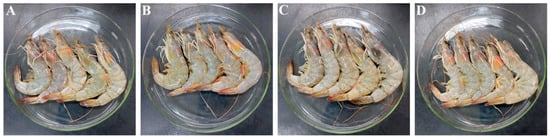
Vibrio parahaemolyticus is a widely distributed pathogen, which is frequently the lead cause of infections related to seafood consumption. The objective of the present study was to investigate the antimicrobial effect of the combination of 405 nm light-emitting diode (LED) and citral on V. parahaemolyticus. The antimicrobial effect of LED illumination and citral was evaluated on V. parahaemolyticus not only in phosphate-buffered saline (PBS) but also on shrimp. Quality changes of shrimp were determined by sensory evaluation. Changes in bacteria cell membrane morphology, cell membrane permeability, cell lipid oxidation level, and DNA degradation were examined to provide insights into the antimicrobial mechanism. The combination of LED treatments and citral had better antimicrobial effects than either treatment alone. LED combined with 0.1 mg/mL of citral effectively reduced V. parahaemolyticus from 6.5 log CFU/mL to below the detection limit in PBS. Combined treatment caused a 3.5 log reduction of the pathogen on shrimp within 20 min and a 6 log reduction within 2 h without significant changes in the sensory score. Furthermore, combined LED and citral treatment affected V. parahaemolyticus cellular morphology and outer membrane integrity. The profile of the comet assay and DNA fragmentation analysis revealed that combination treatment did not cause a breakdown of bacterial genomic DNA. In conclusion, LED may act synergistically with citral. They have the potential to be developed as novel microbial intervention strategies. View Full-Text
The number of foodborne infections climbed in Sweden in 2021 compared to the year before but most are still below pre-Coronavirus pandemic levels.
The report by the National Veterinary Institute (SVA), Folkhälsomyndigheten (the Public Health Agency of Sweden), Livsmedelsverket (the Swedish Food Agency) and Jordbruksverket (Swedish Board of Agriculture) showed a rise for Campylobacter, Salmonella, Listeria, E. coli and Yersinia infections.
Disease surveillance relies on patients seeking care and fewer people have done this during the pandemic. This is believed to be related to patients with symptoms choosing to not seek care and a true reduction in disease incidence because of changes in general hygiene such as increased handwashing, physical distancing and reduced travel because of COVID-19-related recommendations, according to the agencies.
This introduction is not part of the Animal Products Notice, but is intended to indicate its general effect.
Purpose
This notice supplements the requirements of the Animal Product Regulations 2021 and sets requirements for microbiological sampling and testing of animal material and animal products intended for human consumption.
Background
The National Microbiological Database (NMD) Programme is a standardised microbiological sampling and testing programme to provide ongoing monitoring of microbiological process control across all industry participants.
Who should read this Animal Products Notice?
You should read this notice if you are:•an operator who processes red meat or poultry intended for human consumption; or a recognised laboratory that tests red meat or poultry intended for human consumption
Why is this important?
A failure to comply with this notice may be an offence under section 135(1)(c) of the Animal Products Act 1999 and may result in further action by an animal products officer.
Foodborne outbreaks represent a significant public health burden. Outbreak investigations are often challenging and time-consuming, and most outbreak vehicles remain unidentified. The development of alternative investigative strategies is therefore needed. Automated analysis of Consumer Purchase Data (CPD) gathered by retailers represents one such alternative strategy. CPD-aided investigations do not require trawling questionnaires to create a hypothesis and can provide analytical measures of association by direct data analysis. Here, we used anonymized CPD from 920,384 customers enrolled in Norway’s largest supermarket loyalty program to simulate foodborne outbreaks across a range of different parameters and scenarios. We then applied a logistic regression model to calculate an odds ratio for each of the different possible food vehicles. By this method, we were able to identify outbreak vehicles with a 90% accuracy within a median of 6 recorded case-patients. The outbreak vehicle identification rate declined significantly when using data from only one of two retailers involved in a simulated outbreak. Performance was also reduced in simulations that restricted analysis from product ID to the product group levels accessible by trawling questionnaires. Our results show that—assuming agreements are in place with major retailers—CPD collection and analysis can solve foodborne outbreaks originating from supermarkets both more rapidly and accurately than than questionnaire-based methods and might provide a significant enhancement to current outbreak investigation methods.
FAIRFIELD, California, July 6, 2022 – Primal Pet Foods is voluntarily recalling a single lot (#W10068709) of Raw Frozen Primal Patties for Dogs Beef Formula (6-pound), with best by date of 05/22/23, due to potential contamination with Listeria monocytogenes.
The company distributed sixty-six cases (396 units) of this single lot of Raw Frozen Primal Patties to Maryland, Georgia, Texas, and British Columbia, in late April 2022. No other lot codes or Primal products are impacted by this announcement.
Primal Pet Foods has received no complaints or reports of illness to pets or humans due to this recalled product.
This voluntary recall is a result of routine sampling by the U.S. Food and Drug Administration, which revealed a positive result for Listeria monocytogenes in one sample from one lot of Raw Frozen Primal Patties for Dogs Beef Formula.
Listeria monocytogenes rarely cause illness in dogs, but it is possible. Dogs can have mild symptoms such as diarrhea and vomiting. Even if a dog is not showing symptoms, it can still be a carrier of the bacteria and spread it to humans. If a dog has consumed the recalled product, pet parents are encouraged to consult their veterinarian.
People can become sick by handling contaminated food or touching surfaces that have been exposed to Listeria monocytogenes. Symptoms in humans may include fever, headache, muscle aches, stiff neck, nausea, abdominal pain, diarrhea, confusion, loss of balance and convulsions. Young children, elderly people, pregnant women, and those with weakened immune systems are particularly vulnerable to Listeria monocytogenes infections and symptoms can be more severe. Anyone exhibiting symptoms after handling this product should contact their healthcare provider.
Primal Pet Foods is committed to the quality and safety of its products. The company uses a “test and hold” protocolExternal Link Disclaimer to ensure that all products test negative for harmful bacteria before being released for sale. Primal Pet Foods confirmed that all testing results on this single lot of recalled product were negative for Listeria monocytogenes – both raw materials and finished product – before it left its production facility.
The Raw Frozen Primal Patties are sold in flexible packaging in the freezer at select pet stores. Primal Pet Foods has temperature tracking devices on all shipments of frozen product to ensure storage requirements are met while being transported. This product should be kept frozen until a pet parent is ready to use it.
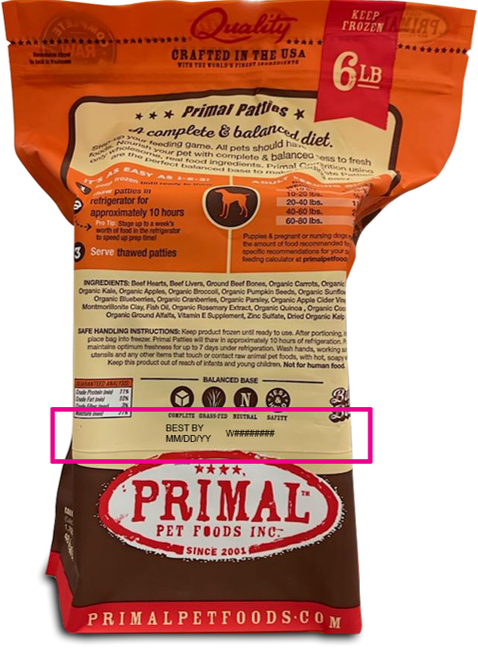
The lot number and best by date can be found on the lower third of the back of the Raw Frozen Primal Patties package. If a pet parent has product from this single lot (#W10068709) in their possession, they should stop feeding it to their dog and dispose of it immediately. Pet parents are also encouraged to follow all safe handling instructionsExternal Link Disclaimer on Primal packaging and wash their hands and all preparation surfaces after handling any raw product. If pet parents have any questions, they can contact Primal Pet Foods by phone at (800) 742-1312 Monday–Friday, 6:00 a.m. through 4:00 p.m. PST, or by submitting an online requestExternal Link Disclaimer.
This recall is being conducted in cooperation with the U.S. Food and Drug Administration.
UPDATE 4 July 2022: Based on internal investigation, Barry Callebaut said it confirms that no chocolate products affected by the salmonella-positive production entered the retail food chain, after the strain was detected at its factory in Wieze, Belgium, on Monday 27 June.



 FoodWorld