Category Archives: foodbourne outbreak

USA – Cyclospora Illnesses Spike to 384 Sick with 30 Hospitalized

Food Poisoning Bulletin

Cyclospora Illnesses Spike to 384 Sick with 30 Hospitalized

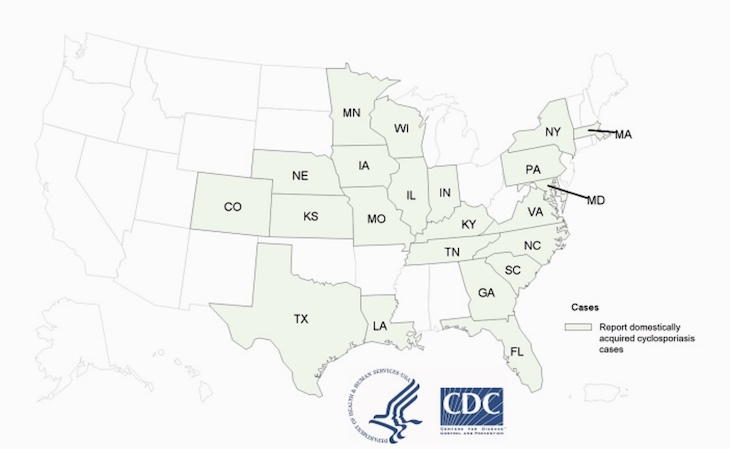
Cyclospora illnesses have spiked to 384 sick in 22 states and 30 hospitalized, according to the Centers for Disease Control and Prevention (CDC). There has been a cyclospora outbreak, in fact, usually several cyclospora outbreaks, in the United States during the spring and summer months every year since 2013. This is an increase of 323 cases since the last update was issued on June 30, 2022. Cases are still being reported.

French E. coli outbreak linked to cucumbers from Belgium

Food Safety News

More than 30 people were sick in France in late 2021 as part of an outbreak traced to contaminated cucumbers.

In September 2021, the Hauts-de-France Regional Health Agency was notified of a suspected foodborne outbreak among students in the Lille area. Two hospitalized children were diagnosed with hemolytic uremic syndrome (HUS). HUS is a severe complication associated with E. coli infection that causes kidney failure. The agency asked Santé publique France for support in investigating the incident.

In total, 35 cases of gastroenteritis, half of whom had bloody diarrhea and fever, were identified. Ten people were hospitalized.

Identified cases were 29 children in four schools and five elderly adults who received meals through a local delivery program. One case was the parent of a pupil. Five children and one adult had meals delivered to them at home.

The median age of patients was 8 with a range of 4 to 89 years old and almost two thirds were female.

School cafeterias and the meal delivery service were all supplied by the same municipal canteen.

450 sick in Ferrero chocolate Salmonella outbreak

Food Safety News

A Salmonella outbreak linked to Kinder chocolate has sickened more than 450 people, based on the latest figures.

Only 10 cases have been reported in the month since the previous European Centre for Disease Prevention and Control (ECDC) update, bringing the total to 455 as of mid-July.

The outbreak has hospitalized a high proportion of people, mostly children younger than 10 years of age, and some had severe clinical symptoms including bloody diarrhea.

The latest monophasic Salmonella Typhimurium case is from the United Kingdom with a sampling date of June 16. Concerns were previously raised by authorities that potentially contaminated chocolate could still be on sale despite a recall in April.

The UK has the most patients with 128 followed by France with 121. Belgium has recorded 66 sick people, 49 are ill in Switzerland, 34 in Germany, 18 in Ireland and 14 in Austria. There are still four cases in Canada and one in the United States.

Sweden, Spain, Norway, Netherlands, Luxembourg, Italy, Denmark and Czech Republic all have single-figure case numbers.

Research – English E. coli outbreak caused by milk pasteurisation problem in 2019

Cambridge Org

In November 2019, an outbreak of Shiga toxin-producing Escherichia coli O157:H7 was detected in South Yorkshire, England. Initial investigations established consumption of milk from a local dairy as a common exposure. A sample of pasteurised milk tested the next day failed the phosphatase test, indicating contamination of the pasteurised milk by unpasteurised (raw) milk. The dairy owner agreed to immediately cease production and initiate a recall. Inspection of the pasteuriser revealed a damaged seal on the flow divert valve.

Ultimately, there were 21 confirmed cases linked to the outbreak, of which 11 (52%) were female, and 12/21 (57%) were either <15 or >65 years of age. Twelve (57%) patients were treated in hospital, and three cases developed haemolytic uraemic syndrome. Although the outbreak strain was not detected in the milk samples, it was detected in faecal samples from the cattle on the farm. Outbreaks of gastrointestinal disease caused by milk pasteurisation failures are rare in the UK. However, such outbreaks are a major public health concern as, unlike unpasteurised milk, pasteurised milk is marketed as ‘safe to drink’ and sold to a larger, and more dispersed, population. The rapid, co-ordinated multi-agency investigation initiated in response to this outbreak undoubtedly prevented further cases.

Research – Chinese Foodborne Botulism Outbreaks Have High Mortality Rate; Tofu, Beef Common Causes

Food Safety Magazine

study published in China CDC Weekly provides insight into foodborne botulism outbreaks in China. Researchers conducted an epidemiological analysis for the years of 2004–2020, which revealed a high mortality rate for cases of foodborne botulism and informed recommendations for reducing such outbreaks in China.

In the epidemiological analysis, data was collected from 22 of 31 Chinese provincial-level administrative divisions (PLADs) of the National Foodborne Disease Outbreaks Surveillance system, as well as the China National Knowledge Infrastructure, Wanfang Data, and Chinese Science and Technique Journals. The number and proportion of foodborne botulism outbreaks, illnesses, and deaths by PLAD; food types associated with outbreaks; and contributing factors were observed.

In total, 80 foodborne botulism outbreaks occurred in China during 2004−2020, with 386 illnesses and 55 deaths; initial misdiagnosis occurred in 27.5 percent of botulism cases. Most outbreaks were reported between June and August, aside from a spike in cases in January. Of the 22 PLADs that reported foodborne botulism outbreaks, Xinjiang reported the largest number of outbreaks (20), followed by Qinghai (13). Home-cooked, traditionally processed stinky tofu and dried beef were the most common vehicles for Clostridium botulinum, linked to 51.25 percent of botulism cases. Improper processing and storage practices contributed to 77.5 percent of foodborne botulism outbreaks.

Based on the study’s findings, the researchers suggest the implementation of botulism prevention and food safety education for farmers and herders in Xinjiang and Qinghai. The researchers also stress the urgency of improving Chinese foodborne illness outbreak investigation.

Belgium – Belgium reports large rise in foodborne illness outbreaks in 2021

Food Safety News

An additional 200 outbreaks were recorded in Belgium in 2021 versus the year before, according to the Federal Agency for the Safety of the Food Chain (FASFC).

There was a significant increase in the number of food poisoning outbreaks from 333 in 2020 to 547 in 2021. The number of people affected in them went from 1,262 with 27 hospitalizations and two deaths to 2,070 sick, 78 hospitalizations but no deaths in 2021.

FASFC, also known as AFSCA and FAVV, said it was important to remember 2020 was an exceptional year because of the closure of many food businesses caused by COVID-19 related restrictions.

Figures for the past year are still slightly lower than 2019, when 571 outbreaks were recorded and 2,457 people were affected.

The agent was unknown in 512 outbreaks with almost 1,700 illnesses in 2021, according to data from Sciensano, the national public health institute.

Read more at the link above.

USA – Outbreak Investigation of Salmonella: Peanut Butter (May 2022) – Outbreak Over

FDA

FDA’s investigation is complete; CDC declares outbreak over; additional information forthcoming

The FDA, along with CDC and state and local partners, investigated a multistate outbreak of Salmonella Senftenberg infections linked to certain Jif brand peanut butter products produced at the J.M. Smucker Company facility in Lexington, Kentucky.

J.M. Smucker Company voluntarily recalled certain Jif brand peanut butter products that have the lot codes described below. Photo examples are included below.

The FDA is preparing a report to discuss findings and provide information to assist in future prevention efforts.

Recommendation

The affected recalled products should no longer be available for sale. However, the product has a long shelf life and could still be in consumers’ homes. Consumers, restaurants, and retailers should not eat, sell, or serve any recalled Jif brand peanut butter, including recalled products that contain the recalled Jif peanut butter. Consumers should also avoid feeding recalled peanut butter to pets or other animals, including wild birds.

For Consumers

Follow these steps:

  1. Check if you have Jif peanut butter in your home.
  2. Locate the lot code on the back of the jar, under the Best If Used By Date (the lot code may be next to the Best If Used By Date for cups or squeeze pouches).
  3. In the lot code, if the first four digits are between 1274 and 2140, and if the next three numbers after that are ‘425’, this product has been recalled and you should not consume this product. An example is below.

If you are unsure what to do with your recalled product, you can call or email J.M. Smucker Company for more information:

The J.M. Smucker Co. Hotline: 800-828-9980
Website: jif.com/contact-usExternal Link Disclaimer

FDA recommends that if you have used the recalled Jif brand peanut butter that have lot code numbers 1274425 through 2140425 and the first seven digits end with 425, you should wash and sanitize surfaces and utensils that could have touched the peanut butter. If you or someone in your household ate this peanut butter and have symptoms of salmonellosis, please contact your healthcare provider.

For Retailers, Re-packers, and Manufacturers

In addition to the steps above, FDA recommends referring to the firm’s recall press for the UPC codes and other retailer information. Do not sell or serve recalled peanut butter or products containing recalled peanut butter.

Denmark – Denmark searches for source of Salmonella outbreak

Food Safety News

kswfoodworld salmonella

Danish officials are trying to find the source of a Salmonella outbreak that has affected 16 people.

The sick people have been infected with the same type of Salmonella Enteritidis, according to the Statens Serum Institut (SSI).

Patients fell ill between March 31 and June 23. They are 11 men and five women between the ages of 8 to 59 years old with a median of 28.

USA – FDA Is Focusing on Safety of Frozen Berries

Food Safety Tech

From 1983 to 2018, there were 50 outbreaks globally that were attributed to frozen berries: 36 caused by Norovirus and 14 by Hepatitis A.

On July 22, the FDA announced that it is developing a food safety prevention strategy to enhance the safety of fresh and frozen berries. The move comes in response to multiple hepatitis A (HAV) and norovirus (NoV) outbreaks linked to the consumption of both fresh and frozen berries.

The FDA reports that there have been four HAV outbreaks and three NoV outbreaks linked to frozen berries from 1990 to 2016 in the U.S., and since 2011, there have been three HAV outbreaks linked to fresh berries, including a current outbreak linked to fresh organic strawberries.

In addition, from 1983 to 2018, there were 50 outbreaks globally that were attributed to frozen berries: 36 caused by NoV and 14 by HAV. The FDA noted that although freezing preserves berries it generally does not inactivate viruses that may be introduced at various points in the supply chain, such as by infected workers, contaminated water or contaminated food contact surfaces. In addition, fresh berries are generally eaten raw without a kill-step that could eliminate pathogens.

In August, the FDA plans to resume an assignment to collect and test frozen berries that it paused at the start of the COVID-19 pandemic. The assignment seeks to estimate the prevalence of HAV and NoV in frozen strawberries, raspberries and blackberries and help the FDA identify sites where practices or conditions may exist that constitute safety vulnerabilities.

The FDA also plans to work collaboratively with industry, academia and regulatory partners in the development of a food safety prevention strategy to identify measures that can be taken to limit or prevent contamination from occurring throughout the berry supply chain, approaches to re-enforce control measures and their application as well as areas where additional research is needed.

France – French E. coli outbreak linked to dairy

Food Safety News

At least a dozen children have been sickened in France with officials linking illnesses to a dairy company.

Since early June, 12 cases of haemolytic uremic syndrome (HUS) have been reported in the Provence-Alpes-Côte d’Azur and Occitanie regions. HUS is a severe complication associated with E. coli infection that causes kidney failure and sometimes death.

Seven boys and five girls aged 11 months to 9 years old are sick. They fell ill from June 4 to July 18.

In France, Shiga toxin-producing E. coli (STEC) surveillance is only based on HUS in children younger than 15, so it only catches the most severe cases.

Santé publique France, the Directorate General for Food (DGAL) and Directorate General for Health (DGS) are part of the investigation.