Category Archives: Food Toxin

Canada -Raw milk believed to be source of E. coli contamination in cheese: BCCDC

Cowichan Valley Citizen

The BC Centre for Disease Control (BCCDC) believes raw milk was the likely source of an E. coli contamination in Little Qualicum Cheeseworks’ Qualicum Spice cheese.

On Nov. 13, five people in B.C. became sick after consuming products from Little Qualicum Cheeseworks, prompting a warning from the BCCDC.

For several months, the BC Centre of Disease Control and Vancouver Island Health Authority worked with Little Qualicum Cheeseworks, going through the cheese-making process with the company, checking procedures, ingredient and equipment, said Sion Shyng, food safety specialist with the BCCDC.

New Zealand – Shellfish biotoxin alert – between Granville Point and Cape Karikari

MPI

Map highlighting in red the areas affected.

The Ministry for Primary Industries (MPI) today issued a public health warning advising the public not to collect or consume shellfish harvested from the Northland area between Granville Point and Cape Karikari (Whakapouaka). This warning includes Houhora and Rangaunu Harbours.

Routine tests on shellfish samples taken from this region have shown levels of Paralytic Shellfish Poisoning (PSP) toxins above the safe limit of 0.8 mg/kg set by MPI. Anyone eating shellfish from this area is potentially at risk of illness.

Mussels, oysters, tuatua, pipi, toheroa, cockles, scallops, catseyes, kina (sea urchin) and all other bivalve shellfish should not be eaten.

Note: cooking shellfish does not remove the toxin.

Pāua, crab and crayfish may still be eaten if the gut has been completely removed prior to cooking, as toxins accumulate in the gut. If the gut is not removed its contents could contaminate the meat during the cooking process.

New Zealand -Shellfish biotoxin alert – Northland East Coast

MPI

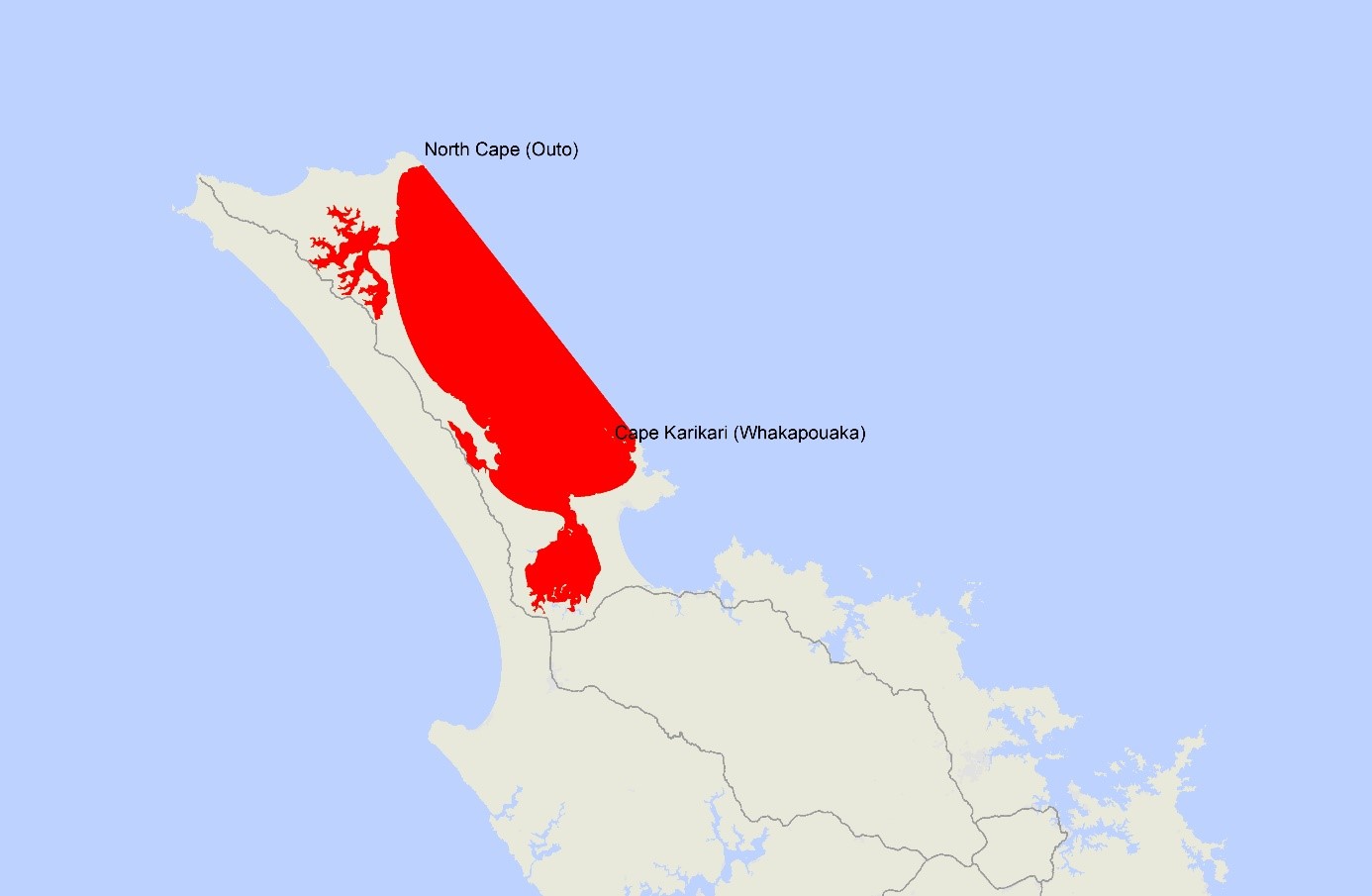
Map highlighting in red the areas affected.

The Ministry for Primary Industries today extended the public health warning against collecting shellfish in the Northland east coast region. The affected area now extends from North Cape (Outo) south to Cape Karikari (Whakapouaka). The warning includes Parengarenga, Houhoura and Rangaunu Harbours.

This warning has been extended due to a reported illness from someone consuming shellfish collected from Rarawa Beach.

MPI is undertaking sampling and testing of shellfish from this region. Test results have shown levels of Paralytic Shellfish Poisoning (PSP) toxins above the safe limit of 0.8 mg/kg set by MPI.

Anyone eating shellfish from this area is potentially at risk of illness.

Mussels, oysters, tuatua, pipi, toheroa, cockles, scallops, catseyes, kina (sea urchin) and all other bivalve shellfish should not be eaten.

Note: cooking shellfish does not remove the toxin.

Pāua, crab and crayfish may still be eaten if the gut has been completely removed prior to cooking, as toxins accumulate in the gut. If the gut is not removed its contents could contaminate the meat during the cooking process.


Bangledesh – 9 nursing students fall sick from food poisoning

The Daily Star

At least nine female students of a nursing college in Habiganj fell sick on Friday due to food poisoning.

All the nine students of Habiganj Nursing Institute are now undergoing treatment at Habiganj Sadar Hospital.

A number of guardians of the victims alleged that after having their lunch, provided by the institution, at around 3:00pm on Friday, the girls started vomiting and also complained of abdominal pain.

The authorities of the nursing institute often supply low quality food to the students, said Nusrat Jahan, a student of the institute, adding that earlier they found ants and flies in their food on different occasions.

Nusrat also demanded a probe body to investigate the incident.

USA – Bacterial Outbreak Associated With Xi’an Noodles in Seattle Sickens Three

Food Poisoning Bulletin

Three people are sick after a bacterial toxin is associated with Xi’an Noodles restaurant in Seattle, Washington. None of the patients have been hospitalized. The people ate at that restaurant on December 21, 2018.

The press release states that symptoms and timing suggest that a bacterial toxin is responsible for the illnesses, such as Clostridium perfringens or Bacillus cereus. The exact food or beverage served at Xi’an Noodles that caused the illness has not yet been identified.

Environmental Health investigators were at the restaurant on December 31, 2018. Earlier food safety inspections and the current rating for the restaurant were good.

Investigators looked for potential risk factors, including lack of thermometer use, incorrect cooling of foods that can be dangerous, and improper storage of foods at room temperature.

RASFF Alerts – Aflatoxin – Peanuts – Groundnuts – Pistachios

RASFF-Logo

RASFF -aflatoxins (B1 = 4.3 µg/kg – ppb) in peanuts from Nicaragua, via Lithuania in Latvia

RASFF-aflatoxins (B1 = 5.6; Tot. = 33 µg/kg – ppb) in groundnuts from Argentina from the Netherlands

RASFF-aflatoxins (B1 = 21; Tot. = 24 µg/kg – ppb) in pistachios from the United States in the Netherlands

RASFF Alerts – Ochratoxin A – Seedless Raisins – Dried Figs – Roasted Salted Pistachios – Sultanas

RASFF-Logo

RASFF-ochratoxin A (11.7 µg/kg – ppb) in seedless raisins from Turkey in the UK

RASFF-ochratoxin A (27.7; 189 µg/kg – ppb) in dried figs from Turkey in Lithuania

RASFF-ochratoxin A (96 µg/kg – ppb) in roasted salted pistachios from unknown origin, packaged in Denmark in Finland

RASFF-ochratoxin A (14.20 µg/kg – ppb) in sultanas from Turkey in Poland

USA – Notable Outbreaks and Recalls of 2018 – A Busy Year!

Food Safety Tech


As stated by CDC’s John Besser, Ph.D. last month at the Food Safety Consortium, “It’s been quite a year for outbreaks.” Here’s a not-so-fond look back at some of the noteworthy outbreaks and recalls of 2018.

Romaine Lettuce –E.coli O157:H7

Raw Beef Products – Salmonella

Shell Eggs – Salmonella

Pre-cut Melon – Salmonella

Vegetable Trays – Cyclospora

Salad Mix – Cyclospora

Raw Turkey – Salmonella

Honey Smacks Cereal – Salmonella

Duncan Hines Cake Mix – Salmonella

Johnston County Hams – Listeria monocytogenes

Switzerland – Be careful eating Chinese fondue, says Swiss food safety agency – Campylobacter

Le News  Campylobacter_jejuni_01


Chinese fondue is a culinary crossover between two nations. A dish that exists in both China and Switzerland. The Swiss version retains the communal pot of hot broth, thinly sliced raw meat and Chinese mushrooms of the original but departs radically in terms of flavour.

According to the Federal Food Safety and Veterinary Office (FSVO), food poisoning rises at the end of the year, something partly attributable to Chinese fondue. Raw chicken, and its high rate of campylobacter contamination, is the main cause. In general meat is the most likely source of food poisoning, according to FSVO, and men between 18 and 30 are the most likely to get poisoned.

Research – 2017 BIOMIN Mycotoxin Survey Results

Biomin

The latest edition of the annual survey, covering 18757 agricultural commodity samples from 72 countries with over 73000 analyses, highlights the main dangers from the most important mycotoxins in primary feedstuffs and their potential risk to livestock animal production.

The survey results provide an insight on the incidence of aflatoxins (Afla), zearalenone (ZEN), deoxynivalenol (DON), T-2 toxin (T-2), fumonisins (FUM) and ochratoxin A (OTA) in the primary components used for feed which include corn (maize), wheat, barley, rice, soybean meal, corn gluten meal, dried distillers grains (DDGS) and silage, among others.