Category Archives: Food Toxin

New Zealand – Shellfish biotoxin alerts – Hawkes Bay

MDPI

North Island warnings

Hawke’s Bay

Reason for alert Paralytic Shellfish Poisoning (PSP)

Check the symptoms of PSP

Date warning issued 16 June 2021

Media release

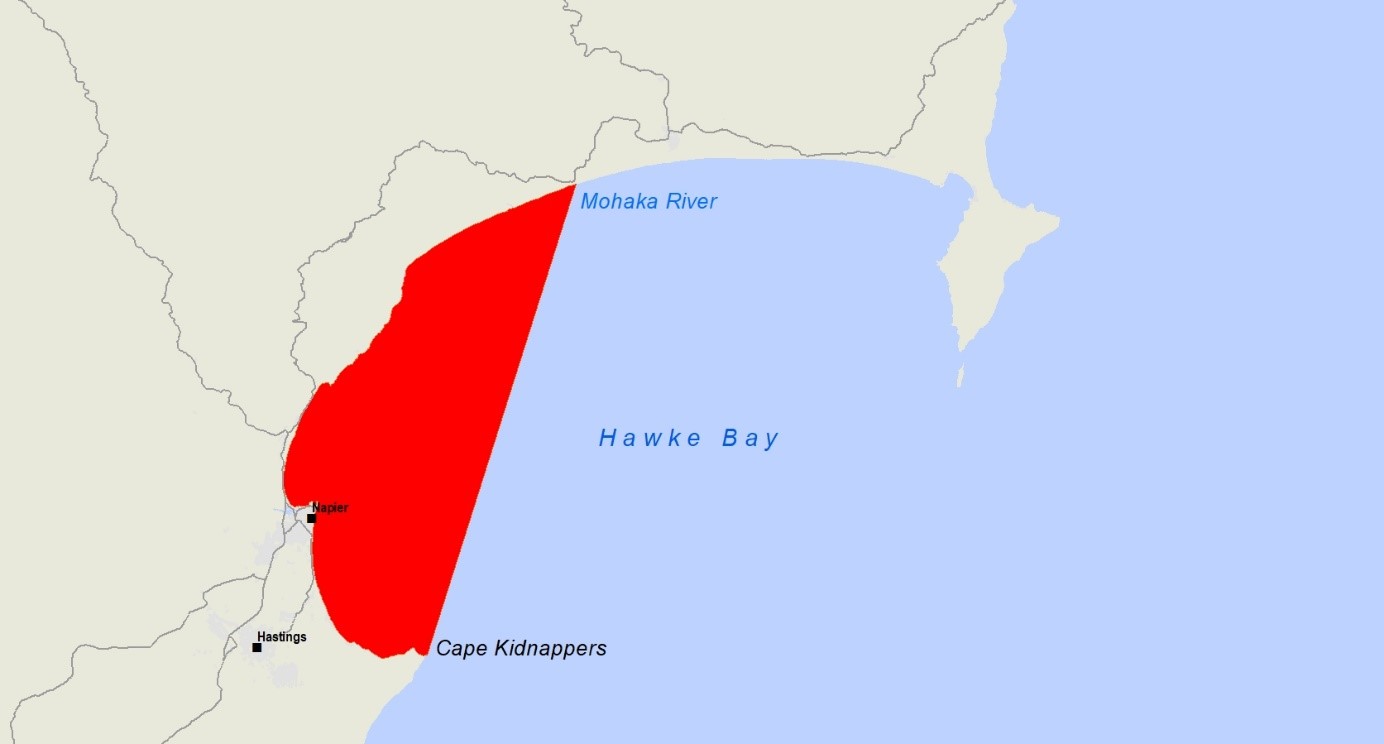
Affected area From the Mohaka River mouth, south to Cape Kidnappers.
Shellfish affected Mussels, oysters, tuatua, pipi, toheroa, cockles, scallops, catseyes, kina (sea urchin), and all other bivalve shellfish.

Note, cooking shellfish does NOT remove the toxin.

Pāua, crab, and crayfish may still be eaten if the gut has been completely removed prior to cooking, as toxins accumulate in the gut. If the gut is not removed its contents could contaminate the meat during the cooking process.

Symptoms Symptoms typically appear between 10 minutes and 3 hours after ingestion and may include:

  • numbness and a tingling (prickly feeling) around the mouth, face, and extremities (hands and feet)
  • difficulty swallowing or breathing
  • dizziness
  • headache
  • nausea
  • vomiting
  • diarrhoea
  • paralysis and respiratory failure, and in severe cases, death.
Other information Paralytic shellfish toxins have been detected in shellfish from Pania Reef at levels over the safe limit of 0.8mg/kg set by MPI. Ongoing testing will continue and any changes will be communicated accordingly.

Map of affected area

Map showing the affected area

British Virgin Islands- Ciguatera increase

Food Safety News

Authorities in the British Virgin Islands have issued a warning after a surge in Ciguatera fish poisoning (CFP) within the past few weeks.

Cases until the week of June 6 were sporadic, but within three weeks there have been eight confirmed infections with other suspected cases also being investigated.

National Epidemiologist Harmony Massiah said CFP is not uncommon in tropical and sub-tropical areas and is mainly associated with consumption of big coral reef fish like snapper, bass and perch that have accumulated ciguatoxin in the body.

Larger fish will have higher amounts of the toxin. Contaminated fish cannot be identified by appearance and the toxin cannot be destroyed by cooking or freezing.

Canada – Notice not to consume ground beef and pork sold by Fouquet Morel inc. – E.coli O157

MAPAQ

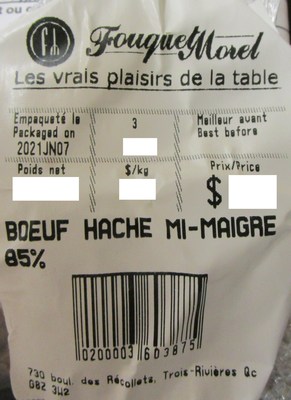
QUEBEC, June 14, 2021 / CNW Telbec / – The Ministry of Agriculture, Fisheries and Food (MAPAQ), in collaboration with Fouquet Morel Inc., located at 730, boulevard des Récollets, in Trois -Rivers, advise the population not to consume the products indicated in the table below, as these foods are likely to contain the bacterium E. coli O157.

Product name

Format

Packing date

Retention deadline

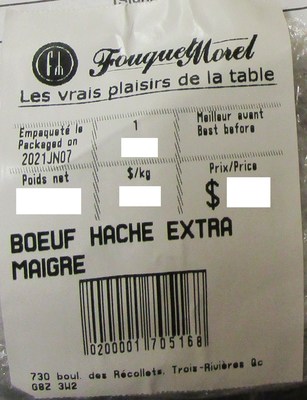
“Extra lean ground beef”

Variable

“Emb. : 2021JN07 “

N / A

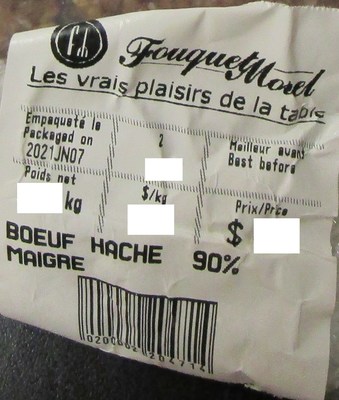
“90% lean ground beef”

“Medium-lean ground beef 85%”

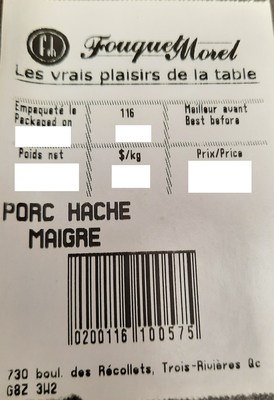
“Lean ground pork”

The products that are the subject of this advisory were packaged on June 7, 2021 and have been offered for sale only at the establishment identified above. They were packaged in trays of transparent plastic wrap. They were offered in a refrigerated state. The product label includes, in addition to their name, the words “Fouquet Morel – The real pleasures of the table”.

The operator is voluntarily recalling the products in question. He agreed with MAPAQ to disseminate this warning as a precautionary measure. In addition, people who have any of these products in their possession are advised not to consume it. They must return it to the establishment where they bought it or throw it away.

It should be noted that proper cooking of meat destroys the E. coli O157 bacteria in all cases. Preparing ready-made meals, such as spaghetti sauce, shepherd’s pie, or meat pie, requires a fairly long cooking time and a temperature high enough to destroy the bacteria.

Food contaminated with E. coli O157 may not look or smell spoiled, but eating such foods can cause serious illness or death. They are manifested by diarrhea and abdominal pain, often accompanied by blood in the stool. These symptoms usually appear two to ten days after eating a contaminated food. Nausea, vomiting and sometimes fever can be associated with it. When these symptoms appear, it is strongly recommended to consult a doctor without delay. Most symptoms go away within five to ten days.

To date, it should be indicated that a case of illness has been reported to MAPAQ and that it could be associated with the consumption of this category of food.

.

Lean ground pork (CNW Group / Ministry of Agriculture, Fisheries and Food) 

Extra Lean Ground Beef (CNW Group / Ministry of Agriculture, Fisheries and Food) 

90% lean ground beef (CNW Group / Ministry of Agriculture, Fisheries and Food) 

Medium-lean ground beef 85% (CNW Group / Ministry of Agriculture, Fisheries and Food) 

Risk  classification : class 1
Reference number:  4343

India – 44 villagers fall sick due to food poisoning in Telangana

New Indian Express

44 persons fell sick due to food poisoning at Thadiathnoor village in Narnoor mandal here on Friday. Four were shifted to RIMS for better treatment, while the others were shifted to the Narnoor PHC.

The villagers had attended a function on Thursday evening, where they consumed chappati and mango juice. They fell sick on Friday morning. DMHO K Manohar visited the patients at the hospital.

Research – MYCOBIOTA ISOLATION AND AFLATOXIN B1 CONTAMINATION IN FRESH AND STORED SESAME SEEDS FROM RAINFED AND IRRIGATED ZONES OF PUNJAB, PAKISTAN

Study was carried out to evaluate the incidence of mycobiota and contamination of AFB 1  in sesame seeds from rainfed and irrigated zones of the Punjab, Pakistan. For this purpose, 100 sesame seed samples were collected directly from the fields of major sesame-producing areas of the rainfed and irrigated zone. Samples were subjected to the Agar Plate Method for the isolation of mycobiota and thin-layer chromatography for AFB 1 contaminations. Then, seed samples were stored for 12 months. After 12 months, the seeds were again analyzed for mycobiota and AFB 1 contaminations for comparison. The result of the present study revealed that all samples were reported positive for fungal growth in fresh and stored conditions. Twenty-one fungal species belonging to ten different fungal genera were isolated. Aspergillus flavus was the leading contaminant found in fresh and stored sesame seeds from rainfed and irrigated zone followed by A. niger, Alternaria alternata and Fusarium oxysporum . Least reported fungi were Aspergillus ochraceus and Cladosporium oxysporum.  AFB 1 analysis revealed that 92% fresh and 99% stored samples were contaminated with AFB 1 . In the rainfed zone, 88% fresh and 100% stored samples were contaminated with AFB 1 with a mean concentration of 15.74ppb and 33.8ppb, respectively. Similarly, in the irrigated zone, 96% fresh and 98% stored samples were contaminated with AFB 1 with a mean concentration of 20.5ppb and 27.56ppb, respectively. 20% fresh and 100% stored samples from rainfed zone and 28% fresh and 60% stored samples from irrigated zone were tainted with AFB 1 levels above 20 ppb, not fit for human consumption as per maximum limit (20ppb) assigned by FDA and FAO. This is the first-ever report of mycobiota and AFB 1 contamination in sesame seeds from rainfed and irrigated zones of the Punjab, Pakistan. This baseline data will be considered as an initial step to tackle this significant problem.

Belgium – “Bernister Fleuri” soft raw milk cheese – STEC E.coli

AFSCA

Recall of La Ferme des Grandes Fagnes
Product: “Bernister Fleuri” soft raw milk cheese.
Problem: Possible presence of E.coli STEC.


In agreement with the AFSCA, the Ferme des grandes Fagnes is withdrawing “Bernister Fleuri” cheese (300g) from sale and is recalling it to consumers because of the presence of E.coli STE.

La Ferme des Grandes Fagnes asks its customers not to consume this product and to return it to the point of sale where it was purchased where it will be reimbursed.

Product description

– Product category: Soft raw milk cheese
– Product name: Bernister Fleuri
– Best before date (Best before): 07/08/2021
– Batch number: 211721
– Sales period: from 05/11/2021 to 06/10/2021
– Type of packaging: cellophane
– Weight: 300g

The product was sold through several outlets, including:

Name of point of sale /

Name of the distribution chain

Street + number Postal code Municipality (city)
RAG DISTRIBUTION Carl Jost Street, 46 4621 RETINNE
The Milky Way Chaussée de Namur 40 5170 DEEPVILLE
Butcher LAVAL Albert Counson Street 127 4970 FRANCORCHAMPS
LMBA Maitres Butchers Ardennes Avenue of the Allies 98 4960 MALMEDY
Vitamine cheese dairy (Evrard) Station Street 15 4430 YEARS
Grossemarkt Butgenbach LS Monschauerstrasse 9 4750 BUTGENBACH
DELVITH Rue de Malmedy 21 4760 BULLANGE
Gourmet counter Rue des Deux Eglises 4 4120 NEUPRE
PARENT SIGARD Great street 38                           6700        Arlon                   
LALERO BVBA HAACHTSESTEENWEG 47                     1820        STEENOKKERZEEL          
KAASWERELD VOF Karel Picquelaan 96 9800 DEINZE
SLIGRO FOOD GROUP Wingepark 10 3110 Rotselaar
Butcher Curnel Henri Massenge Street 4970 Stavelot
AD Spa Avenue Reine Astrid 244 4900 Spa
Sweet cuberdon Rue du Têris 56, 4100 Seraing

For any further information , contact:
Fabienne Remacle tel: 0474 280 559

RASFF Alert – Foodborne outbreak suspected to be caused by thawed yellowfin tuna steaks – No cause given but i would suspect Histamine

RASFF

Foodborne outbreak suspected to be caused by thawed yellowfin tuna steaks (Thunnus albacares) with added water from Italy, with raw material from Spain in Croatia, Italy, Poland, Romania and Slovenia


RASFF Alert – E.coli – Lamb Meat

RASFF

Escherichia coli in lamb meat from New Zealand in Italy

RASFF Alerts – Aflatoxin – Shelled Groundnuts – Pistachios Kernels

RASFF

Aflatoxin in groundnuts shelled from Brazil in Bulgaria

RASFF

Aflatoxins in Bolivian groundnuts in the Netherlands

RASFF

AFLATOXINS IN PISTACHIOS KERNELS FROM IRAN in Italy


RASFF Alerts – Histamine – Mackerel

RASFF

Histamine in Mackerel in France in Austria, Belgium, Germany, Italy and Netherlands