Category Archives: food recall

RASFF Alerts – Listeria monocytogenes – Chilled Smoked Salmon – Cooked Chicken Cuts – Pizza Baguette with Ham – Smoked Trout Fillets – Cooked Sausages with Smoked Garlic

European Food Alerts

RASFF

Listeria monocytogenes (<10 CFU/g) in chilled smoked salmon from the United Kingdom, via Germany in Switzerland

RASFF

Listeria monocytogenes (presence /25g) in frozen cooked chicken cuts from Austria in Switzerland

RASFF

Listeria monocytogenes (160 to 2900 CFU/g) in pizza baguette with ham from Poland in Poland

RASFF

Listeria monocytogenes (< 10 CFU/g) in smoked trout fillets from Denmark in the Netherlands

RASFF

Listeria monocytogenes (350 CFU/g) in cooked sausages with smoked garlic from France in France

RASFF Alert- STEC E.coli – Vacuum Packed Beef Salami

European Food Alerts

RASFF

shigatoxin-producing Escherichia coli ( stx1+ stx2+ /25g) in vacuum-packed beef salami from Slovenia in Slovenia

RASFF Alert – Mycotoxin – Ochratoxin A – Dried Figs

European Food Alerts

RASFF

ochratoxin A (28.8 mg/kg – ppm) in dried figs from Turkey in Germany

RASFF Alert – Foodborne Outbreak – Salmonella – Courgettes

European Food Alerts

RASFF

foodborne outbreak suspected to be caused by Salmonella enterica ser. Kedougou in courgettes from the Netherlands and Spain in Finland

RASFF Alert – Moulds – Sesame Seeds

European Food Alerts

RASFF

sesame seeds from Nigeria, via Turkey infested with moulds in the Netherlands

RASFF Alerts – Aflatoxin – Organic Almonds – Pistachio Kernels – Dried Figs – Groundnut Kernels

European Food Alerts

RASFF

aflatoxins (B1 = 31; Tot. = 34 µg/kg – ppb) in organic almonds from Italy in Denmark

RASFF

aflatoxins (B1 = 38.8; Tot. = 44 µg/kg – ppb) in pistachio kernels from the United States, dispatched from Turkey in Bulgaria

RASFF

aflatoxins (B1 = 12.8; Tot. = 24.4 µg/kg – ppb) in dried figs in Sweden

RASFF

aflatoxins (B1 = 175; Tot. = 190 µg/kg – ppb) in groundnut kernels from Angola in Portugal

RASFF

aflatoxins (B1 = 17.4; Tot. = 24.5 µg/kg – ppb) in organic dried figs from Spain in Denmark

RASFF

aflatoxins (B1 = 34; Tot. = 37 µg/kg – ppb) in pistachios from Turkey in the Netherlands

RASFF

aflatoxins (B1 = 64.8; Tot. = 72.2 µg/kg – ppb) in pistachio kernels from Iran in Germany

Israel – Aloe Vera Drink – Pseudomonas aeruginosa

Click to access RCL_17122020_EN.pdf

Australia – Nudie nothing but 2 apples 200ml – Mycotoxin – Patulin

FSANZ

Product information

Monde Nissan Australia Pty Ltd (nudie Foods) is conducting a recall of nudie nothing but 2 apples 200ml. The product has been available for sale at independent food retailers including IGA in NSW, Vic & SA and independent food retailers in Qld, Tas & WA and Woolworths nationally.

Date markings

BEST BEFORE 18-JUNE-21
(All other Best Before dates are not affected)

nudie nothing but 2 apples 200ml

Problem

The recall is due to microbial (mycotoxin – patulin) contamination.

Food safety hazard

Food products containing the mycotoxin patulin may cause illness if consumed.

Country of origin

Australia

What to do​

Any consumers concerned about their health should seek medical advice and should return the products to the place of purchase for a full refund.

For further information please contact:

Monde Nissan Australia Pty Ltd
1800 466 834
info@nudie.com.au
www.nudie.com.au

Related links:

USA – Outbreak Investigation of E. coli – Leafy Greens (December 2020) – CDC declares outbreak over, FDA investigation ongoing

FDA

The FDA, along with CDC and state and local partners, investigated a multistate outbreak of E. coli O157:H7 infections in the fall of 2020. The epidemiology and traceback investigation have determined that the outbreak was linked to leafy greens. The epidemiological and traceback investigations were not able to determine a specific type of leafy green linked to illnesses. On 12/22/2020, the CDC announced that this outbreak appears to be over. This outbreak, announced by FDA and CDC on October 28, 2020, was caused by a strain of E. coli that is genetically related to a strain linked to the fall 2019 romaine outbreak.

The FDA completed a traceback investigation of multiple types of leafy greens identified in patient interviews. Although no single ranch was identified as a common source of the leafy greens, FDA and state partners also conducted on-site investigations on farms of interest. 

Teams were deployed to dozens of ranches in the region to conduct large scale environmental sampling. Additionally, no Shiga toxin-producing E. coli were found on leafy greens. 

At this time, FDA’s investigational activities, including sample analysis are ongoing. A detailed report of FDA’s findings in the investigation will be released in early 2021, following the conclusion of investigational activities.

Recommendation

CDC has declared this outbreak to be over. There is no recommendation for consumers, retailers, or suppliers.


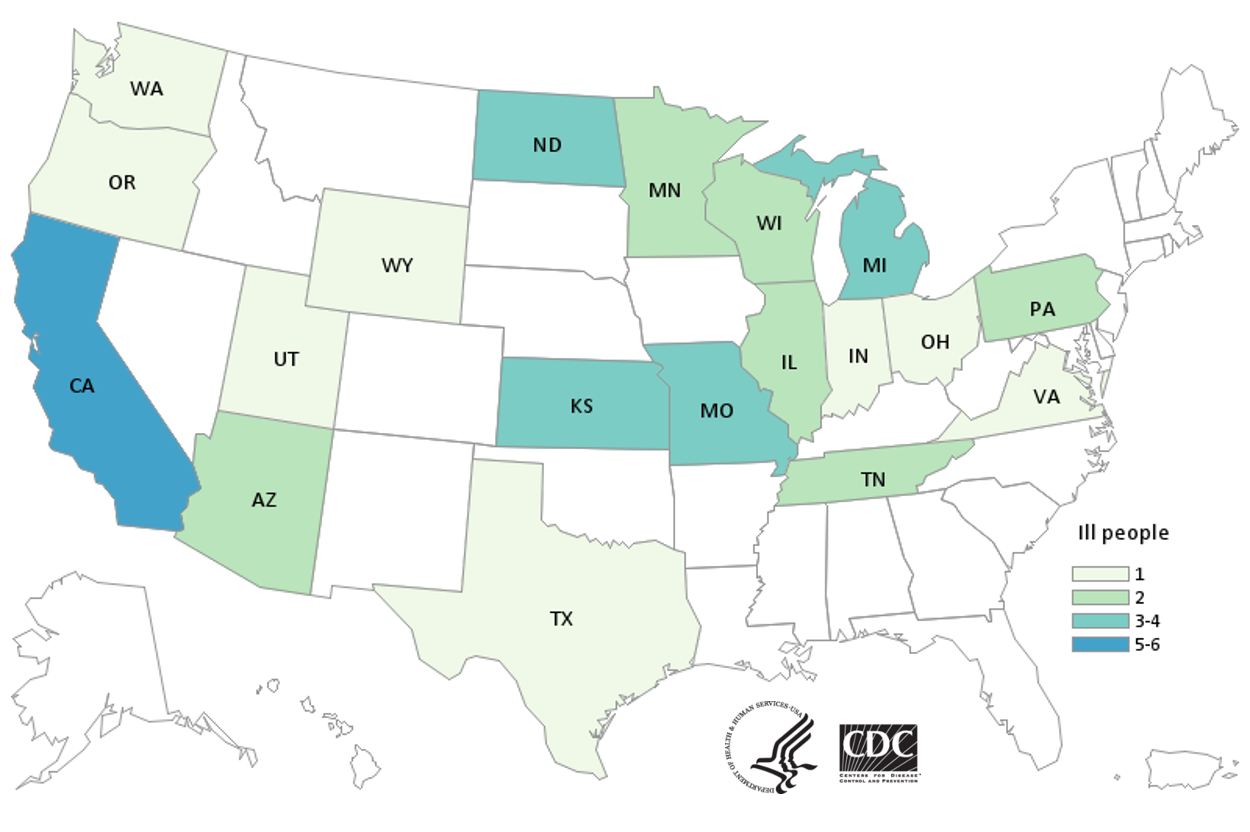
Case Count Map Provided by CDC

Outbreak Investigation of of E. coli in Leafy Greens (December 2020) - Case Count Map from CDC 12/22/2020

Case Counts

Total Illnesses: 40
Hospitalizations: 20 (4 Cases HUS)
Deaths: 0
Last Illness Onset Date: October 31, 2020
States with Cases: AZ (2), CA (6), IL (2), IN (1), KS (4), MI (3), MN (2), MO (3), ND (4), OH (1), OR (1), PA (2), TN (2), TX (1), UT (1), VA (1), WA (1), WI (2), WY (1)
*States with confirmed distribution; product could have been distributed further

Useful Links

Denmark – Disease outbreaks with rare microsporidia – Enterocytozoon bieneusi.

SSI

The Statens Serum Institut and the Danish Veterinary and Food Administration are currently investigating a disease outbreak in a company with a microorganism that has so far not been registered as a cause of disease outbreaks in Denmark. It is a species of microsporidia, Enterocytozoon bieneusi. It is believed that the infection occurred through food.

In October, a company in the metropolitan area reported more than 70 cases of diarrhea among their employees.

The Statens Serum Institut (SSI) has so far found samples from 11 people positive for Enterocytozoon bieneusi, which is a species of microsporidia. It is not a microorganism that we often detect in Denmark, and we have not previously seen disease outbreaks with it.

The infection can cause severe and prolonged diarrhea, abdominal pain and nausea. In addition, there may be symptoms such as fever, headache, muscle aches and fatigue (flu-like). The infection occurs from feces from infected people with poor hygiene to other people either directly or through food and drink.

“There are no registered persons outside the company who should have been infected with E. bieneus. But we urge the country’s physicians to pay attention to patients with prolonged diarrhea for no apparent reason. Especially if it is about immunocompromised people and with particularly long-lasting symptoms, ”says ward doctor Lasse Skafte Vestergaard, SSI. Read more about the disease outbreak with microsporidia  (EPI-NEWS – week 52a – 2020)

Diagrams of Enterocytozoon bieneusi Spore, Life Cycle, and Possible... |  Download Scientific Diagram

Microsporidia are protozoan parasites belonging to the phylum Microsporidia within which exist over 1000 species classified into approximately 100 genera. These eukaryotic obligate intracellular protozoans have been described infecting every major animal group, especially insects, fish, and mammals (Wittner 1999). Microsporidia have been increasingly recognized as opportunistic pathogens of immunodeficient patients (Weber et al. 1994), especially in Aids patients but it is also becoming increasingly common in immunocompetent individuals (Gainzarain et al. 1998, Lores et al. 2001).

Although during the last decade numerous data related to the epidemiology of this infection in humans and animals have been accumulated, implying a zoonotic nature of these parasites, direct evidence of transmission from animals to humans are still lacking (Deplazes et al. 2000).

Encephalitozoon cuniculi is probably the most extensively studied mammalian microsporidian and has been reported to infect a wide range of hosts, including common laboratory rodents as well as human and non-human primates. This is the first microsporidian species infecting humans that has been considered a zoonosis (Deplazes et al. 1996, Didier et al. 1996) .

The first identification of E. intestinalis in mammals other than humans was reported by Bornay et al. (1998) in the faeces of donkeys, dogs, pigs, cow, and goat suggesting that E. intestinalis might also be of zoonotic origin.

Enterocytozoon bieneusi is the most frequent microsporidian found in humans, especially in Aids patients. It has been associated mainly with chronic diarrhoea, although it has been diagnosed in patients with other forms of immunosuppression and in immunocompetent travellers with self-limited diarrhoea (Weber & Bryan 1994, Sobottka et al. 1995). In addition, this pathogen has recently been detected in other natural hosts such as pigs (Deplazes et al. 1996, Breitenmoser et al. 1999, Rinder et al. 2000), cows, goats, pigs, chickens, cats, turkeys (Bornay et al. 1998), rabbits, dogs (del Aguila et al. 1999), and in simian immunodeficiency virus-inoculated monkeys (Tzipori et al. 1997, Mansfield et al. 1997). Consequently, this microsporidian infection may be more common than previously suspected.