Category Archives: Food Poisoning

France -Collective food-borne infections suspected of being linked to the consumption of raw shellfish, epidemiological report as of January 8, 2020

Sante Publique France

Cases of TIAC suspected of being linked to the consumption of raw shellfish in mainland France have been reported since December 2019.

A collective food poisoning (TIAC) ​​is defined by the appearance of at least 2 cases of illness with a similar symptomatology, generally gastrointestinal, the cause of which can be related to the same food or meal. Any person (doctor, manager of collective catering establishments, consumer, etc.) who is aware of an episode that may be a TIAC, must declare this suspicion of TIAC to the administration (Regional Health Agency (ARS) and / or the Departmental Directorate (for social cohesion) and for the protection of populations (DD (CS) PP). This declaration involves local information from the other structure (ARS or DD (CS) PP).

Since the beginning of December 2019, 179 compulsory declarations (DO) of collective food poisoning (TIAC) ​​suspected of being linked to the consumption of raw shellfish, mainly oysters, have been sent to Santé publique France. The reports come from the majority of regions in mainland France (see Figure 1).
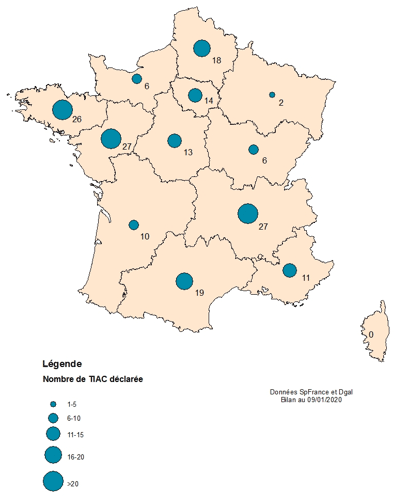
Figure 1 – Number of TIAC suspected of being linked to the consumption of raw shellfish, by reporting region. Metropolitan France, December 1, 2019 – January 8, 2020.
Figure 1 - Number of TIAC suspected of being linked to the consumption of raw shellfish, by reporting region.  Metropolitan France, December 1, 2019 - January 8, 2020.

The vast majority (138/179, 77%) of these TIAC occurred from December 23 (Figures 2 and 3). A peak of patients is observed around December 25-27 (Figure 2). The offending meals are grouped around December 24-25 (Figure 3).

A total of 1,033 people were sick, of whom 21 (2%) were hospitalized. Most of them are people over the age of 15. Of the 595 patients with age information, 19 (3.1%) were children under the age of 15. The symptoms, mainly diarrhea and vomiting, as well as the incubation times, are compatible with infections with norovirus or other enteric viruses. Stool tests performed to date by the National Reference Center for Gastroenteritis Viruses have confirmed the presence of norovirus and other enteric viruses.
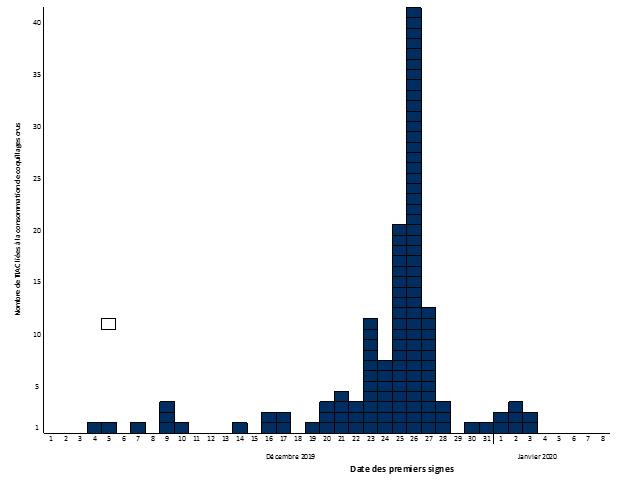
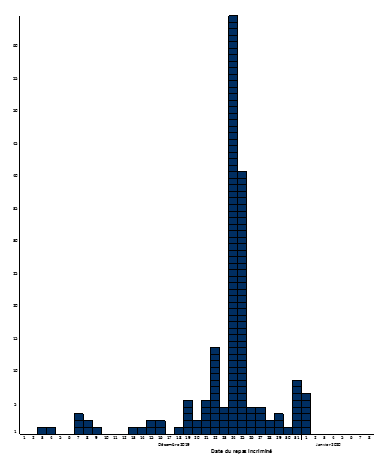
Figure 2 – Number of TIAC suspected of being linked to the consumption of raw shellfish by date of first signs of patients (information available for 125/179 TIAC). December 1, 2019 – January 8, 2020.
Figure 2 - Number of TIAC suspected of being linked to the consumption of raw shellfish by date of first signs of patients (information available for 125/179 TIAC).  December 1, 2019 - January 8, 2020.
Figure 3 – Number of TIAC suspected of being linked to the consumption of raw shellfish by date of the offending meal (information available for 176/179 TIAC). December 1, 2019 – January 8, 2020.
Figure 3 - Number of TIAC suspected of being linked to the consumption of raw shellfish by date of the offending meal (information available for 176/179 TIAC).  December 1, 2019 - January 8, 2020.

The number of TIAC suspected of being linked to the consumption of raw shellfish is significantly higher than in previous years. Each year between 25 and 120 TIAC suspected of being linked to the consumption of shellfish are reported to Public Health France, of which between 4 and 30 occurred during the December-January periods.

Following reports from TIAC suspected of being linked to the consumption of raw shellfish, the Directorate General for Food (DGAL) in conjunction with the Departmental Directorates in charge of protecting populations (DD (CS) PP) is carrying out an investigation traceability in order to trace back to the production area for suspected shellfish and confirmation analyzes are carried out on the areas concerned. To date, several areas have been closed due to contamination by noroviruses. Zone closings can be viewed on this site:
http://www.atlas-sanitaire-coquillages.fr/ (“Statutes” section)

Cruise Ship – Norovirus – What you need to know.

Cruise Critic

With cruise ship “outbreaks” regularly appearing in the news, awareness of Norovirus — an extremely common and highly contagious virus that causes gastroenteritis — has been significantly raised.
But before you reconsider that long-awaited cruise vacation because of gloom-and-doom reports on television and in your daily paper, know these facts:

  • Norovirus is not a “cruise ship” virus, nor does it limit itself to sea-going vessels.
  • Norovirus spreads swiftly wherever there are many people in a small area, including nursing homes, restaurants, hotels, dormitories … and cruise ships.
  • The common cold is the only illness more common, and the Centers for Disease Control and Prevention in Atlanta estimates that there are more than 20 million cases of Norovirus annually.
  • Norovirus is associated with cruise travel simply because health officials are required to track illnesses on ships (and are not at hotels and resorts); therefore, outbreaks are found and reported more quickly at sea than on land.

Here’s everything you need to know about Norovirus — and how to avoid getting sick on your next cruise vacation. See the link above.

Singapore -SFA recalls live mussels from France due to presence of Norovirus

CNA


SINGAPORE: The Singapore Food Agency (SFA) said on Saturday (Jan 11) that it has directed food specialist Classic Fine Foods to recall the Bouchot live mussels from France.

In a media release, SFA said that the European Commission Rapid Alert System for Food and Feed has issued a recall for the live mussels from Baie Du Mont-Saint-Michel Aop in France “due to the presence of a norovirus”.

Information USA – What Are the Symptoms of Common Foodborne Pathogens?

CDC

Burden of Foodborne Illness: Findings

CDC estimates that each year roughly 1 in 6 Americans (or 48 million people) gets sick, 128,000 are hospitalized, and 3,000 die of foodborne diseases.


These estimates provide the most accurate estimates yet of which known foodborne pathogens (bacteria, viruses, and parasites) are causing the most illnesses in the United States, and how many foodborne illnesses are caused by unspecified agents. The estimates also show that much work remains to be done—specifically in focusing efforts on the top known pathogens and identifying the additional causes of foodborne illness and death.

CDC provides estimates for two major groups of foodborne illnesses

Known foodborne pathogens — 31 pathogens known to cause foodborne illness. Many of these pathogens are tracked by public health systems that track diseases and outbreaks. Read the report >

Unspecified agents — Agents with insufficient data to estimate agent-specific burden; known agents not yet identified as causing foodborne illness; microbes, chemicals, or other substances known to be in food whose ability to cause illness is unproven; and agents not yet identified. Because you can’t “track” what isn’t yet identified, estimates for this group of agents started with the health effects or symptoms that they are most likely to cause, such as acute gastroenteritis. Read the report >


Total number of foodborne illnesses each year

CDC estimated the number of illnesses, hospitalizations, and deaths caused by both known and unspecified agents. CDC then estimated what proportion of each were foodborne. The first table below provides estimates for domestically acquired foodborne illnesses, and the second table provides estimates for domestically acquired illnesses caused by all transmission routes (foodborne, waterborne, person-to-person contact, animal contact, environmental contamination, and others).

Estimated annual number of domestically acquired, foodborne illnesses, hospitalizations, and deaths due to 31 pathogens and the unspecified agents transmitted through food, United States
Foodborne agents Estimated annual number of illnesses Estimated annual number of hospitalizations Estimated annual number of deaths
Number (90% credible interval) % Number (90% credible interval) % Number (90% credible interval) %
31 known pathogens 9.4 million
(6.6–12.7 million)
20 55,961
(39,534–75,741)
44 1,351
(712–2,268)
44
Unspecified agents 38.4 million
(19.8–61.2 million)
80 71,878
(9,924–157,340)
56 1,686
(369–3,338)
56
Total 47.8 million
(28.7–71.1 million)
100 127,839
(62,529–215,562)
100 3,037
(1,492–4,983)
100
Estimated annual number of illnesses, hospitalizations, and deaths due to 31 pathogens and the unspecified agents, United States
Foodborne agents Estimated annual number of illnesses Estimated annual number of hospitalizations Estimated annual number of deaths
Number (90% credible interval) % Number (90% credible interval) % Number (90% credible interval) %
31 known pathogens 37.2 million
(28.4–47.6 million)
21 228,744
(188,326–275,601)
47 2,612
(1,723–3,819)
42
Unspecified agents 141.8 million 79 258,033 53 3,574 58
Total 179 million 100 486,777 100 6,186 100


Pathogens causing the most foodborne illnesses, hospitalizations, and deaths each year

Top five pathogens contributing to domestically acquired foodborne illnesses
Pathogen Estimated number of illnesses 90% credible interval %
Norovirus 5,461,731 3,227,078–8,309,480 58
Salmonella, nontyphoidal 1,027,561 644,786–1,679,667 11
Clostridium perfringens 965,958 192,316–2,483,309 10
Campylobacter spp. 845,024 337,031–1,611,083 9
Staphylococcus aureus 241,148 72,341–529,417 3
Subtotal 91

 Top of Page

Top five pathogens contributing to domestically acquired foodborne illnesses resulting in hospitalization
Pathogen Estimated number of hospitalizations 90% credible interval %
Salmonella, nontyphoidal 19,336 8,545–37,490 35
Norovirus 14,663 8,097–23,323 26
Campylobacter spp. 8,463 4,300–15,227 15
Toxoplasma gondii 4,428 2,634–6,674 8
E. coli (STEC) O157 2,138 549–4,614 4
Subtotal 88
Top five pathogens contributing to domestically acquired foodborne illnesses resulting in death
Pathogen Estimated number of deaths 90% credible interval %
Salmonella, nontyphoidal 378 0–1,011 28
Toxoplasma gondii 327 200–482 24
Listeria monocytogenes 255 0–733 19
Norovirus 149 84–237 11
Campylobacter spp. 76 0–332 6
Subtotal 88

RASFF Alerts – Salmonella – Black Pepper – Salted Chicken Half Breast – Organic Pork and Veal Sausage – Pine Nuts – Chicken Wings – Chicken Cutlets – Chicken Legs – Chicken Fillets

RASFF-Logo

RASFF – Salmonella enterica ser. Javiana (presence /25g) and Salmonella enterica ser. München (presence /25g) in black pepper from Brazil in Germany

RASFF – Salmonella enterica ser. Javiana (presence /25g) in black pepper from Brazil in Germany

RASFF – Salmonella (present /25g) in frozen salted chicken half breasts from Brazil in the Netherlands

RASFF – Salmonella enterica ser. Matadi (presence /25g) and Salmonella enterica ser. Saintpaul (presence /25g) in black pepper from Brazil in Germany

RASFF – Salmonella enterica ser. Abaetetuba (presence /25g), Salmonella enterica ser. Bredeney (presence /25g) and Salmonella enterica ser. Münster (presence /25g) in black pepper from Brazil in Germany

RASFF – Salmonella II 42:r:- (presence /25g) and Salmonella enterica ser. Gaminara (presence /25g) in black pepper from Brazil in Germany

RASFF – Salmonella enterica ser. Gaminara (presence /25g), Salmonella enterica ser. Minnesota (presence /25g), Salmonella enterica ser. Poona (presence /25g) and Salmonella enterica ser. Saintpaul (presence /25g) in black pepper from Brazil in Germany

RASFF – Salmonella (in 2 out of 5 samples /10g) in chilled organic pork and veal sausage (chipolata) from Belgium in Belgium

RASFF – Salmonella (present /25g) in pine nuts from Turkey in Italy

RASFF – Salmonella enterica ser. Infantis (in 1 out of 5 samples /25g) in chilled chicken wings from Poland in the Czech Republic

RASFF – Salmonella enterica ser. Enteritidis (present /25g) in frozen chicken cutlets from Poland in France

RASFF – Salmonella enterica ser. Morehead (present /25g) and Salmonella enterica ser. Oranienburg (present /25g) in black pepper from Brazil in Germany

RASFF – Salmonella enterica ser. Enteritidis and Salmonella enterica ser. Kottbus in frozen chicken legs from Poland in Bulgaria

RASFF – Salmonella enterica ser. Enteritidis (presence /25g) in frozen chicken fillets from Poland in France

RASFF Alerts – Aflatoxin – Dried Figs – Groundnuts – Pistachios – Roasted Chopped Hazlenuts – Hazlenuts – Organic Peanut Butter

RASFF-Logo

RASFF – aflatoxins (B1 = 12.02; Tot. = 12.33 µg/kg – ppb) in dried figs from Turkey in Germany

RASFF – aflatoxins (B1 = 7.54; Tot. = 8.89 µg/kg – ppb) in groundnuts from the United States in Poland

RASFF – aflatoxins (B1 = 8.4; Tot. = 11.5 / B1 = 7.3; Tot. = 12.9 / B1 = 44; Tot. = 127 µg/kg – ppb) in dried figs from Turkey in France

RASFF – aflatoxins (B1 = 10.8; Tot. = 11.6 / B1 = 23; Tot. = 26 µg/kg – ppb) in dried figs from Turkey in France

RASFF – aflatoxins (B1 = 15.4; Tot. = 16.1 µg/kg – ppb) in pistachios from Iran in Germany

RASFF – aflatoxins (B1 = 47.9; Tot. = 53.2 µg/kg – ppb) in pistachios from the United States in Germany

RASFF – aflatoxins (B1 = 53; Tot. = 57.6 µg/kg – ppb) in groundnuts from the United States in the UK

RASFF – aflatoxins (B1 = 17.1; Tot. = 21.9 µg/kg – ppb) in pistachio kernels from Turkey, with raw material from the United States in Germany

RASFF – aflatoxins (Tot. = 17.2 µg/kg – ppb) in roasted chopped hazelnut kernels from Turkey in Germany

RASFF – aflatoxins (B1 = 77; Tot. = 127 / B1 = 320; Tot. = 370 µg/kg – ppb) in hazelnuts with shell from Azerbaijan in France

RASFF – aflatoxins (B1 = 9.9; Tot. = 11.7 µg/kg – ppb) in organic peanut butter from the United Kingdom, via the Netherlands in Denmark

RASFF – aflatoxins (B1 = 8.86 µg/kg – ppb) in dried figs from Turkey in Poland

RASFF Alert- STEC E.coli – Chilled Beef Steak Tartare

RASFF-Logo

RASFF – shigatoxin-producing Escherichia coli (stx2+ /25g) in chilled beef steak tartare from Poland in Poland

RASFF Alert – Foodborne Outbreak – Shigella – Fresh Sugar Snap Peas

RASFF-Logo

RASFF – foodborne outbreak suspected to be caused by Shigella sonnei in fresh sugar snap peas from Kenya, via the Netherlands in Norway

RASFF Alerts – Norovirus – Foodborne Outbreak – Live Oysters –

RASFF-Logo

RASFF – foodborne outbreak suspected to be caused by live oysters (Crassostrea gigas) from France

RASFF – foodborne outbreak suspected to be caused by live oysters (Crassostrea gigas) from France

RASFF – foodborne outbreak caused by live oysters from France, via the Netherlands in Sweden

RASFF – norovirus in live mussels from France in Switzerland

RASFF – norovirus in live bouchot mussels from France in the Netherlands

RASFF – norovirus in oysters from France in the Netherlands

RASFF – withdrawal of bivalve molluscs harvested in France because of possible contamination with norovirus in Luxembourg

India – Food poisoning leaves 2 dead, 22 in hospital

Times of India

KANNUR: Two inmates how now  died and 22 others have been hospitalised following food poisoning at a destitute home near Oduvally. The inmates suffered food poisoning apparently after they consumed ghee rice, chicken curry and salad.