Category Archives: Food Microbiology Testing

Sweden – Fish suspected in deadly Swedish Listeria outbreak

Food Safety News

Three people have died in Sweden as part of a Listeria outbreak that may have been caused by smoked fish.

Folkhälsomyndigheten (the Public Health Agency of Sweden) said deaths of three of the older patients were connected to their Listeria infections but it is not clear if they died with or because of listeriosis.

From the end of May to the beginning of July, 10 people contracted Listeria infections caused by the same type of the bacteria. Another four people fell ill in late 2022 from this strain.

Patients are 10 men and four women aged 63 to 93 years old. They live in eight different regions in the country.

Based on information from a questionnaire given to patients about foods they ate before becoming sick, many reported eating gravad or cold-smoked salmon but the exact product that caused the outbreak is not yet clear.

USA – Investigations of Foodborne Illness Outbreaks

FDA

What’s New

  • A new outbreak of Cyclospora cayetanensis (ref #1171) in a not yet identified product has been added to the table. There are currently 39 cases. FDA and state partners have initiated sample collection and testing and FDA has initiated traceback.
  • A new outbreak of E. coli O26 (ref #1165) with 13 cases linked to a not yet identified product has been added to the table. FDA has initiated traceback.
  • For the outbreak of Cyclospora cayetanensis (ref #1163), the case count has increased from 118 to 121 cases and FDA has initiated traceback.
  • For the outbreak of Salmonella Paratyphi B var. L(+) tartrate+ (ref #1157), the case count has increased from 34 to 35 cases.
  • For the outbreak of Cyclospora cayetanensis (ref #1159), the case count has increased from 43 to 68 cases.
  • For the outbreak of hepatitis A virus (ref #1143) linked to frozen strawberries, the advisory was updated on July 20, 2023 to include one additional case. FDA reminds consumers to check their freezers and not eat recalled frozen strawberries.

UK – Standards Agency and Food Standards Scotland issue updated advice to higher risk consumers on ready-to-eat cold-smoked and cured fish following publication of a risk assessment

Gov UK

The Food Standards Agency (FSA) and Food Standards Scotland (FSS) are advising pregnant women and those with a weakened immune system to avoid eating ready-to-eat cold-smoked or cured fish.

The Food Standards Agency (FSA) and Food Standards Scotland (FSS) are advising pregnant women and those with a weakened immune system to avoid eating ready-to-eat cold-smoked or cured fish, following publication of a risk assessment showing they are at higher risk of severe illness from listeriosis. Products include smoked salmon, smoked trout and gravlax.

As the risk of serious illness from listeriosis increases with age, the FSA and FSS are also advising that older people should be aware of the risks associated with eating these products.

The FSA and FSS’s joint risk assessment (Opens in a new window), commissioned in response to an ongoing outbreak of Listeria monocytogenes linked to ready-to-eat cold smoked fish, found that while the risk of contracting listeriosis in higher-risk individuals from cold-smoked fish is low, the severity of the illness is high. This means there is the potential for severe illness, hospitalisation, and death among higher risk groups.

Spain: Botulism outbreak linked to packaged potato omelette

Outbreak News Today

On July 11, Italy notified through the Early Warning and Response System of the Union Union (EWRS) two cases of botulism whose only food in common had been an omelet of packaged potato consumed in Spain.

On July 14, the Community of Madrid and the Community Valenciana notified the National Epidemiological Surveillance Network (RENAVE) of two cases with symptoms compatible with botulism, with ingestion of the same food, for which reason the immediately alerts the Autonomous Communities and Cities (CC.AA.).

Also, it contacted the Spanish Agency for Food Safety and Nutrition (AESAN) as responsible for analyzing traceability and coordinating pertinent investigations regarding the food product.

Up to now, 7 cases have been reported with a history of consumption of packaged potato in the days prior to the onset of the symptoms: 5 laboratory-confirmed cases with symptom onset date between June 24 and July 10 and 2 probable cases (with compatible clinic and epidemiological link), whose dates of onset of symptoms have been 21 June and July 1 respectively.

Belgium – Chicken thighs 2 kg (frozen) of the Everyday brand – Salmonella

AFSCA

Product: Chicken thighs 2 kg (frozen) of the Everyday brand.
Problem: Possible presence of Salmonella.
During an internal check, the presence of Salmonella Enteritidis was found in a sample of Everyday whole chicken thighs (frozen) with the dates of minimum durability 19/9/2024, 21/9/2024 and 30/9/2024 .

In consultation with the FASFC, Colruyt has therefore decided to withdraw the products concerned from sale.

Customers who have purchased this product are invited not to consume it and to bring it back to the store, where they will be reimbursed. In the meantime, all stores have removed the affected products from the shelves.

Product description:

Everyday whole chicken thighs 2 kg (frozen)
Date of minimum durability (BDD): 19/9/2024, 21/9/2024 and 30/9/2024
Sale period: from 29/3/2023 to 25/7/2023 included
Article number: 13650

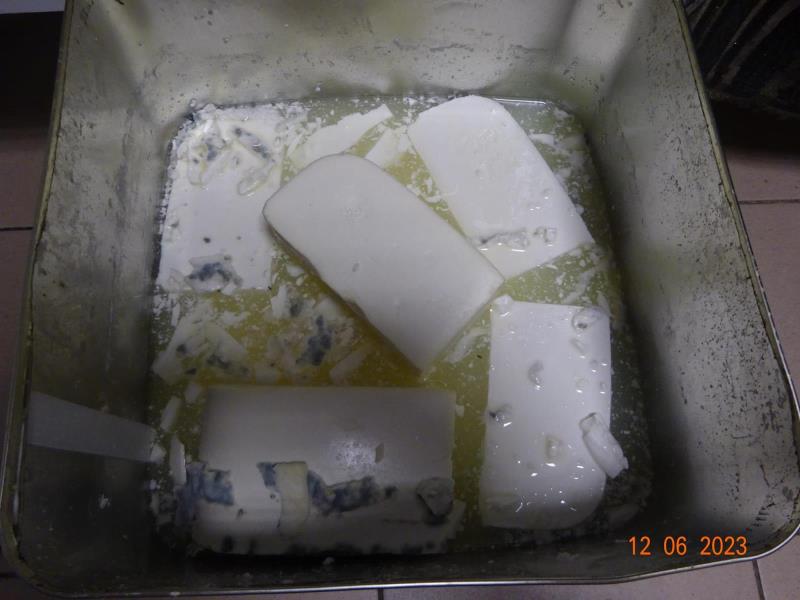
Czech Republic – Raw material for food production- cheese

Potravinynapranyri

Place of inspection:
Tanvald – Šumburk nad Desnou ( Krkonošská 116, 468 41 Tanvald – Šumburk nad Desnou )
ID: 18046789
Food group: Milk and milk products Dairy products – alternatives

Raw material for food production
Category: Dangerous foods
Invalid parameter:

fungi visible to the eye

It was a raw material for a food product that was stored under unfavorable temperature conditions.

There were colonies of mold on the surface of the food. Food is not considered safe if it shows signs of spoilage.

Best before date: 15 02 2024
Packaging: tin box + color label (open package)
Date of sample collection: 12/06/2023
Reference number: 23-000469-SZPI-CZ
The sample was detected by the official control of the State Agricultural and Food Inspection.

Luxembourg – EVERYDAY BRAND CHICKEN THIGHS – Salmonella

SAP

Name Chicken thighs (frozen)
Brand Everyday
Unit 2kg
Bundles – DLCs 3,078,040 – 09/19/2024

3,080,041 – 09/19/2024, 09/21/2024, 09/30/2024

Sale period 03/29/2023 – 07/25/2023

Danger  : Possible presence of Salmonella

Salmonella can cause symptoms such as nausea, vomiting, abdominal cramps, diarrhea, fever and headache within 6 to 72 hours after consumption. These symptoms may be aggravated in young children, immunocompromised subjects and the elderly. People who have consumed these products and have these symptoms are invited to consult a doctor and report this consumption to him.

The product can be distributed by various points of sale in Luxembourg.

Information Source: Recall Notification

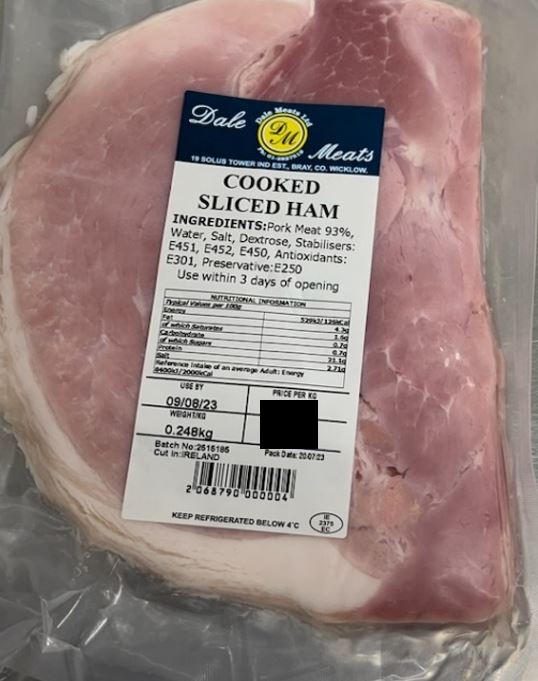
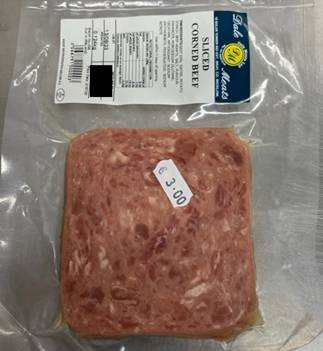
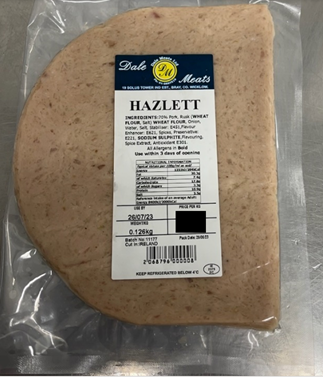
Ireland – Recall of Dale Meats Cooked Whole and Sliced Ham, Sliced Hazlett and Sliced Corned Beef products due to presence of Listeria monocytogenes

FSAI

Category 1: For Action
Alert Notification: 2023.20
Product Identification: Dale Meats cooked whole ham, sliced ham, sliced hazlett and sliced corned beef
Batch Code All batch codes; All use-by-dates up to 19/08/2023
Country Of Origin: Ireland

Message:

Dale Meats is recalling all batches of cooked whole ham, sliced ham, sliced hazlett and sliced corned beef with a use-by-date up to 19/08/2023 due to the presence of Listeria monocytogenes.

Recall notices will be displayed at point-of-sale.

Nature Of Danger:

Symptoms of Listeria monocytogenes infection can include mild flu-like symptoms, or gastrointestinal symptoms such as nausea, vomiting and diarrhoea. In rare cases, the infection can be more severe, causing serious complications. Some people are more vulnerable to Listeria monocytogenes infections, including pregnant women, babies, and people with weakened immune systems, including the elderly. The incubation period (time between initial infection and first symptoms appearing) is on average 3 weeks but can range between 3 and 70 days.

Action Required:

Manufacturers, wholesalers, distributors, caterers & retailers:

Retailers are requested to remove the implicated batches from sale and display recall notices at point-of-sale.

Consumers:

Consumers are advised not to eat the implicated batches.

Czech Republic – He ate. Natural, steamed cheese, hand-knitted – Visible Mould/Mold

Potravinynapranyri

Illustrative photo #5

Place of inspection:
Brno ( Halasovo náměstí 805/5, 638 00 Brno )
ID: 44012373
Food group: Milk and milk products Cheese

He ate. Natural, steamed cheese, hand-knitted.
Category: Dangerous foods
Invalid parameter:

fungi visible to the eye

All of the inspected packages had mold colonies under the intact packaging. Food is not considered safe if it shows signs of spoilage.

Unsuitable storage temperatures of this product were not detected during the inspection. The food did not have an expired minimum durability date.

Best before date: 06/04/2023
Packaging: PA/PE
Quantity of the product in the package: 0.11 kg
Manufacturer: Dairy Polná spol. sro, Za Nádražím 680, 588 13 Polná, Czech Republic
Date of sample collection: 6/2/2023
Reference number: 23-000427-SZPI-CZ
The sample was detected by the official control of the State Agricultural and Food Inspection.

USA – Salmonella Outbreak Linked to Ground Beef

Print

CDC

Investigators are working to identify the source of the ground beef sick people ate in this outbreak. Any ground beef can have germs, like Salmonella. Always cook ground beef to an internal temperature of 160°F.

Fast Facts
  • Illnesses: 16
  • Hospitalizations: 6
  • Deaths: 0
  • States: 4
  • Recall: No
  • Investigation status: Active
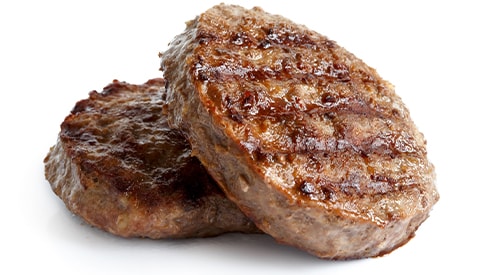
Two ground beef patties on a white background.
 
Source of the Outbreak

All of the people who remembered the type of ground beef they ate and where they bought it reported eating 80% lean ground beef purchased from ShopRite locations in Connecticut, New Jersey, and New York before they got sick. Ground beef is the only common food people reported eating. Investigators are working to identify the source of the ground beef sick people ate.

Salmonella in Ground Beef

Ground beef is a known source of Salmonella illnessesSalmonella germs live in the intestines of people and animals and can be spread through contaminated food, water, food preparation surfaces, and unwashed hands. Salmonella germs are killed when ground beef is cooked to an internal temperature of 160°F. Eating raw or undercooked ground beef can make you sick.