Category Archives: Food Inspections

RASFF Alert – Mycotoxin – Ochratoxin A – Dried Apricot

RASFF

Ochratoxin A in dried apricot pieces from Turkey in Germany

RASFF Alert – Algal Toxin – Okadaic Acid – DSP – Diarrhoeic Shellfish Poisoning

RASFF

Okadaic acid in Diarrhoetic Shellfish Poisoning from Portugal in Spain

RASFF Alerts – Listeria monocytogenes – Roasted Corn – Vegan Falafel

RASFF

Listeria monocytogenes in vegan falafel from the Netherlands in Spain and Aruba

RASFF

Listeria monocytogenes in roasted corn from Spain in Ireland

RASFF Alerts – Salmonella – Polish Chicken Products – Black Pepper – Poultry Meat Preparation – Chicken Kebab – Tahini – Frozen Beef and Gouda Brochettes – Halva

RASFF

Salmonella spp. in black pepper from Brazil in Germany

RASFF

Salmonella in poultry meat preparation from Thailand in the Netherlands

RASFF

Salmonella in poultry meat preparation from Thailand in the Netherlands

RASFF

Salmonella Enteritidis in chicken breast from Poland in Slovakia

RASFF

Salmonella Enteritidis in chicken thigh from Poland in Germany

RASFF

Salmonella Infantis in chicken kebab from Hungary in Austria

RASFF

Salmonella spp. in tahini from Syria in France, Germany and Switzerland

RASFF

Salmonella in chicken meat preparation from Thailand in the Netherlands

RASFF

Salmonella spp. in Halva spread from Syria in France, Germany and the Netherlands

RASFF

Detection of Salmonella spp in frozen beef and gouda brochettes from Romania in France and  the Netherlands

RASFF

Salmonella spp. in tahini from Syria in Austria, France, Germany and Iceland

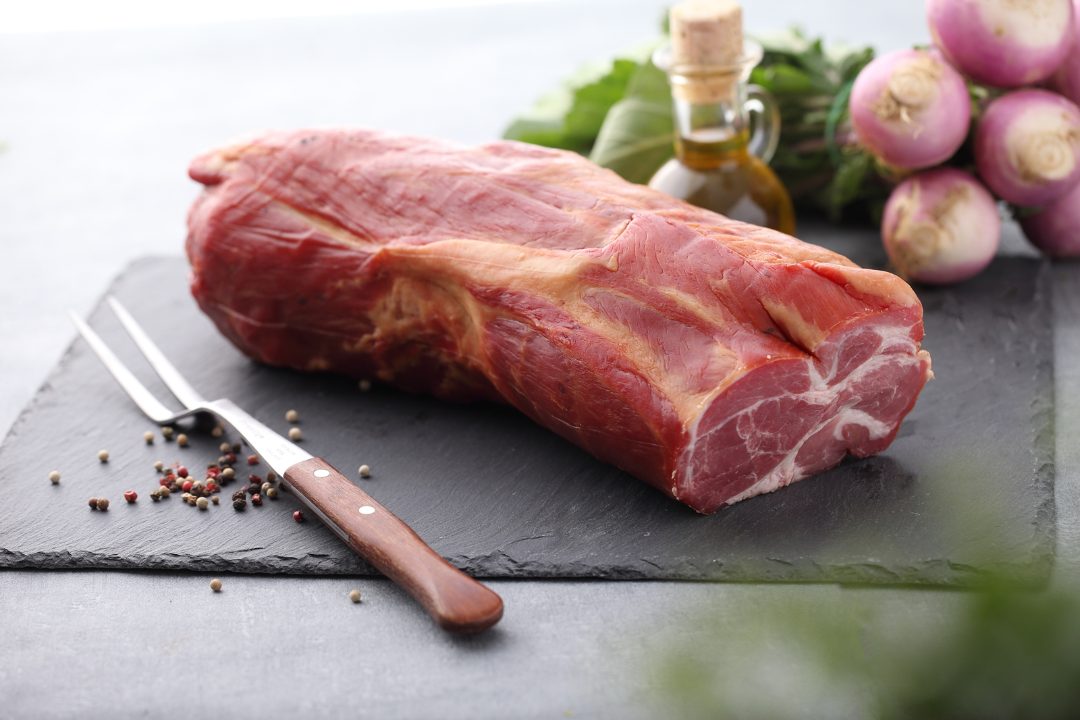
France – SUPERIOR RAW SMOKE COLLAR – Salmonella

Gov france

Identification information of the recalled product

  • Product category Feed
  • Product subcategory Meats
  • Product brand name MAURER
  • Model names or references VACUUM WHOLE RAW SMOKED COLLAR
  • Identification of products
    GTIN Batch Date
    3301090182780 22137, whole under vacuum Use-by date 07/16/2022
  • Packaging Vacuum-packed and cut in traditional GMS departments
  • Marketing start/end date From 05/24/2022 to 07/16/2022
  • Storage temperature Product to be stored in the refrigerator
  • Health mark EN 68-166-001 CE
  • Further information Date of manufacture: May 12, 2022 Use-by date: July 16, 2022
  • Geographic area of ​​sale Whole France
  • Distributors METRO COLMAR, METRO BELFORT, METRO KINGERSHEIM, METRO SOUFFELWEYRSHEIM, INTERMARCHE BARTENHEIM, METRO NANCY, CORA WITTENHEIM, INTERMARCHE BASE DE SAINT DIE, LE DELAS SAS RUNGIS, ETS. RIBAULT-SAULNIERES

Practical information regarding the recall

  • Reason for recall Presence of salmonella
  • Risks incurred by the consumer Salmonella spp (causative agent of salmonellosis)

Quebec – Notice not to consume Alasko brand frozen IQF whole raspberries sold by the company Distribution Alimentaire Aubut inc. – Norovirus

Quebec

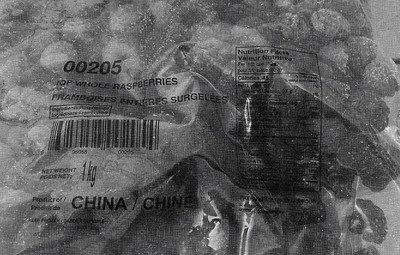
IQF Whole Raspberries (CNW Group/Ministry of Agriculture, Fisheries and Food)

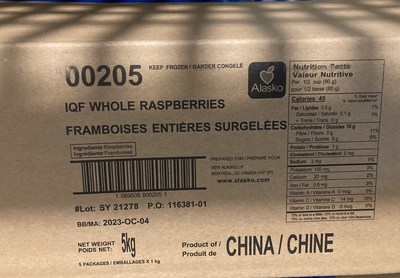
Crate of raspberries (CNW Group/Ministry of Agriculture, Fisheries and Food)

The Ministry of Agriculture, Fisheries and Food (MAPAQ), in collaboration with the Food Inspection Division of the City of Montreal and the company Distribution Alimentaire Aubut inc., warns the public not to consume the product indicated in the table below, because this food may have been contaminated with a norovirus.

This warning stems from a Canadian Food Inspection Agency food recall involving Alasko brand IQF Whole Raspberries from China. They are distributed in several establishments across Canada . The recalled lot is as follows*:

*Lot # SY21278  PO
: 116381-01
BB/MA: 2023-OC-04

* The information on the batch concerned is only found on the transport boxes.

The product was offered in a frozen state. Its label includes, in addition to its name, the mention “Prepared for New Alasko LP”.

Establishment

Product name

Format

Affected lot

Aubut Food Distribution Inc.

3975 St. Ambroise Street

Montreal

“IQF Whole Raspberries”

Box of 5 kg (5 bags of 1 kg)

Units sold until June 15, 2022

1 kg bag

The company named in the table is voluntarily recalling the product in question. It has agreed with MAPAQ and the Food Inspection Division of the City of Montreal to issue this warning as a precautionary measure. In addition, people who have this product in their possession are advised not to consume it. They must return it to the establishment where they bought it or throw it away.

Even if the product does not show signs of tampering or a suspicious smell, it may be contaminated with norovirus and cause illness when consumed. Generally, the possible symptoms are nausea, vomiting, diarrhea and abdominal cramps. Muscle pain, fatigue, fever, chills and headache may also occur. People exposed to norovirus usually show these symptoms within 24 to 48 hours of eating contaminated food. Cases of illness have been reported to MAPAQ and could be associated with the consumption of this food.

Belgium – Jumbo brand falafel (vegan)- Listeria monocytogenes

AFSCA

Jumbo recall
Product: Jumbo brand falafel (vegan).
Nature of the problem: possible presence of Listeria

In agreement with the FASFC, Jumbo is withdrawing from sale the product “falafel vegan” with the EAN code 8718452486236 and the expiry dates (DLC) 03-07-2022 and 07-07-2022 of the Jumbo brand and is recalling it to consumers because of the possible presence of Listeria.

Jumbo asks its customers not to consume this product and to return it to the point of sale where it was purchased, where they will be reimbursed.

Product description Product

name: falafel (vegan)
Brand: Jumbo
EAN code: 8718452486236 Best before
dates (BDD): 07-03-2022 and 07-07-2022
Sale period: June 10 to 14, 2022
Nature of packaging: plastic packaging
Weight: 200 g

The product was distributed through Jumbo’s subsidiaries in Belgium.

For more information , customers can contact customer services on 0800-98998 or Jumbo.com .

Our apologies for the inconvenience caused.

Ukraine – HOW TO PROTECT YOURSELF FROM BOTULISM IN SUMMER

PHC

Since the beginning of the week, six people with a previous diagnosis of botulism have been hospitalized in different regions of Ukraine – Volyn, Chernihiv, Zhytomyr, Rivne, Kherson and Kyiv. Among the causes of the disease, experts from the Centers for Disease Control and Prevention call the use of fried and dried river fish of their own cooking or unknown production, home canned food. 

We remind you that botulism is a food poisoning that can lead to serious consequences. In summer, when the air temperature rises, you should pay attention to the conditions of storage and cooking. Therefore, to protect against botulism, you should avoid the following products if you have doubts about their quality and storage / transportation conditions:  

  • dried, smoked, salted and canned fish;
  • canned meat and mushrooms;
  • home canned food.

Symptoms of botulism:

  • visual impairment – you can’t read the text, but you can see objects well;
  • severe dry mouth;
  • difficult to speak (voice becomes quiet, hoarse or disappears);
  • increased fatigue, muscle weakness;
  • dizziness;
  • short-term signs of damage to the digestive system (nausea, vomiting, weak stools), and then – the stage of intestinal paresis (bloating, constipation);
  • lesions of the muscles of the neck and limbs.

Symptoms of botulism often appear gradually, without sharp rises in temperature, so there is an illusion of frivolity. Later there is a visual impairment – one of the first signs of botulism. At the same time there is thirst, dryness of the mucous membranes, swallowing disorders, may change the tone of voice. Patients complain of a feeling of “lump” in the throat, pain when swallowing, sore throat.

Neurological symptoms last for several days and are accompanied by a general toxic syndrome – patients complain of severe headache, dizziness, insomnia, general weakness, fever. In severe cases, patients are concerned about the feeling of shortness of breath. Respiratory failure develops, which is the cause of death in botulism.

At the slightest suspicion of botulism, see a doctor immediately! 

Norway – Foodtrade AS and Sunrise Food AS recall Brazil nuts from Bolivia – Aflatoxin

Matportalen

Peanuts

Foodtrade AS is recalling Brazil nuts in 1 kg bags of the brand «The nut mixer Brazil nuts», in addition to Brazil nuts sold in bulk at fruit and vegetable stores across the country. The products are sold in the stores of Nøtteblanderen. The reason is that the nuts contain aflatoxin above the permitted limit value. Aflatoxin is a harmful toxin from molds.

About 300 bags of nuts from Foodtrade AS have been sold in Nøtteblanderen’s stores in Oslo, Bergen, Stavanger, Ålesund and Kristiansand in the period April-June 2022.

The nut mixer reports that the remaining products have been withdrawn and are no longer available in their stores.

The nut mixer asks customers who have purchased this product to return it to the store where it was purchased, or throw it in residual waste.

A total of 21 cartons of Brazil nuts from Sunrise AS have been sold in bulk in fruit and vegetable shops across the country. Consumers who have purchased the Brazil nuts after 2 May 2022 are asked to either contact the store where the product was purchased or throw it away.

The mold aflatoxin has been detected in a batch of Brazil nuts from Bolivia. Aflatoxins are carcinogenic and can damage the genetic material (DNA) after high intake over a long period of time. The amount of aflatoxin in these nuts is above the permitted limit value, and the products are therefore considered to be unsafe. 

The withdrawal applies to the following item:

  • Product name: The nut mixer Brazil nuts
  • Name of the company that recalls the goods: FoodTrade AS
  • Shop: The nut mixer (Oslo, Bergen, Stavanger, Ålesund and Kristiansand)
  • Lot no .: FT01L0012204BI
  • Best before date: 04/12/23
  • Net weight: 1 kg
  • Importer: FoodTrade AS
  • Country of origin: Bolivia
  • Product name: «Brazil nuts» – sold in bulk in store, delivered in cartons of 20 kg, marked P641332 / Implot: 220422
  • Name of the company that recalls the goods: Sunrise Food AS
  • Shop: fruit and vegetable shops all over the country
  • Sales period: from and including 3 May 2022 until 15 June 2022
  • Importer: Sunrise Food AS
  • Country of origin: Bolivia

Hong Kong- Food Safety Focus – Histamine in Fish and Fish Products

CFS

 Histamine in Fish and Fish Products

Reported by Mr. Kenneth Yung, Research Officer,
Risk Assessment Section, Centre for Food Safety

Fish is an important part of many types of cuisine that we savour.  However, the consumption of fish and fish products containing high level of histamine may cause scombrotoxin fish poisoning (SFP), also called histamine poisoning.  In Hong Kong, the Centre for Health Protection of the Department of Health recorded a total of 26 local SFP cases, affecting 45 persons from 2009 to 2018.  In this article, we discuss how histamine is formed and the ways to control level of histamine in fish and fish products..
Examples of fish which contain elevated levels of naturally

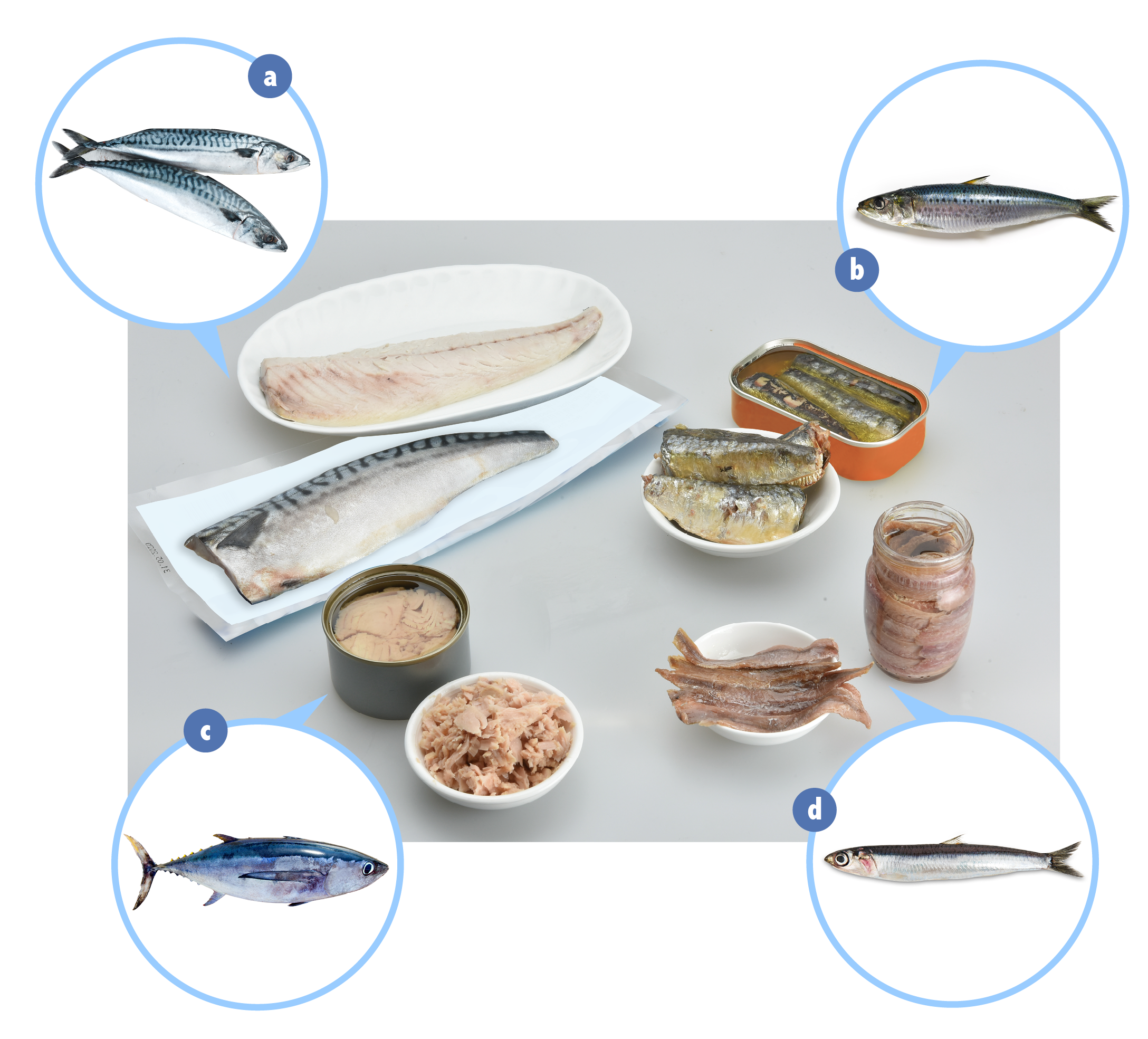
Examples of fish which contain elevated levels of naturally occurring histidine: (a) mackerel, (b) sardine, (c) tuna and (d) anchovy.  Some of their respective products have also been found to contain high levels of histamine.

Formation of Histamine in Fish and Fish Products

Histamine is a toxic metabolite produced by histamine-producing bacteria during spoilage and fermentation of fish and fish products.  Many histamine-producing bacteria are part of the natural microflora of the skin, gills and gut of freshly caught fish.  Histidine decarboxylase (HDC) enzymes, synthesized by histamine-producing bacteria when they multiply, convert the amino acid histidine that are naturally present in fish into histamine.

The level of histamine in fish and fish products mainly depends on species of fish and time-temperature control. Certain fishes like mackerel, sardine, tuna and anchovy naturally contain high amount of histidine and have been associated with SFP cases in Hong Kong and/or other places.

Time and temperature control is the most effective method for ensuring food safety for fish species prone to histamine production.  In the absence of proper time-temperature control such as refrigeration and freezing, formation of histamine may occur at any point throughout the supply chain.  Previous study conducted jointly by the Food and Environmental Hygiene Department and the Consumer Council revealed that high levels of histamine (up to 2600 mg/kg) that can cause SFP were detected in opened canned fish samples that were left at room temperature for 24 hours.  However, histamine was not detected in samples that were kept at 2°C for up to 168 hours.

Health Effects of Histamine

SFP is caused by the ingestion of food containing high levels of histamine i.e. consuming a serving size of 250g fish or fish product with histamine level exceeding 200 mg/kg may cause symptoms in healthy individuals.  Symptoms of SFP include tingling and burning sensation around the mouth, facial flushing and sweating, nausea, vomiting, headache, palpitations, dizziness and rash.  Exacerbation of asthma and more serious cardiac manifestations were reported in more severe cases.  The onset of symptoms is within a few hours after consumption and these symptoms will normally disappear in 12 hours without long term effect.

Control of Histamine in Fish and Fish Products

High levels of histamine can build up in fish and fish products before any signs of spoilage (e.g. bad smell or taste) develop.  Therefore, measures for control of histamine should be taken along the food chain from harvest to consumption.

Care should be taken that the cold chain is maintained at or below 4°C along the supply chain, including points of transfer such as offloading of fish from the vessel and processing procedures.  Frozen fish and fish products should be kept at or below -18°C.  Transport vehicles or vessels should be adequately equipped to keep fish cold and pre-chilled before loading fish where applicable.  Adequate heat treatment (e.g. cooking, hot smoking) can kill histamine-producing bacteria and inactivate HDC enzymes, but cannot destroy pre-formed histamine.  Recommendations in the Code of Practice for Fish and Fishery Products (CAC/RCP 52-2003), issued by Codex Alimentarius Commission, should be observed to ensure food safety.
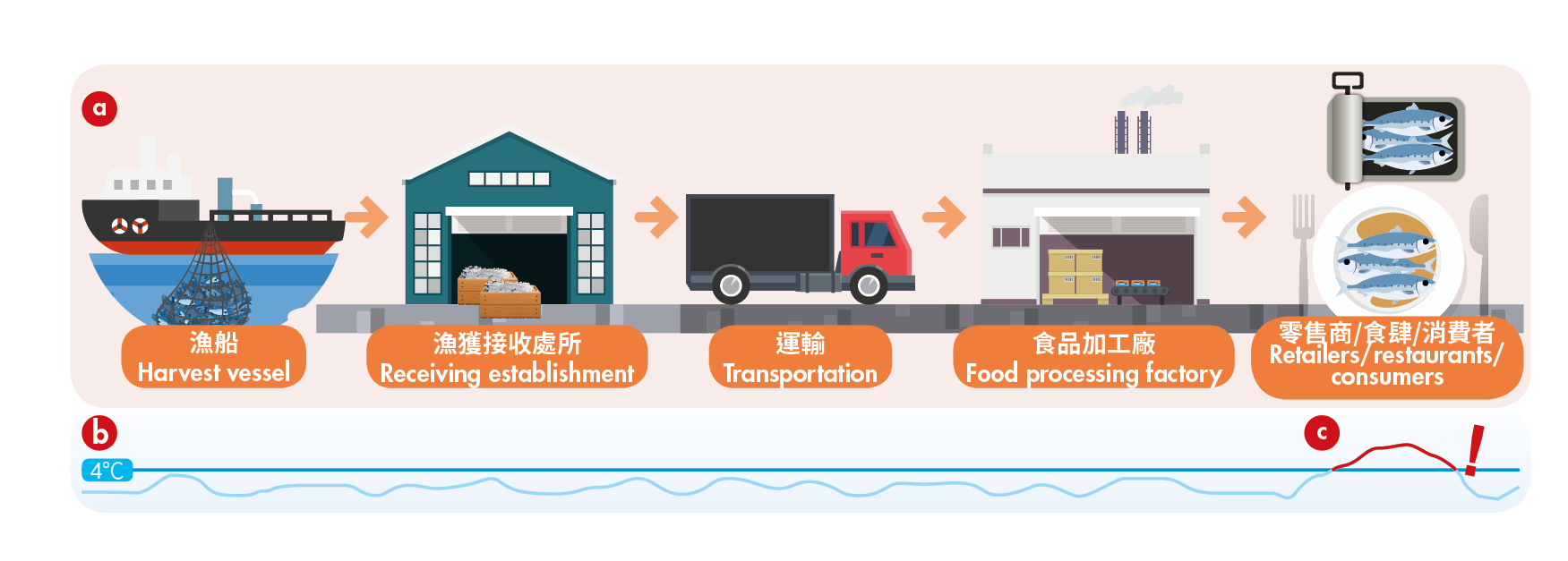
Food chain from harvest to consumption

(a) Cold chain should be maintained throughout the whole supply chain. (b) Refrigerated fish and fish products should be kept at or below 4°C. (c) The time which fish products are kept under ambient temperature should be minimised.

At the consumer level, fish should be chilled rapidly after purchase.  For prepackaged fish and fish products, store according to the instructions of the manufacturer (e.g. keep refrigerated). If cooked fish and ready-to-eat fish products (e.g. tuna fish sandwiches and opened canned fish) are placed at room temperature all day long, they can be re-contaminated and histamine can form.  Therefore, if these foods are not being eaten immediately, they should be kept under refrigeration and be finished as soon as possible.