Category Archives: EHEC

Norway – Outbreak of E. coli (EHEC infection)

Matportalen

This outbreak is caused by a different EHEC bacterium than the outbreak reported in June. FHI has started an outbreak investigation together with relevant municipal chief medical officers, the Norwegian Food Safety Authority and the Veterinary Institute. All the infected fell ill in July and none of them have traveled abroad.

The infected are aged < 5 to 45 years, and live in Trøndelag (4), Viken and Vestfold and Telemark. Two of them have developed the serious complication haemolytic uraemic syndrome (HUS). In addition, a further HUS case has been notified where EHEC has been detected, but we are awaiting more analyzes before we can say whether the person is infected with the same strain of bacteria as the other cases. It is not yet known what the source of infection is, but it is common for gastrointestinal bacteria to become infected through food.

– At the present time, we cannot say whether this is a limited outbreak or whether there may be new cases, says Silje Bruland Lavoll, senior physician in the section for infection from food, water and animals at the Norwegian Institute of Public Health. Investigative work can be complicated and take time, and in many cases we are unable to find the source of infection or to clarify whether it is a common source.

– We follow the situation closely and work closely with the municipal health service, the Norwegian Food Safety Authority and the Veterinary Institute, she adds.

– The Norwegian Food Safety Authority assists the Norwegian Institute of Public Health and municipal chief physicians in obtaining information from the sick persons and their relatives. Interviews are conducted about what the people have eaten and what they have been in contact with, says senior advisor Turid Berglund in the biological food safety section of the Norwegian Food Safety Authority.

Preliminary analyzes show that it is the bacterium EHEC O26:H11, which has been detected in all those infected. FHI is now working on further analyzes (whole genome sequencing) to confirm this.

RASFF Alerts – STEC/EHEC E.coli – Cheese – Pigtail

RASFF

Detection of E. coli STEC on cheese from France in Austria, Belgium, Denmark, Germany, Iceland, Ireland, Luxembourg, Netherlands, Netherlands Antilles, Northern Ireland, Portugal, Spain, Sweden, Switzerland, Thailand, United Kingdom.

RASFF

STEC/EHEC in pigtail from the Netherlands in Belgium

Research – Enterohemorrhagic Escherichia coli O157:H7 — Xuzhou City, Jiangsu Province, China, 2001–2021

China CDC

  • Summary

    What is already known about this topic?The largest and longest outbreak of diarrhea, which was complicated with hemolytic uremic syndrome (HUS) caused by enterohemorrhagic Escherichia coli (EHEC) O157:H7, occurred in Xuzhou City and its adjacent areas from 1999 to 2000 in China.

    What is added by this report?According to surveillance results from 2001 to 2021, there was a significant decrease in the isolation rate of O157:H7, and cattle and sheep remained the primary hosts. However, non-Shiga toxin-producing O157:H7 emerged as the dominant strain, with stx2+stx1– strains following closely behind.

    What are the implications for public health practice?National surveillance of O157:H7 effectively serves as an early warning system and guidance for assessing the intensity and trend of disease epidemics. It is crucial to raise awareness of the public health risks associated with Shiga toxin-producing E. coli.

Research – Germs in flour: pathogens in wheat, spelled and rye flour

Breaking Latest News

Critical germs not uncommon, 2020 showed according to the Zoonosen-Monitoring of the Federal Office for Consumer Protection and Food Safety Food inspectors in Germany found germs from the group of Shiga toxin-forming Escherichia coli (Stec) in 22 of 242 wheat flour samples. Very specific Stec – Enterohaemorrhagic E. coli, EHC for short – can cause, for example, gastrointestinal problems with diarrhea or the haemolytic-uraemic syndrome, which can lead to kidney failure or blood clotting disorders in sensitive people such as small children.

Research – Bioprotective Lactic Acid Bacteria and Lactic Acid as a Sustainable Strategy to Combat Escherichia coli O157:H7 in Meat

MDPI

Abstract

Human infection by Enterohemorrhagic Escherichia coli (EHEC) constitutes a serious threat to public health and a major concern for the meat industry. Presently, consumers require safer/healthier foods with minimal chemical additives, highlighting the need for sustainable solutions to limit and prevent risks. This work evaluated the ability of two antagonistic lactic acid bacteria (LAB) strains, Lactiplantibacillus plantarum CRL681 and Enterococcus mundtii CRL35, and their combination in order to inhibit EHEC in beef (ground and vacuum sealed meat discs) at 8 °C during 72 h. The effect of lower lactic acid (LA) concentrations was evaluated. Meat color was studied along with how LAB strains interfere with the adhesion of Escherichia coli to meat. The results indicated a bacteriostatic effect on EHEC cells when mixed LAB strains were inoculated. However, a bactericidal action due to a synergism between 0.6% LA and LAB occurred, producing undetectable pathogenic cells at 72 h. Color parameters (a*, b* and L*) did not vary in bioprotected meat discs, but they were significantly modified in ground meat after 24 h. In addition, LAB strains hindered EHEC adhesion to meat. The use of both LAB strains plus 0.6% LA, represents a novel, effective and ecofriendly strategy to inactivate EHEC in meat.

Research – Quantifying risk associated with changes in EHEC physiology during post-harvest pre-processing stages of leafy green production

CPS

Summary

The goal of this project is to determine if the time between harvest and end use of romaine lettuce impacts E. coli O157:H7 pathogenicity and detectability resulting in increased health risk. Laboratory scale experiments with inoculated lettuce undergoing simulated harvest and cooling will be used to measure changes in E. coli O157:H7 stress tolerance and virulence. Input from industry partners including temperature data from commercial romaine harvesting and cooling, and details on supply chain logistics, will be combined with the laboratory scale experimental data and used to model risk associated with specific harvest and handling practices. The resulting quantitative tool will be publicly available and allow for growers and producers to determine any practices that should be implemented to reduce the potential for O157 transmission on romaine lettuce.

BFR

Flour is a natural product and a valuable foodstuff.

However, Shiga toxin-producing Escherichia coli (STEC) were detected in multiple flour samples (wheat, spelt and rye) during routine food monitoring in Germany in 2018. Escherichia (E.) coli are bacteria that occur naturally in the intestines of animals and humans and the detection of E. coli in food is a strong indicator of a faecal contamination.

Bacteria from the faeces or stool can be shed into the environment and subsequently contaminate various animal- and plant-based foods. Direct transmission between animals and humans and from humans to humans are also possible. Certain toxin producing variants of E. coli can cause serious diseases in animals and humans.

E. coli variants that can form Shiga toxins are of particular importance for humans. These are abbreviated as STEC. STEC, which cause diseases in humans, are referred to as entero-hemorrhagic E. coli (EHEC). The symptoms of an infection with STEC are initially gastrointestinal.

The possible severity of the disease ranges from watery to bloody diarrhea. In adults, the course of the disease can also proceed without symptoms. A particularly severe complication is the hemolytic-uremic syndrome (HUS). HUS is a disease that manifests in acute kidney failure, blood coagulation disorders and destruction of the red blood cells and can lead to death in individual cases. This form of the disease affects particularly sensitive groups of people, such as young chil-dren.

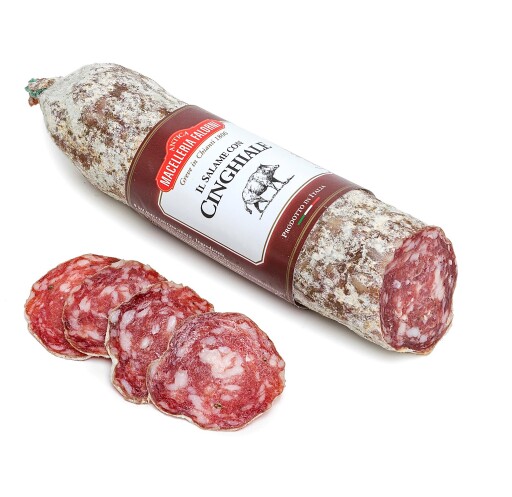
Austria – Salame con cinghiale, salami with wild boar, approx. 350g – STEC E.coli

AGES

AGES informs about a recall of the company Interfood Lebensmittelgrosshandel Ges.mbH. The company recalled the product Salame con cinghiale, salami with wild boar, approx. 350g on November 28th, 2022:
© APA/Jody Mattioli
recall reason
Possible contamination with verotoxin-producing E.coli (EHEC)
Marketed by
Interfood food wholesale Ges.mbH
Manufacturer
Antica Macelleria Falorni srl
Expiry Date
02/13/2023
Batch number
22259

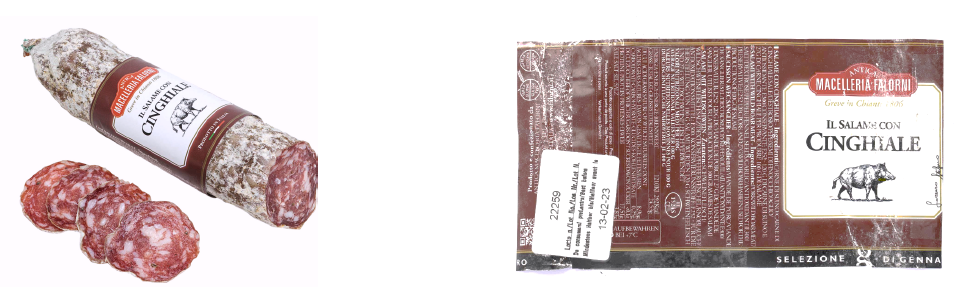
Interfood Lebensmittelgrosshandel is recalling the following product for reasons of consumer protection: “Salame con cinghiale, salami with wild boar, approx. 350g” with a best-before date (MHD) of February 13, 2023 and batch number 22259.

The batch number is on the back of the banderole, the best before date on the side. The producer of the product is “Antica Macelleria Falorni srl, Piazza G. Matteotti 71, IT-50022 Greve in Chianti (IT)”.

The affected product with the batch mentioned should no longer be consumed, as it could possibly be contaminated with verotoxin-forming E. coli (EHEC) .

The symptoms of a possible illness with EHEC can be watery diarrhea or nausea, vomiting and/or abdominal pain, in rare cases also fever and bloody diarrhea. The incubation period after consumption is usually one to three days, rarely up to ten days. Babies and children up to preschool age are more likely to become ill. This group, as well as older people or people with a weak immune system, are particularly at risk of developing severe courses and complications (up to and including acute kidney failure).

If consumers experience the symptoms mentioned, they should consult a doctor immediately and the suspicion of EHEC should be pointed out.

Consumers can return the affected batch of this product to the respective points of sale.

Other batches of the same product and other products from the manufacturer are not affected by this recall. This warning does not mean that the hazard was caused by Interfood.

Questions & contact:

Interfood Lebensmittelgrosshandel GmbH
Tel.: 05223 / 56808
Email: office@interfood.at

original recall

Germany – Salami with Wild Boar – STEC E.coli

LMW

Alert type: Food
Date of first publication: 11/25/2022
Product name:

Salame con cinghiale, salami with wild boar, approx. 350 g

Product images:

Unnamed.PNG

recall/press release

Manufacturer (distributor):

Manufacturer: Anitca Macelleria Falorni srl, Piazza G. Matteotti 71, IT-50022 Greve in Chianti (IT) Distributor: Di Gennaro Feinkost- und Weinhandelsgesellschaft mbH

Reason for warning:

The affected product with the batch mentioned should no longer be consumed, as it could possibly be contaminated with verotoxin-forming E. coli (EHEC).

Packaging Unit: 350g
Durability: 02/13/2023
Lot identification: 22259
Further information:

Reference is made to the attached press release from the food company.

Click to access Produktru%08ckruf_Falorni_final.pdf

Research – Raw-milk cheeses: What are the associated health risks and what preventive measures can be taken?

ANSES

Salmonella, enterohaemorrhagic E. coli, Listeria monocytogenes – a wide range of bacteria can be found in the raw-milk cheeses and other raw-milk dairy products we consume. These are sometimes involved in cases of food poisoning, leading them to be recalled or withdrawn from the market. In order to further improve the control of these risks, ANSES has identified the types of raw-milk cheeses on which efforts should focus as a priority.

ANSES received a request from the Directorate General for Food to identify and classify the main bacterial hazards associated with the various types of raw-milk cheeses and other dairy products made from raw milk. The aim was also to assess the main sources of contamination and the means implemented to control the associated risks.

The main microbiological hazards in raw-milk cheeses and dairy products

In France over the last decade, 34%, 37% and 60% of outbreaks of salmonellosis, listeriosis and enterohaemorrhagic E. coli (EHEC) infections respectively have been linked to the consumption of raw-milk cheeses. While some bacteria can cause gastroenteritis symptoms (Salmonella spp. and Staphylococcus aureus), others can have much more serious consequences such as kidney failure (EHEC) or even death (L. monocytogenes, EHEC).

The main sources of these hazards are soft cheeses with a surface mould (such as Camembert, Brie and Crottin) and short-ripened uncooked pressed cheeses (such as Morbier, Reblochon and Saint-Nectaire). Next come soft washed-rind cheeses such as Munster and Maroilles.

Continue efforts to prevent microbiological risks, from farm to consumer

The means implemented to control microbiological risks in the main dairy sectors (cattle, sheep, goats), from the rearing stage to the consumption stage, were studied by the Agency. It concluded that:

At farm level, good animal husbandry and hygiene practices are well known in the various sectors. The efforts already well under way in terms of hygiene during milking and the management of mastitis should be continued;
At the production stage, levels of risk control are also very high; the Agency recommends continuing to implement good hygiene practices and to carry out self-checks in order to best anticipate any risk of an outbreak;
At consumer level, in order to avoid a foodborne infectious disease, it is essential to comply with the information on the packaging or that given by the seller concerning the temperature at which the cheese should be stored in the refrigerator and its use-by date. Lastly, ANSES reiterates its recommendation that pregnant women, immunocompromised individuals, people over the age of 65 and young children should avoid consuming raw-milk cheeses, with the exception of hard pressed cheeses such as Gruyère and Comté.

“For several years now, we have been seeing a strong commitment on the part of the various raw-milk cheese sectors to preventing microbiological risks. Thanks to the actions taken, levels of hygiene and risk control are now very high on farms. The self-checks implemented at the processing stage are able to identify a large number of problematic batches. However, there is still a residual risk and it is important to identify new ways of optimising the current control measures. For example, this could involve improving epidemiological investigations, identifying poor hygiene practices at an earlier stage, or communicating more with consumers”, explains Laurent Guillier, who coordinated ANSES’s expert appraisal.

Did you know?

Contrary to popular belief, removing the rind from a raw-milk cheese is not enough to protect yourself against bacteria, as these can be found everywhere in the cheese.

On the other hand, when raw-milk cheeses are well cooked, as in an oven-baked recipe, they no longer pose a health risk.

A new forthcoming expert appraisal
This work to classify raw-milk cheeses was a first step in responding to the formal request. The expert appraisal work is continuing, to evaluate the effectiveness of the various health measures such as the sorting of milk at farm level and self-checks at the production stage. The next step will be to identify priority work areas for further reducing microbiological risks.

Click to access BIORISK2019SA0033.pdf