Category Archives: E.coli

Greece – Evidence for waterborne origin of an extended mixed gastroenteritis outbreak in a town in Northern Greece, 2019

Cambridge Core

We investigated a large gastroenteritis outbreak that occurred in Northern Greece in 2019. A case was defined as anyone presenting with diarrhoea and/or vomiting from 24/01/2019 to 04/02/2019. We conducted a case-control study (CCS) using random selection of participants >16 years of age, residents of town X, who visited the health care centre between 25-28/01/2019.

Moreover, we conducted a retrospective cohort study (CS) at the four elementary schools of the town. We collected clinical and water samples and the water supply system was inspected. In total, we recorded 638 cases (53% female; median age was 44 years (range 0-93)). Forty-eight cases and 52 controls participated in the CCS and 236 students in the CS. Both CCS and CS indicated tap water as the most likely source (OR=10, 95% CI, 2.09-93.4, explaining 95.7% of cases; RR= 2.22, 95% CI, 1.42-3.46, respectively).

More than one pathogen were detected from stool samples of 6 of the 11 cases tested (norovirus, Campylobacter jejuni, EHEC and EPEC). Water samples, collected after ad-hoc chlorination, tested negative. Technical failures of the water tanks’ status were identified. Our results suggested a waterborne outbreak. We recommended regular monitoring of the water supply system and immediate repair of technical failures.

USA – FSIS tells us that Greater Omaha Packing Co (GOPAC) shipped E. coli tainted hamburger

Food Poison Journal

The U.S. Department of Agriculture’s Food Safety and Inspection Service (FSIS) is issuing a public health alert because raw beef product produced by Greater Omaha Packing Co. Inc., an Omaha, Neb. establishment, may be contaminated with E. coli. O157:H7. A recall was not requested because the affected product is no longer available for purchase.

FSIS is concerned that some ground beef products may be in consumers’ refrigerators or freezers. Consumers who have purchased these products should not consume them. These products should be thrown away or returned to the place of purchase.

The raw beef item was produced by Greater Omaha Packing Co. Inc. on January 14, 2021, further processed into ground beef and sold by Art’s Food Market located in Sandwich, Illinois. The following product is subject to the public health alert:

2-lb (approximately) trays containing raw ground beef labeled with a retail label with “PACKED” dates ranging from JAN 28 2021 through JAN 31 2021.
This item was sold by the single retail location in Sandwich, Illinois.

USA – Washington, Oklahoma, Arkansas, Virginia and New York linked to mystery E. coli Outbreak

Food Poison Journal

5 states, 16 sick with 1 death. Whole genome sequencing (WGS) shows cases are likely related to same food.  Previous outbreak with same WGS linked to romaine lettuce, ground beef, and recreational water. 

CDC, public health and regulatory officials in several states, the U.S. Food and Drug Administration (FDA), and the U.S. Department of Agriculture’s Food Safety and Inspection Service (USDA-FSIS) are collecting different types of data to identify the food source of a multistate outbreak of E. coli O157:H7 infections.

As of February 1, 2021, a total of 16 people infected with the outbreak strain have been reported from 5 states. This map shows where sick people live.

State and local public health officials are interviewing people to find out what foods they ate in the week before they got sick.

Research – Microbial load and Prevalence of Escherichia coli, and Salmonella spp. in Macadamia Nut Production Systems

Journal of Food Protection

This study evaluated the potential impact of environmental factors and harvesting practices on microbial load of macadamia nuts. Three farms located in the main macadamia nut production regions including Mbombela (A), Barberton (B) and White River (C) areas in Mpumalanga Province, South Africa were sampled over a ,rtwo-year period. A total of 264, irrigation water (54), soil (30) and macadamia nut (180) samples were collected and evaluated for microbial concentrations. All water samples had mean E. coli counts below 1000 CFU/100ml which is the standard regulatory requirement for agricultural water considered fit-for-purpose for irrigation of nut trees in south Africa. Mean total aerobic plate counts of on-tree nut-in-husk samples (3.91 log CFU/g; n=60) increased after harvesting (5.98 log CFU/g; n=60) but decreased with dehusking to 4.89 log CFU/g (n=60) on nut-in-shell. Salmonella spp. were only detected in water samples from two farm B (67 %; n=18) and C(15 %; n=18). However, neither Listeria monocytogenes nor Salmonella spp. were detected in any of the soil samples. Escherichia coli were only detected in 20 % (n=10) of soil samples collected from two farms (A and B). None of the E. coli isolated in this study were positive for the eae, stx 1, and stx 2, enterohaemorrhagic E. coli (EHEC), virulence genes. Information from this study provides basic data that can be used in the development of macadamia nut specific hazard assessment tools within primary production environments.

Research – Control of Salmonella and Pathogenic E. coli Contamination of Animal Feed Using Alternatives to Formaldehyde-Based Treatments

MDPI

kswfoodworld salmonella

This study compared a novel non-formaldehyde combination product developed for pathogen control in animal feed Finio (A), with a panel of three commonly used organic acid feed additive products: Fysal (B), SalCURB K2 (C) and Salgard (D). Products were evaluated for their ability to reduce Salmonella Typhimurium DT104 and avian pathogenic Escherichia coli in poultry feed. A commercial layer-hen mash was treated with each product and then mixed with feed previously contaminated (via inoculated meat and bone meal) with either Salmonella or E. coli. After 24 hours at room temperature, 10 replicate samples were taken from each preparation and plate counts were performed using a selective agar. All concentrations of product A (0.5, 1.0, 1.5, 2.0 and 2.5 kg per metric tonne (MT)) plus the higher concentration of products B and D (6.0 kg MT−1) significantly reduced Salmonella counts compared with those in the untreated control group (< 0.05). Product C did not significantly reduce levels of Salmonella under these conditions. Because of the poor recovery of E. coli, statistical comparisons for this organism were limited in scope, but only product A at the highest concentration appeared to have eliminated it.

USA – FDA CORE Response Team Update

FDA

core

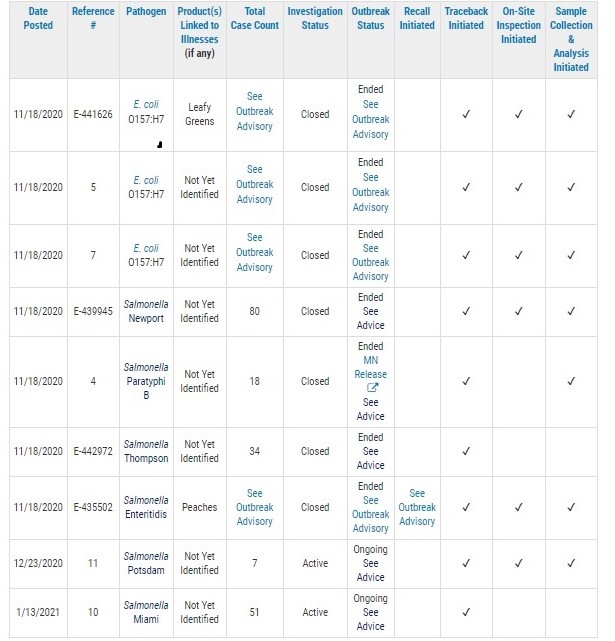
USA – Outbreak Investigation of E. coli – Leafy Greens (December 2020)

FDA

Total Illnesses: 40
Hospitalizations: 20 (4 Cases HUS)
Deaths: 0

The FDA, along with CDC and state and local partners, investigated a multistate outbreak of E. coli O157:H7 infections in the fall of 2020. The epidemiology and traceback investigation have determined that the outbreak was linked to leafy greens. The epidemiological and traceback investigations were not able to determine a specific type of leafy green linked to illnesses. On 12/22/2020, the CDC announced that this outbreak appears to be over. This outbreak, announced by FDA and CDC on October 28, 2020, was caused by a strain of E. coli that is genetically related to a strain linked to the fall 2019 romaine outbreak.

The FDA completed a traceback investigation of multiple types of leafy greens identified in patient interviews. Although no single ranch was identified as a common source of the leafy greens, FDA and state partners also conducted on-site investigations on farms of interest.

Teams were deployed to dozens of ranches in the region to conduct large scale environmental sampling. Additionally, no Shiga toxin-producing E. coli were found on leafy greens. As part of the field investigation, teams conducted environmental sampling on and around ranches of interest to identify any factors that could have led to contamination. Samples of soil, scat or animal droppings, compost, water, and other environmental sources were collected and analyzed.

Laboratory analysis of samples is now complete. The analysis has confirmed a positive match to the outbreak strain in a sample of cattle feces, which was collected during follow-up investigations on a roadside, uphill from where leafy greens or other food identified in the traceback investigation were grown. While the finding does not provide definitive information on how E. coli may have contaminated product during the growing and harvesting season, it does confirm the presence of a strain of E. coli O157:H7 that causes recurring outbreaks in a more narrowly defined growing region and a potential, continued source of contamination.

At this time, FDA’s investigational activities have concluded. The FDA continues to review the findings from this outbreak and a detailed report will be released in the near future. This report will include recommendations shaped by the investigation findings.

In the meantime, as recommended in our Leafy Greens Action Plan, the FDA continues to recommend growers assess and mitigate risk associated with adjacent and nearby land use practices, particularly as it relates to the presence of livestock, which are a persistent reservoir of E. coli O157:H7 and other STEC.

Recommendation

CDC has declared this outbreak to be over. There is no recommendation for consumers, retailers, or suppliers.

Korea – 3 officials from McDonald’s supplier get suspended sentences for selling tainted patties – E.coli

Korea Herald

Ecoli Istock

Three officials from a burger patty supplier for McDonald’s Korea were given suspended prison sentences by a local court Tuesday for providing patties potentially contaminated with E. coli to the local unit of the global fast-food giant.

A managing director of the supplier, whose name was withheld, and two mid-ranking officials in charge of production and quality management, respectively, were indicted without detention in 2018 for allegedly distributing 63 tons of beef patties that tested positive for intestinal hemorrhagic E. coli contamination.

In addition, they were charged with selling 2,160 tons of beef patties with Shiga toxin genes detected in a PCR (polymerase chain reaction) test, a test method that amplifies DNA. Shiga toxin is a toxin component released from intestinal hemorrhagic E. coli.

The Seoul Central District Court convicted all three for violating the Livestock Products Sanitary Control Act but handed out suspended jail terms ranging from two to three years.

Research – Bacteria Broadly-Resistant to Last Resort Antibiotics Detected in Commercial Chicken Farms

MDPI

Resistance to last resort antibiotics in bacteria is an emerging threat to human and animal health. It is important to identify the source of these antimicrobial resistant (AMR) bacteria that are resistant to clinically important antibiotics and evaluate their potential transfer among bacteria. The objectives of this study were to (i) detect bacteria resistant to colistin, carbapenems, and β-lactams in commercial poultry farms, (ii) characterize phylogenetic and virulence markers of E. coli isolates to potentiate virulence risk, and (iii) assess potential transfer of AMR from these isolates via conjugation. Ceca contents from laying hens from conventional cage (CC) and cage-free (CF) farms at three maturity stages were randomly sampled and screened for extended-spectrum β-lactamase (ESBL)-producing Enterobacteriaceae, carbapenem-resistant Acinetobacter (CRA), and colistin resistant Escherichia coli (CRE) using CHROMagar™ selective media. We found a wide-spread abundance of CRE in both CC and CF hens across all three maturity stages. Extraintestinal pathogenic Escherichia coli phylogenetic groups B2 and D, as well as plasmidic virulence markers iss and iutA, were widely associated with AMR E. coli isolates. ESBL-producing Enterobacteriaceae were uniquely detected in the early lay period of both CC and CF, while multidrug resistant (MDR) Acinetobacter were found in peak and late lay periods of both CC and CF. CRA was detected in CF hens only. blaCMY was detected in ESBL-producing E. coli in CC and CF and MDR Acinetobacter spp. in CC. Finally, the blaCMY was shown to be transferrable via an IncK/B plasmid in CC. The presence of MDR to the last-resort antibiotics that are transferable between bacteria in food-producing animals is alarming and warrants studies to develop strategies for their mitigation in the environment. View Full-Text

RASFF Alert – E.coli – Raw Milk Sheeps Cheese

European Food Alerts

RASFF

high count of Escherichia coli (1300000 CFU/g) in raw milk sheep’s cheese from Portugal in France