Category Archives: Contaminated water

RASFF Alert – Illness from Drinking Water

RASFF

45 people sick due to drinking water Chateau in Sint Hubert – Belgium and Netherlands

Italy – Oligomineral Natural Mineral Water 1.5 lt – Staphylococcus aureus

Salute

Brand : Fonte Valle Reale

Name : Oligomineral Natural Mineral Water 1.5 lt

Reason for reporting : Recall due to microbiological risk

Publication date : 2 August 2022

Documentation

Documentation

Research – Dangerous pathogens lurk in wet areas

Science Daily

Hospitals and homes are havens for germs and disease — but a well-regulated hot water system can prevent the spread of waterborne pathogens, including an emerging infectious disease problem from ‘superbugs’ which can be resistant to most antibiotics.

However, Flinders University experts warn that some drinking water treatment methods may be ineffective against some waterborne pathogens that pose a threat to immune-compromised individuals — and point-of-use devices such as taps and showerheads may create havens for these microorganisms to grow.

The elderly, newborns and those with compromised immune systems are especially vulnerable to waterborne infections. Numbers are rising of people with conditions such as advanced age, cancer and immunodeficiency issues who may be more at risk of ‘opportunistic premise plumbing pathogens’ (OPPP) infection.

Regular changes to tap and outlet filters, hot water service maintenance checks (for heat and pressure) and effective cleaning of shower and tap faucets are recommended for immune-compromised patients receiving healthcare at home or post-surgical management.

Healthcare at home has emerged as an alternative to extensive inpatient hospital stays — especially through the COVID-19 pandemic, to reduce the burden on the healthcare system and to support those with potential long term respiratory side effects.

“These measures can help reduce the risk of waterborne infections in home care, along with quality treatments of mains water to provide safe drinking water,” says lead researcher Claire Hayward, from Flinders University’s College of Science and Engineering.

A new study published in the journal Current Opinion in Infectious Diseases, by environmental health experts at Flinders University, found evidence of hospital water as a source of potential infection and even antimicrobial and multidrug resistant organisms.

“Biofilms formed on taps, showers, drains and other outlets provide an ideal niche to harbour these dangerous antibiotic resistant pathogens originating from the supply water or the human microbiota from washing contaminated hands,” says Ms Hayward.

OPPP infections such as Legionella pneumophila, Pseudomonas aeruginosa and Mycobacterium avium are a group of waterborne pathogens that are slowly receiving increased public health attention in infection control guidelines.

“However, drinking water as a source of healthcare-associated infections continues to be overlooked or underestimated in this monitoring,” Ms Hayward says.

The OPPP waterborne pathogens can be disinfectant resistant and persist in refuges with low nutrients, then form biofilms capable of supporting other clinically relevant pathogens such as Staphylococcus aureus, Enterobacteriaceae, Klebsiella pneumoniae and Escherichia coli.  

Once these biofilms are established on plumbing surfaces, there are many ways for contamination and transmission. The design of outlet devices that result in splashing and aerosolising of water can also increase the risk of contaminating nearby areas.

“The rise of these resistant pathogens has been identified by the World Health Organization and US Centers for Disease Control and Prevention as one of the most significant threats to global public health,” says research co-author, Flinders University microbiology expert Professor Melissa Brown.

“While the COVID-19 pandemic has increased the use of disinfectants and sanitisers, particularly in healthcare facilities, these antiseptic soaps do not tackle what’s going on behind the scenes in the water supply pipes and faucets,” she says.

The researchers recommend broad, universal surveillance guidelines to understand the role of drinking water and water-related devices to reduce healthcare associated infections and the rise of possible antimicrobial resistance that poses a threat to at risk individuals in residential and healthcare settings.

Research – Marine Harmful Algal Bloom (HAB)-Related Illness Tracking

OEHHA

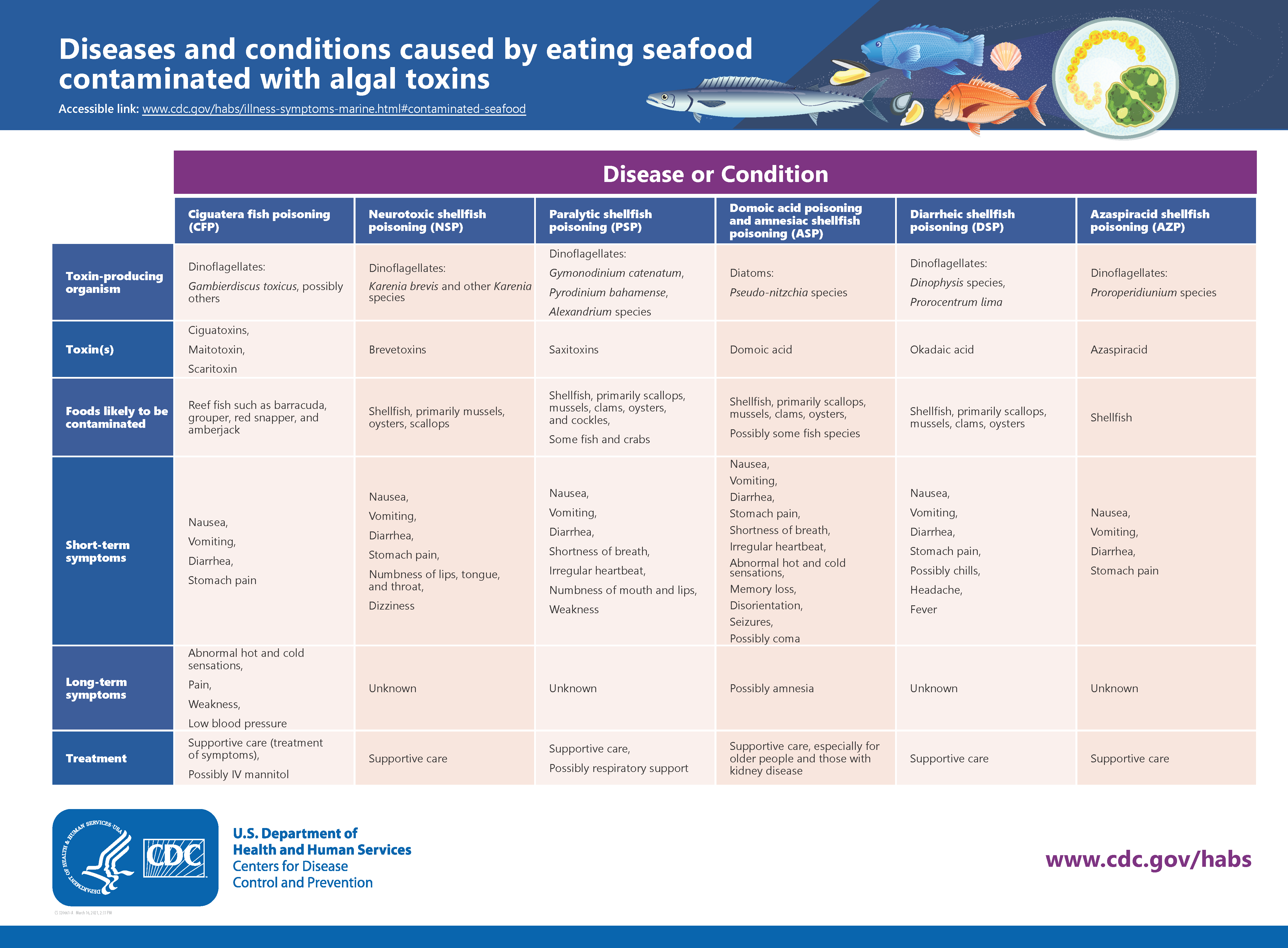
Diseases and conditions caused by eating seafood contaminated with algal toxins

What are marine harmful algal bloom (HAB)-related illnesses?

When phytoplankton and algae in marine waters occur at levels that pose a health risk to humans, animals, and the environment, they are referred to as marine harmful algal blooms (HABs). The US Centers for Disease Control and Prevention (CDC) provide resources on potential human and animal exposures to marine HABs or associated marine biotoxins via skin contact or inhalation, or consumption of fish and shellfish.

Research – Epidemiological and microbiological investigation of a large increase in vibriosis, northern Europe, 2018

Eurosurveillance

Food Illness

The habitat of  spp. bacteria is fresh and brackish water with moderate salinity. Non-toxigenic , as well as several human pathogenic non-cholera  species, including  and , cause vibriosis after seawater exposure or consumption of contaminated seafood [1]. Clinical manifestations range from mild gastroenteritis and otitis to wound infections that may lead to severe necrotising fasciitis and septicaemia with a potentially fatal outcome [25].

The Baltic Sea region is one of the areas where increasing numbers of cases related to  species causing vibriosis (VCV) have been reported in the last decades [6]. Several studies have shown how the occurrence of heatwaves, which lead to an increase in sea surface temperature, are linked with an increase in the number of reported vibriosis cases [4,712]. For instance, the years with an especially warm summer in the Baltic Sea region, 2006, 2010 and particularly 2014 (the warmest year in historical records at the time), were also the years with the largest number of vibriosis cases reported [6,11].

However, there is a notable gap in surveillance data for vibriosis since it is not a notifiable disease in the majority of European countries [1,6]. Therefore, the aim of this multi-country study was to describe the epidemiology of vibriosis cases in countries bordering the North and Baltic Seas area during the exceptionally warm year of 2018 [13,14], in order to investigate the extent of these infections in the study countries, map their genetic diversity, understand the predictors for developing severe vibriosis, and propose recommendations for public health measures.

Austria – S-BUDGET ASTORIA Natural still mineral water in a 1.5 liter non-returnable bottle – Coliforms

AGES

AGES informs about a recall of the company SPAR. On July 4th, 2022, the company recalled the product S-BUDGET ASTORIA still natural mineral water in the 1.5 liter non-returnable bottle:
recall reason
coliform bacteria
Marketed by
SAVE
Manufacturer
SPAR S BUDGET
Expiry Date
06/01/2023

As a precaution, SPAR is recalling S-BUDGET ASTORIA natural mineral water still in the 1.5 liter non-returnable bottle

Salzburg (OTS) – SPAR continuously controls the products of the SPAR brands to ensure the highest quality. During a routine quality control, the product “S-BUDGET ASTORIA natural mineral water still in the 1.5 liter disposable bottle” with best-before dates (MHD) 05/31/2023 and 06/01/2023 was found to contain a small amount of coliform bacteria that is greater than the permissible limit established. For this reason, SPAR is recalling the product with the above best before dates.

Customers are asked not to drink the “S-BUDGET ASTORIA natural mineral water still in the 1.5 liter disposable bottle”. All other S-BUDGET products or mineral water from other SPAR brands are not affected by this recall.

All customers who have already bought one of the products that may be affected can of course return it to the nearest SPAR, EUROSPAR or INTERSPAR store or Maximarkt. Customers are reimbursed the purchase price even without proof of purchase.

Customers who have questions about this are welcome to contact customer service at office@spar.at or call the freephone number 0800 / 22 11 20 .

Research – Quantitative Risk Assessment of Vibrio parahaemolyticus in Shellfish from Retail to Consumption in Coastal City of East China 

Journal of Food Protection

Food Illness

Vibrio parahaemolyticus is the main foodborne pathogen of acute gastroenteritis in the world. A quantitative microbiological risk assessment (QMRA) was conducted to evaluate the health risk caused by V. parahaemolyticus in shellfish in the costal cities of east China. The QMRA framework was established from shellfish at retail through cooking at home to consumption. The prevalence and concentration of V. parahaemolyticus in shellfish, cooking methods, storage temperature and time after purchase, shellfish consumption frequency and consumption amount were analyzed in the exposure assessment. The results of the exposure assessment were introduced into the Beta-Poisson dose response model, and Monte Carlo analysis was used to calculate the risk of gastroenteritis caused by shellfish consumption. The results showed that the probability of illness caused by V. parahaemolyticus due to shellfish consumption per person per year (Pill,yr) was 3.49E-05. There were seasonal differences in the Pill/meal, the maximum Pill/meal was 4.81E-06 in summer, and the minimum Pill/meal was 2.27E-07 in winter. The sensitivity analysis showed that the concentration of V. parahaemolyticus in shellfish and the consumption per meal were main factors contributing to the illness. This QMRA provided valuable information such as the probability of illness associated with the consumption of shellfish and it also provided references for prevention strategies and control standards of V. parahaemolyticus in shellfish.

Nepal – Nepalese cholera outbreak: Kathmandu bans Panipuri

World Akkam

Kathmandu, June 26: Kathmandu, the capital of Nepal, is currently facing another outbreak of cholera. As of Sunday, at least 12 people have been infected with the disease, and authorities are struggling to contain the outbreak.

Cases of cholera have been found in several parts of the city, and health authorities have not yet identified the source. It was found that the water sources in many areas contained Vibrio cholerae.

Meanwhile, Kathmandu’s affiliated city, Lalitpur, has banned the sale of Panipuri and chat from Sunday for fear of cholera.

Lalitpur Metropolitan City (LMC) has decided to stop selling and distributing Panipuri and Chatpate in big cities from Saturday. LMC has banned the sale of Panipuri and Chapati, claiming that Vibrio cholerae was found in the water used in Panipuri.

Ireland – Potentially dangerous parasite in County Limerick water supply – Cryptosporidium

Limerick Post

DRINKING water supplies in Foynes have come under the microscope with the ongoing detection of a parasite that could pose a threat to human health.

Cryptosporidium, a parasite found in human and animal faeces, has been detected in the Foynes/Shannon Estuary water treatment plant this year.

The Environmental Protection Agency said it was “very concerned” after it conducted an audit which detected two breaches of recommended limits of cryptosporidium at the plant on February 23 and April 13.

The EPA said that it was most likely due to “a deterioration in raw water quality combined with significant deficiencies and pressures on the treatment processes at the plant”.

The environmental watchdog said the incident was suitably escalated and managed to protect the health of the population of over 7,200 in the Foynes area who use the water supply.

USA – Several people sickened by bacterial outbreak in Sanders County – Campylobacter

KPAX

The source of a bacterial outbreak in Sanders County that caused several people to become ill has been confirmed.

State and county officials recently notified the Montana Department of Transportation (MDT) that the Kennedy Creek water box has been associated with a Campylobacter outbreak.

The Montana Department of Environmental Quality (DEQ) has labelled this untreated water as a health concern and advised MDT to close off public access to the water.

After Sanders County Public Health officials confirmed several cases of infection from Campylobacter bacteria, the water from the untreated creek was tested and the presence of this bacteria was confirmed, according to MDT.

Over 20 people have tested positive for the bacterial infection and have reported diarrhea, abdominal pain, nausea, and fever after drinking water from the location.