Category Archives: bacterial contamination

Canada – Updated Food Recall Warning – Fresh Attitude brand Baby Spinach recalled due to Salmonella

CFIA

Recall details

Ottawa, November 27, 2020 – The food recall warning issued on November 26, 2020 has been updated to include additional distribution information. This additional information was identified during the Canadian Food Inspection Agency’s (CFIA) food safety investigation.

Vegpro International is recalling Fresh Attitude brand Baby Spinach from the marketplace due to possible Salmonella contamination. Consumers should not consume the recalled products described below.

Recalled products

Brand Product Size UPC Codes
Fresh Attitude Baby Spinach 312 g 8 88048 00028 8 Best Before 2020 DE 04
Fresh Attitude Baby Spinach 142 g 8 88048 00004 2 Best Before 2020 DE 04
Best Before 2020 DE 05

What you should do

If you think you became sick from consuming a recalled product, call your doctor.

Check to see if you have the recalled products in your home. Recalled products should be thrown out or returned to the store where they were purchased.

Food contaminated with Salmonella may not look or smell spoiled but can still make you sick. Young children, pregnant women, the elderly and people with weakened immune systems may contract serious and sometimes deadly infections. Healthy people may experience short-term symptoms such as fever, headache, vomiting, nausea, abdominal cramps and diarrhea. Long-term complications may include severe arthritis.

Background

This recall was triggered by the company. The CFIA is conducting a food safety investigation, which may lead to the recall of other products. If other high-risk products are recalled, the CFIA will notify the public through updated Food Recall Warnings.

The CFIA is verifying that industry is removing the recalled products from the marketplace.

Illnesses

There have been no reported illnesses associated with the consumption of these products.

Product photos

Printer ready version of photos

  • Fresh Attitude - Baby Spinach: 312 g
  • Fresh Attitude - Baby Spinach: 142 g
  • Fresh Attitude - Baby Spinach: 142 g

Public enquiries and media

Company information
Vegpro International: Customer Service 1-877-613-5700
Public enquiries
Toll-free: 1-800-442-2342 (Canada and U.S.)
Telephone: 1-613-773-2342 (local or international)
Email: cfia.enquiries-demandederenseignements.acia@canada.ca
Media relations
Telephone: 613-773-6600
Email: cfia.media.acia@canada.ca
Research – Attributing Human Foodborne Diseases to Food Sources and Water in Japan Using Analysis of Outbreak Surveillance Data

Journal of Food Protection

ABSTRACT

In Japan, strategies for ensuring food safety have been developed without reliable scientific evidence on the relationship between foodborne diseases and food sources. This study aimed to provide information on the proportions of foodborne diseases caused by seven major causative pathogens (Campylobacter spp., Salmonella, enterohemorrhagic Escherichia coli [EHEC], Vibrio parahaemolyticus, Clostridium perfringens, Staphylococcus aureus, and norovirus) attributed to foods and to explore factors affecting changes in these source attribution proportions over time using analysis of outbreak surveillance data. For the calculation of the number of outbreaks attributed to each source, simple-food outbreaks were assigned to the single-food category in question, and complex-food outbreaks were classified under each category proportional to the estimated probability. During 2007 to 2018, 8,730 outbreaks of foodborne diseases caused by seven pathogens were reported, of which 6,690 (76.6%) were of unknown source. We estimated the following source attribution proportions of foodborne diseases: chicken products (80.3%, 95% uncertainty interval [UI] 80.1 to 80.4) for Campylobacter spp.; beef products (50.1%, UI 47.0 to 51.5) and vegetables (42.3%, UI 40.9 to 45.5) for EHEC; eggs (34.6%, UI 27.8 to 41.4) and vegetables (34.4%, UI 27.8 to 40.8) for Salmonella; finfish (50.3%, UI 33.3 to 66.7) and shellfish (49.7%, UI 33.3 to 66.7) for V. parahaemolyticus; grains and beans (57.8%, UI 49.7 to 64.9) for S. aureus; vegetables (63.6%, UI 48.5 to 74.6), chicken products (12.7%, UI 4.6 to 21.5), and beef products (11.1%, UI 8.5 to 13.1) for C. perfringens; and shellfish (75.5%, UI 74.7 to 76.2) for norovirus. In this study, we provide the best available evidence-based information to evaluate the link between foodborne diseases and foods. Our results on source attribution for Campylobacter spp. and EHEC suggest that the strict health regulations for raw beef were reflected in the proportions of these diseases attributed to this food.

HIGHLIGHTS
  • Source attribution proportions of foodborne diseases in Japan were estimated.
  • Source attribution was useful to guide interventions and evaluate their effect.
  • Strict health regulations for raw beef affected source attribution proportions.

Research – Quantification of cross-contamination of Campylobacter jejuni during food preparation in a model kitchen in China

Journal of Food Protection

campy2

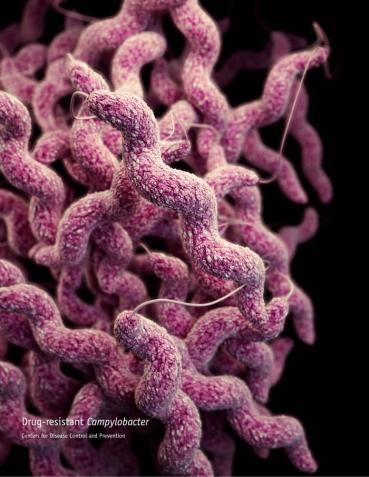
Image CDC

Numerous outbreak investigations and case-control studies of campylobacteriosis have provided evidence that handling Campylobacter -contaminated chicken products is a high risk factor for infection and illness. In this study, the cross-contamination and transfer rates of Campylobacter jejuni from chicken to ready-to-eat foods were determined in various food-handling scenarios. Skinless raw chicken breasts were artificially contaminated with Campylobacter jejuni and diced on three kinds of texture cutting boards. Whether cold water or cold water with detergent or hot water was used, statistically significant differences were found between the transfer rate of Campylobacter jejuni to unwashed and washed cutting boards or hands, respectively. When both kitchen knife and cutting board were reused after dicing the artificially contaminated chicken, the transfer rates of Campylobacter jejuni to cucumber cut on bamboo, wooden and plastic cutting board were 16.28%, 12.82% and 5.32%, respectively. The transfer rates from chicken to bread, a large lift-up water faucet handle and a small twist faucet handle via unwashed hands were 0.49%, 4.64% and 3.14%, respectively. This research provides scientific evidence that various types of contaminated kitchen-ware and cook’s hand are vital potential vehicles for the cross-contamination of Campylobacter from raw chicken to ready-to-eat food, and emphasizes the importance of timely and properly cleaning to prevent cross-contamination during food handling, therefore a high quality consumer education to reduce the risk of foodborne infection is urgent and necessary.

UK – Happy Hounds Wales Ltd recalls frozen raw dog food products because of the possible presence of Salmonella

FSA

Happy Hounds Wales Ltd is taking the precautionary step of recalling a number of raw dog food products because they may contain salmonella.

Product details

Frozen Beef Kidney
Pack size 1kg
Batch code 962
Best before 26 October 2021
Frozen Whole Heart
Pack size Individual Item
Batch code 962
Best before 26 October 2021
Frozen Chicken and Beef Sleeve
Pack size 1kg
Batch code 1344/962
Best before 2 November 2021
Frozen Lamb and Beef Sleeve
Pack size 1kg
Batch code 962-966
Best before 4 November 2021
Frozen Diced Heart
Pack size 1.5kg
Batch code 962
Best before 26 October 2021

Risk statement

The products listed above may contain salmonella. Salmonella is a bacterium that can cause illness in humans and animals. The product could therefore carry a potential risk because of the presence of salmonella, either through direct handling of the pet food, or indirectly, for example from pet feeding bowls, utensils or contact with the faeces of animals.

In humans, symptoms caused by salmonella usually include fever, diarrhoea and

abdominal cramps. Infected animals may not necessarily display signs of illness, but

symptoms can include diarrhoea.

Action taken by the company

Happy Hounds Wales Ltd is recalling the above products on a precautionary basis. Point of sale notices will be displayed in all retail stores that are selling these products. These notices explain to customers why the products are being recalled and tell them what to do if they have bought the product.

Our advice to consumers

(pet owners): If you have bought any of the above products do not use them. Instead, return them to the store from where they were bought for a full refund. When handling and serving raw pet food it is always advised to clean utensils and feeding bowls thoroughly after use. Consumers should wash hands thoroughly after handling raw pet food, bowls, utensils or after contact with the faeces of animals. Raw pet food should be stored separately from any food (especially ready to eat foods). Care should be taken when defrosting to avoid cross contamination of foods and surfaces.

France – Product recall: Large Japanese clam caught in the North-East Atlantic, MYTILIMER brand – E.coli

Oulah

Product recall: Large Japanese clam caught in the North-East Atlantic, MYTILIMER brand

ENCOUNTERED PROBLEM

Presence of Escherichia coli

PROPOSED SOLUTION

People who hold the product in question are asked not to consume them – and more particularly young children, pregnant women, immunocompromised people and the elderly – and to return them to the point of sale where they were purchased.

People who have consumed it and who present symptoms such as diarrhea, abdominal pain or vomiting should consult their doctor as soon as possible, mentioning this consumption and the possible link with the bacterium Escherichia coli.

If there are no symptoms within 10 days of consuming the affected products, there is no need to worry and consult a doctor.

The E. coli bacterium is naturally present in the digestive microflora of humans and warm-blooded animals. Some strains of E. coli are pathogenic, and can be responsible in humans for various disorders ranging from mild diarrhea to more serious forms such as hemorrhagic diarrhea or severe kidney damage such as HUS, mainly in young children.

FURTHER INFORMATION

▸ Barcode
204619000004

▸ Lot
PSM0211

▸ Health
stamp FR 35.299.053 CE

▸ Consumer service contact
For more information, you can contact the Consumer Service on 09 69 36 69 36 (non-premium rate call).

▸ Source
https://www.coursesu.com/

New Zealand – Various Pak’n Save Blenheim brand sliced in-store ready-to-eat meat products – Listeria monocytogenes

MPI

27 November 2020: Pak’n Save Blenheim is recalling all batches and all packed on dates up to and including 26.11.20 of Pak’n Save Blenheim brand sliced in-store ready-to-eat meat products due to the possible presence of Listeria monocytogenes.

Expand All
Expand Expand to see images of the recalled products

Expand to see images of the recalled products
Product identification
Product type Ready to eat meat products
Name of product
  • Pak’n Save Blenheim brand Pestells Ham Off The Bone
  • Pak’n Save Blenheim brand Ham & Chicken – Farmlands
  • Pak’n Save Blenheim brand Polish Sausage – Hellers
  • Pak’n Save Blenheim brand Champagne Smoked Leg Ham – Premier
  • Pak’n Save Blenheim brand Hot Pork – Farmlands
  • Pak’n Save Blenheim brand Premier Honey Baked Ham
  • Pak’n Save Blenheim brand Manuka Smoked Ham Round – Huttons
  • Pak’n Save Blenheim brand Pastrami – Farmlands
  • Pak’n Save Blenheim brand Roast Beef – Farmlands
  • Pak’n Save Blenheim brand Corned Silverside – Farmlands
  • Pak’n Save Blenheim brand Farmlands Pork Brawn KG
  • Pak’n Save Blenheim brand Cooked Beef Tongue – Farmlands
  • Pak’n Save Blenheim brand Ham & Chicken Flavoured Luncheon – Huttons
  • Pak’n Save Blenheim brand Roast Beef Meal
Date marking All batches and all packed on dates up to and including 26.11.20
Package size and description The products are sold in vacuum packs and plastic containers of various weights.
Distribution The products are sold only at Pak’n Save Blenheim.
Notes This recall does not affect any other Pak’n Save Blenheim brand products. The contamination occurred at Pak’n Save Blenheim. Products from the manufacturers listed that are sold in their own packaging at Pak’n Save Blenheim or sold elsewhere are not affected by this issue.

Consumer advice

Customers are asked to check the date mark on the product label.

Affected products should not be consumed unless the product is cooked thoroughly (piping hot all the way through). There have been no reports of illness. However, if you have consumed any of these products and have any concerns about your health, seek medical advice.

Customers should return the products to Pak’n Save Blenheim for a full refund, or cook thoroughly (piping hot all the way through).

More information on listeria

Who to contact

If you have questions, contact Pak’n Save Blenheim:

  • Phone: 03 520 8275
  • Address: 1 Westwood Avenue, Springlands, Blenheim.

Sweden – Lidl Sweden is recalling Organic Flaxseeds, the Alesto brand – Salmonella

LMV

Lidl Sweden is recalling Organic Flaxseeds of the Alesto brand. After routine analyzes, it has been shown that the product may contain salmonella.

LIDL

Lidl Sweden is recalling Organic Flaxseeds from the Alesto brand, after routine analyzes it has been shown that the product may contain Salmonella.

Salmonella has been detected after a routine analysis. We would like to encourage all our customers who bought the product to come back to us with the product. The relevant best-before date 2021-07-08 has been sold in all of Lidl Sweden stores. Salmonella poses no risk if you have heated the food to at least 70 degrees. 

The recall only concerns the product:

Article: Organic Flaxseeds

Pack size: 500g

Brand: Alesto

Best-before date: 2021-07-08

Other best-before dates or other Alesto products are not affected. We at Lidl Sweden apologize and take what happened seriously. Consumers who have purchased the product are welcome to return it to the place of purchase, or to the nearest Lidl store. Of course, customers get their money back, even without presenting a cash receipt.

Facts Lidl’s quality checks
In addition to Lidl Sweden’s suppliers being certified with IFS (International Featured Standard), BRC (British Retail Consortium) or FSSC 22000 (Foundation Food Safety System Certification), Lidl Sweden performs regular unannounced on-site inspections at suppliers (performed by accredited institution). We go further than required by law and also test all products in external accredited laboratories to ensure that our products meet the highest quality.

Contacts

RASFF Alerts – Listeria monocytogenes – Chilled Chicken Legs- Brie Cheese – Goats Cheese

European Food Alerts

RASFF

Listeria monocytogenes (>15000 CFU/g) in chilled chicken legs from France in France

RASFF

Listeria monocytogenes (<10 CFU/g) in brie cheese from France in Denmark

RASFF

Listeria monocytogenes in goat’s cheese from France in Germany 

RASFF Alert – Mycotoxins -Fumonsins – Shelled Groundnuts

European Food Alerts

RASFF

fumonisins (B1 = 2.7 µg/kg – ppb) in shelled groundnuts from Argentina in the UK

RASFF Alert – STEC E.coli – Lamb Carcasses

European Food Alerts

RASFF

shigatoxin-producing Escherichia coli (stx+;eae+) in lamb carcasses from Belgium in Belgium