Category Archives: STEC

USA – Fullei Fresh Issues Correction on Alfalfa Sprout Recall Because of Possible Health Risk STEC E.coli

FDA

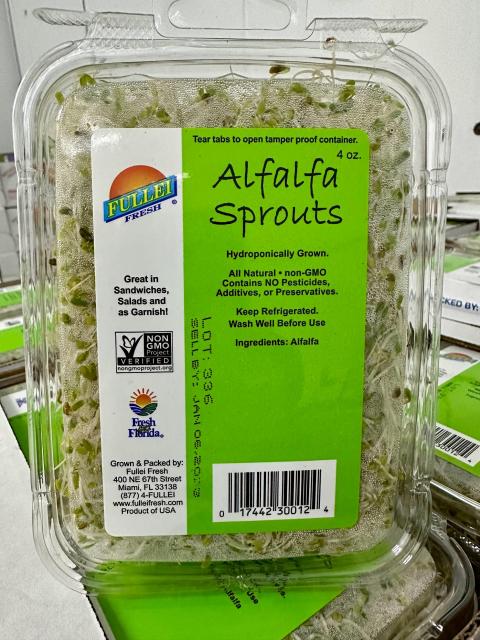
Alfalfa Sprouts Clamshell with Label

MIAMI, FL – Fullei Fresh is voluntarily recalling Alfalfa Sprouts due to the detection of Shiga toxin producing E.coli (STEC.) Shiga toxin producing E.coli is an organism that can cause foodborne illness in a person who eats a food item contaminated with it. Symptoms of infection may include stomach cramps, diarrhea, and vomiting. The illness primarily impacts elderly individuals, children, and people with weakened immune systems. Most healthy adults and children rarely become seriously ill.

STEC is a bacterial strain that is not part of our routine microbial testing conducted in compliance with the FDA’s Produce Safety Rule Subpart M on every lot we produce. It was detected upon sampling of finished product by the FDA.

There have been no known illnesses reported to date in connection with this product.

The affected Fullei Fresh brand alfalfa sprout lot number is 336. They were shipped to distributors and retailers in Florida between December 9-23, 2022. No other lots or products are affected.

The lot numbers are printed on the 8 ounce retail packs and on 5 lb. bulk cardboard boxes in the barcode (the last 3 digits being 336.) Pictures are attached.

Should you be in possession of these products, please discard.

This recall is being made with the knowledge of the Food and Drug Administration and the Florida Department of Agriculture.

If you require further information, please contact sales@fulleifresh.com or (305) 758-3880 Monday through Friday between 8:00 AM and 4:00PM EST.

Company Contact Information

Consumers:
 305-758-3880
 sales@fulleifresh.com

USA – Fullei Fresh Recalls Alfalfa Sprouts Because of Possible Health Risk – STEC E.coli –

FDA

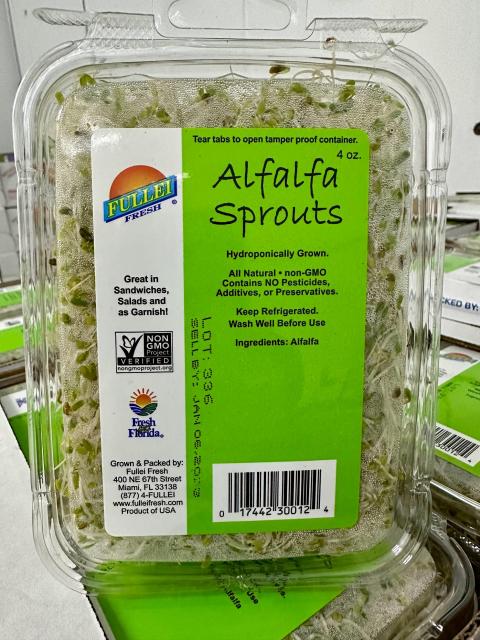
Alfalfa Sprouts Clamshell with Label

MIAMI, FL – Fullei Fresh is voluntarily recalling Alfalfa Sprouts due to the detection of Shiga toxin producing E.coli (STEC.) It is a strain of e.coli which is not part of their routine e.coli O157:H7 and salmonella testing which is normally conducted on every lot produced. There have been no known illnesses reported to date in connection with this product.

The affected Fullei Fresh brand alfalfa sprout lot number is 336. They were shipped to distributors and retailers in Florida between December 9-23, 2022. No other lots or products are affected.

The lot numbers are printed on the 8 ounce retail packs and on 5 lb. bulk cardboard boxes in the barcode (the last 3 digits being 336.) Pictures are attached.

Should you be in possession of these products, please discard.

Research – Bioprotective Lactic Acid Bacteria and Lactic Acid as a Sustainable Strategy to Combat Escherichia coli O157:H7 in Meat

MDPI

Abstract

Human infection by Enterohemorrhagic Escherichia coli (EHEC) constitutes a serious threat to public health and a major concern for the meat industry. Presently, consumers require safer/healthier foods with minimal chemical additives, highlighting the need for sustainable solutions to limit and prevent risks. This work evaluated the ability of two antagonistic lactic acid bacteria (LAB) strains, Lactiplantibacillus plantarum CRL681 and Enterococcus mundtii CRL35, and their combination in order to inhibit EHEC in beef (ground and vacuum sealed meat discs) at 8 °C during 72 h. The effect of lower lactic acid (LA) concentrations was evaluated. Meat color was studied along with how LAB strains interfere with the adhesion of Escherichia coli to meat. The results indicated a bacteriostatic effect on EHEC cells when mixed LAB strains were inoculated. However, a bactericidal action due to a synergism between 0.6% LA and LAB occurred, producing undetectable pathogenic cells at 72 h. Color parameters (a*, b* and L*) did not vary in bioprotected meat discs, but they were significantly modified in ground meat after 24 h. In addition, LAB strains hindered EHEC adhesion to meat. The use of both LAB strains plus 0.6% LA, represents a novel, effective and ecofriendly strategy to inactivate EHEC in meat.

Research – Two Outbreaks of Foodborne Gastrointestinal Infection Linked to Consumption of Imported Melons, United Kingdom, March to August 2021 – Salmonella – STEC E.coli

Science Direct

Abstract

The aim of this study was to describe two foodborne outbreaks caused by contaminated imported melon and make recommendations for future practice. Between March and July 2021, there was an outbreak of 113 cases of Salmonella Braenderup in the UK (62% female, median age 61 years, 33% hospitalized). Analytical epidemiological studies identified Galia melons as the vehicle of infection (OR 671.9, 95% CI 39.0–58,074.0, p < 0.001). Subsequently, the outbreak strain was isolated from two samples of Galia melon imported from Latin America. In July and August 2021, there was an outbreak of 17 cases of Shiga toxin-producing Escherichia coli (STEC) O157:H7 in the UK (53% female, median age 21 years, 35% were hospitalized). Review of the STEC surveillance questionnaire data, followed by the analysis of responses from a modified hypothesis-generating questionnaire, implicated eating precut watermelon from retailer B sourced from Europe as the vehicle of infection. Outbreaks of gastrointestinal pathogens caused by contaminated food of nonanimal origin are a global public health concern. Given the difficulty in removing pathogens from the flesh of ready-to-eat fruit and vegetables, public health interventions should target all steps of the food chain prior to consumption, from cultivation on the farm to processing/packing and distribution.

RASFF Alert – STEC E.coli – Frozen Croissants

RASFF

E coli STEC detected in frozen croissants from France

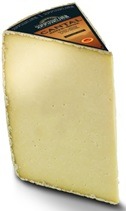
France – Cantal Entre-Deux with raw milk 1/8 wheel x1 (variable weight) – E.coli STEC 0103:H2

Gov france

Identification information of the recalled product

  • Product category Food
  • Product subcategory Milk and dairy products
  • Product brand name REFINERY COUNTER
  • Model names or references1/8 wheel format sold in the cutting department
  • Identification of products
    GTIN Batch Date
    3492840043960 batch: 35621472 Use-by date 31/01/2023
  • Packaging old at the cutting department
  • Marketing start/end date From 29/12/2022 to 03/01/2023
  • Storage temperature Product to be stored in the refrigerator
  • Health mark EN 15.196.001 CE
  • Geographic area of ​​sale Whole France
  • Distributors INTERMARCHE E. LECLERC (SOCAMAINE; SCANORMANDE; SCALANDES; SCACHAP)
  • List of points of sale point_of_sale_list.pdf

Practical information regarding the recall

  • Reason for recall Presence of E.coli STEC 0103:H2
  • Risks incurred by the consumer Toxigenic Shiga Escherichia coli (STEC)

Research -Control measures for Shiga toxin-producing Escherichia coli (‎STEC)‎ associated with meat and dairy products: meeting report

WHO

Although Shiga toxin-producing Escherichia coli (STEC) have been isolated from a variety of food production animals, they are most commonly associated with ruminants from which we derive meat and milk. Because of the widespread and diverse nature of ruminant-derived food production, coupled with the near ubiquity of STEC worldwide, there is no single definitive solution for controlling STEC that will work alone or in all situations. Instead, the introduction of multiple interventions applied in sequence, as a “multiple-hurdle scheme” at several points throughout the food chain (including processing, transport and handling) will be most effective.

This report summarizes the review and evaluation of interventions applied for the control of STEC in cattle, raw beef and raw milk and raw milk cheese manufactured from cows’ milk, and also evaluates available evidence for other small ruminants, swine and other animals. The information is presented from primary production, to the end of processing, providing the reader with information on the currently available interventions based on the latest scientific evidence.

This work was undertaken to support the development of guidelines for the control of STEC in beef, raw milk and cheese produced from raw milk by the Codex Committee on Food Hygiene (CCFH).

Research – Spraying an army of bacteria-eating viruses can save us from food poisoning

Interesting Engineering

Every year more than 40 million people in the U.S. suffer from foodborne illnesses caused by bacteria, viruses, and various other types of pathogens. Food contamination is often underestimated, but it is responsible for 420,000 deaths annually. This number represents more people than the entire population of Iceland.

After being produced on a farm, food passes through a lot of channels before it makes it to our platter. Preventing it from contamination is almost impossible. However, a team of researchers from McMaster University in Ontario has figured out a way to free food from disease-causing bacteria before it goes into your stomach, according to a press release.

They have developed a food decontamination spray that employs food-safe microscopic beads containing bacteriophages (viruses that kill bacteria). The researchers claim, during the study, they were able to free lettuce and meat from E. coli 0157, a common food-borne pathogen that infects the human intestine and causes health issues such as diarrhea. 

USA – Morasch Meats Inc. Recalls Raw Frozen Diced Beef Products Due to Possible E. Coli O157:H7 Contamination

FSIS USDA

WASHINGTON, Dec. 22, 2022 – Morasch Meats Inc., a Portland, Ore. establishment, is recalling approximately 3,930 pounds of raw frozen diced beef products that may be contaminated with E. coli O157:H7, the U.S. Department of Agriculture’s Food Safety and Inspection Service (FSIS) announced today.

The raw frozen diced beef items were produced on August 24, 2022. The following products are subject to recall [view labels]:

  • 30-lb. box packages containing “BEEF DICED 3/10# BAGS,” with case code FM010152, LOT#: 082422 and a date of 8/24/2022 on the case label. Each case contains three 10 lb. vacuum-sealed, clear plastic bags of the diced beef products.

The products subject to recall bear establishment number “EST. 4102” inside the USDA mark of inspection. These items were shipped to distributor locations in Oregon for further distribution to restaurants and other institutional users.

The problem was discovered by FSIS during review of testing results, which showed the product tested positive for E. coli O157:H7.

FSIS is concerned that some product may be in institutional or restaurant freezers. Restaurants and institutions are urged not to serve these products. These products should be thrown away or returned to the place of purchase.

Click to access recall-labels-045-2022_0.pdf

BFR

Flour is a natural product and a valuable foodstuff.

However, Shiga toxin-producing Escherichia coli (STEC) were detected in multiple flour samples (wheat, spelt and rye) during routine food monitoring in Germany in 2018. Escherichia (E.) coli are bacteria that occur naturally in the intestines of animals and humans and the detection of E. coli in food is a strong indicator of a faecal contamination.

Bacteria from the faeces or stool can be shed into the environment and subsequently contaminate various animal- and plant-based foods. Direct transmission between animals and humans and from humans to humans are also possible. Certain toxin producing variants of E. coli can cause serious diseases in animals and humans.

E. coli variants that can form Shiga toxins are of particular importance for humans. These are abbreviated as STEC. STEC, which cause diseases in humans, are referred to as entero-hemorrhagic E. coli (EHEC). The symptoms of an infection with STEC are initially gastrointestinal.

The possible severity of the disease ranges from watery to bloody diarrhea. In adults, the course of the disease can also proceed without symptoms. A particularly severe complication is the hemolytic-uremic syndrome (HUS). HUS is a disease that manifests in acute kidney failure, blood coagulation disorders and destruction of the red blood cells and can lead to death in individual cases. This form of the disease affects particularly sensitive groups of people, such as young chil-dren.