Category Archives: STEC

RASFF Alerts – STEC E.coli – Raw Milk Cow Cheese

RASFF

Shigatoxin-producing Escherichia coli in raw milk cow cheese from France in Luxembourg, Netherlands and Germany

Research -Burden of foodborne disease due to bacterial hazards associated with beef, dairy, poultry meat, and vegetables in Ethiopia and Burkina Faso, 2017

Frontiers in Microbiology

Foodborne disease is a significant global health problem, with low- and middle-income countries disproportionately affected. Given that most fresh animal and vegetable foods in LMICs are bought in informal food systems, much the burden of foodborne disease in LMIC is also linked to informal markets. Developing estimates of the national burden of foodborne disease and attribution to specific food products will inform decision-makers about the size of the problem and motivate action to mitigate risks and prevent illness. This study provides estimates for the burden of foodborne disease caused by selected hazards in two African countries (Burkina Faso and Ethiopia) and attribution to specific foods. Country-specific estimates of the burden of disease in 2010 for Campylobacter spp., enterotoxigenic Escherichia coli (ETEC), Shiga-toxin producing E. coli and non-typhoidal Salmonella enterica were obtained from WHO and updated to 2017 using data from the Global Burden of Disease study. Attribution data obtained from WHO were complemented with a dedicated Structured Expert Judgement study to estimate the burden attributable to specific foods. Monte Carlo simulation methods were used to propagate uncertainty. The burden of foodborne disease in the two countries in 2010 was largely similar to the burden in the region except for higher mortality and disability-adjusted life years (DALYs) due to Salmonella in Burkina Faso. In both countries, Campylobacter caused the largest number of cases, while Salmonella caused the largest number of deaths and DALYs. In Burkina Faso, the burden of Campylobacter and ETEC increased from 2010 to 2017, while the burden of Salmonella decreased. In Ethiopia, the burden of all hazards decreased. Mortality decreased relative to incidence in both countries. In both countries, the burden of poultry meat (in DALYs) was larger than the burden of vegetables. In Ethiopia, the burdens of beef and dairy were similar, and somewhat lower than the burden of vegetables. The burden of foodborne disease by the selected pathogens and foods in both countries was substantial. Uncertainty distributions around the estimates spanned several orders of magnitude. This reflects data limitations, as well as variability in the transmission and burden of foodborne disease associated with the pathogens considered.

Research – Prevention and control of microbiological hazards in fresh fruits and vegetables –Part 3: Sprouts

FAO

MICROBIOLOGICAL HAZARDS IN SPROUTS

Sprouts represent a unique food safety challenge because the proliferation of bacterial pathogens, if present, is enhanced due to the high humidity and the ideal sprouting temperature. For this reason, the Expert Committee identified foodborne bacterial pathogens of concern, including Shiga toxin-producing Escherichia coli(STEC), Salmonella spp., and Listeria monocytogenes and specifically focused on interventions against bacterial foodborne pathogens.

While the seed for sprouting may be contaminated with viral or parasitic pathogens, viruses and parasites do not increase in numbers during sprout production and few viral or parasitic disease outbreaks have been attributed to sprouts.

USA – CDC Fact Sheet – Surveillance System Overview: National Shiga toxin-producing Escherichia coli (STEC) Surveillance

CDC

Surveillance System Overview:

National Shiga toxin-producing Escherichia coli (STEC) Surveillance Shiga toxin-producing Escherichiacoli (STEC) are estimated to cause more than 265,000 illnesses each year in the United States, with more than 3,600 hospitalizations and 30 deaths

(STEC infections often cause diarrhea, sometimes bloody.

Some patients with STEC infection develop hemolytic uremic syndrome (HUS), a severe complication characterized by renal failure, hemolytic anemia, and thrombocytopenia that can be fatal.

Most outbreaks of STEC infection and most cases of HUS in the United States have been caused by STEC O157. Non-O157 STEC have also caused US outbreaks. Although all STEC infections are nationally notifiable, for several reasons many cases are likely not recognized

Not all persons ill with STEC infection seek medical care, healthcare providers may not obtain a specimen for laboratory diagnosis, or the clinical diagnostic laboratory may not perform the necessary diagnostic tests. Accounting for under-diagnosis and under-reporting, an estimated 96,534 STEC O157 and 168,698 non-O157 infections occur each year

STEC transmission occurs through consumption of contaminated foods, ingestion of contaminated water, or direct contact with infected persons (e.g., in child-care settings) or animals or their environments.

Research – The Effect of High-Pressure Processing on the Survival of Non-O157 Shiga Toxin-Producing Escherichia coli in Steak Tartare: The Good- or Best-Case Scenario?

MDPI

Abstract

Samples of steak tartare were artificially contaminated with a cocktail of Shiga toxin-producing Escherichia coli (STEC) O91, O146, O153, and O156 to the level of 3 log and 6 log CFU/g. Immediately after vacuum packing, high-pressure processing (HPP) was performed at 400 or 600 MPa/5 min. Some of the samples not treated with HPP were cooked under conditions of 55 °C for 1, 3, or 6 h. HPP of 400 MPa/5 min resulted in a 1–2 log reduction in the STEC count. In contrast, HPP of 600 MPa/5 min led to the elimination of STEC even when inoculated to 6 log CFU/g. Nevertheless, sub-lethally damaged cells were resuscitated after enrichment, and STEC was observed in all samples regardless of the pressure used. STEC was not detected in the samples cooked in a 55 °C water bath for 6 h, even after enrichment. Unfortunately, the temperature of 55 °C negatively affected the texture of the steak tartare. Further experiments are necessary to find an optimal treatment for steak tartare to assure its food safety while preserving the character and quality of this attractive product.

RASFF Alert – STEC E.coli – Frozen Organic Herb mix

RASFF

Verotoxin-producing Escherichia coli (VTEC/STEC) in frozen organic herb mix from France

Research – Use of a phage cocktail to reduce the numbers of seven Escherichia coli strains belonging to different STEC serogroups applied to fresh produce and seeds

Wiley Online

Abstract

The aims of this research were to evaluate the effectiveness of a phage cocktail at reducing seven Shiga toxigenic Escherichia coli (STEC) serogroups on different food matrixes: mung bean sprouts (MBP), lettuce, and mung bean seeds (MBS) and to test the phage cocktail effectiveness to reduce E. coli O157 on Romaine and iceberg lettuce. To study the effect of the type of food matrix on the STEC phage cocktail effectiveness, a mixture of seven highly sensitive STEC strains designated as phage propagation strains (PPS) were used to adulterate Romaine lettuce, MBP, and MBS matrixes at a concentration of 105 logs CFU/g. A subsample of the treated MBS was germinated to assess STEC survival. Recovered STEC strains were confirmed using latex agglutination and PCR. To test the phage cocktail effectiveness to reduce E. coli O157:H7 on Romaine and iceberg lettuce, a mixture of four STEC strains (different than phage propagation strains, non-PPS) at both low (103 CFU/g) and high (105 CFU/g) concentrations were used to spike the samples in scaled up trials for the purpose of potential commercialization. Phage treatments including a combination of STEC phage cocktail and chlorinated water treatment were then applied to lettuce in a simulated scaled-up trial. STEC was assessed on the treated samples at different storage time and temperatures (0, 24, 48, and 72 hr at 2, 10 and 25°C). In the food matrix trial, the combination of STEC phage cocktail and chlorinated water-reduced PPS (p < 0.001) STEC on lettuce by 2.1 log10 CFU/g and on MBP by 2.2 log10 CFU/g. However, isolates from all 7 STEC serogroups remained viable after phage treatment in both lettuce and MBP; particularly those associated with serogroup O111, O121, O103, and O145, while only a few colonies of serogroup O26, O45, and O157 were detected. Lettuce adulterated with low levels of 4 non-PPS E. coli O157:H7 (103 CFU/g) achieved a reduction of 2.6–3.2 logs. While a reduction 1.7–2.3 logs was achieved by the phage cocktail when lettuce was inoculated with 105 CFU/g. Overall phage performance was more effective at 2 and 10°C and improved over storage time up to 72 hr. However, for MBS, the phage cocktail was not able to kill any of the STEC populations as all of them recovered during germination.

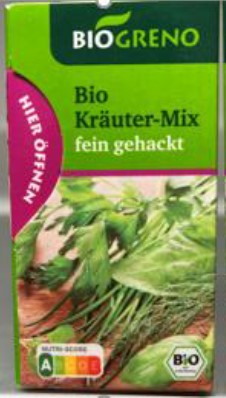
Germany – BIOGRENO Organic Herb Mix, deep-frozen – SeBIOGRENO Organic Herb Mix, deep-frozen -STEC E.coli

LMW

Alert type: Food
Date of first publication: 02/01/2023
Product name:

BIOGRENO Organic Herb Mix, deep-frozen

Product images:

Image BIOGRENO herbal mix.jpg

Photo from the Dresden consumer market by employees

Image batch +BID BIOGRENO herb mix.jpg

Photo from the Dresden consumer market by employees

Manufacturer (distributor):

Manufacturer: Distributor: Darégal SAS Darégal Gourmet Deutschland GmbH 6 boulevard Joffre Gewerbepark 5a F- 91490 Milly-la-Forêt D – 49143 Bissendorf

Reason for warning:

Detection of verotoxin-producing Escherichia coli (VTEC/STEC)

Packaging Unit: Cardboard box – 50g
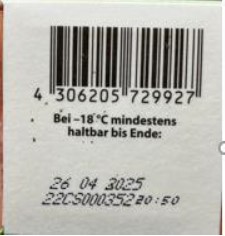
Durability: 04/26/2025
Production date: 04/26/2022
Lot identification: 22CS000352
Further information:

Escherichia coli (E.coli)

Enterohemorrhagic Escherichia coli (EHEC) An EHEC (synonyms: STEC, VTEC) disease usually manifests itself within a week after infection with diarrhea and abdominal cramps. Babies, small children, the elderly and people with a weakened immune system in particular can develop more severe illnesses with bloody diarrhea. Rarely, especially in small children, acute kidney failure can occur in a second flare-up a few days after the onset of diarrhea. Anyone who has eaten this food and develops severe or persistent symptoms should seek medical attention and report possible EHEC infection. It makes no sense to seek preventive medical treatment without symptoms.

Click to access 2023_01_31+Produktr%FCckruf+BIOGRENO.pdf

Further information on the pathogen can be found here: http://www.infectionsschutz.de/erregersteckbriefe/ehec/

Research – Microbiological safety of aged meat

EFSA

Abstract

The impact of dry‐ageing of beef and wet‐ageing of beef, pork and lamb on microbiological hazards and spoilage bacteria was examined and current practices are described. As ‘standard fresh’ and wet‐aged meat use similar processes these were differentiated based on duration. In addition to a description of the different stages, data were collated on key parameters (time, temperature, pH and aw) using a literature survey and questionnaires. The microbiological hazards that may be present in all aged meats included Shiga toxin‐producing Escherichia coli (STEC), Salmonella spp., Staphylococcus aureus, Listeria monocytogenes, enterotoxigenic Yersinia spp., Campylobacter spp. and Clostridium spp. Moulds, such as Aspergillus spp. and Penicillium spp., may produce mycotoxins when conditions are favourable but may be prevented by ensuring a meat surface temperature of −0.5 to 3.0°C, with a relative humidity (RH) of 75–85% and an airflow of 0.2–0.5 m/s for up to 35 days. The main meat spoilage bacteria include Pseudomonas spp., Lactobacillus spp. Enterococcus spp., Weissella spp., Brochothrix spp., Leuconostoc spp., Lactobacillus spp., Shewanella spp. and Clostridium spp. Under current practices, the ageing of meat may have an impact on the load of microbiological hazards and spoilage bacteria as compared to standard fresh meat preparation. Ageing under defined and controlled conditions can achieve the same or lower loads of microbiological hazards and spoilage bacteria than the variable log10 increases predicted during standard fresh meat preparation. An approach was used to establish the conditions of time and temperature that would achieve similar or lower levels of L. monocytogenes and Yersinia enterocolitica (pork only) and lactic acid bacteria (representing spoilage bacteria) as compared to standard fresh meat. Finally, additional control activities were identified that would further assure the microbial safety of dry‐aged beef, based on recommended best practice and the outputs of the equivalence assessment.

PDF

Research – Microbiological safety of aged meat

EFSA

Abstract

The impact of dry-ageing of beef and wet-ageing of beef, pork and lamb on microbiological hazards and spoilage bacteria was examined and current practices are described. As ‘standard fresh’ and wet-aged meat use similar processes these were differentiated based on duration. In addition to a description of the different stages, data were collated on key parameters (time, temperature, pH and aw) using a literature survey and questionnaires.

The microbiological hazards that may be present in all aged meats included Shiga toxin-producing Escherichia coli(STEC),Salmonella spp., Staphylococcus aureus, Listeria monocytogenes, enterotoxigenic Yersinia spp., Campylobacter spp. and Clostridium spp. Moulds, such as Aspergillus spp. and Penicillium spp., may produce mycotoxins when conditions are favourable but may be prevented by ensuring a meat surface temperature of−0.5 to 3.0°C, with a relative humidity (RH) of 75–85% and an airflow of 0.2–0.5 m/s for up to 35 days.

The main meat spoilage bacteria include Pseudomonas spp., Lactobacillus spp. Enterococcus spp., Weissella spp., Brochothrix spp., Leuconostoc spp. Lactobacillus spp., Shewanella spp. and Clostridium spp. Undercurrent practices, the ageing of meat may have an impact on the load of microbiological hazards and spoilage bacteria as compared to standard fresh meat preparation. Ageing under defined and controlled conditions can achieve the same or lower loads of microbiological hazards and spoilage bacteria than the variable log10increases predicted during standard fresh meat preparation. An approach was used to establish the conditions of time and temperature that would achieve similar or lower levels of L. monocytogenes and Yersinia enterocolitica (pork only) and lactic acid bacteria(representing spoilage bacteria) as compared to standard fresh meat. Finally, additional control activities were identified that would further assure the microbial safety of dry-aged beef, based on recommended best practice and the outputs of the equivalence assessment.