Category Archives: outbreak

Bali – 21 students in Lombok got food poisoning after eating deep fried tempe

Coconuts Bali

Dozens of students from a madrasah (Islamic school) in Central Lombok are suspected to have gotten food poisoning after snacking on deep fried tempe, for which they had to be taken to the local community clinic (Puskesmas).

West Praya sub-precinct chief, Heri Indrayanto, said in a statement that the students bought the deep fried tempe from a street vendor identified as M and ate them with chili sauce during recess.

“It is suspected that the victims got food poisoning after eating the fried tempe with chili sauce,” Heri said.

Fifteen minutes after consuming the fritter, the students started to get headaches and felt nauseous, while some started vomiting. They were then taken to the nearest Puskesmas for treatment.

Heri said a total of 21 students had food poisoning, and even the seller M also experienced the same symptoms. Authorities had seized all the ingredients and sent them for a lab test at the Health Agency in Central Lombok.

USA – Outbreak Investigation of Salmonella Oranienburg: Whole, Fresh Onions (September 2021)

FDA

FDA and CDC are investigating illnesses linked to whole, fresh onions. Do not eat, sell, or serve certain onions from ProSource Inc.

The FDA, along with CDC and state and local partners, is investigating a multistate outbreak of Salmonella Oranienburg infections linked to whole, fresh onions. FDA’s traceback investigation is ongoing but has identified ProSource Inc. (also known as ProSource Produce, LLC) of Hailey, Idaho as a source of potentially contaminated whole, fresh onions imported from the State of Chihuahua, Mexico.

ProSource Inc. has agreed to voluntarily recall red, yellow, and white onions imported from the State of Chihuahua, Mexico, with import dates from July 1, 2021 through August 27, 2021. Descriptors of these onion types include, but are not limited to, jumbo, colossal, medium, and sweet onions.

Illness subclusters investigated in this outbreak are currently associated with restaurants and food service locations. The investigation is ongoing to determine the source of contamination and if additional products or firms are linked to illness. The FDA is working to determine if these onions were available to consumers through grocery stores. Additional information will be provided as it becomes available.

Recommendation

Advice for restaurants, retailers and consumers: Restaurants, retailers and consumers should not eat, sell, or serve red, yellow, and white onions supplied by ProSource Inc. that were imported from the State of Chihuahua, Mexico from July 1, 2021 through August 27, 2021, or products containing such onions. Consumers should ask if the onions being served or sold were supplied by ProSource Inc. and imported from the State of Chihuahua, Mexico. If you still cannot determine if your onions were supplied by ProSource Inc and imported from the State of Chihuahua, Mexico, do not sell, serve, or eat them, and throw them out.

Potentially affected red, yellow, and white onions from ProSource Inc. were imported between July 1, 2021 through August 27, 2021. Onions can last up to three months if stored in a cool, dry place. Restaurants, retailers, and consumers who suspect having purchased such onions may still have them in storage and should not eat, sell, or serve them, and should throw them out.

FDA recommends that anyone who received or suspects having received such onions imported by ProSource Inc. between July 1, 2021 through August 27, 2021 to use extra vigilance in cleaning and sanitizing any surfaces and containers that may have come in contact with these products to reduce the risk of cross-contamination. This includes cleaning and sanitizing cutting boards, slicers, countertops, refrigerators, and storage bins.

Consumers who have symptoms of Salmonella infection should contact their health care provider. Most people with salmonellosis develop diarrhea, fever, and abdominal cramps. More severe cases of salmonellosis may include a high fever, aches, headaches, lethargy, a rash, blood in the urine or stool, and in some cases may become fatal.

Suppliers and Distributors: Suppliers, distributors, and others in the supply chain should not use, ship, or sell red, yellow, and white onions from ProSource Inc. that were imported from the State of Chihuahua, Mexico or food products containing such onions. Suppliers and distributors that re-package raw onions should use extra vigilance in cleaning any surfaces and storage areas that may have come into contact with such onions from ProSource Inc. If there has been potential cross contamination or mixing of onions from other sources with such onions from ProSource Inc., suppliers and distributors should discard all comingled and potentially cross-contaminated product.

Investigation Background

October 20, 2021

The FDA, along with CDC and state and local partners, is investigating a multistate outbreak of Salmonella Oranienburg infections linked to whole, fresh onions. FDA’s traceback investigation is ongoing but has identified ProSource Inc. (also known as ProSource Produce, LLC) of Hailey, Idaho as a source of potentially contaminated whole, fresh onions imported from the State of Chihuahua, Mexico.

Epidemiological data collected by investigators from the CDC and state and local partners identified 20 illness clusters at restaurants where onions were served. Information from these clusters shows that many ill people ate raw onions. Investigators worked to identify a common food item eaten by all of the sick people in an effort to identify the source of the outbreak.

State officials collected food items from some of the restaurants where sick people ate. The outbreak strain of Salmonella Oranienburg was found in a sample taken from a takeout condiment cup containing cilantro and lime. The sick person reported that the condiment container also contained onions, but none were left in the cup when it was tested. Because multiple food items were present in the container and in the sample that was tested, it is not possible to know which food item was contaminated.

FDA’s traceback investigation identified ProSource Inc. as a common supplier for many of the restaurants that sick people reported eating at, including the restaurant where the sample from the condiment cup containing cilantro, lime, and previously onions, was collected.

The FDA continues to conduct its traceback investigation to determine if additional products or suppliers have been affected. Additional information will be provided as it becomes available.

Recall Information

ProSource Inc. has agreed to voluntarily recall red, yellow, and white onions imported from the State of Chihuahua, MX, with import dates from July 1, 2021 through August 27, 2021. Descriptions of these onion types include, but are not limited to, jumbo, colossal, medium, and sweet onions. Additional recall information will be made public as soon as it is available from ProSource Inc.


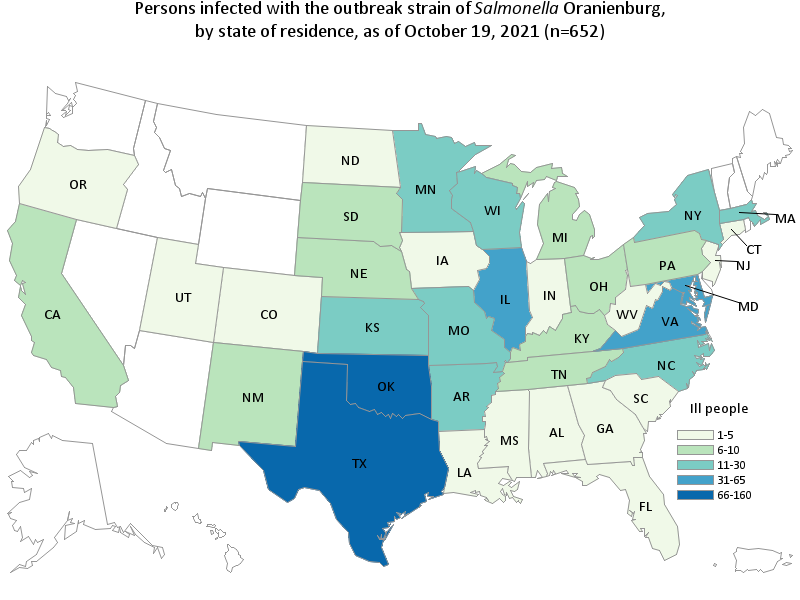
Case Count Map Provided by CDC

Outbreak Salmonella Onions Case Count Map Oct 20 2021

Case Counts

Total Illnesses: 652
Hospitalizations: 129
Deaths: 0
Last Illness Onset: September 30, 2021
States with Cases: AL, AR, CA, CO, CT, FL, GA, IA, IL, IN, KS, KY, LA, MA, MD, MI, MN, MO, MS, NC, ND, NE, NJ, NM, NY, OH, OK, OR, PA, SC, SD, TN, TX, UT, VA, WI, WV
Product Distribution: Nationwide

Research – Multi-country outbreak of Salmonella Typhimurium and S. Anatum infections linked to Brazil Nuts

ECDC

Click to access salmonella-typhimurium-rapid-outbreak-assessment-october-2020.pdf

USA – Kentucky reports outbreak of E. coli due to food distribution

Food Poison Journal

Kentucky Cabinet for Health and Family Services reports that ten Kentuckians recently tested positive with a strain of E. coli O157:H7. Of the cases, two individuals developed a rare but serious condition called hemolytic uremic syndrome (HUS). Public health investigators have not yet identified the source of the outbreak but have noted that some sort of food distribution is likely.

The reported cases primarily include adults, many of whom reside in western Kentucky. No deaths linked to the outbreak have been reported but six people have been hospitalized. Health care providers have been notified of the outbreak and are advised to be alert for patients experiencing acute diarrheal illness, which could be associated with E. coli. This is a particular strain of E. coli that produces a type of toxin (Shiga toxin) that can be dangerous for those infected.

USA – U.S. and Canada part of Salmonella outbreak linked to tahini and halva

Food Safety News

The United States and Canada are part of an outbreak affecting Europe because of Salmonella in tahini and halva from Syria.

The United States has reported six Salmonella Mbandaka cases, one in 2020 and the rest this year.

Interviews were conducted with two people: both report shopping at international markets that stock mostly Arabic and Middle Eastern foods and ingredients, and ate items containing tahini. Interviews are pending on the remaining ill people. Two have traveled to Syria and have not been reachable by public health officials.

Ill people range from less than one to 57 years old, with a median age of 19.5 years. Illness onset dates are from Nov. 19, 2020 to Sept. 5, 2021.

Canada has eight confirmed cases: five of Salmonella Mbandaka, two of Salmonella Havana and one of Salmonella Orion from 2019 to 2021.

USA – Patient dies in hepatitis A outbreak traced to restaurants in Virginia

Food Safety News

One person has died in a hepatitis A outbreak associated with three restaurants in the Roanoke, VA, area, according to state officials, and two more people have been added to the patient list.

“We don’t believe there is an ongoing threat to the public,” said Christ Wills of the Roanoke City and Alleghany Health Districts, which is a subagency of the Virginia health department.

However, Wills told Food Safety News today there will likely be more sick people than the 37 who have been identified because of the long incubation time for the virus. As of today, 26 of the patients have been so sick they had to be admitted to hospitals. The age range of patients is now trending to include younger patients with people from 31 to 79 years old now infected. 

USA – Salmonella Outbreak Linked to Raw Frozen Breaded Stuffed Chicken Products is over.

CDC

CDC, public health and regulatory officials in several states, and the U.S. Department of Agriculture’s Food Safety and Inspection Service (USDA-FSIS) investigated a multistate outbreak of Salmonella Enteritidis infections.

Epidemiologic, laboratory, and traceback data showed that raw frozen breaded stuffed chicken products produced at the P-2375 Serenade Foods facility in Milford, Indiana, made people sick.

As of October 13, 2021, this outbreak is over.

Epidemiologic Data

A total of 36 people infected with the outbreak strain of Salmonella Enteritidis were reported from 11 states (see map). The true number of sick people in an outbreak is likely much higher than the number reported, and the outbreak may not be limited to the states with known illnesses. This is because many people recover without medical care and are not tested for Salmonella.

Illnesses started on dates ranging from February 21, 2021, to August 16, 2021 (see timeline). Sick people ranged in age from 1 to 83 years, with a median age of 38 years, and 57% were female. Of 32 people with information available, 12 were hospitalized. No deaths were reported.

State and local public health officials interviewed people about the foods they ate in the week before they got sick. Of the 27 people interviewed, 14 (52%) reported preparing and eating frozen breaded stuffed chicken products. They bought different brands of raw frozen breaded stuffed chicken products from multiple stores.

Jordan – Shigella outbreak rises to 80, Source still not identified

Outbreak News Today

Shigella - kswfoodworld

Image CDC

In a follow-up on the shigella outbreak in Jerash, Jordan, the Director of Jerash Governmental Hospital, Sadiq Al-Atoum, said the number of shigellosis cases recorded in Jerash has risen by 22 cases, bringing the total number to 80.

At least 16 people are still being treated.

The Director of Communicable Diseases, Ali Zitawi, said that all of the patients are under the age of 12 and suffered from the same symptoms: abdominal pain, fever, diarrhea and vomiting.

Health authorities in Jordan continue to collect samples from water sources, restaurants and bakeries in Jerash and Ajloun to determine the source of the Shigella bacteria.

USA – Investigation Details -Salmonella Oranienburg Outbreak

October 14, 2021

CDC and public health and regulatory officials in several states are collecting different types of data to investigate a multistate outbreak of Salmonella Oranienburg infections. The investigation has not yet identified a food linked to illness.

Epidemiologic Data

As of October 14, 2021, 592 people infected with the outbreak strain of Salmonella Oranienburg have been reported from 36 states (see map). Illnesses started on dates ranging from May 31, 2021, to September 29, 2021 (see timeline).

Sick people range in age from less than 1 year to 97 years, with a median age of 36, and 57% are female. Of 363 people with information available, 116 (32%) have been hospitalized and no deaths have been reported.

The true number of sick people in an outbreak is likely much higher than the number reported, and the outbreak may not be limited to the states with known illnesses. This is because many people recover without medical care and are not tested for Salmonella. In addition, recent illnesses may not yet be reported as it usually takes 3 to 4 weeks to determine if a sick person is part of an outbreak.

State and local public health officials continue to interview people about the foods they ate in the week before they got sick. CDC is analyzing the data and has not identified a specific food item as a potential source of this outbreak.

Laboratory Data

Whole genome sequencing of bacteria from 556 people’s samples did not predict any antibiotic resistance. Three people’s samples were predicted to be resistant to one or more of the following antibiotics: amoxicillin-clavulanic acid, ampicillin, cefoxitin, and ceftriaxone, gentamicin, streptomycin, sulfamethoxazole, and tetracycline. Standard antibiotic susceptibility testing by CDC’s National Antimicrobial Resistance Monitoring System (NARMS) laboratory is currently underway. Most people with Salmonella illness recover without antibiotics. However, if antibiotics are needed, this resistance is unlikely to affect the choice of antibiotic used to treat most people because it is rare.

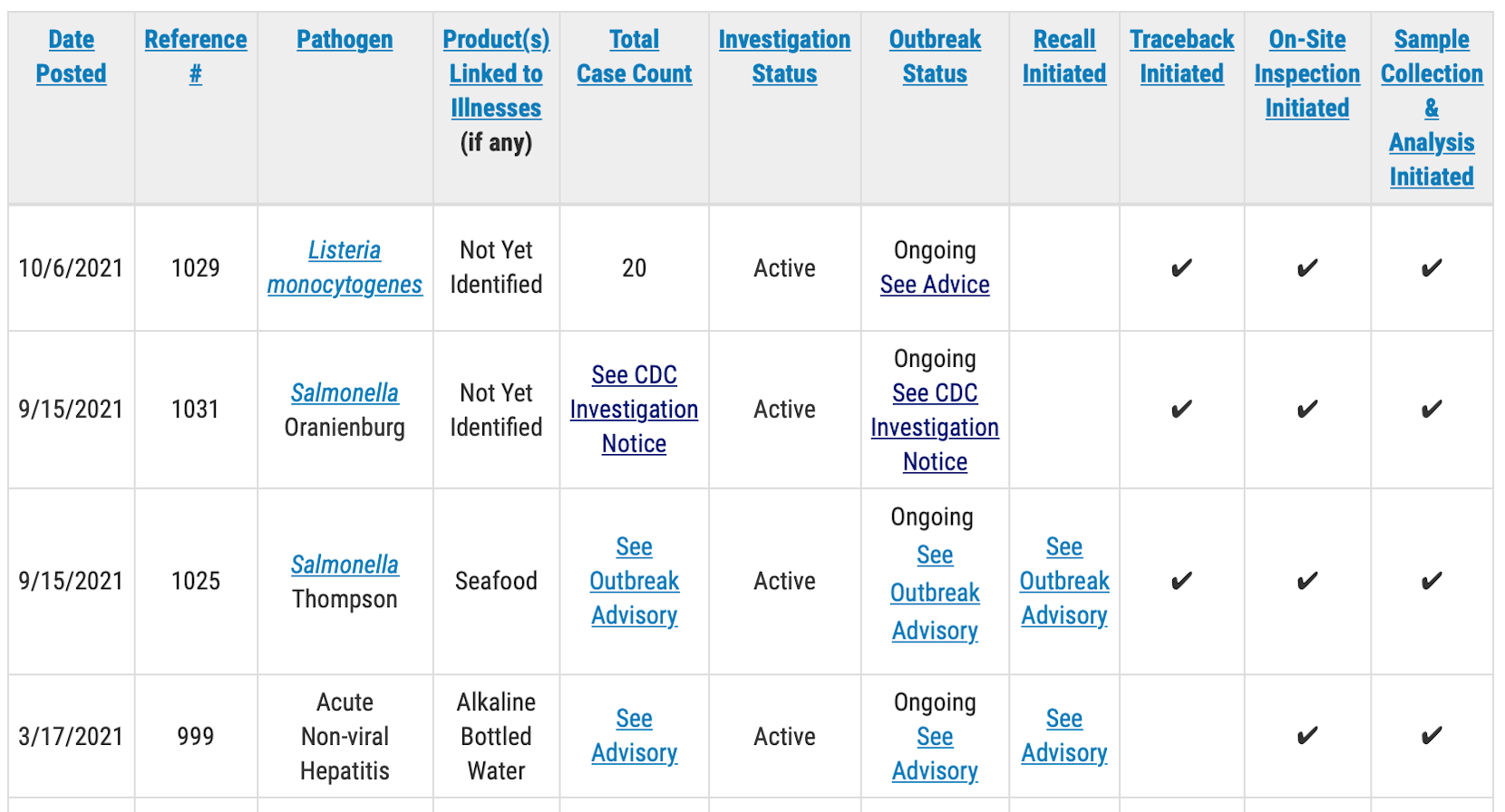
USA – Core Investigations Table Update

FDA

New Listeria Outbreak- no real information

Ongoing Salmonella Oranienburg and Salmonella Thompson investigations