Over 100 people suffered food poisoning after consuming food served at a baptism ceremony in Kerala last Thursday. Police have registered a case and are conducting further investigations.

Posted in Food Illness, Food Micro Blog, Food Microbiology Blog, Food Microbiology Research, Food Microbiology Testing, Food Poisoning, Foodborne Illness, Illness, microbial contamination, Microbial growth, Microbiological Risk Assessment, Microbiology, Microbiology Investigations, Microbiology Risk
A hotel on the New South Wales Central Coast suffered from a severe food poisoning outbreak of Salmonella after approximately 70 out of 230 people who attended a two-day conference at the Crown Plaza Terrigal Pacific hotel on November 30th fell ill. A total of 27 out of the 70 illnesses have now been confirmed by medical professionals as cases of Salmonella.
The NSW Food Authority are currently investigating the cause of this outbreak and urges, “anyone who felt unwell or had concerns after the conference should seek medical care, get in touch with their local public health unit, or contact conference organizers, the Aboriginal Languages Trust.”
Authorities are continuing to investigate food that may have been contaminated at the conference, and for the time being, the hotel’s kitchen has voluntarily closed, though “it is required to do [so] under the Food Act of 2003.”
Posted in food bourne outbreak, Food Illness, Food Micro Blog, Food Microbiology, Food Microbiology Blog, Food Microbiology Research, Food Microbiology Testing, Foodborne Illness, foodborne outbreak, foodbourne outbreak, Illness, microbial contamination, Microbial growth, Microbiological Risk Assessment, Microbiology, Microbiology Investigations, Microbiology Risk, outbreak, Salmonella
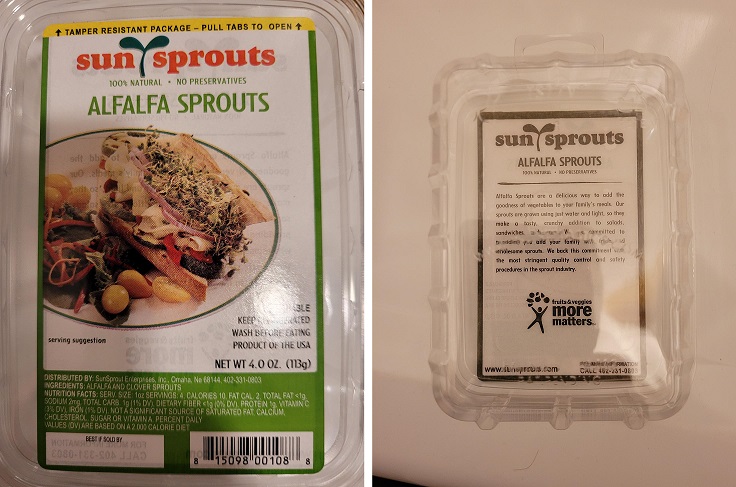
The U.S. Food and Drug Administration (FDA), along with the Centers for Disease Control and Prevention (CDC) and state and local partners, is investigating a multistate outbreak of Salmonella Typhimurium infections. FDA’s traceback investigation is ongoing but has identified Sun Sprouts brand alfalfa sprouts grown by CW Sprouts Inc., doing business as (DBA) SunSprout Enterprises of Fremont, NE as a likely source of illnesses in this outbreak.
Based on the epidemiologic information provided by the CDC along with interviews conducted by state and local public health officials, the individuals identified in this outbreak reported consuming alfalfa sprouts prior to their illness onset, either at local restaurants or in their homes after purchasing from local grocery stores. Preliminary traceback evidence indicates that the restaurants and grocery stores identified in this outbreak received alfalfa sprouts from SunSprout Enterprises. Additionally, two of the individuals identified in this outbreak confirmed they had purchased Sun Sprouts brand alfalfa sprouts from their local grocery store. Whole Genome Sequencing (WGS) conducted on clinical samples collected from ill individuals identified 15 isolates that matched the outbreak strain: OK (1), NE (8), and SD (6). WGS for additional clinical isolates are still pending sequencing.
On December 29, 2022, SunSprout Enterprises initiated a voluntary recall of two lots (# 4211 and 5211) of raw alfalfa sprouts due to potential contamination with Salmonella. On the same day, SunSprout Enterprises expanded their voluntary recall to include two additional lots (# 3212, and 4212) of raw alfalfa sprouts. The raw alfalfa sprouts for all recalled lots (#4211, 5211, 3212, and 4212) are packaged in 4-ounce clamshells and 2.5 lb packages with best sold by dates between 12/10/2022 and 1/7/2023.
The investigation is ongoing to determine the source of contamination and whether additional products are linked to illnesses. FDA will update this advisory should additional consumer safety information become available.
Advice for consumers, restaurants, and retailers: Consumers, restaurants, and retailers should not eat, sell, or serve recalled Sun Sprouts brand alfalfa sprouts.
Consumers, restaurants, and retailers should check their refrigerators for recalled Sun Sprouts brand alfalfa sprouts with best by dates between 12/10/2022 and 1/7/2023. If you purchased or used recalled alfalfa sprouts, you should use extra vigilance in cleaning and sanitizing any surfaces that may have come in contact with these products, to reduce the risk of cross contamination.
If you or someone in your household ate Sun Sprouts alfalfa sprouts and have symptoms of salmonellosis, please contact your healthcare provider.
Suppliers and Distributors: Suppliers, distributors and others in the supply chain should not use, ship or sell recalled alfalfa sprouts grown by SunSprout Enterprises. If there has been potential cross-contamination or mixing of recalled alfalfa sprouts with products from other sources, suppliers and distributors should not use any comingled and potentially cross-contaminated product and should use extra vigilance in cleaning any surfaces and storage areas that may have come into contact with recalled alfalfa sprouts.
Recalled products include raw alfalfa sprouts sold in 4-ounce clamshells and 2.5 Ib packages, with best by dates between 12/10/2022 and 1/7/2023.

Total Illnesses: 15
Hospitalizations: 2
Deaths: 0
Last illness onset: 12/13/2022
States with Cases: NE, OK, SD
Posted in food bourne outbreak, food contamination, food handler, Food Hazard, Food Hygiene, Food Illness, Food Inspections, Food Micro Blog, Food Microbiology, Food Microbiology Blog, Food Microbiology Testing, Food Pathogen, food recall, Food Safety, Food Safety Alert, Food Safety Management, Food Safety Regulations, Food Testing, Foodborne Illness, foodborne outbreak, foodbourne outbreak, Illness, microbial contamination, Microbial growth, Microbiological Risk Assessment, Microbiology, Microbiology Investigations, Microbiology Risk, outbreak, Salmonella
Posted in Decontamination Microbial, Food Micro Blog, Food Microbiology, Food Microbiology Blog, Food Microbiology Research, Food Microbiology Testing, Food Technology, microbial contamination, Microbial growth, Microbiological Risk Assessment, Microbiology, Microbiology Investigations, Microbiology Risk, Technology, UHPH
Posted in Campylobacter, campylobacter coli, Campylobacter jejuni, Decontamination Microbial, food bourne outbreak, Food Micro Blog, Food Microbiology, Food Microbiology Blog, Food Microbiology Research, Food Microbiology Testing, foodborne outbreak, foodbourne outbreak, Hepatitis A, Listeria, Listeria monocytogenes, microbial contamination, Microbial growth, Microbiological Risk Assessment, Microbiology, Microbiology Investigations, Microbiology Risk, outbreak
Globally, the Vibrio parahaemolyticus and Vibrio vulnificus represent important human pathogens associated with the consumption of seafood. In response to the requests for scientific advice from Codex Committee on Food Hygiene (CCFH), risk assessments for the pathogens V. vulnificus, V. cholerae, V. parahaemolyticus and guidance on methods for the detection of Vibrio spp. with seafood have been conducted and published previously by JEMRA. In order to provide an update on the state-of-the-art advice regarding risk assessment for V. parahaemolyticus and V. vulnificus in seafood, an expert meeting was convened.
Several critical developments in the last decade were subsequently noted by the expert working group: 1) The emergence of highly pathogenic strains; 2) In response to climate change, there has been a significant geographical spread regarding when and where these seafood-associated Vibrio infections; 3) Demographic considerations are very important; 4) A range of new approaches for best practice; and 5) A range of new methods, such as those utilising genomics and satellite imagery. This report describes the output of that expert meeting.
Posted in Decontamination Microbial, Food Micro Blog, Food Microbiology, Food Microbiology Blog, Food Microbiology Research, Food Microbiology Testing, microbial contamination, Microbial growth, Microbiological Risk Assessment, Microbiology, Microbiology Investigations, Microbiology Risk, Vibrio, Vibrio albensis, Vibrio alginolyticus, Vibrio cholera, vibrio cholerae, Vibrio parahaemolyticus, Vibrio vulnificans, Vibrio vulnificus
Read the full article at the link above
A systematic analysis of the literature showed that 58% of infectious diseases in humans have been aggravated at some point by climatic hazards, such as changes in temperatures and water and food availability.
The leading pathogens responsible (eg, S aureus, E coli, K pneumoniae, S pneumoniae, and non-typhoidal Salmonella) have all been found to have climate-dependent reactions, causing an increase in their diffusion and even resistance to treatment.
For example, sharp temperature decreases have been associated with an increased incidence of pneumonia, and increased morbidity in cold and humid weather.
Although Shiga toxin-producing Escherichia coli (STEC) have been isolated from a variety of food production animals, they are most commonly associated with ruminants from which we derive meat and milk. Because of the widespread and diverse nature of ruminant-derived food production, coupled with the near ubiquity of STEC worldwide, there is no single definitive solution for controlling STEC that will work alone or in all situations. Instead, the introduction of multiple interventions applied in sequence, as a “multiple-hurdle scheme” at several points throughout the food chain (including processing, transport and handling) will be most effective.
This report summarizes the review and evaluation of interventions applied for the control of STEC in cattle, raw beef and raw milk and raw milk cheese manufactured from cows’ milk, and also evaluates available evidence for other small ruminants, swine and other animals. The information is presented from primary production, to the end of processing, providing the reader with information on the currently available interventions based on the latest scientific evidence.
This work was undertaken to support the development of guidelines for the control of STEC in beef, raw milk and cheese produced from raw milk by the Codex Committee on Food Hygiene (CCFH).
Posted in Decontamination Microbial, Food Micro Blog, Food Microbiology, Food Microbiology Blog, Food Microbiology Research, Food Microbiology Testing, Food Pathogen, Listeria, Listeria monocytogenes, microbial contamination, Microbial growth, Microbiological Risk Assessment, Microbiology, Microbiology Investigations, Microbiology Risk, Pathogen, pathogenic
Posted in Decontamination Microbial, Food Micro Blog, Food Microbiology, Food Microbiology Blog, Food Microbiology Research, Food Microbiology Testing, Listeria, Listeria monocytogenes, microbial contamination, Microbial growth, Microbiological Risk Assessment, Microbiology, Microbiology Investigations, Microbiology Risk

 FoodWorld