Category Archives: microbial contamination

USA – Multistate Norovirus Outbreak Linked to Raw Oysters from Texas

CDC

The Centers for Disease Control and Prevention (CDC), the U.S. Food and Drug Administration (FDA), the Texas Department of State Health Services, and other public health partners, are investigating a multistate outbreak of norovirus illnesses linked to raw oysters from Texas.

FDA Advises Restaurants, Retailers and Consumers to Avoid Potentially Contaminated Oysters from Harvest Area TX 1, Texas | FDA

Fast Facts

Illnesses: 211 illnesses* have been reported as of December 15, 2022.

States affected: Alabama (AL), Florida (FL), Georgia (GA), Louisiana (LA), Mississippi (MS) North Carolina (NC), Tennessee (TN), Texas (TX)

Recall: Yes DSHS Recalls Oysters Harvested in Area of Southeastern Galveston Bay | Texas DSHS

Investigation Status: Active

*This number is an estimate based on the information we have at this time. CDC is working with state and local partners and will update this number as more information is gathered.

Raw Oysters and Norovirus

If eaten raw, oysters and other filter-feeding shellfish can contain viruses and bacteria that can cause illness or death. Anyone who consumes raw shellfish is at risk of contracting norovirus. Children younger than five years old, the elderly, and those people with weakened immune systems are more likely to have severe infections. Food contaminated with norovirus may look, smell, or taste normal. To avoid food poisoning from oysters, cook them well to a temperature of at least 145 degrees F.

What Businesses Should Do

Do not serve or sell raw oysters harvested between 11/17/2022 and 12/7/2022 from harvest area TX 1, Galveston Bay, Texas:

  • Restaurants and food retailers should not serve raw oysters from harvest area TX 1, Galveston Bay, Texas, harvested between 11/17/2022 and 12/7/2022, which will be printed on product tags.
  • The FDA has confirmed that raw oysters harvested in area TX 1, Galveston Bay, Texas were potentially contaminated with norovirus and distributed to restaurants and retailers in Alabama (AL), Florida (FL), Georgia (GA), Louisiana (LA), Mississippi (MS) North Carolina (NC), Tennessee (TN) and Texas (TX). It is possible that additional states received these oysters through further distribution within the U.S.

Throw away any remaining oysters or return them to your distributor for destruction.

These oysters may be contaminated with norovirus. Follow these steps:

  • Wash and sanitize containers and surfaces that may have come into contact with these oysters.
  • Wash hands with warm water and soap following the cleaning and sanitation process.
What You Should Do

Do not eat any raw oysters from the areas listed above. If you have oysters at home from any of the areas listed above, throw them away. Clean any utensils or food preparation surfaces that may have touched the oysters.

If you think you might have gotten sick from eating possibly contaminated raw oysters, talk to your healthcare provider and report your illness to your local health department.
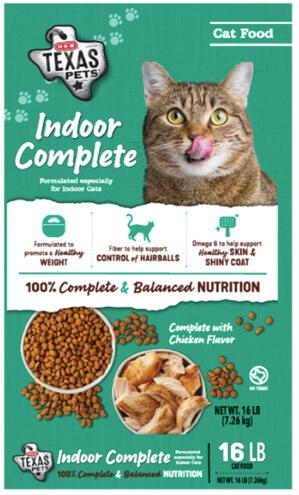
 

USA – TFP Nutrition Initiated Voluntary Recall of 16 lb. Bags of HEB TEXAS PETS Indoor Complete Dry Cat Food Because of Possible Salmonella Health Risk

FDA

Front of bag, HEB TEXAS PETS Indoor Complete Dry Cat Food

Company Announcement Date:
FDA Publish Date:
Product Type:
Food & Beverages
Reason for Announcement:
Potential Salmonella contamination
Company Name:
TFP Nutrition
Brand Name:
HEB TEXAS PETS
Product Description:
HEB TEXAS PETS Indoor Complete Dry Cat Food

Company Announcement

TFP Nutrition announced today that it is issuing a voluntary recall of a dry cat food formulation manufactured on November 13, 2022, at its Nacogdoches, Texas facility. HEB Texas Pets Indoor Complete Dry Cat Food is being recalled due to potential Salmonella contamination. Salmonella can affect animals eating the products and there is risk to humans from handling contaminated cat products, especially if they have not thoroughly washed their hands after having contact with the products or any surfaces exposed to these products. No cat or human illness has been reported with respect to the recalled cat food to date.

Cats with Salmonella infections may be lethargic and have diarrhea or bloody diarrhea, fever, and vomiting. Some cats will have only decreased appetite, fever and abdominal pain. Infected but otherwise healthy cats can be carriers and infect other animals or humans. If your cat has consumed the recalled product and has these symptoms, please contact your veterinarian.

Healthy people infected with Salmonella should monitor themselves for some or all of the following symptoms: nausea, vomiting, diarrhea or bloody diarrhea, abdominal cramping and fever. Rarely, Salmonella can result in more serious ailments, including arterial infections, endocarditis, arthritis, muscle pain, eye irritation, and urinary tract symptoms. Consumers exhibiting these signs after having contact with this product should contact their healthcare providers.

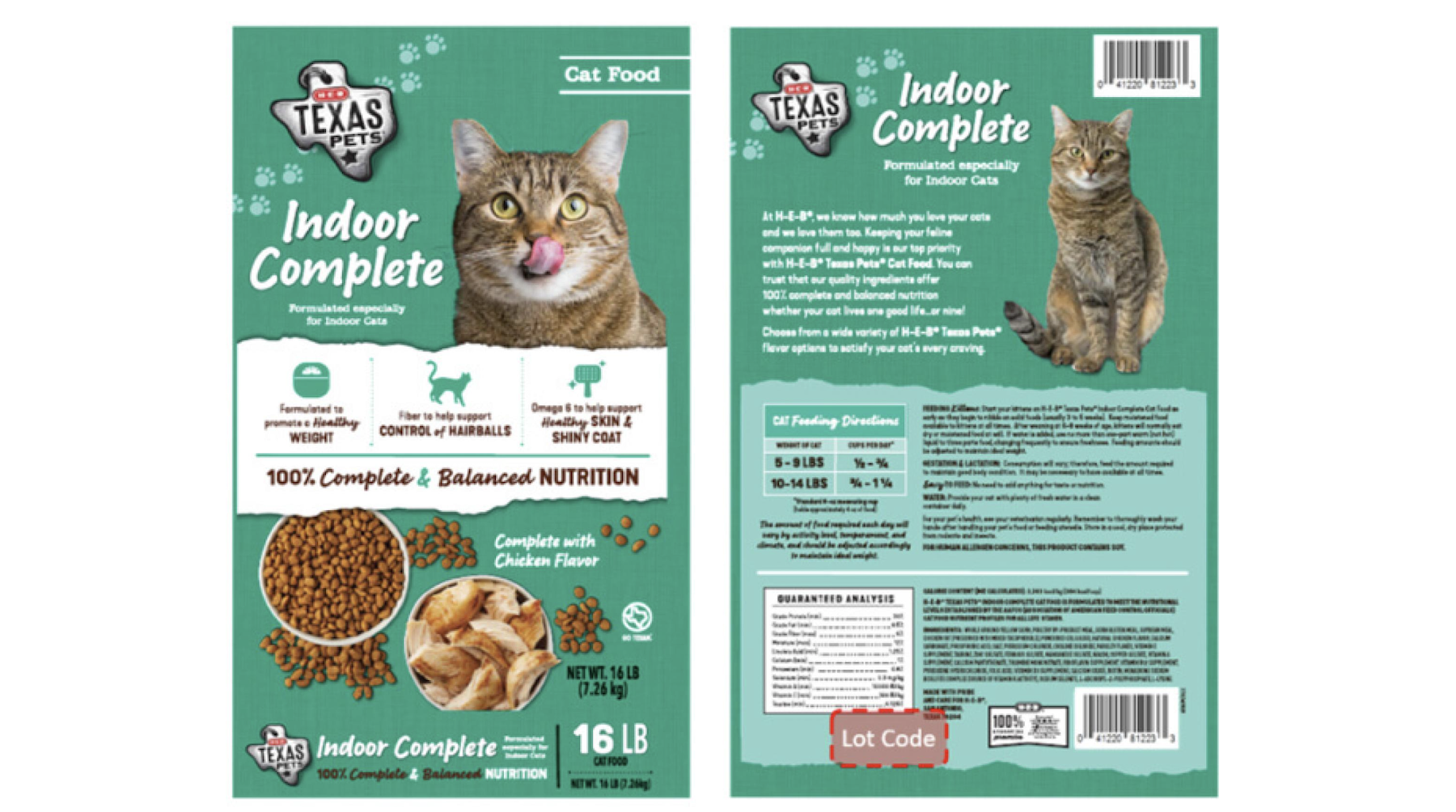
This product was only distributed in the State of Texas and sold in HEB retail stores. All recalled product has been removed from store shelves and no other HEB products are affected by the voluntary recall. Affected product will contain “MFG 13 NOV 22” on the second line of the lot code located on the back of the bag.

Description Size Production Code
H-E-B Texas Pets Indoor Complete Dry Cat Food 16 lb. MFG 13 NOV 22

Cat owners who are unsure if the product they purchased is included in the recall, or would like a replacement product or refund, may contact TFP Nutrition via a toll-free call at 1-800-560-9197, Monday through Sunday, 8 am – 5pm CST. Consumers may also go to tfpnutrition.com/recallExternal Link Disclaimer for more information.


Company Contact Information

Consumers:
TFP Nutrition
 800-560-9197
Media:
 800-560-9197

USA – H-E-B Texas Pets Indoor Complete Dry Cat Food – Salmonella

Petful

Photos of the front and back of the package of H-E-B Texas Pets Indoor Complete Dry Cat Food that is being recalled.

Maker: TFP Nutrition
Cause: Potential salmonella contamination
Announcement: FDA recall notice dated Dec. 16, 2022 (archived here)
What was recalled: 16 lb. bags of H-E-B Texas Pets Indoor Complete Dry Cat Food with Production Code “MFG 13 NOV 22”

TFP Nutrition has announced a voluntary recall of a batch of its H-E-B Texas Pets Indoor Complete Dry Cat Food due to potential contamination with salmonella. The affected product was manufactured on Nov. 13, 2022, at the company’s facility in Nacogdoches, Texas, and was distributed only in that state and sold exclusively in H-E-B retail stores.

Salmonella can affect animals that consume contaminated products and also poses a risk to humans who handle the products, particularly if they do not wash their hands thoroughly after contact. No cases of illness in either cats or humans have been reported in relation to the recalled cat food at this time.

Research – Life and death of an ‘altruistic’ bacterium

Science Daily

Biofilms, complex communities of bacteria, abound around us: on the surface of cheese where they give off flavors and aromas, in streams where they form the slimy substance on rocks, on our teeth where they form plaque.

Living in a biofilm provides numerous advantages to bacteria: things like resource sharing, shelter from predators, and increased resistance to toxic compounds such as antibiotics.

But having the option to leave the biofilm when environmental conditions deteriorate can be a plus for bacteria, too, allowing them to relocate to a more hospitable environment.

”For the bacterium Caulobacter crescentus, the biofilm becomes a kind of prison in perpetuity: once cells are attached to a surface through a strong adhesive at one end of the cell, they cannot leave the biofilm,” said Yves Brun, a professor in the Department of Microbiology, Infectious Diseases and Immunology at Université de Montréal.

”However, when these attached cells divide, their unattached ‘daughter’ cells have a choice of joining the biofilm or swimming away.”

Research -Microbial safety and sanitary quality of strawberry primary production in Belgium: risk factors for Salmonella and Shiga toxin producing Escherichia coli (STEC) contamination.

PDF

ABSTRACT

Strawberries are an important fruit in Belgium both in production and consumption, but little information is available about the presence of Salmonella and STEC in these berries, the risk factors in agricultural production and possible specific mitigation options.

In 2012, a survey was undertaken of three soil and three soilless cultivation systems in Belgium.

No Salmonella spp. was isolated. No STEC was detected in the strawberry samples (0 out of 72), but STEC was detected by qPCR in 11 out of 78 irrigation water and 2 out of 24 substrate samples.

Culture isolates were obtained for 2 out of 11 qPCR positive irrigation water samples and 2 out of 2 substrate samples. Multivariable logistic regression analysis revealed elevated generic E. coli numbers (odds ratio (OR) for 1 log increase being 4.6) as the most important risk factor for STEC, together with the berry picking season (elevated risk in summer).

Presence of generic E. coli in the irrigation water (≥ 1 cfu per 100 ml) was mainly influenced by the type of irrigation water (collected rainfall water stored in ponds was more often contaminated than ground water pumped from boreholes (OR = 5.8)) and the lack of prior treatment (untreated water versus water subjected to sand filtration prior to use (OR = 19.2)).

The follow-up study in 2013 at one of the producers indicated cattle as the most likely source of STEC contamination of the irrigation water.

Research – An outbreak of Cryptosporidium parvum linked to pasteurised milk from a vending machine in England: a descriptive study, March 2021

Cambridge Org

We describe the investigations and management of a Cryptosporidium parvum outbreak of linked to consumption of pasteurised milk from a vending machine. Multiple locus variable number of tandem repeats analysis was newly used, confirming that C. parvum detected in human cases was indistinguishable from that in a calf on the farm. This strengthened the evidence for milk from an on-farm vending machine as the source of the outbreak because of post-pasteurisation contamination. Bacteriological indicators of post-pasteurisation contamination persisted after the initial hygiene improvement notice. We propose that on-farm milk vending machines may represent an emerging public health risk.

Research -Quantitative microbiological risk assessment of traditional food of animal origin produced in short supply chains in Poland

EFSA

Abstract

Polish raw-milk cheeses produced in short supply chains may pose a threat to consumer safety due to pathogen presence. Listeria monocytogenes is a bacterium of great importance for the food safety of refrigerated RTE foods due to its ability to grow at refrigeration temperatures.

During the EU-FORA fellowship, a stochastic risk assessment was designed and executed to estimate the risk for consumers from L. monocytogenes in these products. The aim was to develop a probabilistic QMRA model that would incorporate the variability and uncertainty of the model’s inputs such as prevalence, initial concentration levels, product intrinsic factors, domestic storage temperature and consumer behaviour. The project involved data collection and analysis, growth model selection, mathematical modelling and Monte Carlo analysis in R programming language.

Microbiological and physicochemical testing were carried out throughout the year on two types of cheeses in combination with a domestic refrigerator temperature survey and accompanying consumption questionnaire. Collected data were fitted to probability distributions using R. The appropriate growth model for the pathogen was selected based on an inoculation study performed on one of the raw-milk cheeses and the chosen mathematical model was written into the R script developed for the QMRA. The dose–response model used the ingested dose calculated from the modelled concentration of L. monocytogenes at the time of consumption and the single serving size from the questionnaire to estimate the probability of illness. The final risk was expressed as probability of listeriosis for Polish consumers per serving of raw-milk cheese.

Research – Microbiological Quality of Pig Carcasses in a Slaughterhouse under Risk-Based Inspection System

MDPI

Abstract

Meat product inspection is one of the procedures adopted more than a century ago to guarantee food quality and safety for consumption. Due to technology and regulation advancement for farming and slaughtering pigs, a change in zoonotic profile attributed to pork has been identified.
 
Thus, a global movement began to establish inspection parameters based on epidemiological risk profiles, culminating in the publication of a new regulation in Brazil in 2018. This normative instruction establishes that slaughterhouses under federal inspection must implement risk-based inspection until 2028.
 
Changes in the inspection system can generate questions and objections on the part of customers and consumer markets. In order to assess microbiological contamination when adopting a risk-based inspection system, the occurrence of Salmonella spp. and the quantification of Enterobacteriaceae and mesophilic aerobic counts were compared in pig carcasses slaughtered under traditional and risk-based inspection systems.
 
A statistical significance reduction was identified regarding the quantification of Enterobacteriaceae (log −0.18 to −1.61 CFU/cm2) and mesophilic aerobic counts (log 4.60 to 3.49 CFU/cm2). The occurrence of Salmonella spp. did not show a significant difference (4% to 5.3%). The results allowed us to conclude that adopting risk-based inspection systems improves food safety through Enterobacteriaceae and mesophilic aerobic counts reduction.

Research – Prevalence ofE. coliO157:H7 in water sources: an overview on associated diseases, outbreaks and detection methods

Elsevier

Escherichia coliO157:H7 is a zoonotic pathogen with its ability to cause human illness ranging from diarrheal dis-ease to fatal hemolytic uremic syndrome.E. coliO157:H7 had been associated with waterborne outbreaksresulting in high morbidity and mortality worldwide. Therefore, it is important to investigate the prevalence ofE. coliO157:H7 in water sources especially used for drinking and to develop the diagnostic methods for itsearly detection. The review describes traditional cultural methods, immunological techniques, and polymerasechain reaction (PCR)–based methods for detection of this bacterium in water sources. The current PCR-basedtechniques such as real-time PCR are more specific and sensitive and require less detection time (b3 hours).These methods can be applied for regular water monitoring and proper management of water sources to preventwaterborne diseases due toE. coliO157:H7.


Research – Vibrio vulnificus and Vibrio parahaemolyticus in Oysters under Low Tidal Range Conditions: Is Seawater Analysis Useful for Risk Assessment?

MDPI

Food Illness

Abstract

Human-pathogenic Vibrio bacteria are acquired by oysters through filtering seawater, however, the relationships between levels of these bacteria in measured in oysters and overlying waters are inconsistent across regions. The reasons for these discrepancies are unclear hindering our ability to assess if -or when- seawater samples can be used as a proxy for oysters to assess risk. We investigated whether concentrations of total and human pathogenic Vibrio vulnificus (vvhA and pilF genes) and Vibrio parahaemolyticus (tlhtdh and trh genes) measured in seawater reflect concentrations of these bacteria in oysters (Crassostrea virginica) cultured within the US lower Chesapeake Bay region. We measured Vibrio spp. concentrations using an MPN-qPCR approach and analyzed the data using structural equation modeling (SEM). We found seawater concentrations of these bacteria to predictably respond to temperature and salinity over chlorophyll a, pheophytin or turbidity. We also inferred from the SEM results that Vibrio concentrations in seawater strongly predict their respective concentrations in oysters. We hypothesize that such seawater-oyster coupling can be observed in regions of low tidal range. Due to the ease of sampling and processing of seawater samples compared to oyster samples, we suggest that under low tidal range conditions, seawater samples can foster increased spatial and temporal coverage and complement data associated with oyster samples.