Category Archives: Foodborne Illness

Sweden – Salmonella outbreak over.

Food Safety News

Salmonella

An outbreak of Salmonella has ended in Sweden with officials unable to find the source of infection.

In October, 40 people became ill with monophasic Salmonella Typhimurium with the majority falling sick in the first half of the month. An earlier update identified 33 patients. Cases were linked by whole genome sequencing.

As no new illnesses have been recorded after late October, the outbreak was recently judged to be over by authorities.

Sick people were 2 to 92 years old with a median age of 44. They lived in eight different regions.

Canada – Avocados are possible link in Canada Salmonella Outbreak

Food Poison Journal

Food Safety News reports that in a public health notice, officials report a Salmonella Enteritidis outbreak of unknown origin is continuing to grow, with patients spread across five Canadian provinces.

As of Dec. 9, there were 16 new confirmed patients, bringing the tally to 79, according to the Public Health Agency of Canada. Four people have been hospitalized. No deaths have been reported.

“Many of the individuals who became sick reported eating fresh avocados purchased from grocery stores or served at restaurants before their illness. Investigation findings to date have identified that these avocados have been distributed in British Columbia, Alberta, Saskatchewan and Manitoba. More information is needed to confirm the source of the outbreak. The outbreak appears to be ongoing, as illnesses continue to be reported,” according to public health officials.

Argentina – More Salmonella cases reported in Salta, Nearly half in young children

Outbreak News Today

kswfoodworld salmonella

In a follow-up on the Salmonella situation in Salta province, Argentina, the Ministry of Public Health reported that from the beginning of 2021 and until the end of last week, 1,283 cases of salmonellosis were confirmed in the province.

In the first months of the year, a greater number of cases comprised in the first nine epidemiological weeks was observed. Then, between weeks 10 and 38, isolated infections occurred. And, from week 32 that began on August 8 until today, 665 laboratory-confirmed cases were reported.

Research – An outbreak of food poisoning due to Escherichia coli serotype O7:H4 carrying astA for enteroaggregative E. coli heat-stable enterotoxin1 (EAST1) – Seaweed

Cambridge Org

In June 2020, a large-scale food poisoning outbreak involving about 3000 elementary and junior high school students occurred in Yashio, Saitama, Japan. A school lunch was the only food stuff ingested by all of the patients. Escherichia coli serotype O7:H4 carrying the astA gene for enteroaggregative E. coli (EAggEC) heat-stable enterotoxin 1 (EAST1) was detected in faecal specimens from the patients, and sample inspection revealed its presence in a seaweed salad and red seaweed (Gigartina tenella) as one of the raw materials. Analysis of the antibiotic sensitivity of the isolates revealed resistance to ampicillin and cefotaxime. All isolates were confirmed to be of the same origin by pulsed-field gel electrophoresis after digestion with the restriction enzyme XbaI, and single nucleotide polymorphism analysis using whole genome sequencing. To our knowledge, this is the first report of a large-scale food poisoning caused by E. coli O7:H4, which lacks well-characterized virulence genes other than astA.

Canada – Public Health Notice: Outbreak of Salmonella infections – Update

PHAC

The Public Health Agency of Canada (PHAC) is collaborating with provincial public health partners, the Canadian Food Inspection Agency (CFIA) and Health Canada to investigate an outbreak of Salmonella infections involving five provinces: British Columbia, Alberta, Saskatchewan, Manitoba and Ontario. The illnesses reported in Ontario were related to travel to Alberta and British Columbia.

The source of the outbreak has not been confirmed and the investigation is ongoing. Many of the individuals who became sick reported eating fresh avocados purchased from grocery stores or served at restaurants before their illness. Investigation findings to date have identified that these avocados have been distributed in British Columbia, Alberta, Saskatchewan and Manitoba. More information is needed to confirm the source of the outbreak. The outbreak appears to be ongoing, as illnesses continue to be reported.

The Public Health Agency of Canada is issuing this public health notice to inform residents and businesses in British Columbia, Alberta, Saskatchewan and Manitoba of the investigation findings to date so that they can make informed decisions. At this time, there is no evidence to suggest that residents in other provinces and territories are affected by this outbreak. This notice also includes important safe food handling information for Canadians and businesses that may help prevent further Salmonella infections.

This public health notice will be updated as the investigation evolves.

Investigation summary

As of December 9, there have been 79 laboratory-confirmed cases of Salmonella Enteritidis illness investigated in: British Columbia (34), Alberta (28), Saskatchewan (4), Manitoba (11) and Ontario (2). The illnesses reported in Ontario are related to travel to Alberta and British Columbia. Individuals became sick between early September 2021 and mid-November 2021. Four individuals have been hospitalized. No deaths have been reported. Individuals who became ill are between 5 and 89 years of age. The majority of cases (63%) are female.

CFIA is conducting a food safety investigation. If specific contaminated food products are identified, they will take the necessary steps to protect the public, including requesting a recall of product as required. Currently there are no Food Recall Warnings associated with this outbreak.

Research -EU One Health report: drop in reported zoonotic diseases in humans and foodborne outbreaks in 2020

EFSA

Campylobacteriosis was the most reported zoonosis in the EU in 2020, with 120,946 cases compared to more than 220,000 the previous year. It was followed by salmonellosis, which affected 52,702 people compared to 88,000 in 2019. The number of reported foodborne outbreaks also fell by 47%. These findings are based on the annual EU One Health zoonosis report, by EFSA and ECDC.

Experts acknowledged the impact of the COVID-19 pandemic in Europe in the remarkable drop in reported zoonotic diseases in humans – ranging from 7% to 53% depending on the reported disease in question – and foodborne outbreaks.

Possible factors behind the large decrease in cases include changes in health seeking behaviour, restrictions on travel and on events, the closing of restaurants, quarantine, lockdown, and other mitigation measures such as the use of masks, physical distancing and hand sanitisation.  

The next most commonly reported diseases were yersiniosis (5,668) and infections caused by Shigatoxin-producing E.coli (4,446). Listeriosis was the fifth most reported zoonosis (1,876 cases), mainly affecting people over the age of 64.

Listeriosis and West Nile virus infections were the diseases with the highest case fatality and hospitalisation rates – with most locally acquired human infections of West Nile virus reported in Greece, Spain and Italy.

The report also monitors foodborne outbreaks in the EU, events during which at least two people contract the same illness from the same contaminated food. A total of 3,086 foodborne outbreaks were reported in 2020. Salmonella remained the most frequently detected agent and caused about 23% outbreaks. The most common sources of salmonellosis outbreaks were eggs, egg products and pig meat.

The report also includes data on Mycobacterium bovis/caprae, BrucellaTrichinellaEchinococcus, Toxoplasma gondii, rabies, Q fever and tularaemia.

EFSA is publishing two interactive communication tools on foodborne outbreaks – a story map and a dashboard. The story map provides general information on foodborne outbreaks, their causative agents and implicated food vehicles. The dashboard allows people to search and query the large amount of data on foodborne outbreaks collected by EFSA from EU Member States and other reporting countries since 2015.

USA – FDA Core Investigation Table Update

FDA

Increase in numbers of cases from Salmonella Javiana, source still not identified

USA – Outbreak Investigation of Salmonella Thompson – Seafood (October 2021) – Outbreak Over.

FDA

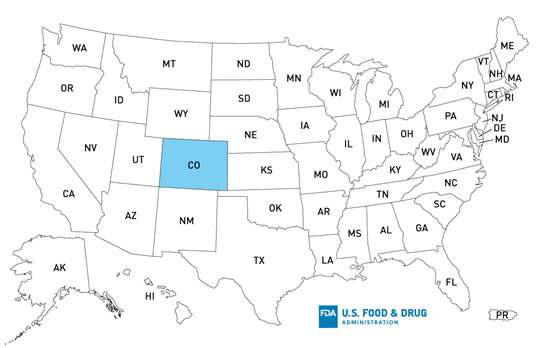
The FDA, along with CDC and state and local partners, investigated a multistate outbreak of Salmonella Thompson infections linked to seafood manufactured or processed by Northeast Seafood Products, Inc. of Denver, CO. As of 12/6/2021, the CDC has declared this outbreak over. According to CDC, the majority of sick people were either Colorado residents or reported traveling to Colorado in the week before they got sick.

FDA’s traceback investigation identified Northeast Seafood Products, Inc. as a common distributor among illness sub-clusters. As part of this outbreak investigation, environmental samples were collected from Northeast Seafood Products, Inc. On 10/7/2021, environmental samples collected from Northeast Seafood Products, Inc. were reported positive for Salmonella Thompson and were determined to be a match to the outbreak strain through whole genome sequencing.

On 10/8/2021, Northeast Seafood Products, Inc. recalled Haddock, Monkfish, Bone-in Trout, Grouper, Red Snapper, Red Rock Cod, Ocean Perch, Pacific Cod, Halibut, Coho Salmon, Atlantic Salmon Portions, Lane Snapper, Tilapia, All Natural Salmon Fillet, Pacific Sole, and Farm Raised Striped Bass. These products were sold to restaurant and Albertsons, Safeway, and Sprouts supermarkets in Colorado. The Pacific Cod sold through Sprouts is not being recalled. A full list of recalled products is available on FDA’s website.

Recommendation

Consumers, restaurants, and retailers should not eat, sell, or serve any recalled seafood. Recalled seafood was sold fresh and would be past shelf-life unless it was frozen after purchase. FDA recommends that anyone who might have purchased or received recalled product, check their freezers and throw away recalled product.

A full list of recalled products is available on FDA’s website.


Map of U.S. Distribution of Recalled Northeast Seafood Products

 Outbreak Investigation of Salmonella Thompson – Seafood - Map of U.S. Distribution of Recalled Products (October 8, 2021)

Case Count Map Provided by CDC

Outbreak Investigation of Salmonella Thompson – Seafood - CDC Case Count Map (December 6, 2021)

Case Counts

Total Illnesses: 115
Hospitalizations: 20
Deaths: 0
Last Illness Onset: September 7, 2021
States with Cases: AZ (1), CA (1), CO (93), CT (1), IA (1), MN (2), MO (1), NE (2), NJ (2), PA (1), TX (2), VA (3), WA (1), WI (2), WY (2)
Product Distribution*: CO
*States with confirmed distribution; product could have been distributed further

India – Karimnagar: 100 students fall sick due to food poisoning in Choppadandi

Telangana Today

Karimnagar: At least 100 students of Social Welfare Girls Residential School, Choppadandi, took ill after having lunch on Friday. They complained of stomach-ache and started vomiting following food poisoning.

According to the students, they were served cabbage, egg, dal and sambar for lunch. Immediately after lunch, they developed symptoms of food poisoning. The school authorities suspect there was a problem with the cabbage dish.

Norway – Imported frozen raspberries probable source of Hepatitis A outbreak

Outbreak News Today

The source of infection for the national outbreak of hepatitis A was probably imported, frozen raspberries. This is shown by the investigation that the Norwegian Food Safety Authority and the Norwegian Institute of Public Health have carried out in connection with the outbreak, which is now considered over.

The outbreak of hepatitis A lasted from April to October this year and involved 20 infected people.

Tracing of the source shows that the raspberries are probably no longer on the market. The outbreak is therefore considered over, says senior adviser Heidi Lange at the National Institute of Public Health (NIPH).