The FDA, along with CDC and state and local partners, is investigating a multistate outbreak of Listeria monocytogenes infections potentially linked to Dole packaged leafy greens. According to the CDC, as of December 22, 2021, 16 people infected with the outbreak strain of Listeria monocytogenes have been reported from 13 states. Illnesses started on dates ranging from August 16, 2014 to October 17, 2021 (one case occurred in 2014 and the remaining cases occurred between 2018 and 2021).
CDC investigated this outbreak in 2019 and 2020 but was unable to gather enough data to identify the source in the past. CDC reopened the investigation in November 2021 when four new illnesses were reported since the end of August.
In October 2021, as a part of routine retail sampling, the Georgia Department of Agriculture collected a product sample of prepackaged salad mix from a grocery store for testing. The sample tested positive for Listeria monocytogenes. In response to the sample results, Dole initiated a recall of packaged garden salads in October 2021. These products are now past their “Best if Used By” dates. The positive sample was later sent for whole genome sequencing (WGS) analysis; and in December 2021, WGS analysis was completed. The results show that the Listeria monocytogenes in the product sample was a match to the outbreak strain. FDA is conducting an inspection at the facility that produced the product that tested positive for Listeria monocytogenes.
The Michigan Department of Agriculture and Rural Development also recently initiated retail sampling of Dole products in their state as part of this investigation. One product containing lettuce from the Dole facility in Yuma, AZ, tested positive for Listeria monocytogenes. WGS analysis showed that the Listeria monocytogenes in the product sample is also a match to the outbreak strain.
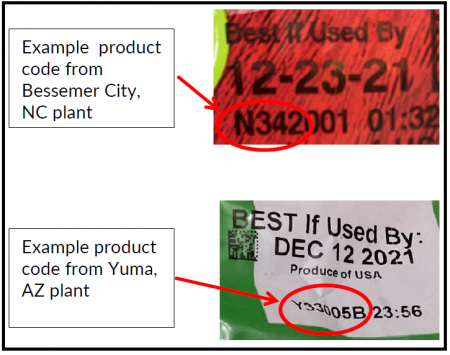
In response to the sample analyses and the ongoing outbreak investigation, Dole has agreed to voluntarily suspend operations at both the Bessemer City, NC, facility and Yuma, AZ, facility and has voluntarily recalled all products and brands from those facilities. Those products have production lot codes beginning with either the letter “N” or “Y” in the upper right-hand corner of the package and Best if Used By dates from November 30, 2021 to January 8, 2022.
This recall does not include whole head packaged lettuce. A full list of recalled products is available on FDA’s website.
This investigation is ongoing, and additional information will be provided as it becomes available.
Recommendation
Consumers, restaurants, and retailers, should not eat, sell, or serve recalled Dole packaged salads. A full list of recalled products is available on FDA’s website.
FDA recommends that anyone who received recalled products use extra vigilance in cleaning and sanitizing any surfaces and containers that may have come in contact with these products to reduce the risk of cross-contamination. Listeria can survive at refrigeration temperatures and can easily spread to other foods and surfaces.
Recall Information
In response to the sample analyses and the ongoing outbreak investigation, Dole has agreed to voluntarily suspend operations at both the Bessemer City, NC, facility and Yuma, AZ, facility and has voluntarily recalled all products and brands from those facilities. Those products have production lot codes beginning with either the letter “N” or “Y” in the upper right-hand corner of the package and Best if Used By dates from November 30, 2021 to January 8, 2022.
This recall does not include whole head packaged lettuce.
The following images are of example labels from recalled products highlighting where to find product codes. View a full list of recalled products.
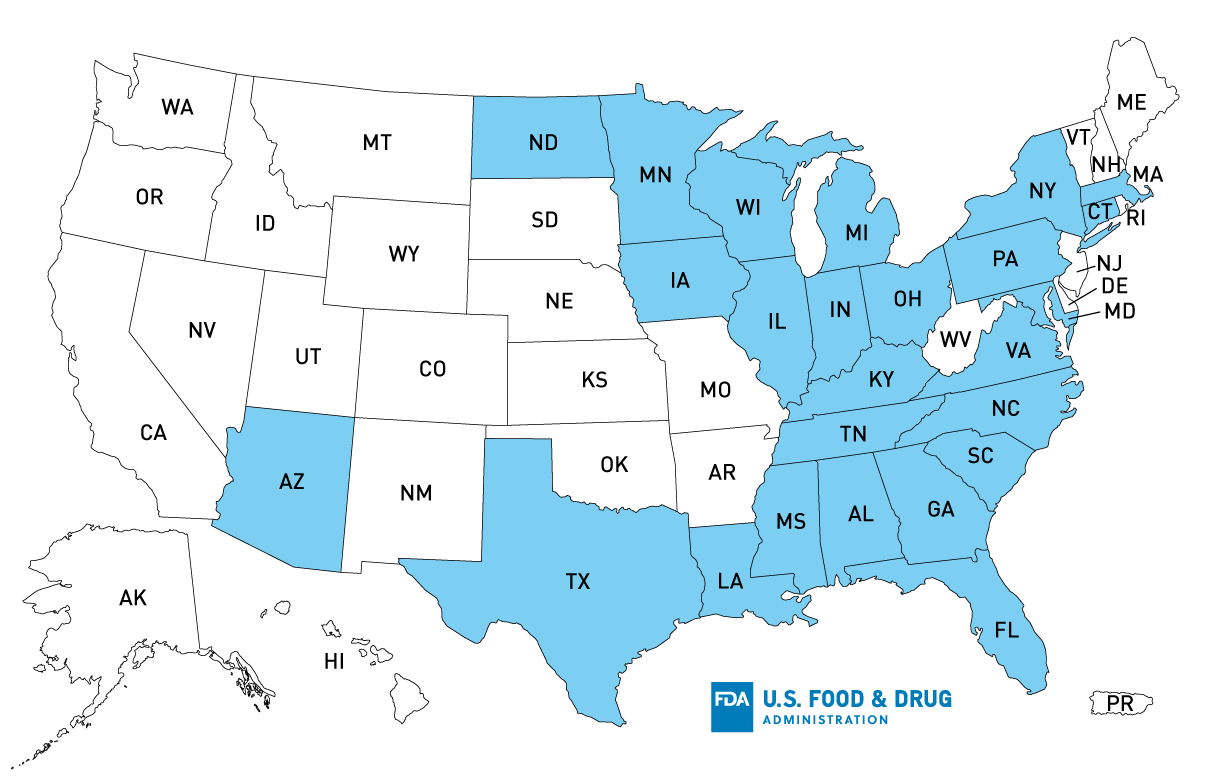
Map of U.S. Distribution of Recalled Packaged Salad
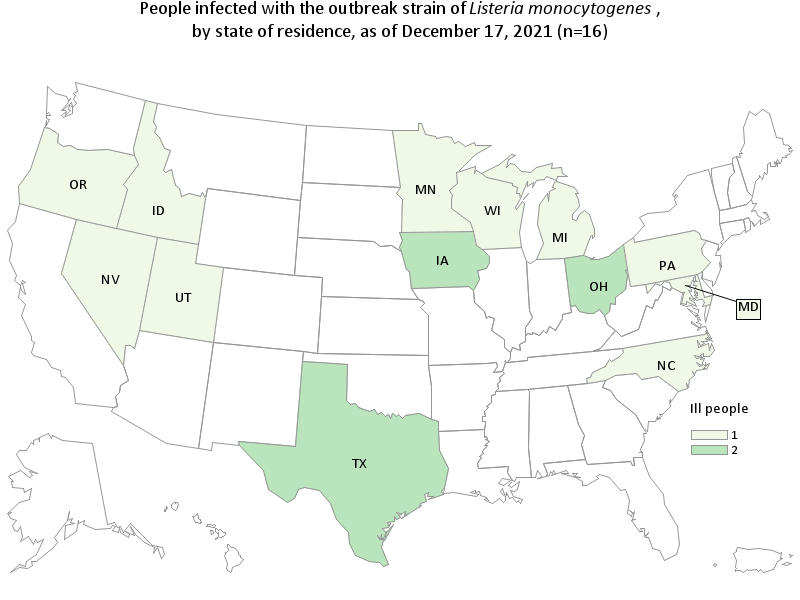
Case Count Map Provided by CDC
Case Counts
Total Illnesses: 16
Hospitalizations: 12
Deaths: 2
Last Illness Onset: October 17, 2021
States with Cases: IA, ID, MD, MI, MN, NC, NV, OH, OR, PA, TX, UT, WI
Product Distribution*: AL, AZ, CT, FL, GA, IA, IL, IN, KY, LA, MA, MD, MI, MN, MS, NC, ND, NY, OH, PA, SC, TN, TX, VA, WI
*Distribution has been confirmed for states listed, but product could have been distributed further, reaching additional states
As of November 12, 2021, 892 people infected with the outbreak strain of Salmonella Oranienburg have been reported from 38 states and Puerto Rico. Illnesses started on dates ranging from May 31, 2021, to October 25, 2021.
Sick people range in age from less than 1 year to 101 years, with a median age of 37, and 58% are female. Of 571 people with information available, 183 (32%) have been hospitalized.
According to other publicly available data, we expect to see the number of sickened in this outbreak to crest 1,000.
The FDA and CDC, in collaboration with state and local partners, are investigating a multistate outbreak of Listeria monocytogenes infections. According to the CDC, as of December 21, 2021, 10 people infected with the outbreak strain of Listeria monocytogenes have been reported from eight states. Illnesses started on dates ranging from July 26, 2016 to October 19, 2021.
As a part of routine sampling, the Michigan Department of Agriculture and Rural Development (MDARD) collected a product sample of Fresh Express Sweet Hearts salad mix with a Use-By-Date of December 8, 2021 for testing. The sample tested positive for Listeria monocytogenes and subsequent whole genome sequencing (WGS) analysis determined that the Listeria monocytogenes present in the samples matches the strain that has caused illnesses in this outbreak.
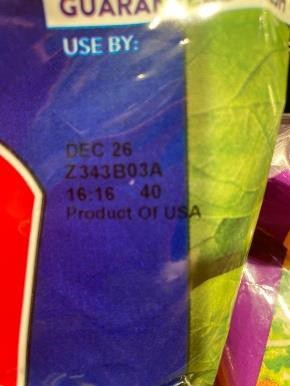
In response to the sample results and the ongoing outbreak investigation, Fresh Express voluntarily ceased production at the Streamwood, IL, facility and initiated a recall of certain varieties of its branded and private label salad products produced at the company’s Streamwood, Illinois facility. The recall includes all Use-By Dates of fresh salad items with product codes Z324 through Z350. Product codes are located on the front of the packages below the Use-By Date, as shown above. No other Fresh Express products are subject to recall. A full list of recalled products is available on FDA’s website.
This is an ongoing investigation and additional information will be provided as it becomes available.
Recommendation
Consumers, restaurants, and retailers, should not eat, sell, or serve recalled packaged salads. A full list of recalled products is available on FDA’s website.
FDA recommends that anyone who received recalled products use extra vigilance in cleaning and sanitizing any surfaces and containers that may have come in contact with these products to reduce the risk of cross-contamination. Listeria can survive in refrigerated temperatures and can easily spread to other foods and surfaces.
Product Images
U.S. Distribution of Recalled Packaged Salad
Case Counts
Total Illnesses: 10
Hospitalizations: 10
Deaths: 1
Last Illness Onset: October 19, 2021
States with Cases: IL, MA, MI, NJ, NY, OH, PA, VA
This notice has been updated to communicate the source of the outbreak and reflect 5 additional illnesses that have been reported in the ongoing outbreak investigation. There are now 84 Salmonella illnesses reported across 5 provinces. Based on the investigation findings to date, the outbreak is linked to Alasko brand frozen whole kernel corn.
The Canadian Food Inspection Agency (CFIA) issued food recall warnings on December 14 and 19 for Alasko brand frozen whole kernel corn imported by New Alasko Limited Partnership. Some of these products were possibly distributed nationally. This led to a secondary recall for Fraser Valley Meats brand frozen whole kernel corn on December 18. Additional food recall warnings in Canada are possible. More information on recalled products is available online.
Do not eat, use, sell, or serve any recalled Alasko brand or Fraser Valley Meats brand frozen whole kernel corn. This advice applies to individuals, as well as retailers, distributors, manufacturers and food service establishments such as hotels, restaurants, cafeterias, hospitals and long-term care homes, across Canada.
The Public Health Agency of Canada (PHAC) is collaborating with provincial public health partners, the Canadian Food Inspection Agency (CFIA) and Health Canada to investigate an outbreak of Salmonella infections involving 5 provinces: British Columbia, Alberta, Saskatchewan, Manitoba and Ontario. The illnesses reported in Ontario were related to travel to Alberta and British Columbia.
Many of the individuals who became sick reported eating a variety of raw and cooked produce items before their illness. Initially, investigators identified that fresh avocados were reported by many cases before they became ill; however, more information was needed to confirm the source of the outbreak.
As part of the food safety investigation, the CFIA collected different food items from restaurants where ill people dined. Testing found the outbreak strain of Salmonella in an unopened package of Alasko brand frozen whole kernel corn. Traceback findings identified Alasko as the common brand of frozen corn consumed at various food service establishments by individuals who became sick. Based on the investigation findings to date, the outbreak is linked to Alasko brand frozen whole kernel corn.
The CFIA issued food recall warnings on December 14 and 19 for Alasko brand frozen whole kernel corn. The recalled products were distributed in British Columbia, Alberta, Saskatchewan, Manitoba and Quebec, and may have been distributed in other provinces and territories. This led to a secondary recall for Fraser Valley Meats brand frozen whole kernel corn on December 18. More information on the recalled products are available online. The CFIA is continuing its food safety investigation, which may lead to the recall of other products. If other products are recalled, the CFIA will notify the public through updated food recall warnings.
The outbreak appears to be ongoing, as recent illnesses continue to be reported. Do not eat, use, sell, or serve recalled Alasko brand or Fraser Valley Meats brand frozen whole kernel corn. This advice applies to individuals, as well as retailers, distributors, manufacturers and food service establishments such as hotels, restaurants, cafeterias, hospitals and long-term care homes, across Canada.
This outbreak is an important reminder to Canadians and businesses that frozen vegetables can carry harmful germs that can lead to foodborne illness if not properly handled and cooked prior to consuming.
This public health notice will be updated as the investigation evolves.
Investigation summary
As of December 21, there have been 84 laboratory-confirmed cases of Salmonella Enteritidis illness investigated in: British Columbia (36), Alberta (30), Saskatchewan (4), Manitoba (12) and Ontario (2). The illnesses reported in Ontario are related to travel to Alberta and British Columbia.
Individuals became sick between early September 2021 and late November 2021. Four individuals have been hospitalized. No deaths have been reported. Individuals who became ill are between 5 and 89 years of age. The majority of cases (64%) are female.
The CFIA issued food recall warnings on December 14 and 19 for Alasko brand frozen whole kernel corn; and a secondary recall for Fraser Valley Meats brand frozen whole kernel corn on December 18. The CFIA is continuing its food safety investigation, which may lead to the recall of other products. If other products are recalled, the CFIA will notify the public through updated food recall warnings.
Most people who become ill from a Salmonella infection will recover fully after a few days. It is possible for some people to be infected with the bacteria and to not get sick or show any symptoms, but to still be able to spread the infection to others.
What you should do to protect your health
The following advice applies to individuals, as well as retailers, distributors, manufacturers and food service establishments such as hotels, restaurants, cafeterias, hospitals and long-term care homes, across Canada:
Do not eat, use, sell or serve any recalled Alasko brand or Fraser Valley Meats brand frozen whole kernel corn.
Clean and sanitize all surfaces and storage areas that recalled Alasko brand or Fraser Valley Meats brand frozen whole kernel corn may have come in contact with, including countertops, containers, utensils, freezers, and refrigerators.
If you have been diagnosed with a Salmonella infection or any other gastrointestinal illness, do not cook food for other people.
For general use of frozen vegetables, including frozen corn, the following tips will also help reduce your risk of becoming ill:
Frozen vegetables are not ready to eat products. Always remember to cook frozen vegetables according to the package directions.
Wash your hands with soap and warm water for at least 20 seconds before and after handling frozen vegetables.
Wash and sanitize any surfaces that may have come in contact with frozen vegetables and its packaging, such as countertops, containers, utensils, freezers, and refrigerators.
Symptoms
Symptoms of a Salmonella infection, called salmonellosis, typically start 6 to 72 hours after exposure to Salmonella bacteria from an infected animal or contaminated product.
Symptoms include:
fever
chills
diarrhea
abdominal cramps
headache
nausea
vomiting
These symptoms usually last for 4 to 7 days. In healthy people, salmonellosis often clears up without treatment, but sometimes antibiotics may be required. In some cases, severe illness may occur and hospitalization may be required. People who are infected with Salmonella bacteria can be infectious from several days to several weeks.
People who experience symptoms, or who have underlying medical conditions, should contact their health care provider if they suspect they have a Salmonella infection.
What the Government of Canada is doing
The Government of Canada is committed to protecting the health of Canadians from enteric disease outbreaks.
PHAC leads the human health investigation into an outbreak and is in regular contact with its federal, provincial and territorial partners to monitor the situation and to collaborate on steps to address an outbreak.
Health Canada provides food-related health risk assessments to determine whether the presence of a certain substance or microorganism poses a health risk to consumers.
CFIA conducts food safety investigations into the possible food source of an outbreak.
Epidemiological information
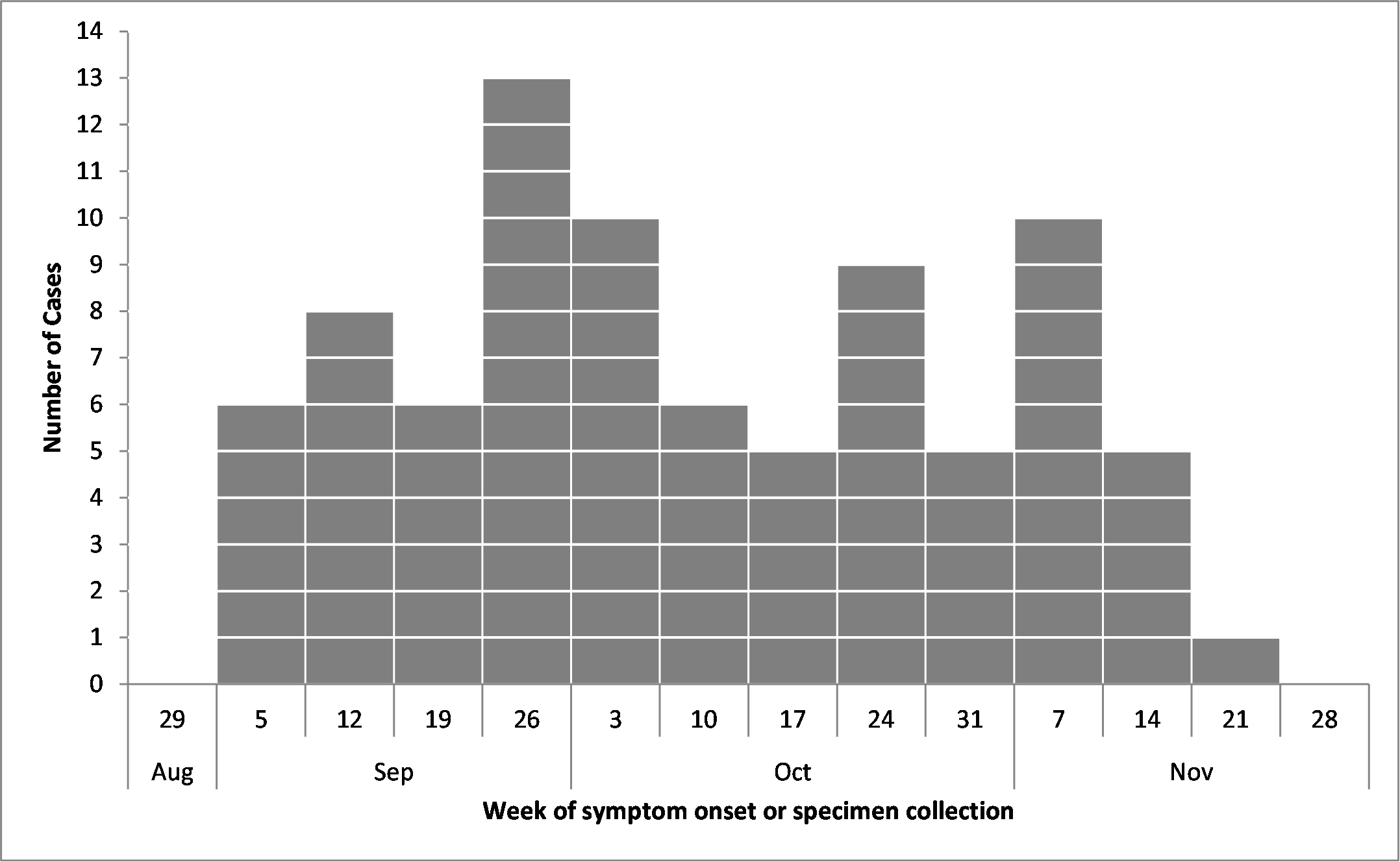
Figure 1 is an epidemiological curve for this outbreak, which shows the numbers of new cases by week. Outbreak investigators use this information to show when illnesses begin, when they peak, and when they trail off. It can take several weeks from the time a person becomes ill to when the illness is reported and testing confirms a link to the outbreak. Data are available for 84 cases.
Figure 1. Number of people infected with Salmonella EnteritidisFigure 1: Text description
The Centers for Disease Control Prevention Vessel Sanitation Program (CDC-VSP) reported that 118 passengers and crew on a recent voyage of the Viking Cruises, Viking Sea, were sickened with diarrhoea due to a gastrointestinal illness of unknown etiology.
The voyage, which took place November 29–December 13, 2021, resulted in 114 of 640 (17.8%) passengers and 4 of 404 (1.0%) crew members sickened.
In response to the outbreak, Viking Cruises and the crew aboard the ship reported the following actions:
Increased cleaning and disinfection procedures according to the ship’s outbreak prevention and response plan.
Collected stool specimens from passenger and/or crew gastrointestinal illness cases and sent specimens for testing.
Sent daily reports of gastrointestinal illness cases to VSP.
VSP is monitoring the situation and the ship’s outbreak response and sanitation procedures.
The State of North Carolina notified Caldwell County this late afternoon about a confirmed case of Hepatitis A in an individual who works at KFC in Hudson.
According to state guidelines, transmission to patrons is unlikely, so vaccination for restaurant patrons is not recommended at this time.
“We are working closely with the restaurant, the State of North Carolina, and the CDC to ensure the health and safety of our community,” said Anna Martin, Caldwell County Public Health Director.
The individual diagnosed with Hepatitis A is being treated. Individuals who came in close contact with the patient have been notified.
The nation is experiencing a large Hepatitis A outbreak, and everyone is encouraged to check their Hepatitis A vaccination status. Anyone who wishes to be vaccinated for Hepatitis A can call the Caldwell County Health Department at 828-426-8400 for a vaccination appointment. The Health Department is open Monday through Friday 8 a.m.-5 p.m.
The death toll in a suspected case of food poisoning in Dahod district’s Bhulwan village went up to eight on Wednesday, with one more person succumbing during treatment.
Seven of the 17 affected persons died until Tuesday after allegedly consuming a meal from the concluding ceremony of a nine-day religious event in Bhulwan village on Sunday. While four persons died late Monday, three succumbed Tuesday evening.
According to police, the villagers participated in sacrificing goats at the concluding ceremony of “Jatar” gathering, which is a nine-day religious event held every five years to pray for the well-being of the village.
A 23-year-old man suffering from food poisoning for more than 18 hours in his quarantine hotel room at Four Points by Sheraton in Tung Chung and was left unattended, raising alarm bells about lack of care for sick residents at isolation hotels.
He was however sent to North Lantau Hospital more than one hour after his friend’s Australian mother, who is a resident finally alerted the hotel front desk at about 2.30 pm Tuesday. Doctor later diagnosed he was suffering from food poisoning.
The man, named JB, arrived in Hong Kong from San Francisco with a 22-year-old friend last Sunday and started their 21 days quarantine at Four Points by Sheraton Hong Kong, Tung Chung. The two are Hong Kong residents and returning home after visited San Francisco.
JB felt gassy and nauseous on Monday night after eating chicken wings and rice provided by the hotel and started vomiting due to suspected food poisoning.
“It [the food] was a little cold when I picked it up,” said JB, “[the chicken wing] looked raw when I inspected after I threw up.”