Category Archives: foodborne disease

Infographics: Estimates of the global burden of foodborne diseases

WHO


USA – Outbreak Investigation of Listeria monocytogenes: Enoki Mushrooms (March 2020)

FDA

Case Counts

Total Illnesses: 36
Hospitalizations: 30
Deaths: 4
Illness Onset Date Range: November 23, 2016 – December 13, 2019

Recommendation

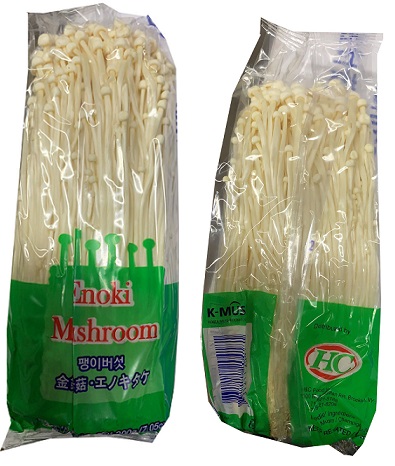
Consumers should not eat and should check their refrigerators and throw away any recalled enoki mushrooms from Sun Hong Foods, Inc., Guan’s Mushroom Co., and H&C Food, Inc. because they may be contaminated with Listeria monocytogenes.

Restaurants and retailers should not sell or serve recalled enoki mushrooms distributed by Sun Hong Foods, Inc., Guan’s Mushroom Co., and H&C Food, Inc.

FDA recommends that anyone who received recalled products use extra vigilance in cleaning and sanitizing any surfaces and containers that may have come in contact with these products to reduce the risk of cross-contamination. Listeria can survive in refrigerated temperatures and can easily spread to other foods and surfaces.

At this time, high risk groups, including the elderly, people with weakened immune systems or chronic diseases, pregnant women and their newborn babies, should not eat enoki mushrooms from Korea (Republic of Korea), even if they were not part of the recalls.

Consumers, restaurants, retailers, and high risk groups should discard and not eat, sell, or serve enoki mushrooms if they cannot tell where they came from.

H&C Food Inc Enoki Mushrooms


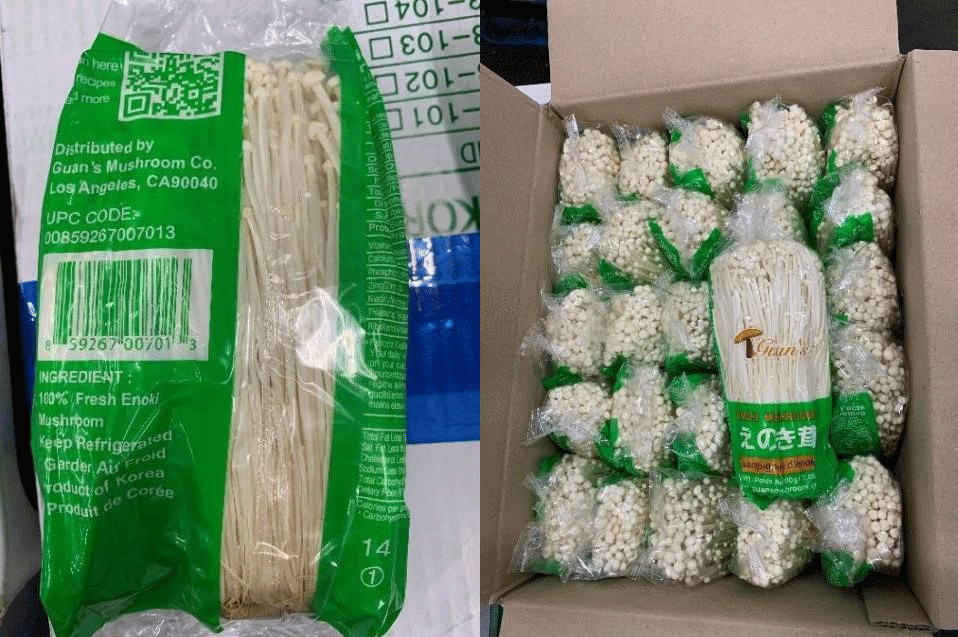
Guan’s Mushroom Co.
Guan’s Mushroom Co.
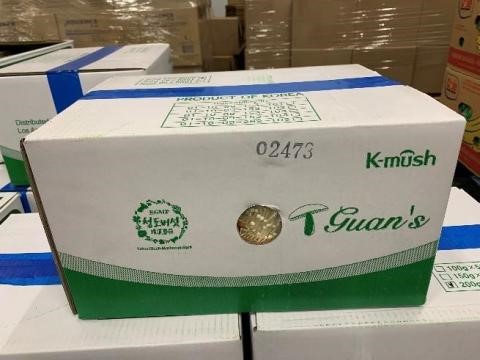
Picture of enoki mushroom case
Sample Enoki Mushrooms Imported from Korea
Company Size UPC Code Retailers* Distribution*
Sun Hong Foods, Inc. 200 g/ 7.05 oz. 7 426852 625810 J&L Supermarket, Jusgo Supermarket, ZTao Market, New Sang Supermarket, Galleria Market, Distributors CA, FL, IL, OR, TX, WA
Guan’s Mushroom Co. 200 g/ 7.05 oz. 859267007013 Sold to Distributors and Wholesalers CA, NY, PA
H&C Food Inc. 200 g/ 7.05 oz. 831211204181 Great Wall Supermarket NY, MD, VA

*This includes confirmed distribution information from companies; products could have been further distributed and sent to additional retailers and states.

Update

FDA, CDC, and state and local partners are currently investigating a multistate outbreak of Listeria monocytogenes infections linked to enoki mushrooms. Enoki mushrooms are a long thin white mushroom, usually sold in clusters. They are especially popular in East Asian cuisine and are also known as enokitake, golden needle, futu, or lily mushrooms.

On April 7, 2020, H&C Foods Inc. recalled 200 g/7.05 oz packages of enoki mushrooms imported from Green Co. LTD of the Republic of Korea. FDA import samples of enoki mushrooms from Green Co. LTD tested positive for Listeria monocytogenes and on April 6, 2020, whole genome sequencing analysis determined that the Listeria monocytogenes found in the positive samples matched the outbreak strain. As a result, On April 7, 2020, Green Co. LTD was placed on Import Alert 99-23, which flags imported shipments from this firm for potential detention without physical examination. The FDA is encouraging the international community to consult the Import Alert.

The investigation is ongoing to determine the source of contamination and if additional products are linked to illness. Additional information will be provided as it becomes available.

Information – Common Symptoms of All of the Food Poisoning Pathogens

Food Poisoning Bulletin

Food poisoning outbreaks occur every year in the United States. These outbreaks can be caused by bacteria such as E. coli, Salmonella, Listeria Monocytogenes, Clostridium botulinum, Campylobacter, Shigella, Staphylococcus aureus, Brucella, Vibrio, and Bacillus cereus; and viruses such as norovirus and hepatitis A. At least 48,000,000 Americans are sickened with food poisoning every year. Do you know the common symptoms of all of the food poisoning pathogens? Follow the link above to find out.


Research – Prevalence of Salmonella spp. and Campylobacter spp. in alternative and conventionally produced chicken in the United States: A systematic review and meta-analysis

JFP

The burden of foodborne illness linked to the consumption of contaminated broiler meat is high in the United States. With the increase in popularity of alternative poultry rearing and production systems, it is important to identify the difference in food safety risks presented by alternative systems when compared to conventional methods. While many studies have been conducted surveying foodborne pathogen prevalence along the broiler supply chain, a systematic overview of all of the available results is lacking. In the current study, a systematic review and meta-analysis was conducted to quantify the differences in Salmonella spp. and Campylobacter spp. prevalence in farming environment, rehang, prechill, postchill, and retail samples between conventional and alternative production systems. A systematic search of Web of Science and PubMed databases was conducted to identify eligible studies. Studies were then evaluated by inclusion criteria, and included studies were qualitatively and quantitatively analyzed. In total, 137 trials from 72 studies were used in the final meta-analysis. Meta-analysis models were individually constructed for subgroups that were determined by sample type, pathogen, and production type. All subgroups possessed high amounts of heterogeneity (I 2 > 75%). For environmental sample subgroups, Campylobacter prevalence was estimated to be 15.8 and 52.8% for conventional and alternative samples, respectively. Similar prevalence estimates for both production types were observed for Salmonella environmental samples and all retail samples. For conventional samples, Campylobacter and Salmonella prevalence was highest in prechill samples, followed by rehang and postchill samples, respectively. The presented results will be of use in future quantitative microbial risk assessments to characterize the differences in foodborne illness risks presented by different broiler production systems.

UK – New research shows societal burden of foodborne illness in the UK

FSA

The FSA Board has welcomed a report which presents new comprehensive estimates of the societal burden caused by foodborne illnesses in the UK.

The outcome of an extensive programme of work conducted over a five-year period was scrutinised by Members at the FSA Board Meeting, and provides a more in depth understanding of the wider impacts of foodborne diseases such as norovirus, campylobacter and listeria.

For the first time, the study also incorporates estimates based on the impacts of foodborne illness cases where a specific pathogen is not identified, often as a result of people not seeking medical attention.

The new model which produced the estimates follows an established process used in the UK and internationally to assess the financial impacts and the ‘human costs’ such as pain grief and suffering and changes to quality and length of life.

Estimates for these ‘human costs’ were developed in part by surveying more than 4,000 people to produce monetised values to measure the impact of different foodborne pathogens.

This will allow for these intangible human impacts to be considered alongside financial impacts when decisions relating to foodborne illnesses are made.

The model shows that for 2018:

  • the burden arising from the 13 main foodborne pathogens is around £3bn. Norovirus imposes the greatest burden at an estimated annual cost of £1.68bn followed by Campylobacter spp. (£0.71bn) and Salmonella spp. (non-typhoidal) (£0.21bn).
  • foodborne illness cases where a pathogen was not identified causes an estimated societal burden of around £6bn.
  • Taken together, the two estimates lead to a headline figure of approximately £9bn, as the annual cost burden of foodborne illness in the UK in 2018.
  • cases of Campylobacter, which are more common but generally less severe, impose a burden of £2,380 each while Listeria, the least common of the 13 measured, has a burden equivalent to £230,748 due to a higher proportion of fatalities, resulting in a higher ‘human cost’.


The Board welcomed the work and the report’s findings which provides the FSA with a more robust and comprehensive awareness of the impact of all foodborne illnesses and an additional tool to direct future decisions on prevention.

Heather Hancock, Chair of The Food Standards Agency said:

“I welcome this vital new research.  Being able to put a cost on the personal, social and economic burden when someone becomes ill as a result of food, represents a milestone for the FSA.

“We will use this new analysis of the cost of illness, and how it varies between different germs, to help set our priorities for tackling foodborne illness and to focus the FSA’s expertise, money and influence.”


Professor Rick Mumford, Head of Science Evidence and Research at the Food Standards Agency said:

“For the first time this model gives the FSA and other partners a much more detailed picture of how foodborne illnesses can impact society.

“We have designed it from the ground up to measure the impacts of specific pathogens as well as for the first time providing an estimate of the majority of cases where no pathogen is attributed.

“As a result, we are now equipped with robust, quantitative evidence on the impact of foodborne disease which significantly strengthens our decision-making ability.”


Richard Smith, Deputy Pro Vice Chancellor and Professor of Health Economics at the University of Exeter said:

“Providing an understanding of the impact of foodborne disease on individuals and wider society is a critical building block to understanding where and how to best deal with it.

“The FSA has a rich history of developing such analyses, and this latest work builds on that with significant revisions and updates to provide the most robust values yet of the societal impact of foodborne disease.

“This provides a robust, powerful and flexible tool to assist FSA in determining its priorities for tackling foodborne disease, which remains a serious challenge for our society.”

FSA economists worked with academics from leading UK universities to develop the Cost of Illness (COI) model to identify and measure all the costs of a particular disease.

The model is loosely based on the Health and Safety Executive (HSE)’s Cost to Britain model (Opens in a new window)which estimates the annual cost of workplace fatalities, self-reported injuries and ill health at £15bn.

This new model was quality assured internally and externally by independent experts and represents a significant improvement from the previous, much simpler model used to estimate the burden of foodborne illness. Further work is currently ongoing to apply these methodologies to other areas, including food allergy and hypersensitivity.

Notes to Editors

Publications

The Burden of Foodborne Disease in the UK 2018 Report

Other notes

Comparisons to previous estimates is not possible as this is the first time that the FSA have estimated the total burden of foodborne illness.

This estimate is therefore inevitably greater than the estimates for identifiable cases alone for the following reasons:

  • this is the first time we are measuring cases where no specific pathogen is attributed, which account for 60% of cases
  • the estimated number of illnesses cases attributed to foodborne illnesses has increased from 1 million to 2.4 million as announced last month
  • The new model uses a different methodology to calculate the non-financial ‘human costs’, which account for almost 80% of the overall burden

USA – Enoki Mushrooms Listeria Monocytogenes Outbreak Sickens 36

Food Poisoning Bulletin

At least 36 people are sick in an enoki mushroom Listeria monocytogenes outbreak linked to product imported from Korea. The mushrooms were imported by Sun Hong Foods. The mushrooms were just recalled after a sample tested positive for Listeria monocytogenes by the Michigan Department of Agriculture and Rural Development. There is zero tolerance for Listeria monocytogenes contamination in ready to eat foods in this country.

Enoki Mushrooms Listeria Monocytogenes Outbreak Sickens 36

Cruise Ship – Cruise ship outbreak: 190 sickened onboard Princess Cruises’ Caribbean Princess

Outbreak News Today

Federal health officials report investigating a gastrointestinal disease outbreak on a Princess Cruises’ Caribbean Princess February 2–16, 2020 voyage.

To date, 190 passengers and crew have experienced symptoms of vomiting and diarrhea. The exact etiology of the outbreak has not been determined.

Research – Novel composite antimicrobial film could take a bite out of foodborne illnesses

Science Daily

A novel composite film — created by the bonding of an antimicrobial layer to conventional, clear polyethylene plastic typically used to vacuum-package foods such as meat and fish — could help to decrease foodborne illness outbreaks, according to researchers in Penn State’s College of Agricultural Sciences.

The antimicrobial lining of the film is comprised of a pullulan-based biopolymer produced from starch syrup during a fermentation process, which is already approved for use in foods. Pullulan, a water-soluble “polysaccharide,” is essentially a chain of sugar, glycerin and cellulose molecules linked together. To kill pathogens such as SalmonellaListeria and pathogenic E. coli, researchers infused the pullulan with Lauric arginate, made from naturally occurring substances and already approved for use in foods.

Development of the composite antimicrobial film is important because 76 million cases of foodborne illnesses occur each year in the U.S. alone, resulting in 300,000 hospitalizations and 5,000 deaths, according to the U.S. Centers for Disease Control and Prevention. In light of this problem and the commercial potential of this discovery, Penn State has applied for a provisional patent on the composite antimicrobial film.

Information -Food Poisoning

foodsafety.gov

Food poisoning—any illness or disease that results from eating contaminated food—affects millions of Americans each year. While the American food supply is among the safest in the world, the Federal government estimates that there are about 48 million cases of foodborne illness annually—the equivalent of sickening 1 in 6 Americans each year. And each year these illnesses result in an estimated 128,000 hospitalizations and 3,000 deaths.

Causes of Food Poisoning

  • Bacteria and Viruses: Bacteria and viruses are the most common cause of food poisoning. The symptoms and severity of food poisoning vary, depending on which bacteria or virus has contaminated the food.
  • Parasites: Parasites are organisms that derive nourishment and protection from other living organisms known as hosts. In the United States, the most common foodborne parasites are protozoa, roundworms, and tapeworms.
  • Molds, Toxins, and Contaminants: Most food poisoning is caused by bacteria, viruses, and parasites rather than toxic substances in the food. But some cases of food poisoning can be linked to either natural toxins or added chemical toxins.
  • Allergens: Food allergy is an abnormal response to a food triggered by your body’s immune system. Some foods, such as nuts, milk, eggs, fish, crustacean shellfish, tree nuts, peanuts, wheat or soybeans, can cause allergic reactions in people with food allergies.

Click the link above for more information.

USA – Cyclospora Number One Multistate Food Poisoning Outbreak For 2019

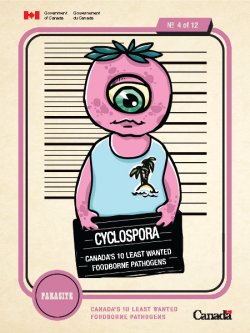
Food Poisoning Bulletin cardcyclosporasme

Cyclospora is the number one multistate food poisoning outbreak for 2019, with more than 2400 people sick. This wasn’t an individual outbreak, but many individual cases and several outbreaks linked to a venue or product. The overall number of domestically acquired cases is higher than those from 2017 and 2018.

hese are the outbreaks of cyclosporiasis linked to a venue or food:

  • An outbreak associated with workplace cafeterias in Virginia that sickened at least 39 people.
  • A large cyclospora outbreak at Cooper’s Hawk Winery in the Jacksonville, Florida area sickened at least 132 people in 11 states.
  • An outbreak in Minnesota sickened 35 people and was associated with three restaurants located in different areas of the state.
  • Cyclosporiasis illnesses in New York City in July sickened more than 90 people.
  • Boston Cyclospora outbreak, also in July, sickened more than 100 people.
  • A cyclospora outbreak linked to Siga Logistics de RL de CV basil imported from Mexico sickened more than 240 people. this was the largest individual outbreak in the overall case count.