Category Archives: Food Microbiology

RASFF Alerts – Aflatoxin – Pistachios and Hazelnuts

RASFF

Aflatoxin in Pistachio from Turkey in Italy

RASFF

Aflatoxins in hazelnuts from Georgia in Germany and Bulgaria

RASFF Alert- Norovirus – French Oysters

RASFF

Norovirus in oysters from France in Belgium

RASFF Alert -STEC E.coli – Minced Meat

RASFF

STEC (stx+;eae+) in minced meat from Belgium in France and the Netherlands

RASFF Alert – Listeria monocytogenes – Cheese – Chorizo – Dairy Products

RASFF

Detection of Listeria monocytogenes on cheese from France in Belgium and Luxembourg

RASFF

Detection of listeria monocytogenes in chorizo from Spain in France

RASFF

Presence of listeria monocytogenes in dairy products from Italy in Malta, Slovenia, France

RASFF Alerts – Salmonella – Sesame Seeds – Polish Chicken – Chicken Sausages – Chicken Breast – Turkey Meat –

RASFF

Salmonella Enteritidis in cream cake from Slovenia in Austria

RASFF

Salmonella in chicken sausages from Belgium in the Netherlands

RASFF

Detection of Salmonella enteritidis on chicken legs from Poland in France

RASFF

Salmonella in frozen roasted chicken breast from Ukraine in France, Germany and Netherlands

RASFF

Salmonella Typhimurium in turkey meat from Poland  in  Belgium, Czech Republic, Denmark, Germany, Hungary, Romania, Slovakia, Sweden.

RASFF

Salmonella spp in sesame seeds from Nigeria in Greece and Switzerland

RASFF

Salmonella spp in sesame seeds from Nigeria in Greece and Switzerland

RASFF

Salmonella spp in sesame seeds from Nigeria in Greece and Switzerland

RASFF

Salmonella spp in sesame seeds from Nigeria in Greece

RASFF

Salmonella spp. in sesame seeds from Nigeria in Greece

Research – Sanitizers to reduce Salmonella on and in turkey eggs evaluated

Feedstuffs

hazegg.jpg

USPOULTRY and the USPOULTRY Foundation have announced the completion of a funded research project at Cargill Inc., in which researchers evaluated egg wash sanitizers to reduce Salmonella contamination on and in turkey eggs. The research was made possible in part by an endowing Foundation gift from Cargill and proceeds from the International Poultry Expo, part of the International Production & Processing Expo (IPPE).

According to the research summary, Salmonella remains the number one cause of foodborne illness in the U.S., which causes an economic burden for the poultry industry as well as public concern for the consumers. As such, the poultry industry must be diligent during processing to reduce Salmonella risk, including interventions for hatch eggs.

Dr. Ted Brown and colleagues at Cargill, Inc. recently completed a research project that evaluated sanitizers with thymol, peracetic acid (PAA), bromine, peroxide, chlorine and quaternary ammonium. The peroxide product proved to be the most effective egg sanitizer at reducing Salmonella prevalence on the egg surface by more than 73%. None of the sanitizers tested in the trial caused damage to the cuticle, and Salmonella did not penetrate the egg.

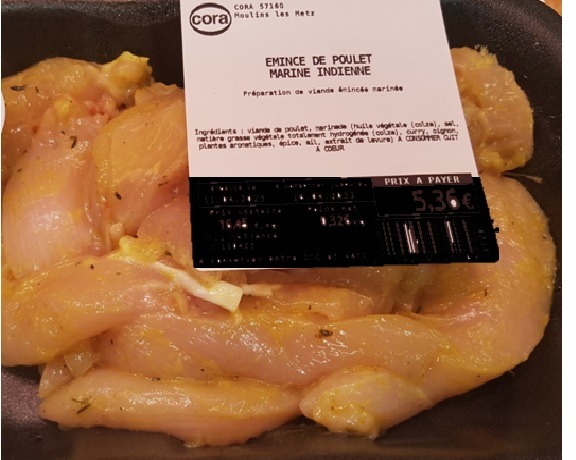
France – Indian marinated chicken mince – Salmonella

Gov france

Identification information of the recalled product

  • Product category Feed
  • Product subcategory Meats
  • Product brand name prepared by the store
  • Model names or references Indian marinated chicken mince
  • Identification of products
    GTIN Batch Date
    2054234000000 packed on 03/31/2023 Use-by date 05/04/2023
  • Packaging variable weight tray
  • Marketing start/end date From 31/03/2023 to 05/04/2023
  • Storage temperature Product to be stored in the refrigerator
  • Health mark/
  • Geographic area of ​​sale cora Moulins les Metz (57)
  • Distributor scora store Moulins les Metz

Practical information regarding the recall

  • Reason for recall presence of salmonella
  • Risks incurred by the consumer Salmonella spp (causative agent of salmonellosis)

Research – Getting Creative To Combat Foodborne Norovirus

Technology Networks

Every year, norovirus causes hundreds of millions of cases of food poisoning — and the deaths of at least 50,000 children — yet there exists no real way to control it. The virus has proven exceptionally difficult to study in the lab, and scientists have struggled to develop effective vaccines and drugs.

A new study at Washington University School of Medicine in St. Louis describes a creative way to make a vaccine against norovirus by piggybacking on the highly effective vaccines for rotavirus, an unrelated virus that also causes diarrhea.

The researchers created an experimental rotavirus-norovirus combo vaccine by adding a key protein from norovirus to a harmless strain of rotavirus. Mice that received the experimental vaccine produced neutralizing antibodies against both rotavirus and norovirus. The study, available online in Proceedings of the National Academy of Sciences, outlines an innovative approach to preventing one of the most common and intractable viral infections.

USA – FDA says the hepatitis A virus in this year’s frozen strawberry outbreak is identical to one from 2022

Food Safety News

Federal officials have confirmed that the strain of hepatitis A virus found in frozen organic strawberries involved in a multi-state outbreak this year is the same strain that caused an outbreak in 2022.

The organic strawberries associated with both outbreaks were imported to the United States from the same growing area in Baja California, Mexico, according to an outbreak update from the U.S. Food and Drug Administration.

So far this year there have been seven people confirmed infected and all seven reported eating frozen organic strawberries. Two of the patients required hospitalization.

FDA’s traceback investigation identified a common supplier of frozen organic strawberries, but Tuesday’s update did not name the supplier. Both this year and in 2022 the implicated strawberries were sold at a variety of stores under several different brand names.

Research – Austria reports Salmonella and Yersinia data for 2022

Food Safety News

Submissions of human Salmonella isolates are approaching pre-COVID-19 pandemic levels in Austria after a decline in 2020 and 2021, according to the Federal Ministry of Labour, Social Affairs, Health and Consumer Protection (BMSGPK).

In 2022, the number of isolates sent to the National Reference Centre for Salmonella increased by 118. This past year, 1,166 Salmonella isolates were submitted to the reference center compared with 1,048 in 2021. It is still below the 1,872 sent in 2019.

In 2022, the Austrian National Reference Centre for Yersinia at the Austrian Agency for Health and Food Safety (AGES) received 201 human isolates.

Of these, 107 were pathogenic, and 94 were non-pathogenic. Among the pathogenic ones, 105 belonged to Yersinia enterocolitica including 88 serovar O:3; biovar 4, and two were Yersinia pseudotuberculosis.

A total of 130 cases of yersiniosis were reported to BMSGPK. This was about the same level as in 2021. Based on data from 38 patients, 22 cases reported diarrhea, 11 had cases of abdominal pain and three each mentioned vomiting and fever.