Category Archives: Food Microbiology Research

USA – Webinar on the Foodborne Outbreak Response Improvement Plan – April 13th 2022

FDA

New Era for Smarter Food Safety

The U.S. Food and Drug Administration (FDA) is holding a webinar on the Foodborne Outbreak Response Improvement Plan that the agency released in early December 2021.

Deputy FDA Commissioner Frank Yiannas and FDA experts across agency’s human foods program will be available to explain and answer questions about the plan with the goal of raising awareness, enhancing understanding, and building support. Stakeholders are welcome to provide their insights as well as ask questions.

This response improvement plan focuses on tech-enabled product traceback, root cause investigations, analysis and dissemination of outbreak data, and operational improvements. It is intended to work in concert with FDA’s New Era of Smarter Food Safety Blueprint, which outlines specific approaches the FDA will take over the next decade to address food safety in the rapidly changing food system.

The plan was also informed by an independent review of the FDA’s structural and functional capacity to support, participate in, or lead multistate foodborne illness outbreak investigation activities. You will hear more about that review in this webinar.

The speakers will be:

  • Frank Yiannas, Deputy Commissioner for Food Policy and Response
  • RADM David Goldman, Chief Medical Officer, Office of Food Policy and Response
  • Stic Harris, Director, FDA’s Coordinated Response and Evaluation Network (CORE)
  • CDR Kari Irvin, Deputy Director, CORE
  • Scott MacIntire, Program Director, Office of Human and Animal Food Operations – West
  • Craig Hedberg, University of Minnesota, author of “An Independent Review of FDA’s Foodborne Outbreak Response Processes”

The webinar will also be recorded and posted to the FDA website.

You are also welcome to submit questions during the webinar to SmarterFoodSafety@fda.hhs.gov.

Registration

Registration is required. There will be an opportunity to ask questions in advance on the registration form.

REGISTERExternal Link Disclaimer

Additional Information

USA – New Era of Smarter Food Safety: FDA’s Foodborne Outbreak Response Improvement Plan

I. What progress have we made to date?

The FDA and its par

FDA

New Era of Smarter Food Safety - FDA's Foodborne Outbreak Response Improvement Plan Cover

Tackling foodborne outbreaks faster and revealing the root cause are essential for the prevention of future outbreaks. We have a plan to do that.

Foodborne disease remains a significant public health problem in the United States. The FDA’s Foodborne Outbreak Response Improvement Plan (FORIP), described in this document, is an important step that the FDA is taking to enhance the speed, effectiveness, coordination, and communication of outbreak investigations. (Unless stated otherwise, this report focuses exclusively on the response to human food and not animal food.)

Our ultimate goal is to bend the curve of foodborne illness in this country.


USA – Microbiological Surveillance Sampling: FY17–19 Processed Avocado and Guacamole

FDA

The U.S. Food and Drug Administration collected and tested processed avocado, the main ingredient in guacamole, and finished guacamole as part of the agency’s proactive and preventive approach to deploying its sampling resources with the ultimate goal of preventing contaminated food from reaching consumers.

Assignment Overview

The assignment began in November 2017 and ended in September 2019. In total, the FDA collected and tested 887 samples of processed avocado and guacamole (domestic and imported product) for Salmonella spp. and Listeria monocytogenes. This total is smaller than the initial number of samples the agency set out to collect and test because the agency encountered factors that twice required a reduction of the collection target, as explained in the Sample Collection section of this report (page 6).

As to the design of the assignment, the FDA directed its field staff not to collect products that had undergone high-pressure processing (HPP) or products intended for HPP. HPP is a “kill step” validated to eliminate pathogenic microorganisms in food, and it is often used in the manufacture of processed avocado and guacamole. In seeking to exclude from the assignment products that had been HPP-treated, the FDA’s intent was to focus on products that posed the greatest risk to consumers.

The agency learned during its evaluation of the test results that some of the products collected had received HPP treatment but were not labeled as such. FDA staff worked retrospectively with industry to identify the HPP-treatment status of the samples collected but could not determine the status of a number of samples. Those samples were designated as “could not ascertain” for purposes of the data analysis.

Findings and Follow-up Actions

The FDA detected Salmonella spp.in two samples which were later determined to be distinct samples of the same brand of domestically manufactured guacamole from different lots. Neither sample had received HPP treatment. In addition, the agency detected Listeria monocytogenes in 15 samples from nine different firms. Of those 15 samples, eight had not been HPP treated. The HPP-treatment status of the other seven samples could not be ascertained.

When the FDA detected a pathogen in a domestic sample, agency personnel worked with the company that owned or distributed the affected product to conduct a voluntary recall in all cases in which product was available, or likely to still be available, to consumers. The FDA also conducted one follow-up inspection of a domestic facility, and state officials in Florida likewise conducted one domestic inspection. As to the imported samples, the agency refused to admit lots associated with the positives and placed the responsible companies on import alert. In all, the agency placed two firms on import alert. In addition, the agency conducted whole genome sequencing (WGS) analysis on the positives but was unable to determine whether processed avocado or guacamole were the food vehicle associated with any known human illnesses.

In addition to affirming that Salmonella spp. and Listeria monocytogenes may be present in processed avocado and/or guacamole, the assignment data show that the estimated prevalence of these pathogens in the non-HPP-treated samples was higher than in the HPP-treated samples. This finding appears to support other research that shows HPP is effective at neutralizing pathogenic microorganisms,[1] even as this assignment was not designed to compare possible differences based on HPP-treatment status. The findings also underscore the need for processors and others in the processed avocado and guacamole supply chain to comply with the FDA’s Preventive Controls for Human Food Rule[2] and for importers of these foods to comply with the FDA’s Foreign Supplier Verification Programs Rule.[3]


USA – FDA Investigation of Cronobacter Infections: Powdered Infant Formula (February 2022) – The problem is more than two years old.

FDA

If you want to check if your powdered formula is part of the recall, you can enter the product lot code on the bottom of your package on the company’s websiteExternal Link Disclaimer.

If you have questions or need information about the recall, you can Submit Questions/Get Assistance.

If your infant is experiencing symptoms related to Cronobacter infection, such as poor feeding, irritability, temperature changes, jaundice, grunting breaths, or abnormal body movements; contact your health care provider to report their symptoms and receive immediate care.

To report an illness or adverse event, you can

The FDA, along with CDC and state and local partners are investigating consumer complaints and/or reports of infant illness related to products from Abbott Nutrition’s Sturgis, MI facility. All of the ill patients are reported to have consumed powdered infant formula produced from Abbott Nutrition’s Sturgis, MI facility.

The FDA is releasing the FDA Form 483s from three inspections conducted at Abbott Nutrition’s facility on Sept. 16-24, 2019Sept. 20-24, 2021, and Jan. 31-March 18, 2022. The inspectional observations in these Form 483s do not constitute final FDA determinations of whether any condition was or is in violation of the Federal Food, Drug, and Cosmetic Act or any of its implementing regulations. FDA will take appropriate action in the future – if warranted – as we continue to evaluate the 2022 inspectional findings.

Important observations noted in the 2022 Form 483 include, but are not limited to:

  • [Abbott Nutrition] did not establish a system of process controls covering all stages of processing that was designed to ensure that infant formula does not become adulterated due to the presence of microorganisms in the formula or in the processing environment.
  • [Abbott Nutrition] did not ensure that all surfaces that contacted infant formula were maintained to protect infant formula from being contaminated by any source.

Once the immediate public health risk is minimized, FDA will conduct a programmatic review to ensure the maximum effectiveness of agency programs and policies related to infant formula and special medical food complaints, illnesses, and recalls.

Conducting this review is a top priority for the FDA and will be done as efficiently as possible, and we can ensure this effort will not interfere with the immediate recall response activities. We will and must continue focusing on taking all steps possible to protect the health of those who rely on safe powdered infant formula.

Recommendation

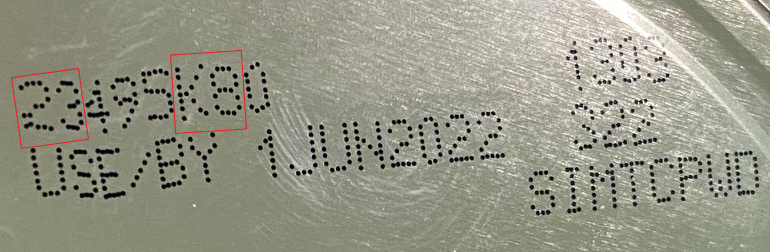
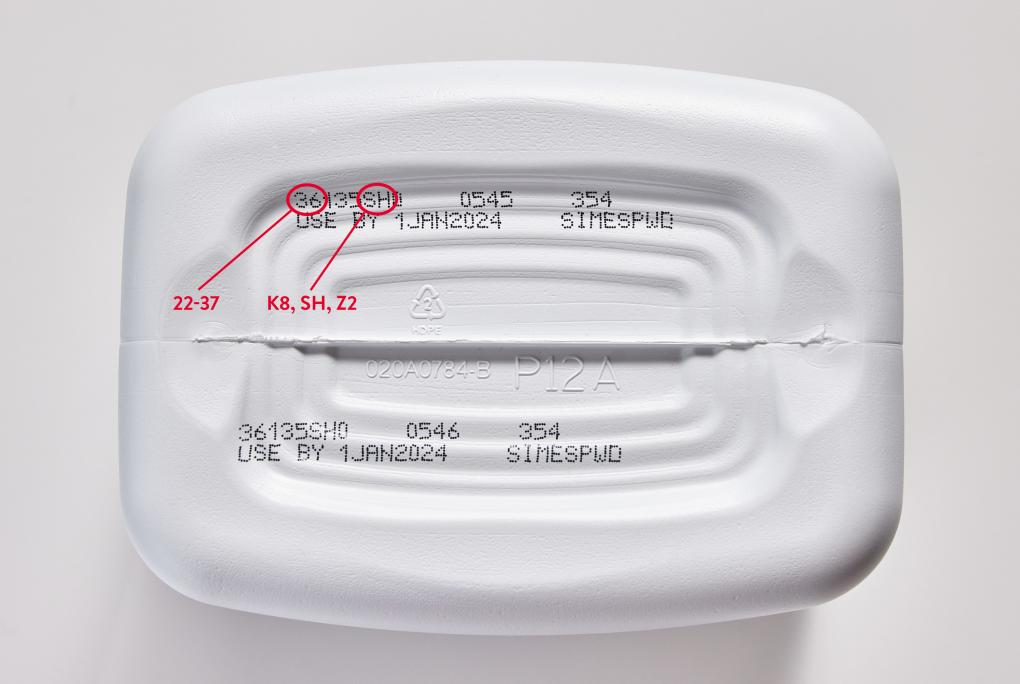
The FDA is advising consumers not to use recalled Similac, Alimentum, or EleCare powdered infant formulas. Recalled products can be identified by the 7 to 9 digit code and expiration date on the bottom of the package (see image below). Products are included in the recall if they have all three items below:

  • the first two digits of the code are 22 through 37 and
  • the code on the container contains K8, SH, or Z2, and
  • the expiration date is 4-1-2022 (APR 2022) or later.

In addition to products described above, Abbott Nutrition has recalled Similac PM 60/40 with a lot code 27032K80 (can) / 27032K800 (case). At this time, Similac PM 60/40 with lot code 27032K80 (can) / 27032K800 (case) is the only type and lot of this specialty formula being recalled. Additional recall information for the initial recall is available on the FDA website. Parents can also enter their product lot code on the company’s websiteExternal Link Disclaimer to check if it is part of the recall.

Additional information for parents and caregivers of infants receiving medical specialty infant formulas and individuals using certain medical foods is available below.

Additional Information for Parents and Caregivers:

The recalls do not include liquid formula products.

Parents and caregivers should never dilute infant formula and should not make or feed homemade infant formula to infants. Consumers should also avoid purchasing imported formula through online sales, as it has the potential to be counterfeit.

If your regular formula is not available, contact your child’s healthcare provider for recommendations on changing feeding practices.

If you get infant formula through WIC, do not throw the formula out. Instead, you should take it to the store for a refund and exchange or call the company at 1-800-986-8540 to help you. WIC recipients should be able to obtain a different brand of similar formula. Call your local WIC clinic for more guidance. Also see:

More information on Cronobacter and infant formula is available on CDC’s website.

Recalled powdered infant formulas have the potential to be contaminated with Cronobacter, a bacterium that can cause severe foodborne illness primarily in infants. Cronobacter infections are rare but are especially high risk for newborn infants (see symptoms below).

Cronobacter bacteria can cause severe, life-threatening infections (sepsis) or meningitis (an inflammation of the membranes that protect the brain and spine). Symptoms of sepsis and meningitis may include poor feeding, irritability, temperature changes, jaundice (yellow skin and whites of the eyes), grunting breaths, and abnormal body movements. Cronobacter infection may also cause bowel damage and may spread through the blood to other parts of the body.

If your child is experiencing any of these symptoms, you should notify your child’s healthcare provider and seek medical care for your child immediately. Healthcare providers and health departments are encouraged to report any confirmed cases of Cronobacter sakazakii to CDC.


Product Images

Sample Product Image from the FDA Investigation of Cronobacter and Salmonella Complaints about Powdered Infant Formula (February 2022)

Case Counts

Total Adverse Events: 4
Hospitalizations: 4
Reported Deaths: 2*
Illness Onset Date Range: 9/6/2021 – 1/4/2022
States with Adverse Events: MN (1), OH (2), TX (1)
Product Distribution: Nationwide and International
* Two deaths have been reported. Cronobacter infection may have contributed to the cause of death for both patients.

USA – FDA issues warning to New Mexico onion importer linked to Salmonella outbreak

Food Safety News

An import company in New Mexico is on notice from the FDA for not having food safety documents for a number of imported foods. The inspection was initiated because of an investigation of a multistate foodborne outbreak of Salmonella Oranienburg illnesses linked to whole, fresh onions imported from the state of Chihuahua, Mexico.

The outbreak has sickened more than 800 people in the United States and remains under investigation. The Centers for Disease and Prevention has not yet declared the outbreak over.

In its warning letter the Food and Drug Administration  acknowledged that the company initiated a voluntary recall on Oct. 22, 2021, of red, yellow, and white onions imported from its “suppliers (redacted)” in Chihuahua, Mexico, from July 1, 2021, through Aug. 25, 2021.

In the March 2, 2022, warning letter just made public by the FDA, the agency described a Nov. 16, 2021, Foreign Supplier Verification Program (FSVP) inspection of Keeler Family Farms in DemingNM.

USA – Welcome to the Agricultural Water Assessment Builder!

FDA

Thank you for choosing to use the Agricultural Water Assessment Builder. The Agricultural Water Assessment Builder v. 1.0 is a user-friendly tool designed to help farms understand the proposed requirements for an agricultural water assessment in the “Standards for the Growing, Harvesting, Packing, and Holding of Produce for Human Consumption Relating to Agricultural Water” proposed rule (agricultural water proposed rule). If finalized, the rule would replace the microbial criteria and testing requirements for pre-harvest agricultural water for covered produce (other than sprouts) in the 2015 Produce Safety Final Rule with provisions for systems-based agricultural water assessments. Relevant definitions and resources can be viewed by clicking the icon next to the title of this page.
We welcome feedback on v1.0 of this optional tool, such as suggestions related to the tool’s functionality and useability. Feedback on the tool can be sent to agwaterbuilder@fda.hhs.gov.
Use of this tool is not required by law (see legal disclaimer) and would not be required. If the agricultural water proposed rule is finalized, FDA expects this tool to supplement and not replace other education, training, and experience that would be needed to understand and implement the requirements of the rule.
The information entered into this page will not be shared with FDA and will not be saved. If you need to pause while entering information, we recommend that you export a copy of your data and save it to your local machine. Once the document is saved, you may resume at a later time, and upload the file to begin from where you paused. Once you have reached the end of this tool, you will be given the opportunity to print out a summary of the information entered. Remember, the data that is entered here is not saved unless your export a file to save on your computer.
This tool is being provided for illustrative purposes only because the requirements for agricultural water assessments under proposed § 112.43 have not been finalized.
Legal disclaimer: Use of the Agricultural Water Assessment Builder v. 1.0 does not constitute FDA approval of an agricultural water assessment or guarantee compliance with FDA’s requirements, if finalized. FDA has taken all reasonable precautions in creating the Agricultural Water Assessment Builder v. 1.0. However, FDA is not responsible for errors, omissions or deficiencies regarding the tool. The Agricultural Water Assessment Builder v. 1.0 is available “as is” and without warranties of any kind, either expressed or implied, including, but not limited to, warranties of performance, merchantability, and fitness for a particular purpose. FDA is not making a commitment in any way to regularly update the tool. Responsibility for the interpretation and use of the Agricultural Water Assessment Builder v. 1.0 lies solely with the user. Third parties’ use of or acknowledgment of the tool does not in any way represent that FDA endorses such third parties or expresses any opinion with respect to their statements.

USA – Salmonella accounted for nearly 80 percent of pathogen violations in U.S. food imports from 2002 to 2019

USDA

<i>Salmonella</i> accounted for nearly 80 percent of pathogen violations in U.S. food imports from 2002 to 2019

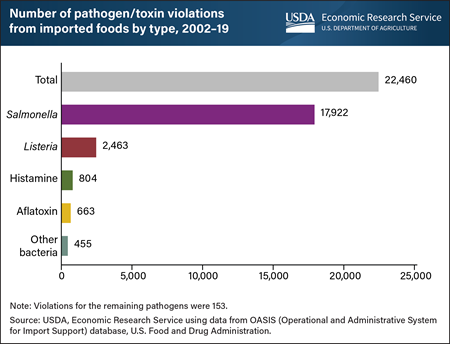
As the quantity of food imported into the United States continues to rise, it is increasingly important to minimize foodborne illness risks for U.S. consumers. Foods contaminated with pathogens or toxins can result in foodborne illnesses. A recent USDA, Economic Research Service (ERS) study examined the number of U.S. import refusals caused by pathogen/toxin contamination and which pathogens accounted for those safety violations. From 2002 to 2019, 22,460 pathogen/toxin violations were discovered among imported shipments. Salmonella was the most frequently identified agent among imported foods during the period with 80 percent, or 17,922 of total pathogen/toxin violations. Listeria recorded the second largest number of violations at 2,463, accounting for 11 percent of the total. It was followed by histamine with 804 violations (3.6 percent), aflatoxin with 663 violations (3 percent), and bacteria other than Salmonella or Listeria with 455 violations (2 percent). Those five most frequently detected pathogens and toxins accounted for 99.3 percent of the total pathogen/toxin violations from imported foods over the period. This chart was drawn from the ERS report Examining Pathogen-Based Import Refusals: Trends and Analysis From 2002 to 2019, published December 2021.

Research – Novel Salmonella Phage, vB_Sen_STGO-35-1, Characterization and Evaluation in Chicken Meat

MDPI

Salmonellosis is one of the most frequently reported zoonotic foodborne diseases worldwide, and poultry is the most important reservoir of Salmonella enterica serovar Enteritidis. The use of lytic bacteriophages (phages) to reduce foodborne pathogens has emerged as a promising biocontrol intervention for Salmonella spp. Here, we describe and evaluate the newly isolated Salmonella phage STGO-35-1, including: (i) genomic and phenotypic characterization, (ii) an analysis of the reduction of Salmonella in chicken meat, and (iii) genome plasticity testing. Phage STGO-35-1 represents an unclassified siphovirus, with a length of 47,483 bp, a G + C content of 46.5%, a headful strategy of packaging, and a virulent lifestyle. Phage STGO-35-1 reduced S. Enteritidis counts in chicken meat by 2.5 orders of magnitude at 4 °C. We identified two receptor-binding proteins with affinity to LPS, and their encoding genes showed plasticity during an exposure assay. Phenotypic, proteomic, and genomic characteristics of STGO-35-1, as well as the Salmonella reduction in chicken meat, support the potential use of STGO-35-1 as a targeted biocontrol agent against S. Enteritidis in chicken meat. Additionally, computational analysis and a short exposure time assay allowed us to predict the plasticity of genes encoding putative receptor-binding proteins.

Research – Co-Occurrence of L. monocytogenes with Other Bacterial Genera and Bacterial Diversity on Cleaned Conveyor Surfaces in a Swine Slaughterhouse

MDPI

Bacterial pathogens, such as Listeria monocytogenes, can show resistance to disinfection and persistence on working surfaces, permitting them to survive and contaminate food products. Persistence—a complex phenomenon involving interactions between many bacteria within a biofilm—is modulated by in situ characteristics. This study aimed to describe, in silico, the microbiota identified in a swine slaughterhouse after sanitation procedures to better understand the presence of L. monocytogenes on these surfaces. Molecular tools for characterization of microbial communities were used to assess the relative contribution of different bacteria resulting from this phenomenon, and the 16S rRNA sequencing method was used on samples from meat conveyor belt surfaces collected on four sampling visits to study the co-occurrence between L. monocytogenes and other bacteria. From the background microbiota, a total of six genera were found to be negatively correlated with Listeria spp., suggesting Listeria growth inhibition, competition, or at least an absence of shared habitats. Based on these results, a complete scenario of interactions of Listeria with components of background microbiota was established. This work contributes to identifying avenues that could prevent the growth and persistence of L. monocytogenes on food-processing surfaces. View Full-Text

Research – Campylobacter jejuni vaccine candidate set for human trials

Outbreak News Today

A potential vaccine developed by University of Guelph researchers to combat one of the main causes of bacterial diarrheal illness worldwide is set to be tested on people early this year.

Human clinical trials of a novel sugar-based vaccine will take place in 2022 at the Cincinnati Children’s Hospital Medical Center. The trials will be funded by the United States National Institutes of Health.

Dr. Mario Monteiro, a professor in the College of Engineering and Physical Sciences, hopes recent refinements to the vaccine in his lab following earlier phase one trials will improve its effectiveness against the Campylobacter jejuni bacterium.