Category Archives: Food Microbiology Blog

Research – Heterotrophic Plate Count Can Predict the Presence of Legionella spp. in Cooling Towers

MDPI

Abstract

Legionella pneumophila (Lp) colonizes aquatic environments and is a potential pathogen to humans, causing outbreaks of Legionnaire’s disease. It is mainly associated with contaminated cooling towers (CTs). Several regulations, including Spanish legislation (Sl), have introduced the analysis of heterotrophic plate count (HPC) bacteria and Legionella spp. (Lsp) in management plans to prevent and control Legionella outbreaks from CTs. The 2003 Sl for CTs (RD 865/2003) considered that concentrations of HPC bacteria ≤10,000 cfu/mL and of Lsp ≤100 cfu/L are safe; therefore, no action is required, whereas management actions should be implemented above these standards. We have investigated to what extent the proposed standard for HPC bacteria is useful to predict the presence of Lsp in cooling waters. For this, we analyzed Lsp and HPC concentrations, water temperature, and the levels of chlorine in 1376 water samples from 17 CTs. The results showed that in the 1138 water samples negative for Legionella spp. (LN), the HPC geometric mean was significantly lower (83 cfu/mL, p < 0.05) than in the positive Lsp. samples (135 cfu/mL). Of the 238 (17.3%) LP samples, 88.4% (210/238) were associated with values of HPC ≤10,000 cfu/mL and most of them showed HPC concentrations ≤100 (53.7%). In addition, a relatively low percentage of LP (28/238, 11.6%) samples were associated with HPC bacteria concentrations >10,000 cfu/mL, indicating that this standard does not predict the colonization risk for Legionella in the CTs studied. The present study has demonstrated that a threshold concentration ≤100 cfu/mL of HPC bacteria could better predict the higher concentration of Legionella in CTs, which will aid in preventing possible outbreaks.

Research – Effect of High Hydrostatic Pressure Processing on the Microbiological Quality and Bacterial Diversity of Sous-Vide-Cooked Cod

MDPI

Abstract

High hydrostatic pressure (HP) is a promising method to improve the microbiological quality of sous-vide foods. Monitoring the composition and behavior of the microbial communities in foods is of most importance for the production of high-quality and safe products. High-throughput sequencing (HTS) provides advanced approaches to determine food’s microbial community composition and structure. The aim of the present study was to determine the impact of different HP treatments on the microbial load and bacterial diversity of sous-vide Atlantic cod. Sous-vide cooking at 57.1 °C for 30 min followed by HP treatment at 500 MPa for 8 min reduced viable cell counts (total aerobic mesophiles) in the cod samples below detectable levels for 45 days of storage under refrigeration. In a second trial with cod cooked sous-vide at 52 °C for 20 min followed by HP treatments at 300 or 600 MPa (with HP treatment temperatures of 22 °C or 50 °C for 4 or 8 min, depending on treatment), only the treatments at 600 MPa delayed bacterial growth for at least 30 days under refrigeration. The optimal HP conditions to improve the microbiological quality of sous-vide cod cooked at low temperatures were obtained at 600 MPa for 4 min at a pressurization temperature of 50 °C. Bacterial diversity was studied in cod cooked sous-vide at 52 °C for 20 min by HTS. In the absence of HP treatment, Proteobacteria was the main bacterial group. A succession of Pseudomonadaceae (Pseudomonas) and Enterobacteriaceae was observed during storage. Firmicutes had low relative abundances and were represented mainly by Anoxybacillus (early storage) and Carnobacterium (late storage). The HP-treated sous-vide cod showed the greatest differences from controls during late storage, with Aerococcus and Enterococcus as predominant groups (depending on the HP conditions). The application of HTS provided new insights on the diversity and dynamics of the bacterial communities of sous-vide cod, revealing the presence of bacterial genera not previously described in this food, such as Anoxybacillus. The significance of Anoxybacillus as a contaminant of seafoods should be further investigated.

Research – Comparison of Activity of Commercial Protective Cultures and Thermophilic Lactic Acid Bacteria against Listeria monocytogenes: A New Perspective to Improve the Safety of Sardinian PDO Cheeses

MDPI

Abstract

Listeria monocytogenes contamination that occurs during and post-processing of dairy products is a serious concern for consumers, and bioprotective cultures can be applied to control the growth of the pathogen in sheep milk cheeses. However, to respect specifications provided for protected designation of origin (PDO) cheeses, only autochthonous microorganisms can be used as bioprotective cultures in these products. This in vitro study aimed to evaluate thermophilic lactic acid bacteria (LAB) isolated from sheep milk as bio-preservative agents to control L. monocytogenes growth in PDO cheese. Results were compared with those obtained with a commercial protective culture (cPC) composed of a Lactiplantibacillus plantarum bacteriocin producer designed to inhibit L. monocytogenes growth in cheese. The in vitro antilisterial activities of n.74 autochthonous LAB and a cPC were tested against 51 L. monocytogenes strains using an agar well diffusion assay. In addition, 16S rRNA sequencing of LAB isolates with antilisterial activity was conducted and strains of Lactobacillus helveticus, Lactobacillus delbrueckii subsp. indicus, Lactobacillus delbrueckii subsp. sunkii, Lactobacillus delbrueckii subsp. lactis and Enterococcus faecalis were identified. In this study, 33.6% (74/220) bacterial strains isolated from milk had characteristics compatible with thermophilic LAB, of which 17.6% (13/74) had in vitro antilisterial activity. These results demonstrate that raw sheep milk can be considered an important source of autochthonous thermophilic LAB that can be employed as protective cultures during the manufacturing of Sardinian PDO cheeses to improve their food safety. The use of bioprotective cultures should be seen as an additional procedure useful to improve cheese safety along with the correct application of good hygienic practices during manufacturing and the post-processing stages.

France – Rib dish cooked in jelly – Listeria monocytogenes

Gov france

Identification information of the recalled product

  • Product category Feed
  • Product subcategory Meats
  • Product brand name unbranded
  • Model names or references Rib dish cooked in jelly
  • Identification of products
    GTIN Batch Date
    3451950106460 23068 Use-by date 04/13/2023
  • Packaging Product sold at Carrefour in a salad bowl of approximately 3.6 kg
  • Storage temperature Product to be stored in the refrigerator
  • Health mark FR 76 681 001
  • Geographic area of ​​sale Whole France
  • Distributors Crossroads
  • List of points of sale Traceability.pdf

Practical information regarding the recall

  • Reason for recall Presence of Listeria
  • Risks incurred by the consumer Listeria monocytogenes (causative agent of listeriosis)

USA – Scenic Fruit Company Recalls Frozen Organic Strawberries and Frozen Organic Tropical Fruit Blend Because of Possible Health Risk – Hepatitis A

FDA

Simply Nature

Made With

Kirkland Signature

PCC Community Markets

Trader Joe’s

March 16, 2023, Scenic Fruit Company of Gresham, Oregon is recalling frozen Organic Strawberries sold to Costco, Aldi, KeHE, Vital Choice Seafood, PCC Community Markets and frozen Organic Tropical Fruit Blend sold to Trader Joe’s due to an outbreak of Hepatitis A illnesses.

Hepatitis A is a contagious liver disease that results from exposure to the Hepatitis A virus, including from food. It can range from a mild illness lasting a few weeks to a serious illness lasting several months. In rare cases, particularly consumers who have a pre-existing severe illness or are immune compromised, Hepatitis A infection can progress to liver failure.

Illness occurs within 15 to 50 days of exposure and includes fatigue, abdominal pain, jaundice, abnormal liver tests, dark urine, and pale stool. Hepatitis A vaccination can prevent illness if given within two weeks of exposure to a contaminated food. Persons who may have consumed affected product should consult with their health care professional or local health department to determine if a vaccination is appropriate, and consumers with symptoms of Hepatitis A should contact their health care professionals or the local health department immediately.

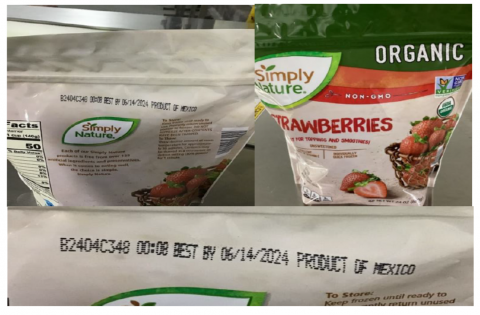
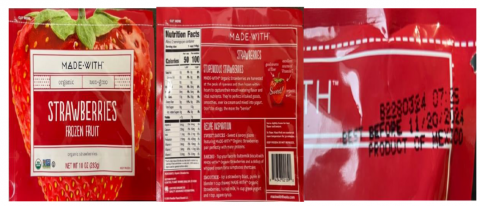
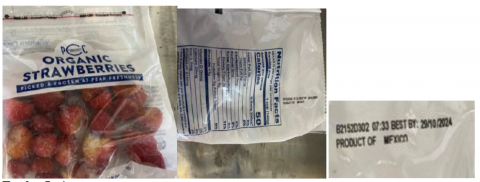
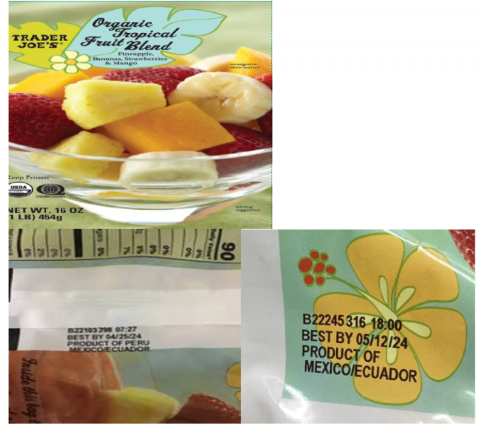
The following products are subject to this recall. The lot codes and best by dates are found on the back of each bag (see attached pictures below):

Brand Name Product Name Net Wt. UPC Best By Dates
Best If Use Dates
Best Before Date
Distributed in States
Simply Nature Organic Strawberries 24 oz. 4099100256222 6/14/2024 California, Minnesota,
Missouri, Ohio, Wisconsin.
Vital Choice Organic Strawberries 16 oz. 834297005024 5/20/2024 Washington
Kirkland Signature Organic Strawberries 4 lbs. 96619140404 10/8/2024 Alaska, Idaho, Montana,
Oregon, Utah, Washington.
Made With Organic Strawberries 10 oz. 814343021390 11/20/2024 Illinois, Maryland
PCC Community
Markets
Organic Strawberries 32 oz. 22827109469 29/10/2024 Washington
Trader Joe’s Organic Tropical Fruit
Blend Pineapple,
Bananas, Strawberries
& Mango
16 oz 00511919 04/25/24
05/12/24
05/23/24
05/30/24
06/07/24
Nationwide

Although Hepatitis A has not been detected on this product, out of an abundance of caution, consumers should stop consuming the product and return it to their local store for a refund. The company has ceased the production and distribution of the product as FDA and the company continue their investigation as to what caused the problem.

All inventories of the affected lot should be removed from sale. Consumers who have purchased the products are urged to destroy or return it to the place of purchase for a full refund. Consumers with questions may contact the company at customer.service@scenicfruit.com

Italy – Horse sliver g 500 atm – Listeria monocytogenes

Salute

Brand : Coppiello Giovanni srl

Name : horse sliver g 500 atm

Reason for reporting : Remind for microbiological risk

Date of publication : 17 March 2023

Documentation

Documentation

USA – Another Hepatitis A recall linked to Strawberries

Food Poison Journal

We have been alerted by our supplier of Trader Joe’s Organic Tropical Fruit Blend (SKU# 51191) that product with BEST BY dates of 04/25/24, 05/12/24, 05/23/24, 05/30/24, and 06/07/24 may have the potential to be contaminated with Hepatitis A.

No illnesses have been reported to date, and all potentially affected product has been removed from sale and destroyed.

If you purchased any Organic Tropical Fruit Blend, please do not eat it. We urge you to discard the product.

Luxembourg – MATCH BRAND POPCORN – Aflatoxin

SAP

Match is recalling the following product in Luxembourg:

Nom Maïs Popcorn
Marque Match
Unit 250 g
Code barre 5410781251068
DDM 23/12/2023
Sale period from 03/01/2023 to 03/16/2023

Danger  : Too high aflatoxin content

Aflatoxins are mycotoxins produced by certain species of Aspergillus molds which develop when the temperature and humidity level of the food is high. Aflatoxins are considered genotoxic and carcinogenic by the European Food Safety Authority and can be dangerous with high and repeated consumption.

Sale confirmed in Luxembourg by: Match/Smatch

Information Source: Match Recall Notification

Denmark – Mold/mould on tortilla wraps

DVFA

Dagrofa ApS is recalling Banderos tortilla wraps with whole grain, as there is a risk of mold on the product. The product should be returned to the store where it was purchased or discarded.

Recalled foods , Published: March 17, 2023

​Which food:

​​Banderos tortilla wrap with whole grain
Net weight: 370g
EAN code: 7611612700948
Best before date: 19.06.2023

Sold in: The retail chains MENY, SPAR, Let-Køb, Min Købmand, Liva, ABC low price, WOLT, Løvbjerg and some stores outside the chains.

Why :
The company has established that there is a risk of mold on the product. Mold formation makes the product unsuitable as food.

Read more about mold on food here:
https://www.foedevarestyrelsen.dk/Foedevarer/kend_kemien/Sider/Spekifikke-foedevarer.aspx

​What should you do as a consumer:
​The Food and Drug Administration advises consumers to return the product to the store where it was purchased or to discard it.

Who returns the product :
Dagrofa ApS, Kærup Industrivej 12, 4100 Ringsted

Sweden – Coop recalls eggs – may contain Salmonella

Livsmedelsverket

Coop recalls eggs due to risk of salmonella.