Category Archives: Food Illness

UK – FSA issues precautionary safety advice for specific melons

FSA

There have been some recent salmonella cases of illness in the UK, the possible source is thought to be whole honeydew, cantaloupe and galia melons originating from Costa Rica, Honduras or Brazil bought on or before 28 May 2021.

Consumers may be able to identify the country of origin from a sticker on the fruit. If consumers are not sure about the country of origin of their galia, cantaloupe or honeydew melon, they are advised to dispose of the fruit as a precaution.

We are aware that a large number of UK retailers may have stocked the affected melons, which have now been removed from sale.

Tina Potter, Head of Incidents for the Food Standards Agency said:

‘As a precaution we are advising people not to eat these melons and to dispose of them. It is important that consumers wash their hands and any surfaces that have been in contact with the melons thoroughly. This will help avoid the risk of cross contamination and the risk of illness.’

Professor Saheer Gharbia, Head of Gastrointestinal Pathogens Unit at Public Health England, said:

‘Symptoms of salmonellosis typically resolve themselves and include diarrhoea, stomach cramps, nausea, vomiting and fever. However, symptoms can be more severe and lead to hospitalisation, especially in the very young and those with weakened immune systems. Anybody with concerns that they have symptoms of salmonellosis should contact their GP or out of hours service.’

Anyone who is concerned about symptoms should contact their GP or out of hours service in the first instance.

Only the melons listed above are affected. We are working with Public Health England, Food Standards Scotland and other UK health protection and food safety colleagues to continue investigations.

Research – A Nosocomial Outbreak of Invasive Listeriosis in An Italian Hospital: Epidemiological and Genomic Features

MDPI

Listeria monocytogenes (L. monocytogenes) is a widespread opportunistic pathogen that causes the listeriosis foodborne disease. This bacterium has become a common contaminant of handled food, and a relevant public health issue. Here we describe a nosocomial outbreak of listeriosis caused by an ST451 strain of L. monocytogenes involving three cancer and one immunocompromised patients hospitalized in different units from the same hospital during September and October 2020. The epidemiological investigation was conducted using traditional microbiological methodology combined with a whole genome sequencing approach. The source of contamination was identified in the kitchen hospital, where a meat slicer used to prepare patients’ meals was tested positive to the same sequence type (ST) of L. monocytogenes. This is the first report of an outbreak of listeriosis caused by ST451 in Italy. View Full-Text

USA – More added to patient list in E. coli outbreak tied to organic yogurt

Food Safety News

An E. coli outbreak linked to locally produced organic yogurt is growing, with 15 people now confirmed infected. Eleven of the patients are children.

Washington State health officials report nine of the patients have required hospitalization and four have developed the potentially deadly kidney complication known as hemolytic uremic syndrome (HUS). No deaths have been reported as of the health department’s May 26 update.

“The outbreak is likely linked to PCC Community Market brand yogurt produced by Pure Eire Dairy,” according to the update and information previously reported by state and local officials. The dairy also produces organic yogurt under the Pure Eire brand.

RASFF Alerts – Foodborne outbreak -Salmonella Dublin in chilled raw milk cheese

RASFF

Foodborne outbreak suspected to be caused by Salmonella Dublin in chilled raw milk cheese from France

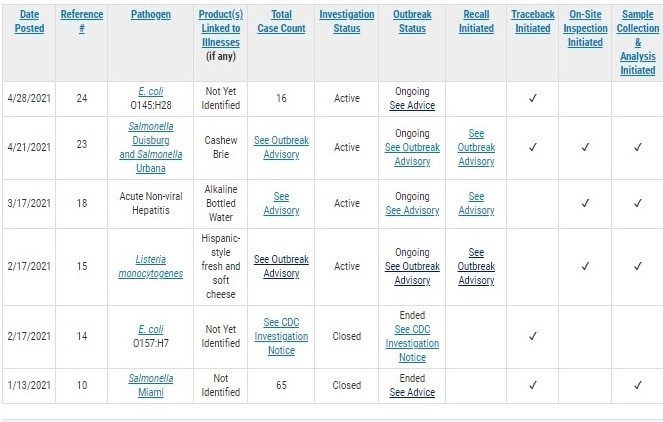
USA – FDA Core Investigation Table Update

FDA

0a

Research – Hepatitis A outbreak associated with consumption of dates, England and Wales, January 2021 to April 2021

Eurosurveillance

An outbreak of genetically related hepatitis A virus (HAV) infections among people with no travel history was identified by the Public Health England (PHE) Virus Reference Department (VRD) in conjunction with local teams noting that the cases had eaten dates.

We describe investigations including case characteristics, phylogenetics, analytical studies, and control measures. We aim to flag the possible risk of hepatitis A to populations in other countries through the consumption of contaminated dates, particularly as Ramadan, which is associated with an increase in consumption of dates, began on 12 April 2021, and hepatitis A has a long incubation period of 15 to 50 days.

A confirmed case was defined as a laboratory-confirmed HAV infection with one of three clustered sequences (sequences VRD21_HAV005, VRD21_HAV009 and VRD21_HAV020) and onset date from 1 January 2021 in England or Wales, no travel history or contact with a suspected or confirmed HAV case in the 60 days before onset. A probable case was a laboratory-confirmed HAV infection, with no or pending sequencing result, and with an epidemiological link to a confirmed HAV case with one of the three clustered sequences.

Samples from all locally diagnosed HAV infections in England and Wales are routinely sent to the VRD for characterisation. The outbreak cases had HAV from three closely related Middle Eastern genotype IB sequences (≤ 2 bp different in a 505 bp segment) which clustered most closely with those found in travellers returning from Syria and Lebanon. The sequences have been submitted to the European Nucleotide Archive (ENA), accession numbers OD998295–OD998297.

USA – FDA Releases Results of FY20-FY21 Romaine Lettuce Sampling Assignment


FDA

Eurofins Food Testing UK

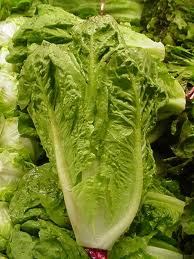
The U.S. Food and Drug Administration is releasing the findings of a sampling assignment that tested raw agricultural commodity romaine lettuce mostly at facilities and on farms in the Salinas, California, and Yuma, Arizona growing regions for the presence of pathogens that have been linked to outbreaks of foodborne illness.

The assignment to detect pathogenic Escherichia coli (specifically, Shiga toxin-producing E. coli or STEC) and Salmonella spp began in November 2019 and ended in December 2020, after a pause in sample collection and testing from March through October 2020 due to the COVID-19 pandemic. The FDA did not detect any pathogens during the assignment.

The agency prioritized sample collection at farms and FDA-registered facilities identified in traceback investigations as suppliers of romaine lettuce possibly linked or linked to outbreaks of foodborne illnesses from 2017 to 2019.   The FDA collected and tested 279 samples for both pathogens. Each sample was made up of 10 subsamples, with each subsample consisting of one or more heads or hearts of romaine lettuce and weighing at least 300 grams. This approach – the collection and testing of samples composed of multiple subsamples – increases the probability of detecting pathogens if present, given that microbial hazards may not be uniformly present. Agency field staff collected all samples in their natural form but for the outer leaves having been removed. No fresh-cut lettuce was collected.

Ensuring the microbiological safety of leafy greens continues to be a priority to the FDA. Although no pathogens were detected during this assignment, maintaining surveillance during the growing/harvesting season is helpful to informing the agency’s leafy greens prevention efforts, specifically those outlined in the FDA’s  Leafy Greens Action Plan. The FDA originally released the action plan in March 2020 to foster a more urgent and collaborative approach to preventing leafy greens outbreaks caused by STEC.  In April 2021, the FDA released an updated version of the plan which reaffirms our commitment to advancing leafy greens safety.

For More Information

USA – FSIS Issues Public Health Alert for Frozen, Cooked Diced Poultry Products Due to Possible Listeria Contamination

FSIS USDA

FSIS Announcement

WASHINGTON, May 24, 2021 – The U.S. Department of Agriculture’s Food Safety and Inspection Service (FSIS) is issuing a public health alert for approximately 130,860 pounds of frozen fully cooked, diced chicken products because they may be contaminated with Listeria monocytogenes.

The frozen, fully cooked, diced chicken items were packed on Jan. 25, 2021, Jan. 26, 2021, March 23, 2021, and March 24, 2021. The following products are subject to the public health alert:

  • 4-lb. plastic bags containing “FULLY COOKED CHICKEN MEAT ¾ DICED WHITE” with code 13530, Est. number P-18237, and pack dates of “01/25/2021” and “01/26/2021.”
  • 4-lb. plastic bags containing “FULLY COOKED CHICKEN MEAT DARK/WHITE ¾ DICED” with code 16598, Est. number P-45638, and pack dates “24/MAR/2021” and “23/MAR/2021.”

The products bear establishment numbers “P-18237” or “P-45638” inside the USDA mark of inspection and were distributed by Big Daddy Foods, Inc., a Houston, Texas firm. These items were further distributed to consumers at local food banks in Florida through the USDA Farmers to Families Food Box program in individual food boxes. The products were distributed between Feb. 25, 2021 through March 1, 2021, and March 29, 2021 through April 8, 2021, at temporary locations.

The problem was discovered during routine FSIS inspection activities when inspection personnel observed products requiring recooking due to possible Lm contamination had been repackaged without being recooked. A subsequent FSIS investigation determined other affected product had been further distributed in commerce. There have been no confirmed reports of adverse reactions due to consumption of these products. Anyone concerned about an illness should contact a health care provider.

Consumption of food contaminated with L. monocytogenes can cause listeriosis, a serious infection that primarily affects older adults, persons with weakened immune systems, and pregnant women and their newborns. Less commonly, persons outside these risk groups are affected.

Listeriosis can cause fever, muscle aches, headache, stiff neck, confusion, loss of balance and convulsions sometimes preceded by diarrhea or other gastrointestinal symptoms. An invasive infection spreads beyond the gastrointestinal tract. In pregnant women, the infection can cause miscarriages, stillbirths, premature delivery or life-threatening infection of the newborn. In addition, serious and sometimes fatal infections can occur in older adults and persons with weakened immune systems. Listeriosis is treated with antibiotics. Persons in the higher-risk categories who experience flu-like symptoms within two months after eating contaminated food should seek medical care and tell the health care provider about eating the contaminated food.

Consumers who have received these products are urged not to consume them. These products should be thrown away.

FSIS advises all consumers to reheat ready-to-eat product until steaming hot.

Consumers with food safety questions can call the toll-free USDA Meat and Poultry Hotline at 1-888-MPHotline (1-888-674-6854) or live chat via Ask USDA from 10 a.m. to 6 p.m. (Eastern Time) Monday through Friday. Consumers can also browse food safety messages at Ask USDA or send a question via email to MPHotline@usda.gov . For consumers that need to report a problem with a meat, poultry, or egg product, the online Electronic Consumer Complaint Monitoring System can be accessed 24 hours a day at https://foodcomplaint.fsis.usda.gov/eCCF/.

Product Images

Company Information

ESTABLISHMENT ID
PROCESSING CATEGORY

Fully Cooked – Not Shelf Stable

Company Contact Information

COMPANY MEDIA CONTACT
Company Media Contact
FSIS Contact Information
MEDIA CONTACT
Congressional and Public Affairs
Maria Machuca

Europe – Salmonella sickens up to 200 across EU and UK

Food Safety News

Salm2

More than 200 people in 11 countries could be part of a Salmonella outbreak across Europe. Investigations to find the source of the Salmonella Braenderup infections are ongoing.

The European Centre for Disease Prevention and Control (ECDC) confirmed to Food Safety News that it was supporting countries in their investigations and following the incident closely with the European Food Safety Authority (EFSA).

The hardest hit country is the United Kingdom with 52 confirmed infections while France only has one confirmed patient. Denmark has 27 and Sweden 25 confirmed infections with the Netherlands recording 13 people sick.

Bahamas – Conch Alert After Cases Of Suspected Poisoning

Tribune 242

KSWFOODWORLD

FOOD safety officials are cautioning against the consumption of fresh conch after several suspected cases of conch poisoning.

Several reports of conch poisoning made the rounds on social media over the past few days before the Bahamas Agricultural Health and Food Safety Authority issued a statement yesterday.

The authority warned consumers to avoid fresh conch until officials are able to determine the source of the contamination.

Conch poisoning is typically caused by the bacterium, Vibrio parahaemolyticus, with contamination attributed to poor hygienic practices during its handling and preparation.

Health Minister Renward Wells said there had been about 10 reported cases of conch poisoning. He said the ministry was concerned that this has risen in recent days. He was unable yesterday to say where the cases originated.

Meanwhile, Bahamas Commercial Fishers Alliance President Adrian Laroda said he would not caution against eating conch because it could have implications on the industry. Instead, he urged handlers to wash the mollusk properly during preparation.