Category Archives: food bourne outbreak

Canada – 9 in hospital after restaurant Salmonella outbreak

Mississauga

Public health authorities say a Salmonella outbreak linked to a restaurant in southwestern Ontario has sent nine people to hospital.

Lambton County’s public health unit says there are 33 confirmed cases related to the outbreak at Barakat restaurant in Sarnia, Ont., while about 170 people say they have experienced symptoms.

Dr. Sudit Ranade, the health unit’s medical officer of health, says the owners have voluntarily closed the restaurant and are co-operating with the public health investigation.

Ranade says those who ate at Barakat restaurant between Oct. 21 and Oct. 29 and have symptoms of Salmonella infection should report the illness to Lambton Public Health.

Salmonella infection is a foodborne illness that spreads by ingesting food or water contaminated by feces or through contact with infected persons.

USA – Outbreak Investigation of Salmonella Stanley: Wood Ear Mushrooms – Dried Fungus (September 2020)

FDA

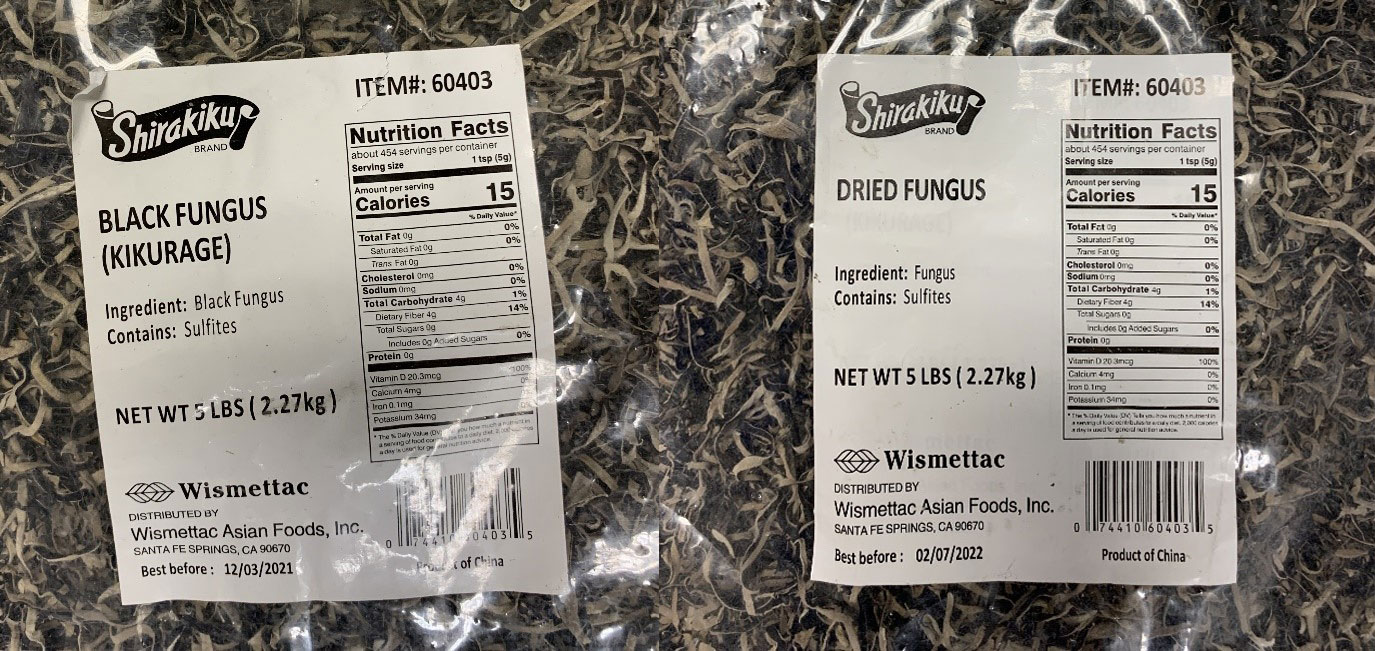
The FDA, along with CDC and state and local partners, investigated a multistate outbreak of Salmonella Stanley infections linked to wood ear mushrooms imported by Wismettac Asian Foods, Inc. of Santa Fe Springs, CA. Wood ear mushrooms are a dried mushroom, also commonly labelled or referred to as Kikurage, Dried Black Fungus, Dried Fungus, or Mu’er/Mu Er/Mu-Err.

Wismettac Asian Foods, Inc. acted quickly upon being notified of the positive test result and recalled all wood ear mushrooms within shelf life on September 23, 2020.

Recommendation

Wood ear mushrooms imported by Wismettac Asian Foods, Inc. were only sold to restaurants and were not available directly to consumers. Although these items have been recalled, restaurants that received recalled products should use extra vigilance in cleaning and sanitizing any surfaces that may have come in contact with the recalled product, to reduce the risk of cross contamination. All recalled product should be thrown out.


Investigation Update

November 4, 2020

As of November 4, 2020, the CDC declared that this outbreak is over.

General Food Safety Tips for Dried Mushrooms

Dried mushrooms, that have not been recalled due to potential contamination, should always be reconstituted using boiling water to kill any pathogens. This advice does not apply to recalled products, which should be thrown out.

Product Images

Outbreak Investigation of Salmonella Stanley in Wood Ear Mushrooms (September 2020) - Photos of Recalled Shirakiku Dried Fungus

Recall Information

On September 23, 2020, Wismettac Asian Foods, Inc. recalled Shirakiku brand imported dried fungus. This product was labeled as Shirakiku brand Black Fungus (Kikurage) with UPC Code 00074410604305, imported from China. Product was distributed in six packs of five-pound bags to restaurants in AR, CA, CO, CT, DE, DC, FL, GA, HI, IA, IL, IN, LA, MA, MD, MI, MN, MO, MS, NC, NV, NJ, NY, OH, OR, PA, SC, TN, TX, VA, WA, and WI.

Research – Characteristics of Norovirus Food Poisoning Outbreaks in Korea in the 2000s

Journal of Food Protection

Eurofins

Norovirus food poisoning outbreaks in Korea (South) appeared in 2000s and have been increasing since then. We aimed to investigate the epidemiological features of norovirus food poisoning outbreaks in Korea over the past years (2002 ~ 2017), based on official food poisoning statistics and available reports, and to find their association with climate factors. Norovirus was the most common cause of food poisoning among known causative substances in Korea during the study period. More than one-third of the incidents occurred in group meal-service facilities, including school lunch programs. A few of these facilities used groundwater contaminated with noroviruses to wash / cook food, which contributed to outbreaks. Norovirus occurrences showed strong seasonality; cold and relatively dry winter air may help norovirus to flourish. Both norovirus genotypes GI and GII infectious to humans were detected, with GII becoming more prevalent than GI. According to our correlation analysis in connection with climate factors, average temperatures, the highest and lowest temperatures, precipitation, the number of rain days, and humidity showed a significant negative correlation with a monthly norovirus occurrence (p < 0.05). The lowest temperature and average temperature had higher coefficients of correlation, -0.377 and -0.376, respectively. The norovirus outbreaks in Korea showed complex etiological characteristics, although it more prevailed in wintertime, and are now considered as a major public health problem. The use of groundwater in group meal-service settings has a public health impact as well as norovirus concern, therefore groundwater used in food service facilities / business should be treated for safety.

Canada – Ontario: Salmonella outbreak linked to the Barakat restaurant in Sarnia

Outbreak News Today

In the city of Sarnia in Southwestern Ontario, Canada, officials with Lambton Public Health (LPH) report investigating an outbreak of Salmonella infection in people who recently ate at the Barakat restaurant.

As of Friday, LPH has received laboratory confirmation of four cases related to this outbreak. The department is currently following up with several others who have reported becoming ill after eating at this restaurant.

The investigation into the source of this outbreak is ongoing. The owners of the restaurant are cooperating with Lambton Public Health and have voluntarily closed while LPH ensures there is no on-going risk of illness.

Members of the public who ate at the Barakat restaurant between October 21st and October 29th and became ill with symptoms of Salmonella infection (diarrhea, fever, stomach cramps, vomiting) are advised to:

  • Report the illness to Lambton Public Health at 519-383-8331 or toll free 1-800-667-1839
  • Contact their health care provider as needed if symptomatic

USA – Mystery surrounds two new E. coli outbreaks with genetic links to past Romaine events

Food Safety News

With Halloween only hours away,  two new E. coli outbreaks have shown up to haunt the nation’s Romaine growers because genetic links to the past have been discovered.

The two outbreaks of Shiga toxin-producing E. coli O157: H7 (STEC) illnesses are under investigation by the Food and Drug Administration (FDA), Centers for Disease Control, and Prevention (CDC), along with various state and local health departments.

“We do not know what food is causing people to get sick or whether it involves an FDA-regulated food product,” said  Frank Yiannas, FDA Deputy Commissioner for Food Policy and Response.  “However, we have seen similar recurring, emerging, or persistent strains of E. coli in recent outbreaks. E. coli O157: H7 can contaminate many foods, and we cannot assume that the current outbreaks are linked to historically associated foods like romaine and other leafy greens. There is no information currently to indicate that people should avoid any specific food.”

USA – Most Listeria Cases Are in Massachusetts in Deli Meat Listeria Outbreak

Food Poisoning Bulletin

Most Listeria cases are in Massachusetts in the deli meat Listeria monocytogenes outbreak announced last week by the Centers for Disease Control and Prevention (CDC). All ten patients have been hospitalized, and one person, who  lived in Florida, has died.

Research – UK hit hardest by outbreak linked to Brazil nuts; no cases in U.S. yet

Food Safety News

More than 120 people are part of a multi-country Salmonella outbreak linked to Brazil nuts.

Since August 2019, the outbreak, caused by Salmonella Typhimurium and Salmonella Anatum, has affected three European Union countries, the United Kingdom and Canada. The United States was one of more than 30 countries that received Brazil nuts from Bolivia contaminated with Salmonella.

In total, 123 cases of Salmonella Typhimurium have been reported, of which 105 were in the UK, 14 in France, three in Luxembourg and one each in the Netherlands and Canada. One Salmonella Anatum patient was recorded in the UK.

A case-control study in the UK and patient interviews in the UK, France and Luxembourg indicated Brazil nuts and nut bars as likely vehicles of infections. Two batches of Brazil nuts from Bolivia tested positive for Salmonella Typhimurium and Salmonella Anatum matching the outbreak strains.

USA – Salmonella Paratyphi B outbreak linked to Woodbury, Minnesota juice bar

Outbreak News Today

Food Poisoning Salmonella

Minnesota health officials report investigating an outbreak of salmonellosis associated with NéktƏr Juice Bar in Woodbury. Nine Minnesotans so far have been sickened with a specific variant of Salmonella Paratyphi B infections.

The nine cases identified as part of this outbreak range in age from 20 to 82 years, but with a median age of 26. The cases became ill between Aug. 27 and Sept. 21. Two cases have been hospitalized; all are recovering. All of the cases live in or visited East metro counties.

UK – Nearly 400 people sick from Salmonella in UK; nearly half are children.

Food Safety News

Almost 400 people have fallen ill with Salmonella since the start of the year in the United Kingdom after eating frozen chicken products.

The Food Standards Agency (FSA) and Public Health England (PHE) are investigating a rise in patients with two strains of Salmonella Enteritidis linked to frozen raw breaded processed chicken products.

Cases of Salmonella linked to raw breaded chicken products have been identified in previous years, however there has been an increase in 2020.

There have been 327 people sick in England, 32 in Scotland, 26 in Wales and five in Northern Ireland.

USA – Outbreak Investigation of Salmonella Enteritidis: Peaches (August 2020)

FDA

The FDA, along with CDC, Canadian, state and local partners, has been investigating a multistate outbreak of Salmonella Enteritidis infections linked to peaches packed or supplied by Prima Wawona or Wawona Packing Company.

The multistate outbreak of Salmonella Enteritidis infections linked to peaches from Prima Wawona that were sold in several regions of the United States and Canada, investigated by the FDA, along with CDC and Canadian, state, and local partners, is over. As of October 15, 2020, CDC reported a total of 101 cases across 17 states. This outbreak resulted in recalls of bagged and bulk, or loose, peaches packed or distributed by Prima Wawona. FDA also worked to publicly disclose international distribution of recalled product from Prima Wawona in an effort to facilitate the swift removal of all potentially affected product from the international market. More information about international distribution of the recalled product can be found in the previously published table below. FDA’s traceback investigation, which included 18 cases across eight states, identified multiple distributors, packing facilities, and orchards that supplied peaches during the time period of interest. Investigators from FDA, the California Department of Public Health (CDPH) and the California Department of Food and Agriculture (CDFA) visited Wawona packing facilities and/or orchards that likely supplied peaches to Prima Wawona during the timeframe of interest. FDA’s traceback investigation is ongoing; however, the cause and source of the outbreak has not yet been determined.

Thus far, in an effort to investigate several possible pathways of contamination, FDA has completed over 570 product and environmental sample analyses from multiple facility locations and/or peach orchards, including environmental swabs, peaches and peach tree leaf samples. At this time, sample collection and analysis is underway related to additional peach orchards. A genetic match to the outbreak strain has yet to be identified in any of the samples collected, although a different serotype of Salmonella was detected in one sample collected and analyzed during the investigation. No peaches linked to the positive sample ever reached the marketplace. Although the outbreak is being declared over, FDA will continue its investigation and will communicate any findings that could assist future prevention efforts.

Available recall information is included below.

Recommendation

On August 22, 2020, Prima Wawona recalled bagged and bulk, or loose, peaches that they supplied to retailers nationwide.

The recalled products are now well beyond expiration and likely no longer on the market or in consumers’ homes. However, consumers who may have frozen the recalled bagged peaches packed or supplied by Prima Wawona from June 1, 2020 to August 19, 2020 or the recalled loose/bulk peaches packed or supplied by Prima Wawona from June 1, 2020 to August 3, 2020 should throw them away.