Category Archives: food bourne outbreak

Norway – Yersinia outbreak in Norway linked to salad

Food Safety News

Yersinia p

A Yersinia outbreak in Norway has been solved and declared over just days after it was announced.

Folkehelseinstituttet (the Norwegian Institute of Public Health) said the national outbreak of Yersinia enterocolitica O3 was likely caused by a pre-mixed salad product.

Less than a week earlier, the agency had announced an investigation into a recent rise in Yersinia infections.

The outbreak started in mid-November and involved 10 confirmed patients. All of them are women aged 11 to 59 years old who became ill in mid to late November with the last case on Nov. 26. Three people live in Viken, two each in Oslo, Innlandet, and Vestland, and one in Telemark and Vestfold.

USA – New Salmonella Potsdam Outbreak Announced by FDA

Food Poisoning Bulletin

FDA’s CORE Response Teams have published information about food poisoning outbreaks for the last month or so on their CORE Investigation Table. This table lists recent outbreaks caused by E. coli, Salmonella, Listeria monocytogenes, Campylobacter, and other pathogens. This table sometimes links to actionable steps for consumers to take, but may not. At this time, there is no information about the potential food source for the new Salmonella Potsdam outbreak.

RASFF Alert – Foodborne Outbreak – Salmonella – Courgettes

European Food Alerts

RASFF

foodborne outbreak suspected to be caused by Salmonella enterica ser. Kedougou in courgettes from the Netherlands and Spain in Finland

USA – Investigations of Foodborne Illness Outbreaks Update

FDA

The link above is a list of outbreak investigations being managed by FDA’s CORE Response Teams. The investigations are in a variety of stages, meaning that some outbreaks have limited information, and others may be near completion.

public health advisory will be issued for outbreak investigations that have resulted in specific, actionable steps for consumers to take to protect themselves. Please direct your attention to those pages for the most up to date information on the investigation and for consumer protection information.

USA – Outbreak Investigation of E. coli – Leafy Greens (December 2020) – CDC declares outbreak over, FDA investigation ongoing

FDA

The FDA, along with CDC and state and local partners, investigated a multistate outbreak of E. coli O157:H7 infections in the fall of 2020. The epidemiology and traceback investigation have determined that the outbreak was linked to leafy greens. The epidemiological and traceback investigations were not able to determine a specific type of leafy green linked to illnesses. On 12/22/2020, the CDC announced that this outbreak appears to be over. This outbreak, announced by FDA and CDC on October 28, 2020, was caused by a strain of E. coli that is genetically related to a strain linked to the fall 2019 romaine outbreak.

The FDA completed a traceback investigation of multiple types of leafy greens identified in patient interviews. Although no single ranch was identified as a common source of the leafy greens, FDA and state partners also conducted on-site investigations on farms of interest. 

Teams were deployed to dozens of ranches in the region to conduct large scale environmental sampling. Additionally, no Shiga toxin-producing E. coli were found on leafy greens. 

At this time, FDA’s investigational activities, including sample analysis are ongoing. A detailed report of FDA’s findings in the investigation will be released in early 2021, following the conclusion of investigational activities.

Recommendation

CDC has declared this outbreak to be over. There is no recommendation for consumers, retailers, or suppliers.


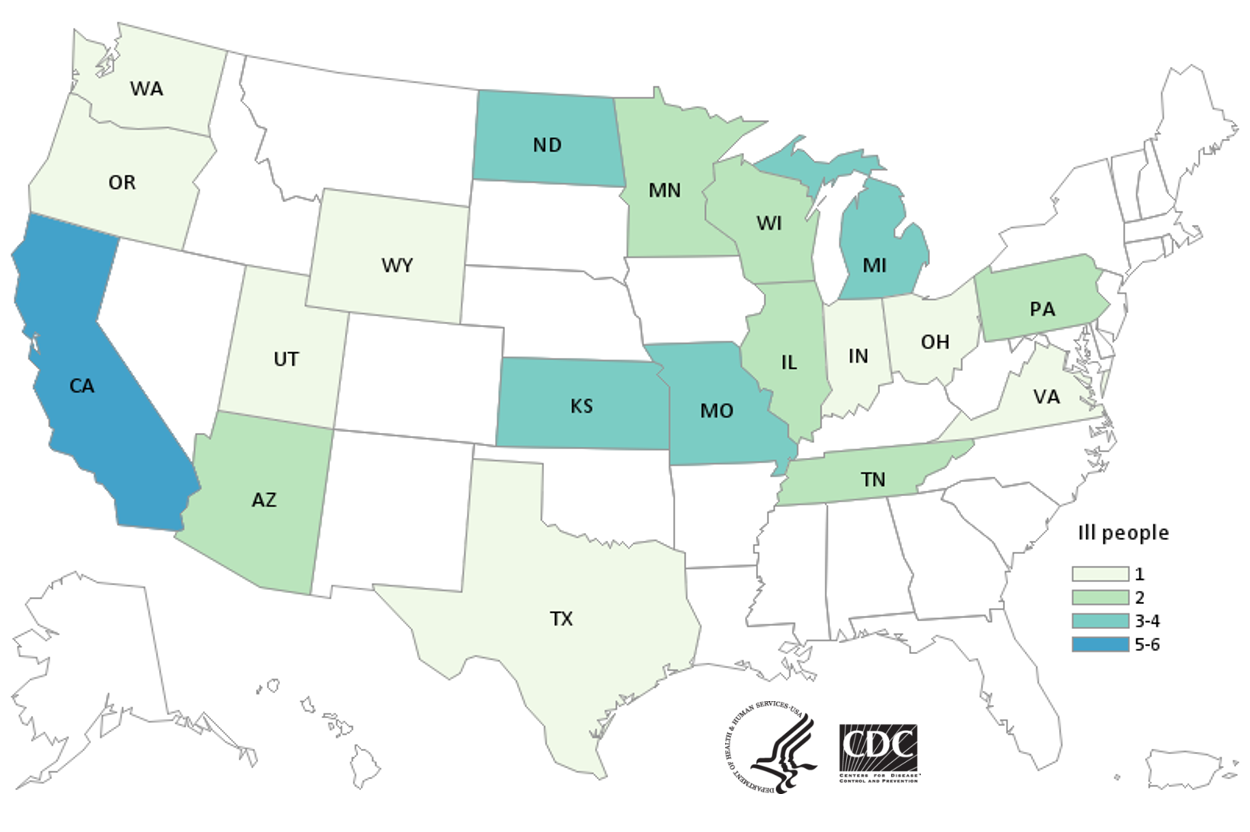
Case Count Map Provided by CDC

Outbreak Investigation of of E. coli in Leafy Greens (December 2020) - Case Count Map from CDC 12/22/2020

Case Counts

Total Illnesses: 40
Hospitalizations: 20 (4 Cases HUS)
Deaths: 0
Last Illness Onset Date: October 31, 2020
States with Cases: AZ (2), CA (6), IL (2), IN (1), KS (4), MI (3), MN (2), MO (3), ND (4), OH (1), OR (1), PA (2), TN (2), TX (1), UT (1), VA (1), WA (1), WI (2), WY (1)
*States with confirmed distribution; product could have been distributed further

Useful Links

Denmark – Disease outbreaks with rare microsporidia – Enterocytozoon bieneusi.

SSI

The Statens Serum Institut and the Danish Veterinary and Food Administration are currently investigating a disease outbreak in a company with a microorganism that has so far not been registered as a cause of disease outbreaks in Denmark. It is a species of microsporidia, Enterocytozoon bieneusi. It is believed that the infection occurred through food.

In October, a company in the metropolitan area reported more than 70 cases of diarrhea among their employees.

The Statens Serum Institut (SSI) has so far found samples from 11 people positive for Enterocytozoon bieneusi, which is a species of microsporidia. It is not a microorganism that we often detect in Denmark, and we have not previously seen disease outbreaks with it.

The infection can cause severe and prolonged diarrhea, abdominal pain and nausea. In addition, there may be symptoms such as fever, headache, muscle aches and fatigue (flu-like). The infection occurs from feces from infected people with poor hygiene to other people either directly or through food and drink.

“There are no registered persons outside the company who should have been infected with E. bieneus. But we urge the country’s physicians to pay attention to patients with prolonged diarrhea for no apparent reason. Especially if it is about immunocompromised people and with particularly long-lasting symptoms, ”says ward doctor Lasse Skafte Vestergaard, SSI. Read more about the disease outbreak with microsporidia  (EPI-NEWS – week 52a – 2020)

Diagrams of Enterocytozoon bieneusi Spore, Life Cycle, and Possible... |  Download Scientific Diagram

Microsporidia are protozoan parasites belonging to the phylum Microsporidia within which exist over 1000 species classified into approximately 100 genera. These eukaryotic obligate intracellular protozoans have been described infecting every major animal group, especially insects, fish, and mammals (Wittner 1999). Microsporidia have been increasingly recognized as opportunistic pathogens of immunodeficient patients (Weber et al. 1994), especially in Aids patients but it is also becoming increasingly common in immunocompetent individuals (Gainzarain et al. 1998, Lores et al. 2001).

Although during the last decade numerous data related to the epidemiology of this infection in humans and animals have been accumulated, implying a zoonotic nature of these parasites, direct evidence of transmission from animals to humans are still lacking (Deplazes et al. 2000).

Encephalitozoon cuniculi is probably the most extensively studied mammalian microsporidian and has been reported to infect a wide range of hosts, including common laboratory rodents as well as human and non-human primates. This is the first microsporidian species infecting humans that has been considered a zoonosis (Deplazes et al. 1996, Didier et al. 1996) .

The first identification of E. intestinalis in mammals other than humans was reported by Bornay et al. (1998) in the faeces of donkeys, dogs, pigs, cow, and goat suggesting that E. intestinalis might also be of zoonotic origin.

Enterocytozoon bieneusi is the most frequent microsporidian found in humans, especially in Aids patients. It has been associated mainly with chronic diarrhoea, although it has been diagnosed in patients with other forms of immunosuppression and in immunocompetent travellers with self-limited diarrhoea (Weber & Bryan 1994, Sobottka et al. 1995). In addition, this pathogen has recently been detected in other natural hosts such as pigs (Deplazes et al. 1996, Breitenmoser et al. 1999, Rinder et al. 2000), cows, goats, pigs, chickens, cats, turkeys (Bornay et al. 1998), rabbits, dogs (del Aguila et al. 1999), and in simian immunodeficiency virus-inoculated monkeys (Tzipori et al. 1997, Mansfield et al. 1997). Consequently, this microsporidian infection may be more common than previously suspected.

Belgium – Norovirus outbreak reported at Belgian school; raw vegetables blamed

Food Safety News

Food Borne Illness - Norovirus -CDC Photo

More than 150 students and staff at a school in Belgium fell ill during an outbreak of norovirus earlier this month, according to information recently released.

The Federal Agency for the Safety of the Food Chain (FASFC) reported the food poisoning at the Atheneum Pegasus school in the city of Ostend was caused by crudités, which are mixed raw vegetables.

The FASFC, known in French as AFSCA and Dutch as FAVV, was informed in early December about the incident and started investigating with Zorg en Gezondheid (The Agency for Care and Health), and Sciensano, the national reference laboratory, to determine the source of contamination.

A total of 71 students and some staff were absent on one day and complained of vomiting, abdominal pain and fever.

New Zealand – Clean, cook and chill to decrease risk of food poisoning

RNZ

As the festive season kicks off, people are being reminded of the increased risk of food poisoning at home.

The Ministry for Primary Industries has launched a food safety campaign reminding everyone to “Clean Cook, and Chill”.

Food Safety Minister Dr Ayesha Verrall said with rising summer temperatures, the risk of food poisoning increased.

“Food poisoning is a significant issue in New Zealand with an estimated 100,000 people getting sick from unsafe food handling practices at home.

“That’s why the Ministry for Primary Industries is launching an awareness campaign, reminding consumers to follow the 3 C’s: clean, cook and chill, when handling, cooking and storing raw meats such as poultry, to avoid getting sick and paying the price,” she said.

MPI has also teamed up with MasterChef winning sisters Karena and Kasey Bird to offer additional advice and helpful cooking tips on social media this summer.

Verrall said a recent study found that most New Zealanders don’t believe that food poisoning can be deadly or create long-term health consequences.

She said while for many, food poisoning will just mean a few days of an upset stomach, for others it can be more serious.

“Some people can and do experience more severe forms of foodborne illnesses as a result of picking up harmful bacteria and viruses like Campylobacter, Norovirus, Salmonella, Listeria, Escherichia coli (E. coli) and Bacillus cereus.

“This is especially true for young tamariki, our elderly community, pregnant mothers and Kiwis who suffer from other health issues,” she said.

Norway – Yersinia enterocolitica outbreak reported in Norway

Outbreak News Today

Yersinia p

The Norwegian Institute of Public Health has discovered an increased incidence of the gastrointestinal bacterium Yersinia enterocolitica O3. So far, infection has been detected in 10 people who live in several counties. Outbreak investigation has been initiated in collaboration with relevant municipal chief physicians, the Veterinary Institute and the Norwegian Food Safety Authority.

The National Institute of Public Health collaborates with the municipal health service, the Norwegian Food Safety Authority and the Norwegian Veterinary Institute to map whether patients can have a common source of infection. The patients are interviewed and the local Norwegian Food Safety Authority takes samples from food products in the homes of those who are infected, if residues are available, in order to identify the source of the outbreak if possible.

USA – Outbreak Investigation of E. coli O157:H7: Unknown Food (Fall 2020)

FDA

The FDA and CDC, in collaboration with state and local partners, have completed the investigation on two of three multistate outbreak of E. coli O157:H7 infections in the U.S. this fall.

One of these investigations, Outbreak Unknown Source 3, identified 18 reported illnesses in nine states: California, Colorado, Illinois, Michigan, New York, Ohio, Pennsylvania, Virginia, Washington.

FDA completed a traceback investigation of several potential food vehicles identified in patient interviews and although no single farm was identified as a common source of the outbreak, FDA and state partners also conducted on-site investigations on farms of interest. However, information and samples collected in these inspections did not link these farms to the outbreak. The investigation of a farm does not mean that the farm is linked to an outbreak. The results of an investigation into a farm may well lead to that firm being ruled out of the investigation. On 12/18/2020, the CDC announced that this outbreak had ended.

The other completed outbreak investigation, Outbreak Unknown Source 1, identified 32 reported illnesses in 12 states: California, Illinois, Louisiana, Maryland, Michigan, Montana, New Jersey, Ohio, Utah, Virginia, Washington, Wisconsin. This strain of E. coli is genetically similar to a strain linked to a romaine outbreak that occurred in the spring of 2018, though a food was not linked to the current outbreak. FDA completed a traceback investigation and was unable to determine a common source of the outbreak. FDA and state partners also conducted on-site inspections on farms of interest, though information collected in these inspections did not link these farms to the outbreak. On 12/18/2020, the CDC announced that this outbreak had ended.

Investigations of a third E. coli outbreak of Unknown Source 2 continue.

Recommendation

Consumers, restaurants, and retailers, were advised not to eat, sell, or serve recalled Tanimura & Antle, Inc. brand packaged single head romaine lettuce with a pack date of 10/15/2020 or 10/16/2020.

The recalled products are now well beyond expiration and likely no longer on the market or in consumers’ homes.